Showing Insurance to Buy a Forest Permit
A permit for riding in the Allegheny National Forest is not a substitute for insurance, and you may need to show proof of coverage when you apply. The tricky part is knowing which document to bring and whether it matches the machine you plan to ride. Here’s how to prepare, what to check on your insurance card, and what to do if the paperwork is incomplete.
Why insurance proof matters for an Allegheny Forest permit
The Allegheny National Forest has its own ATV permit requirements for riding on designated routes in the forest. The permit is separate from Pennsylvania ATV registration and insurance. Having one does not automatically satisfy the requirements for the others.
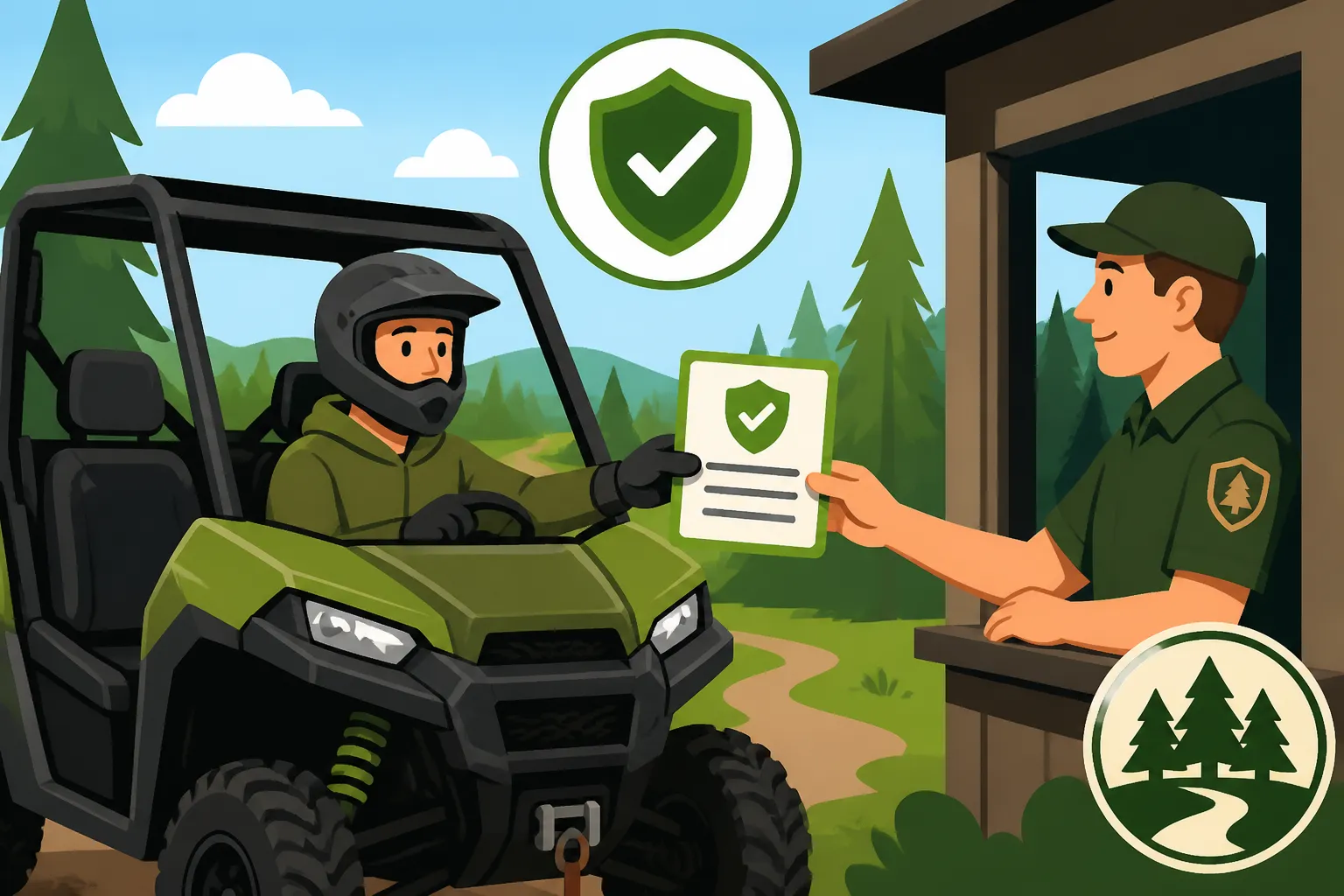
As part of applying for the forest permit, riders may be asked to show proof of current registration and liability insurance. The details can depend on the permit process and the machine, so confirm the current document requirements with the permit issuer before you go. What the Allegheny Permit Requires You to Show
Pennsylvania’s insurance rules are another reason not to treat a permit as proof of coverage. State requirements apply to riding beyond your own land, while the forest permit governs access to the designated routes it covers. Read Pennsylvania ATV Registration and Insurance Proof for how registration and insurance documents serve different purposes.
A permit does not insure your ATV, cover damage to someone else’s property, or replace an insurance policy’s terms. Nor does it grant permission to ride wherever you find a forest road. Check that the route is open to ATVs and covered by the permit before setting out. What the $35 Allegheny Forest ATV Permit Covers explains the permit’s role, while Pennsylvania Rules for Riding a National Forest covers the broader riding rules.
Insurance proof is also a practical safeguard at the application stage. If the insurer’s document is expired, hard to read, or clearly tied to a different machine, an issuer may not be able to verify what you are showing. Preparing the paperwork in advance can prevent a trip to an office or vendor from ending with an incomplete application.
What to bring and check before applying
The goal is to show that the machine you intend to ride is covered by a current policy that meets the permit’s insurance requirement. Before applying, gather your documents and compare the details rather than assuming one card covers every machine in your household.
Bring a current proof-of-insurance document
A current insurance identification card is the usual starting point. Depending on how your insurer provides documents, proof may also be available through its website or mobile app. If you use a digital copy, make sure it is accessible at the application location and that the relevant details can be read clearly. When in doubt, bring a paper copy as a backup.
Look for the following information:
- The insurer’s name and contact details
- The policy number or other identifying information
- The policy’s effective dates
- The named insured
- A description or identification number for the covered ATV or UTV, if shown
The document should let the permit issuer verify that coverage is current and applies to the machine. If your card lists a VIN, compare it with the VIN on the ATV. If your insurer does not display the VIN on the card, bring another policy document or contact the insurer to ask how to verify that the machine is covered.
For a closer look at the state-level requirement, see Pennsylvania ATV Insurance Requirement and Pennsylvania ATV Insurance Minimum Coverage. Do not assume that a proof card alone tells you every detail of the policy. Confirm with your insurer that the coverage applies to the way you plan to use the machine.
Bring registration proof too
Insurance documents do not prove that the ATV is registered. Keep registration paperwork separate and bring the current document the permit issuer asks to see. Confirm that the registration is valid and that its machine details are consistent with the insurance information.
If you are unsure which registration document to bring, Showing Registration to Buy a Forest Permit covers that part of the process. For general Pennsylvania registration rules, see Registering an ATV in Pennsylvania.
| Document | What it helps verify | What it does not replace |
|---|---|---|
| Proof of insurance | That a policy is in effect for the machine or insured rider, as applicable | ATV registration or the forest permit |
| Registration document | That the machine has the required registration | Insurance or permission to ride a particular route |
| Forest permit | That the machine or rider has the required forest access authorization | State registration, insurance, or permission to use closed or unauthorized routes |
Check the permit application instructions for any additional paperwork. Requirements can differ from the documents riders commonly carry on a trail, and a wallet card you already have may not answer every question the application asks.
If your policy or documents do not match the machine
A mismatch does not necessarily mean the ATV is uninsured, but it can make verification difficult. Sort it out with the insurer before applying rather than relying on an assumption at the counter.
Several machines are on one policy
A family or multi-vehicle policy may cover more than one ATV or UTV. Check whether the proof document identifies each machine or whether the insurer provides a separate schedule or coverage document. Bring the supporting paperwork for the specific machine you intend to use.
Do not assume a policy covering one quad extends to another machine just because the same person owns both. Ask the insurer to confirm coverage for each ATV or UTV and request documentation that makes the answer easy to verify.
The policy is in someone else’s name
If you borrow a machine, or if a family member is the named insured, check with both the insurer and the permit issuer. The insurance policy may cover the machine even when the rider is not the named policyholder, but the application may still require the applicant to show documents in a particular way. Do not rely on a verbal assurance from the owner if the permit issuer needs evidence.
For a borrowed ATV, bring the owner’s current proof of insurance and registration, and ask in advance whether the permit can be issued for that machine under the circumstances. The same check is useful if ownership has recently changed and the insurance card has not yet been updated.
The machine was just bought or the policy just changed
A bill of sale is not proof of insurance. If you bought the ATV recently, contact the insurer to make sure the new machine is added to the policy and ask for updated proof. If the VIN is still being corrected or the new card has not arrived, ask the insurer what official temporary documentation it can provide, then confirm with the permit issuer whether that document will be accepted.
Similarly, do not assume an old insurance card remains valid after a policy cancellation, expiration, or change in coverage. Check the dates and the current policy status directly with the insurer.
You have liability-only coverage
Liability coverage and physical-damage coverage are not the same thing. Liability coverage generally concerns covered injury or damage you cause to others, while collision or comprehensive coverage may address damage to your own machine under specified circumstances. A permit requirement for liability insurance does not mean your ATV is protected against every loss.
If you are unclear about what your policy covers, ask the insurer rather than inferring coverage from the word “insured” on a card. Finding an Insurance Policy That Covers Off-Road Use can help frame the questions to ask, including whether the policy covers off-road riding and the activities you plan to do.
A practical application checklist
Use this checklist before heading to the office, vendor, or other permit application channel. The exact process can change, so verify the current instructions with the official permit source before relying on a past season’s information.
- Confirm the permit applies to your planned ride. Check that the routes you want to use are covered and open to ATVs. A forest permit does not provide blanket access to every road or trail.
- Check the machine’s registration. Make sure the registration is current and bring the requested proof. If you are still sorting out registration, see What the Allegheny Permit Requires You to Show.
- Check insurance dates and machine details. Confirm that the policy is active and that it covers the ATV or UTV you will ride.
- Ask about any mismatch before applying. If the card does not list the VIN, the policy is in someone else’s name, or the machine was recently purchased, contact the insurer and permit issuer.
- Bring a readable copy. Use a paper card or an accessible digital document. A screenshot that cuts off dates or policy information may not be useful.
- Keep the proof available while riding. The documents needed to apply are not necessarily the only ones you may need during a ride. Follow the permit and forest rules about carrying proof.
Once your permit is issued, keep its documentation together with your registration and insurance proof. A waterproof wallet or document holder can help protect paper cards from rain and mud; options are available from outdoor retailers and Amazon. Keep copies somewhere separate from the original documents when practical, but do not treat a photo or copy as a substitute where an official document is required.
For details about where the permit is available, see Where to Buy an Allegheny Forest ATV Permit. If your main question is what to expect on the trails after you have the paperwork, Riding Marienville on a Forest Permit and Allegheny Forest Season Dates are useful next steps.
If a permit application is delayed because a document cannot be verified, ask what specific proof is missing. It may be a need for a current card, a clearer machine identification, or confirmation that the policy applies to that ATV. Resolve the issue with the insurer or issuer rather than trying to ride while assuming the application or insurance requirement has been satisfied.
Disclaimer
This article is for general informational purposes only and does not constitute professional advice. Laws, prices and regulations vary by location and change over time. Consult a qualified professional for guidance on your specific situation.