Where to Ride an ATV in Pennsylvania
Finding a legal place to ride in Pennsylvania can be harder than loading the trailer: trail access changes by season, landowner, machine size, and permit rules. This guide explains where ATVs and UTVs can ride, how public trails differ from private parks, and what to check before you set out so you do not arrive at a closed gate or the wrong trailhead.
How ATV riding areas in Pennsylvania are organized
Start by identifying who manages the land
Pennsylvania riding areas generally fall into three categories: designated routes on state forest land, designated routes in the Allegheny National Forest, and privately operated parks or trail systems. Each category can have its own access rules, season, permits, machine limits, and closures. A route that is open on one side of a forest boundary may not be open on the other.
That distinction matters when planning a weekend. A state forest route may require a specific state trail permit, while a trail in the Allegheny National Forest has a separate permit system. A private park sets its own admission and operating rules. Ordinary registration is not a substitute for any trail permit that applies to the land you are riding.
Roads are a separate issue. An ATV registration or trail permit does not give you general permission to ride on public roads, forest roads, or roads connecting trail systems. Road use is limited to routes specifically opened for ATV use and is governed by separate rules. For more on the boundaries between public-road access and trail riding, see Pennsylvania ATV Trail Access Rules — but confirm the specific route with the land manager before relying on it.
Choose a riding area that fits your machine and experience
Not every trail is a good match for every machine. A narrow, rocky route that feels manageable on a compact quad may be a poor fit for a wide side-by-side. State forest trail systems can have vehicle-width or other equipment restrictions; private parks may have different rules or designated areas for larger rigs. Check the rules for the exact trail or park rather than assuming that a UTV can follow any ATV route.
Be realistic about your group’s comfort level, too. A newer rider may prefer a park with a clear trail map, easier loops, and room to stop safely. Experienced riders may enjoy rougher terrain, but technical rock, steep grades, mud, and tight turns can still turn a casual ride into a recovery job. If children or beginners are coming, ask about age rules, supervision requirements, and beginner-friendly routes before traveling.
A useful starting point is to map the riding areas by management type, then compare the machine and rules against your plans. The statewide overview Pennsylvania's 908 Miles of ATV Riding Statewide gives a sense of the public riding network, but it does not mean every mile is open at the same time or to every vehicle.
| Riding area type | What it can offer | What to check before you go |
|---|---|---|
| State forest trail system | Designated public routes through forest terrain | Permit rules, season dates, machine limits, closures, and trailhead access |
| Allegheny National Forest | Designated routes in a national forest setting | Separate forest permit, operating dates, route status, and vehicle eligibility |
| Private riding park | Managed riding areas with park-specific access | Admission process, hours, machine rules, age requirements, and current conditions |
| Public road | Only certain roads may be designated for ATV use | Posted signs, local rules, legal crossing points, registration, insurance, and rider requirements |
Public riding in Pennsylvania state forests
Northcentral routes and the regional permit area
Pennsylvania’s northcentral riding opportunities include routes in Clinton, Lycoming, Potter, and Tioga counties. This is a useful region to consider if you want to combine a forest ride with a visit to communities such as Renovo, Coudersport, or Wellsboro. Named areas in the region include Whiskey Springs, Bloody Skillet, the Potter County Trail, Haneyville, and East Kettle. Each has its own access points and character, so plan around the specific system rather than treating the whole region as one continuous trail.
Some state forest trails in this region are covered by the Northcentral Regional Trail Permit. The permit is distinct from vehicle registration, and having one does not automatically open every nearby road or trail. Start with Pennsylvania's Northcentral Regional Trail Permit to understand the permit area, then use the managing agency’s current information to confirm which trails are open and what proof you need to carry.
The northcentral region is large, and a route that looks close on a map may still involve a long drive between trailheads. Before you leave, identify the correct staging lot, check whether trailers can be parked there, and estimate fuel needs for the whole group. If someone in your party is riding a wide side-by-side, verify eligibility for the exact route rather than relying on a general statement about Pennsylvania trails.
Other state forest systems and trail personalities
State forest riding areas are spread across several parts of Pennsylvania, including the Michaux, Buchanan, Bald Eagle, Tiadaghton, Susquehannock, and Sproul forest regions. Examples include Big Flat and Pine Grove in Michaux, Martin Hill in Buchanan, East Kettle in Bald Eagle, and routes around Haneyville in Tiadaghton. These are not interchangeable destinations: access roads, nearby services, terrain, and trail layouts vary.
The best choice often depends on the ride you want. A group seeking a day of varied forest riding may prefer a system with multiple loops and staging options. Someone towing a large trailer may care more about the entrance road and parking than the trail length. If you are taking a stock machine into rocky terrain, consider whether your tires, ground clearance, and recovery equipment suit the route.
Use official maps and notices to pin down the trail network before choosing lodging or a meeting point. Pennsylvania Trail Maps From DCNR can help with orientation, but a map is not a guarantee that every line is open on the day you arrive. For a route-by-route overview, Pennsylvania's Free State Forest Trails is also a helpful topic to explore; confirm permit conditions and current access separately.
Riding in the Allegheny National Forest
What to know about the forest trail system
The Allegheny National Forest in northwestern Pennsylvania offers designated motorized routes in a forest setting, with riding areas associated with places such as Marienville, Timberline, Penoke, and Rocky Gap. The trails can appeal to riders looking for a longer outing among forest roads and wooded terrain, but you still need to stay on routes open to your vehicle. A forest road is not automatically an ATV trail just because it appears on a map or looks rideable.
The Allegheny National Forest uses its own permit system, separate from state forest permits and vehicle registration. Read Pennsylvania's Allegheny National Forest Permit before planning a visit. Check what documentation is needed, where the permit applies, and whether the route you have in mind is open to your specific machine.
The area’s scale can make preparation especially important. Cell service may be limited, trail junctions can be confusing, and weather or maintenance work can change access. Bring a map that you can use without relying on a constant data connection, and tell someone where you plan to ride. Set a turnaround point and keep enough fuel and daylight for the return leg rather than assuming a loop will take a predictable amount of time.
Matching a route to conditions and group needs
The same trail can ride very differently after rain, during dry weather, or after maintenance. A damp rocky section may be manageable for an experienced rider but stressful for a beginner. A muddy low spot can slow a group and increase the chance of needing a winch or tow. Before setting out, look for current notices and recent condition information, and be willing to change plans if the route is deteriorating.
Think about the group’s pace as well as its ability. If riders have different experience levels, agree on a lead rider and a sweep rider, choose a reasonable regrouping plan, and make sure everyone understands what to do if they become separated. A ride that feels short on a map can take much longer when people stop, negotiate rough sections, or help a machine through a difficult spot.
A route plan should include more than the trail name. Note the access point, parking location, permit requirements, fuel plan, expected riding time, and a backup route. For broader preparation advice, Pennsylvania Trail Conditions Before You Go is a useful reminder to check conditions rather than relying on last season’s experience.
Private ATV parks and managed riding areas
Why a private park can suit some riders
Private parks can be a practical option when you want a defined riding destination with park-specific rules, access procedures, and a managed trail network. The Anthracite Outdoor Adventure Area, commonly called AOAA, is in the Coal Township area of Northumberland County. Rock Run Recreation Area is in Cambria County near Patton. Other private riding venues operate under their own rules, so confirm current offerings directly with the property.
A park may be a better fit for a first outing, a mixed-experience group, or riders who want to know where to check in and where they may ride. That does not mean every park is easy or suitable for every machine. Parks can include demanding terrain, and machine eligibility, age requirements, passenger rules, and protective equipment expectations can differ.
Before booking or towing out, check the park’s own information for its operating schedule, admission process, permitted vehicle types, required documentation, and any limits on passengers or youth riders. Private land does not mean “anything goes.” Stay on marked routes, follow staff instructions, and respect closures. The roundup Pennsylvania Pay-to-Ride Parks Worth the Drive can help you explore options, but the park itself is the final word on its rules.
Comparing a park day with a public-trail day
A private park and a public trail system can deliver very different days. At a park, you may have a single check-in point and a concentrated area of routes. On public land, you may need to manage separate trailhead logistics, permits, seasonal closures, and a larger route network. Neither option is automatically easier; the right choice depends on your group, machine, budget, and preferred style of riding.
Private riding areas may charge for access, while some public routes have different permit arrangements. Do not assume that registration covers park entry, or that paying a park fee satisfies state registration requirements. Check each obligation independently. If your group is traveling from out of town, include parking, fuel, lodging, and any required permits in the plan—not just the ride admission.
| Planning question | Private park | Public trail system |
|---|---|---|
| Who sets access rules? | The park operator | The agency or land manager |
| Where do you confirm conditions? | The park’s official information or staff | The managing agency’s current notices and maps |
| What may access require? | Admission or park-specific documentation | Registration and any applicable trail permit |
| What should you verify for a UTV? | Park eligibility and route restrictions | Width and vehicle rules for the specific route |
| What can complicate the day? | Park schedule, entry process, or machine limits | Seasonal closures, trailhead access, and route conditions |
If you are comparing places for a larger machine, start with the trail’s actual width and vehicle rules, not the label “ATV park” or “forest trail.” Pennsylvania Trails That Allow Full-Size Rigs is a useful topic to investigate, but still confirm eligibility with the specific property or agency.
Seasons, closures, and trail conditions
Plan around the riding season
Pennsylvania riding areas can have defined operating seasons, and public trail dates may differ from one system to another. Seasonal access can be affected by weather, trail maintenance, wildlife and land-management needs, or the condition of the ground. An area that was open during one visit may be closed on a later trip, even if the calendar seems favorable.
Spring is a particularly important time to check before traveling. Wet, thawing trails can rut easily, and managers may close routes to prevent damage. A closed trail is not an invitation to ride around a barrier or take an alternate track through the woods. Those shortcuts can damage the land and put access at risk for everyone.
Use Pennsylvania's ATV Trail Season as a starting point for understanding seasonal access, then confirm dates and closures for your chosen system. If you are making a long drive, check again shortly before departure. A quick check can save a wasted trip and keep you from arriving at a closed gate with a loaded trailer.
Read current conditions, not just the map
A trail map helps you understand the layout, but it usually cannot tell you whether a stream crossing is high, a section has washed out, or a parking area is full. Weather in the mountains can differ from conditions at home. Rain in one part of the region may affect trails even when your local forecast looks clear.
Ask practical questions before leaving: Is the trail open today? Are there temporary detours? Is the staging area accessible to a trailer? Are there restrictions on the machine you plan to bring? If the agency or park posts notices, read the notices for your specific destination rather than only checking a broad regional update.
Carry a paper or offline map and make sure someone in the group knows how to use it. Apps such as onX Offroad can help with trip planning and keeping track of mapped routes, but a digital line on a screen should not be treated as permission to ride. Compare the route with official maps and current land-manager guidance. Use onX Offroad as a planning aid, not as a replacement for checking access rules.
Choosing a trail for your machine and your group
Check width, weight, and route suitability
A UTV’s size can determine whether a route is available to you. Pennsylvania state forest routes may have restrictions, including a width limit on some trails, and other systems can set their own vehicle requirements. Measure the machine as it will be ridden, including accessories that add width, and verify the limit for the exact trail. Do not assume that a side-by-side can fit because it can physically squeeze between trees.
Weight and ground clearance can matter, too. A heavy machine can be harder on soft ground and more difficult to recover if it becomes stuck. A low-clearance vehicle may struggle on rocks, ruts, or uneven crossings. Trail descriptions and maps can help you anticipate the terrain, but they cannot replace an honest assessment of the machine and driver.
If a route excludes your vehicle, do not try to work around the rule by removing a mirror or taking a less-obvious entrance. Choose a system that allows your machine or ride at an authorized park. Before buying or hauling a machine for a particular trip, use Pennsylvania Trails That Allow Full-Size Rigs as a research prompt and confirm the current rule with the land manager.
Make the ride manageable for beginners and families
For a first ride, prioritize clarity and comfort over mileage. Look for a place with straightforward access, a map you can understand, and terrain appropriate for the least experienced rider. Plan a shorter loop, allow time for breaks, and agree in advance that anyone can ask to turn around. That makes it easier to keep the day enjoyable instead of pushing a nervous rider into terrain they are not ready to handle.
Families should verify age, supervision, passenger, helmet, and safety-training requirements for the type of riding they plan. Requirements can vary by setting, and a private park may add its own rules. A youth rider’s machine also needs to suit their size and capability; being able to reach the controls comfortably is not the same as being ready for challenging terrain.
Pack for delays. A basic first-aid kit, water, snacks, suitable protective gear, a charged phone, and a way to contact the group can make a long day less stressful. Keep your group together at junctions and stop somewhere safe before checking maps. If your family is comparing destinations, Pennsylvania Trails Good for Kids can be a starting point, but call the specific park or agency to confirm what is appropriate for your riders.
A practical checklist before you load the trailer
Verify legal access and documents
Start by confirming that your chosen route is open to your machine and that you have the right documents. Registration, a trail permit, and park admission are separate things. Depending on where you ride, you may need more than one of them. Check whether the vehicle must be registered in Pennsylvania or whether an out-of-state registration is recognized for your situation.
Carry required proof in a place where it can be found without unpacking the whole machine. Keep registration and permit information protected from rain and mud, and make sure every rider knows where it is. A photo on a phone can be useful as a backup, but do not assume it replaces a document that the rules require you to carry.
Before departure, confirm route status with the responsible agency or park. If you plan to use any road connection, check that the road is specifically open to ATV use and understand the applicable crossing and equipment rules. A route shown on a recreational map is not, by itself, authorization to ride there.
Plan the trip from driveway to trailhead
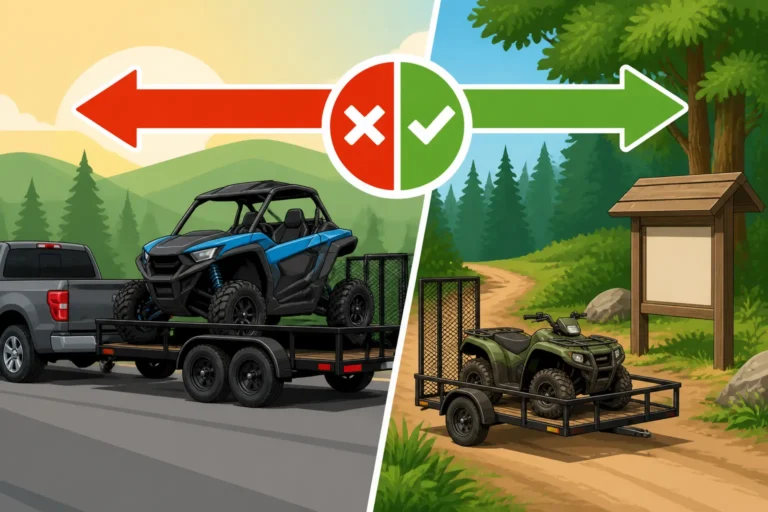
A smooth outing starts before you reach the trail. Check the tow vehicle and trailer, secure each machine with appropriate tie-downs, and confirm that the staging area can accommodate your setup. Small lots may fill quickly or have limited room to turn around. If you are meeting friends, agree on the exact entrance and arrival plan rather than sharing only the name of a large forest.
Estimate fuel and riding time conservatively. The group’s pace will be shaped by the slowest rider, trail difficulty, stops, and any mechanical problem. Bring tools and recovery gear suited to your machines, but do not attempt a recovery that could injure someone or damage the trail. Tell someone who is not riding where you are going and when you expect to return.
Finally, keep the trail in good condition for the next group. Stay on marked routes, avoid riding when closures or soft conditions make damage likely, pack out trash, and give other users room. Check onX Offroad or another mapping tool as part of your planning routine, then verify the route against official information before turning the key. That small extra step can make the difference between a good ride and a frustrating trip home. For broader planning ideas, Pennsylvania ATV Trail Etiquette on Narrow Trails is worth keeping in mind when your route is shared or tight.
Disclaimer
This article is for general informational purposes only and does not constitute professional advice. Laws, prices and regulations vary by location and change over time. Consult a qualified professional for guidance on your specific situation.