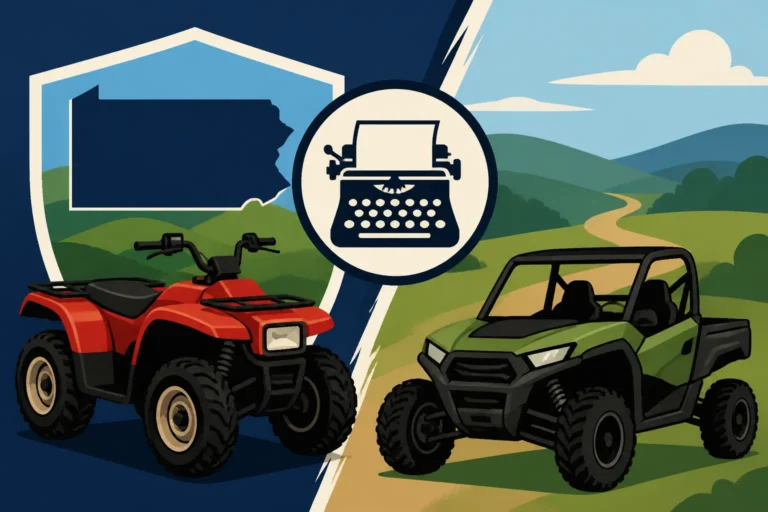
A Pennsylvania Resident Registered in Another State
It can be incredibly confusing and honestly, a bit frustrating, when you've moved to Pennsylvania or just bought an ATV that was previously registered in another state, only to find that your existing plate and paperwork might not cut it here. You've got your machine, you're ready to ride the beautiful trails Pennsylvania has to offer, but suddenly you're faced with a mountain of questions about registration and whether your out-of-state plate is even valid for a PA resident. This guide is here to walk you through everything you need to know about navigating Pennsylvania's ATV registration rules when your machine is currently registered elsewhere, helping you get properly plated and out on the trails without a hitch.
The Basics of Pennsylvania ATV Registration for Residents
Let's start by grounding ourselves in the Pennsylvania way of doing things. Our state has a very specific system for ATVs, and it’s distinct from how passenger vehicles are handled. The Department of Conservation and Natural Resources (DCNR) is the agency in charge, not PennDOT, which often catches new residents off guard. This distinction is crucial because DCNR's focus is on recreational use, trail funding, and ensuring rider safety and compliance, which ties directly into why they want your ATV registered locally if you live here.
Why Pennsylvania Wants Your ATV Registered Locally
It might seem like just another bureaucratic hoop to jump through, especially if you're already paying registration fees in another state. But there's a really good reason [Why DCNR Registers Pennsylvania ATVs]. The fees collected from ATV registrations, along with other sources, directly fund the development, maintenance, and policing of Pennsylvania's extensive network of ATV trails and riding areas. When you register your ATV in Pennsylvania, you're directly contributing to the trails you and other riders enjoy. Without this local registration, the state isn't getting its share to support these resources, and it becomes much harder for DCNR to track machines operating within its borders.
Imagine heading out to the Bloody Skillet ATV Trail system or the AOAA. The rangers patrolling these areas are checking for valid Pennsylvania registration. They're not just looking for a plate; they're ensuring that the machine is properly accounted for within the state's system. This helps with everything from recovering stolen machines to ensuring that the funds are allocated correctly for trail improvements. If your machine is plated in, say, Ohio, and you're a Pennsylvania resident, it complicates things significantly because you're living here, benefiting from our trail system, but not contributing to its upkeep through local registration.
The Two Types of Pennsylvania Registration You'll Encounter
Pennsylvania doesn't have a one-size-fits-all registration. Instead, it offers two distinct types, designed to cover different riding needs. Understanding these is key to making sure you pick the right one for your riding style, especially if you're transitioning from an out-of-state plate. These are detailed under [Pennsylvania's Limited and General Registrations], but let's break them down a bit.
First, there's [Pennsylvania's Limited Registration for Your Own Land]. This is for folks who primarily ride their ATV on private property, specifically land owned or leased by them. Think of it if you use your quad for chores around your farm in Lancaster County, or to navigate your large hunting property up in Potter County. This registration is free and never expires, which sounds fantastic, right? And it is, for its intended purpose. The catch? It explicitly states [What Limited Registration Does Not Let You Do], which includes riding on state-owned trails, designated roads, or any other public land. It's truly for private use only, and the plate you get, [The Plate Pennsylvania Gives Limited Registrants], reflects this limitation.
Then there's [Pennsylvania's General Registration for Everywhere Else]. This is the one you'll need if you plan to hit any of Pennsylvania's amazing public trails, like those in the state forests or at private parks. This registration costs a fee and must be renewed periodically (typically every two years). This is the standard registration for most recreational riders, allowing access to the vast network of DCNR-maintained trails and roads where ATVs are permitted. If you're coming from another state and intend to ride anywhere beyond your own private property in Pennsylvania, this is almost certainly the registration you'll need to pursue. It's the cost of admission, so to speak, to ride our state's fantastic resources.
Understanding Out-of-State Registration as a Pennsylvania Resident
It's not uncommon to find yourself in this exact situation. Perhaps you've lived in Pennsylvania your whole life, but you bought your ATV from a dealer in Maryland or West Virginia years ago, and they conveniently handled the registration for you in their state. Or maybe you inherited a quad from a relative who lived in New York, and it came with New York plates. These scenarios are perfectly normal, but they create a unique challenge when you're a resident of the Keystone State.
Common Scenarios Leading to Out-of-State Registration
One of the most frequent ways this happens is through proximity. If you live near the border in, say, Greene County, it might have been easier or cheaper at the time to purchase a machine in Morgantown, West Virginia. The dealer there might have handled the registration, making it an out-of-state process. You might not have even thought twice about it, as you were just excited to get your new machine. Similarly, someone living in Erie might have purchased an ATV in Ohio, where the sales tax or registration process felt simpler at the moment.
Another common scenario involves moving. You might have lived in Virginia, registered your ATV there, and then moved to Pennsylvania for a new job or to be closer to family. Your Virginia registration was perfectly valid when you lived there, but now that your primary residence is in Pennsylvania, the rules change. Or, as mentioned, inheriting a machine can bring with it another state's paperwork, leaving you to sort out the transfer. In all these cases, the initial convenience of the out-of-state process quickly turns into a bit of a headache once you realize Pennsylvania's specific requirements for its own residents. The machine is here to stay, and so are you, which means Pennsylvania's DCNR wants to see it registered locally.
Why Pennsylvania Doesn't Always Honor Other State's Plates for Residents
This is where the concept of "reciprocity" really comes into play, and it's often misunderstood. Pennsylvania does have reciprocity agreements with certain states for ATV registration, meaning that visitors from those states can often ride on Pennsylvania trails with their home-state registration. However, this reciprocity is almost universally designed for non-residents who are visiting. It allows someone from, say, New York, to come to Pennsylvania for a weekend ride without having to register their machine here.
The key distinction is your residency. If you are a resident of Pennsylvania, the state expects your ATV to be registered in Pennsylvania, just like it expects your car to be registered with PennDOT here. The DCNR's system is set up to manage machines primarily based in Pennsylvania and to collect the necessary funds from its residents for trail maintenance. Your out-of-state plate, while valid in its home state, doesn't fulfill this requirement for a Pennsylvania resident. It’s like having an Ohio driver’s license while living full-time in Pennsylvania – eventually, you'll need to get a PA license. The same principle applies to your ATV. It ensures that the responsibility for maintaining the state's recreational resources is fairly distributed among its actual residents and regular users. This means you generally can't just keep renewing your New Jersey ATV registration indefinitely if you live in Pennsylvania and ride here.
The Process of Switching to Pennsylvania Registration
Alright, so you've got that out-of-state plate, and you're a PA resident. It's time to make the switch. While it might seem daunting, breaking it down into steps makes it much more manageable. The goal is to get that Pennsylvania registration in your hand, so you can legally and confidently hit the trails.
Gathering Your Paperwork and Proof of Ownership
This is often the most critical and sometimes the most challenging part of the entire process. You need to prove to the DCNR that you are the rightful owner of the ATV and that it meets certain criteria. The foundation of this is typically the title from the state where it's currently registered. If your ATV was titled in the other state, you'll need that physical title. Make sure it's properly signed off to you if you bought it used, or in your name if you were the original purchaser. Without a clear chain of ownership, DCNR won't be able to issue a new title or registration.
Beyond the title, you'll definitely need a bill of sale, especially if you purchased the machine from a private party or if the title doesn't clearly show the transfer. This document should detail the buyer (you), the seller, the date of sale, the purchase price, and a full description of the ATV, including the Vehicle Identification Number (VIN). Even if you bought it from a dealer in another state, having that original bill of sale handy is smart. And speaking of VINs, you'll need [VIN Proof for a Pennsylvania Registration]. This often involves a certified VIN verification, which can sometimes be done by a notary, an authorized dealer, or even a law enforcement officer. It’s essentially an assurance that the VIN on your machine matches the paperwork.
Finally, bring proof of your Pennsylvania residency, such as your PA driver's license or a utility bill with your name and current address. The DCNR needs to confirm you are indeed a resident applying for a local registration. Sometimes people forget this seemingly simple step, only to have their application held up.
Navigating the Pennsylvania DCNR Application
Once your documents are in order, it's time to tackle the application itself. The primary form you'll be dealing with is DCNR-43, "Application for Initial Certificate of Title and/or Registration for Snowmobile/ATV." This form is where you'll provide all the pertinent details about yourself and your machine. It asks for everything from your personal information to the make, model, year, and of course, the VIN of your ATV. Be sure to fill out every section accurately and legibly. Misspellings or missing information are common reasons for delays.
You have a few options for submitting your application. You can mail everything in, which is convenient but can take some time. Alternatively, you might be able to apply in person at certain DCNR offices, though it's always wise to call ahead to confirm their hours and services. For many, the easiest way to start the process is by [Registering Online at Pennsylvania's DCNR Portal]. While the entire process might not be fully online (especially if you need to mail in original titles or VIN verifications), the portal can often initiate the application and provide a checklist of what you'll need to submit physically. This can save you a lot of guesswork and ensure you have the most up-to-date forms.
After submission, it's a waiting game. DCNR processes a high volume of applications, and the [How Long Pennsylvania Takes to Process a Registration] can vary based on the time of year and their current workload. Typically, you might expect to wait several weeks for your new title and registration materials to arrive in the mail. If you're planning a trip, be sure to factor this processing time into your schedule. There's nothing worse than having your machine ready but no plate to put on it!
Costs and Considerations for Transferring Your ATV Registration
When you're making the switch to Pennsylvania registration, it's not just about paperwork; there are financial aspects to consider as well. While the cost isn't exorbitant, it's important to budget for it, especially if you also need to title the machine for the first time in Pennsylvania or pay sales tax that wasn't previously collected here.
Breaking Down the Fees Involved
The primary cost will be the [Pennsylvania ATV Registration Cost]. This typically refers to the General Registration, which is needed for trail riding. [Pennsylvania General Registration Cost] is a flat fee, usually covering a two-year period. You'll also likely encounter the [Pennsylvania ATV Title Cost]. Even if your machine was titled in another state, Pennsylvania will issue its own title, which involves a separate fee. This fee is usually a one-time charge as long as you own the machine and don't transfer ownership.
Beyond these, there's the potentially significant issue of sales tax. If you purchased your ATV in another state and paid sales tax there, you might think you're off the hook. However, Pennsylvania has what's called a "use tax." This means that if you, as a Pennsylvania resident, bring a vehicle into the state for use here, and you haven't paid at least Pennsylvania's 6 percent sales tax rate on it, you'll owe the difference. For example, if you bought a quad in Delaware (which has no sales tax) and bring it to Pennsylvania, you'll owe the full 6 percent on the purchase price. This is covered under [Pennsylvania Use Tax on an Out-of-State Purchase] and is a crucial detail many people overlook until they get to the registration desk. Make sure you have proof of what you paid for the machine, or an appraisal if it was inherited, to accurately calculate this.
Potential Pitfalls and How to Avoid Them
The journey to a Pennsylvania plate isn't always perfectly smooth, especially when dealing with machines that have been through multiple states or owners. One of the biggest pitfalls is a missing or improperly signed title. If the title from the previous state is lost, or if the seller didn't sign it correctly, you'll face delays. Always try to get a clear, original title when buying a used ATV, no matter where it's from. If you're in a situation where the seller cannot find the title, it complicates things immensely and might require additional steps to prove ownership, potentially involving a bond or other legal avenues.
Another common issue, as mentioned, is the sales tax. People are often caught off guard by the use tax requirement. Make sure you have a solid bill of sale that clearly shows the purchase price and any sales tax paid, or be prepared to pay the difference to Pennsylvania. If you don't have a formal bill of sale, you might consider using a template from a service like LawDepot or a similar legal document provider to create one, even retroactively, if it helps clarify the transaction for DCNR. This document can be instrumental in proving the purchase price.
Finally, ensure your VIN verification is done correctly by an authorized party. An illegible or incomplete verification can also cause your application to be rejected. Double-check all numbers and signatures before submitting. Taking the time to gather everything meticulously upfront can save you weeks of back-and-forth with DCNR.
What Happens If You Don't Switch
You might be thinking, "What if I just keep my out-of-state plate? Who's going to know?" While it might seem like an easy way to bypass the process, doing so as a Pennsylvania resident carries significant risks and limitations that really aren't worth the potential trouble. Pennsylvania takes its ATV registration seriously, and for good reason.
The Legal Ramifications of Riding Unregistered in Pennsylvania
Let's be blunt: riding your ATV as a Pennsylvania resident on a non-Pennsylvania plate, without having gone through the proper registration process, is essentially riding an unregistered machine in the eyes of the state. This means you are liable for [Pennsylvania Fines for an Unregistered ATV]. These aren't just minor parking tickets; we're talking about substantial penalties. Being caught without proper registration can result in an automatic minimum fine, plus court costs. This can quickly add up to several hundred dollars, far exceeding the cost of simply registering your machine correctly in the first place.
Imagine you're out enjoying a beautiful day on the Whiskey Springs ATV Trail system, and you encounter a DCNR ranger at a trailhead or during a routine patrol. Part of [What a Ranger Checks at a Trailhead] is your registration. If they scan your out-of-state plate and your driver's license shows you're a Pennsylvania resident, you're going to have some explaining to do. This isn't just about an expired sticker; it's about not being compliant with the state's residency rules for vehicle registration. It's a clear violation, and rangers are very familiar with these scenarios. It's a quick way to turn a fun day of riding into a very expensive and frustrating encounter.
Limitations on Where You Can Ride
Beyond the legal penalties, not having a proper Pennsylvania registration severely limits your access to the state's vast riding opportunities. Most of [Pennsylvania's Free State Forest Trails] explicitly require a valid Pennsylvania registration. The same goes for many of the private, pay-to-ride parks like the Anthracite Outdoor Adventure Area (AOAA) or Rock Run Recreation Area; while some might accommodate out-of-state visitors, their primary expectation for residents is a Pennsylvania plate.
Without that Pennsylvania registration, you'll find yourself restricted to riding only on private land where you have permission, and even then, you might run into issues if you need to cross any public roads or trails to get there. The entire network of designated ATV trails, joint-use roads, and state forest roads becomes essentially off-limits to you. This means missing out on hundreds of miles of diverse terrain, from the challenging rocky climbs of Sproul State Forest to the scenic overlooks of Bald Eagle. The cost of avoiding proper registration isn't just financial; it's a forfeiture of the very experiences you bought your ATV for in the first place.
Special Scenarios and Troubleshooting
Even with the best intentions, the process of switching registration can throw a few curveballs. Two common tricky situations involve machines without titles or needing to change your registration type down the line.
When Your Out-of-State Registration Has No Title
This is a scenario that can definitely cause some head-scratching. Some states, particularly for older ATVs or those below a certain engine size, do not issue titles. Or, perhaps the title was lost years ago, and the original state has no record. If you're trying to register such a machine in Pennsylvania, you might worry you're stuck. Thankfully, Pennsylvania does have provisions for [Pennsylvania ATV Title Exemptions] and a pathway for [Pennsylvania ATV Registration Without a Title].
Typically, if the machine was never titled in its previous state because that state didn't require it, you might be able to proceed by providing a bill of sale, a VIN verification, and possibly a sworn affidavit explaining the situation. DCNR will want to ensure the machine isn't stolen and that you are the legitimate owner. For very old machines, like those [Pennsylvania Machines Registered Before February 1987], there are often specific historical exemptions or different procedures to follow due to the age of the machine and the change in titling laws over time. It's best to contact DCNR directly in these unique situations to get precise guidance, as the requirements can be very specific. They'll advise you on what documentation they'll accept in lieu of a title.
Switching Between Limited and General Registration
Sometimes, when you first registered your ATV in Pennsylvania, you might have opted for [Pennsylvania's Free Limited Registration] because you only intended to ride on your own property. But then, a few months later, your friends convince you to join them on a trip to the Allegheny National Forest or a state forest trail system. Suddenly, your Limited Registration won't cut it.
The good news is that you're not permanently stuck. It is absolutely possible to make the [Switching From Limited to General in Pennsylvania]. This process usually involves submitting an updated DCNR-43 form, indicating that you want to change your registration type. You'll then pay the appropriate fee for the General Registration, and DCNR will issue you the new plate and sticker required for public trail access. You won't typically need a new title issued, as that's already in your name; it's just a change in the registration class. It’s always better to switch to the General Registration proactively than to risk a fine or denied access when you're out on the trails.
Here's a quick summary of key differences when moving your ATV registration to Pennsylvania:
| Feature | Out-of-State Registration (as PA Resident) | Pennsylvania General Registration | Pennsylvania Limited Registration |
|---|---|---|---|
| Legal for PA Residents? | No (for riding in PA) | Yes | Yes (private land only) |
| Cost | Varies by state | [Pennsylvania ATV Registration Cost] (approx. $20/2 years) | Free |
| Trail Access | No | Yes (DCNR trails, designated roads, parks) | No (private land only) |
| Plate Issued | Varies by state | Yes (DCNR plate with sticker) | Yes (DCNR plate, no sticker) |
| Title Required | Varies by state | Yes (PA title issued if none) | Often not required for pre-1987 machines, still requires proof of ownership |
| Sales Tax | May incur PA Use Tax if not paid | Paid at time of initial registration/title | N/A (usually for existing machines) |
| Proof of Ownership | Out-of-state title, bill of sale | PA title, bill of sale | Bill of sale, VIN verification |
| Renewal | Varies by state | Yes, every two years (see [Renewing Every Two Years in Pennsylvania]) | Never expires |
Making sure your ATV is properly registered in Pennsylvania as a resident means you're not just avoiding fines, but you're also fully participating in and supporting the fantastic riding opportunities our state has to offer. It's an investment in your own enjoyment and the future of ATV riding in Pennsylvania.
Disclaimer
This article is for general informational purposes only and does not constitute professional advice. Laws, prices and regulations vary by location and change over time. Consult a qualified professional for guidance on your specific situation.