Getting a Borough Permit for Mixed-Use Riding
It's incredibly frustrating when you've just come off a fantastic trail ride, or you're trying to get to one, and the only thing standing between you and that next adventure (or a much-needed burger) is a stretch of paved borough road. You know your ATV or UTV isn't "street legal" in the traditional sense, but you also know some towns have special rules. The confusion around legally connecting trails or accessing services on borough streets in Pennsylvania can feel like navigating a minefield. This guide is here to cut through that confusion, helping you understand how to navigate the specific, often hyper-local, process of obtaining a borough permit for mixed-use ATV and UTV riding, and what to expect once you have it.
Understanding Mixed-Use Riding in Pennsylvania Boroughs
When we talk about "mixed-use riding" for ATVs and UTVs in Pennsylvania boroughs, it's important to set some expectations right away. This isn't about transforming your off-road machine into a daily commuter for paved roads. State law is pretty clear that ATVs and UTVs, for the most part, are meant for off-road use, private property, or designated state trails. The idea of getting a borough permit for mixed-use riding is far more specific and typically involves navigating short distances on public streets for very particular reasons.
What "Mixed-Use" Really Means for ATVs and UTVs
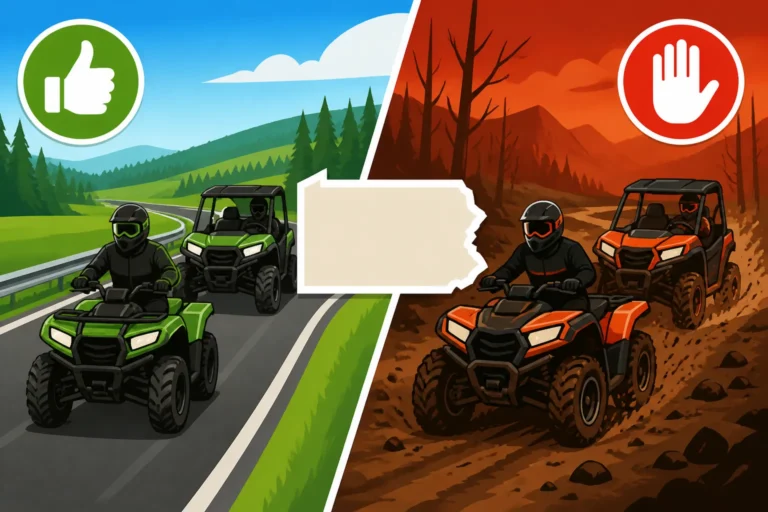
For most Pennsylvania boroughs, "mixed-use" riding means utilizing specific, designated borough streets as connector routes between established trail systems, or for accessing essential services like gas stations, restaurants, or overnight lodging. Think of it as a carefully controlled allowance, not a blanket invitation. You might be able to ride a mile or two down a particular street to link up with another trail, or to grab a bite to eat before heading back out. It's almost always about utility and connection, not leisurely cruising through town. This distinction is crucial because it directly addresses why [Street Legal ATVs in Pennsylvania: The Short Answer] generally remains "no" on a broader state level. These borough permits are an exception to that rule, carved out by local ordinances, and are usually very limited in scope.
The underlying principle is that boroughs, unlike state highways, have a degree of "home rule" authority. This means they can enact their own ordinances, within the framework of state law, to govern their local streets. They might see the economic benefit of allowing riders to patronize local businesses, or they might be responding to community requests for better trail access. However, these local rules are usually very prescriptive, outlining exactly which streets can be used, during what hours, and often with strict speed limits. It's never an open invitation to ride anywhere you please; it's a specific, mapped route for a defined purpose.
Why Boroughs Open Roads (and Why Many Don't)
The decision for a borough to open its roads to ATV and UTV traffic, even with a permit system, is a complex one, often balancing economic opportunity with public safety and quality of life concerns. On one hand, allowing off-road enthusiasts to travel through town can provide a much-needed boost to local businesses. Riders need gas, food, and sometimes a place to stay, and a town that caters to them can see a significant influx of tourist dollars. This is a common driver for municipalities, especially those located near popular trail networks or state forests. They recognize that if riders can't easily access their services, that money will go elsewhere.
On the other hand, many boroughs choose not to open their roads, or do so with extreme reluctance. The primary concerns often revolve around public safety. ATVs and UTVs, by their nature, handle differently than street-legal vehicles and can pose risks in mixed traffic environments. Noise is another significant factor; the rumble of multiple machines can be disruptive to residents, leading to complaints. Concerns about potential road damage, litter, and the general disruption to a quiet residential area also weigh heavily on local officials. Therefore, while some towns like those that allow [Township Roads Open to Pennsylvania ATVs] might see the benefit, many boroughs prioritize keeping their streets strictly for traditional vehicles, making permit programs a rarity rather than the norm across the state.
The Permit Application Process for Boroughs
So, you're hoping to ride your ATV or UTV on a specific borough street? The first, and often most challenging, step is determining if such an option even exists in that particular municipality. Unlike state-level registrations or permits, borough mixed-use permits are entirely localized, meaning the process and even the very existence of such a program can vary wildly from one town to the next, if it exists at all.
Finding Out If a Permit Program Exists
Your journey begins with research. Don't assume that because one borough has a program, its neighbor will too. The best place to start is the borough's official website. Many municipalities will publish their ordinances online, and if there's a specific "off-road vehicle" or "mixed-use street access" ordinance, you'll likely find details there. Look for sections related to traffic, recreation, or specific vehicle types. You might also find maps outlining designated routes. If the website doesn't yield clear results, your next step should be to contact the borough administrative office directly. Call or email and specifically ask about permits or ordinances for ATV/UTV use on borough streets. Be prepared with clear questions, such as whether they have a permit program, what the eligible roads are, and what the application process entails. Don't simply ask if you can ride your quad in town; you need to be specific about mixed-use access.
A great example of a borough that has successfully implemented such a program is detailed in [Windber Borough's Mixed Use Program]. This kind of transparency and clear guidance is what you're hoping to find. If you live near a known ATV trail system, you might also inquire with local riding clubs or even businesses that cater to riders; they often have the inside scoop on which towns are friendly to off-road vehicles and have established permit systems. Without a clear, documented program, attempting to ride your ATV or UTV on borough streets, even for a short distance, could easily lead to a citation.
Common Permit Requirements and What to Expect
If you're lucky enough to find a borough with an established mixed-use permit program, you'll typically encounter a set of common requirements. These are put in place to ensure safety, accountability, and compliance with local rules. First and foremost, you will almost certainly need to prove that your machine is properly registered with the state. This means having a valid [Registering an ATV in Pennsylvania], specifically a General Registration for public land use, not a Limited Registration which is only for your own private land. The borough will need to see proof of this, usually your DCNR-issued registration card and plate.
Next, you'll need to demonstrate you have adequate insurance coverage. While the state requires [Pennsylvania ATV Insurance Requirement] to ride off your own land, boroughs often want to see proof of liability insurance, at a minimum, to protect against potential accidents on public roads. Be ready to provide your insurance card or policy details. Beyond the machine's credentials, you'll also need to provide your own identification, usually a valid driver's license. Some boroughs might also require proof of a [Pennsylvania ATV Safety Certificates], particularly if the permit is for a youth rider or if it’s an extensive program that covers various age groups, though this is less common for just street access. There will almost always be a nominal fee associated with the permit, which covers the administrative costs of processing your application and issuing the permit itself. This isn't usually a major expense, but it's part of the process.
| Requirement | Purpose | Proof Often Needed |
|---|---|---|
| Valid State Registration | Ensures your machine is legally recognized for public land use. | DCNR Registration Card, Pennsylvania ATV Plate |
| ATV Insurance | Protects against liability in case of an accident on borough roads. | Insurance Card or Policy Declaration |
| Operator ID | Verifies identity and often age/driving privilege. | Valid Driver's License or Photo ID |
| Vehicle Information | Links the permit to a specific machine. | VIN, Make, Model (from registration or title) |
| Application Fee | Covers administrative costs of processing and issuing the permit. | Payment (cash, check, or online payment) |
| Safety Certification | Less common, but may be required for youth or specific programs. | Safety Course Certificate (e.g., from DCNR-approved course) |
Once approved, you'll typically receive a physical permit, often a sticker to display on your machine and/or a wallet-sized card to carry with you. This permit will detail the specific roads you're allowed to use, the hours of operation, speed limits (which are usually quite low, often 15-25 mph), and any other pertinent restrictions. It's not uncommon for these permits to have an expiration date, often yearly or biennially, requiring renewal. Always check the specifics for the borough you plan to visit, as they are truly unique to each location.
Navigating Borough-Specific Rules and Restrictions
Once you've secured that coveted borough permit, the work isn't quite over. Possessing the permit is only half the battle; understanding and strictly adhering to the specific rules and restrictions of that particular borough is paramount to enjoying your ride without incident. These local ordinances are designed to integrate ATV and UTV traffic safely into the community, and deviating from them can lead to serious consequences.
Decoding Designated Routes and Restrictions
Every borough with a permit program will have clearly defined routes where ATVs and UTVs are permitted. These are rarely, if ever, every street in town. Instead, they are carefully selected roads that serve as direct connectors, typically from a trail system to a refueling station, a restaurant, or a staging area. It is absolutely essential to get a map from the borough office or download one from their website that clearly illustrates these [Pennsylvania Designated ATV Road List]. Relying on memory or guesswork is a recipe for trouble. You'll often see specific signage, such as the green signs mentioned in [What the Green Sign on a Pennsylvania Township Road Means], indicating roads open to ATVs. These signs are your guideposts, and if a road isn't marked, assume it's off-limits.
Beyond specific routes, you'll encounter a host of other restrictions. Time of day limits are common; many boroughs will prohibit ATV/UTV use after dark or before certain morning hours to minimize noise disturbances. Speed limits are almost universally lower than for cars, often capped at 15 or 20 mph, even if the posted car speed limit is higher. Noise ordinances will be strictly enforced, so make sure your machine's exhaust meets [Pennsylvania Muffler Requirements for ATVs] and isn't excessively loud. You might also find specific equipment requirements. For example, [Pennsylvania Lighting Rules for Road Use] will almost certainly be enforced, meaning you'll need working headlights, taillights, and potentially turn signals, even if your machine doesn't strictly require them for off-road use. Aftermarket accessories from brands like SuperATV can be a great way to ensure your UTV or ATV meets these lighting requirements with high-quality LED light bars, turn signal kits, or even mirrors for better visibility on town roads.
Penalties for Non-Compliance
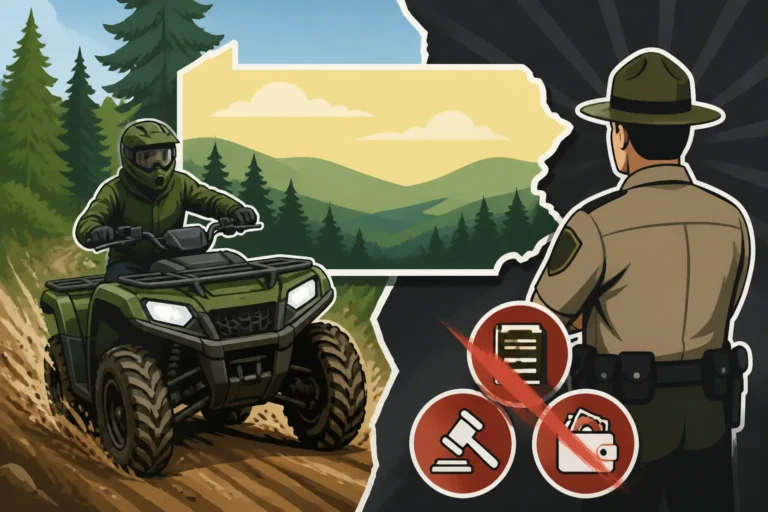
Let's be blunt: violating borough ATV/UTV ordinances can be costly, both in terms of fines and the headache of dealing with law enforcement. Borough police officers have the authority to pull over and cite riders who are not in compliance with local rules, just as they would any other vehicle operator. Riding on a street that is not a designated route, riding without a permit, or violating specific restrictions like speed limits or hours of operation can all result in citations. These fines can be significant, often starting in the hundreds of dollars, and they can quickly add up. For example, while not exactly the same, fines for riding an unregistered machine can be substantial, as highlighted in [Pennsylvania Fines for an Unregistered ATV], and borough violations can be similarly serious.
Beyond monetary penalties, your machine could potentially be impounded, leading to towing and storage fees on top of any fines. In some cases, repeated violations could even lead to the revocation of your permit privileges, meaning you'd no longer be allowed to ride in that borough at all. It's crucial to remember that local police are often responding to citizen complaints. If residents are continuously bothered by loud or reckless riders, enforcement will be swift and strict. The best way to avoid these penalties is to know the rules inside and out and to adhere to them without exception.
Responsible Riding in a Borough Setting
Riding your ATV or UTV through a Pennsylvania borough, even with a valid permit, is a privilege, not a right. How you conduct yourself on those streets can directly impact whether a permit program continues to exist, or if other boroughs might consider implementing similar ones in the future. It’s about being a good ambassador for the sport and demonstrating that off-road enthusiasts can share public spaces responsibly.
Being a Good Neighbor on Four Wheels
When you're riding through a borough, you're not just a rider; you're a visitor in someone's community. This means prioritizing courtesy and safety above all else. Keep your speed to the absolute minimum required, even if it feels slow. Adhere strictly to all traffic laws, including stop signs and traffic lights, as if you were in a passenger car. Remember that pedestrians, bicyclists, and children might be present, so be extra vigilant and yield the right-of-way without hesitation. Minimize noise by avoiding unnecessary revving of your engine, especially near residential areas, schools, or churches. If your machine is equipped with a particularly loud aftermarket exhaust, consider quieter options if you plan on frequent borough travel.
Avoiding actions that could be perceived as disruptive is key. Don't kick up dust or mud, particularly near homes or parked cars. Maintain a clean machine, as a muddy ATV or UTV can track dirt onto clean streets. Wearing appropriate safety gear, including a helmet (as mandated by [Helmet Rules for Pennsylvania Riders]) and eye protection, even for a short ride through town, not only protects you but also projects a responsible image to the community. Brands like SuperATV offer a variety of UTV accessories that can enhance safety and public perception, such as full windshields to keep dust and debris contained, or even full cab enclosures for a more "street-friendly" appearance. These types of additions not only make your ride safer but also can make your machine seem less intrusive to the general public.
Planning Your Ride Through Town
Preparation is your best friend when it comes to mixed-use borough riding. Before you even fire up your engine, take the time to study the designated route map provided by the borough. Know exactly where you're allowed to enter, where you're allowed to exit, and where you can access services like gas or food. Don't just glance at it; internalize the route so you're not fumbling with a map or your phone while trying to navigate unfamiliar streets. This helps ensure a smooth, efficient passage through town without unintended detours onto prohibited roads.
Plan your stops strategically. If you need fuel, identify the gas station on the approved route. If you're grabbing a meal, know which restaurant is accessible. The goal of mixed-use permits is typically to facilitate travel through the borough, or to specific points of interest, not for casual exploration of every street. Treat these borough sections as functional links in your larger ride, and move through them with purpose. Remember, you're sharing these roads with cars, trucks, and pedestrians who might not be accustomed to seeing ATVs or UTVs. By riding defensively, courteously, and strictly adhering to all local ordinances and general traffic laws, you contribute positively to the reputation of all off-road enthusiasts and help ensure these limited opportunities for [Pennsylvania Rules for Riding a Borough Street] remain open for everyone to enjoy.
Disclaimer
This article is for general informational purposes only and does not constitute professional advice. Laws, prices and regulations vary by location and change over time. Consult a qualified professional for guidance on your specific situation.