Pennsylvania’s 908 Miles of ATV Riding Statewide
Pennsylvania’s ATV riding is spread across state forests, the Allegheny National Forest, rail-trail corridors, and private riding parks, so “908 miles statewide” does not mean one continuous trail network or open access everywhere. This guide explains how to choose a riding area, check seasonal access and machine limits, handle permits and registration, and plan a safer day on the trail.
What Pennsylvania’s 908 miles of ATV riding means
Miles are spread across different land systems
Pennsylvania’s ATV opportunities are distributed among separate trail systems, not joined into one statewide route. A mileage figure can help show the scale of riding available, but it does not tell you whether every mile is open on the same day, accessible to the same machine, or covered by the same permit. A route on a state forest, for example, may follow a different calendar and have different limits from a route in the Allegheny National Forest or a privately operated park.
That distinction matters when you are planning a ride from home. A family near State College might look at trails in Bald Eagle State Forest, while riders based near Pittsburgh may be considering a longer drive to the northcentral forests or a managed riding park. Those destinations can differ in trail surface, operating season, admission requirements, available facilities, and the size of machine they accept.
Treat statewide mileage as a starting point, then check the specific trail system. Look for the land manager, trail opening and closing information, machine-width rules, parking instructions, and any permit requirements. The overview [Pennsylvania's 908 Miles of ATV Riding Statewide] can help frame the bigger picture, while [Where to Ride an ATV in Pennsylvania] is useful when you are narrowing down destinations.
Public trails and private parks are different kinds of rides
Public trails often give riders a more natural, remote experience. You may travel over rocky forest roads, narrow wooded trails, or routes with limited services nearby. That can make for a memorable day, but it also means you should plan for changing conditions and carry the essentials instead of assuming that fuel, food, or help will be just around the corner.
Private riding parks can offer a different kind of outing. Their networks may include varied terrain, designated staging areas, and park-specific services, but visitors need to follow the operator’s rules. Requirements can include registering a machine with the park, purchasing admission, wearing certain safety gear, or riding only within marked boundaries. A state registration or forest permit does not automatically give permission to enter private land.
The choice comes down to the experience you want and the rules you are prepared to follow. Public forest riding may suit someone looking for a quieter day and a longer drive between services; a managed park may be a better fit for a group that wants a defined entrance and an organized trail network. For a broader comparison, see [Best Places to Ride an ATV in Pennsylvania] and [Pennsylvania Pay-to-Ride Parks Worth the Drive].
Major Pennsylvania ATV riding areas
Northcentral state forest trails
Pennsylvania’s northcentral region is a major focus for public ATV riding. Trails and riding areas are associated with forests such as Sproul, Tiadaghton, Susquehannock, and Bald Eagle, with routes and access points scattered across a broad, largely rural landscape. It is not one single park with one gate: you need to identify the trail or trailhead you intend to use and confirm that the route is open.
Well-known names include Whiskey Springs, Bloody Skillet, East Kettle, Haneyville, and the Potter County Trail. These areas can be rewarding for riders who like wooded scenery, elevation changes, and a more self-sufficient day out. The tradeoff is that travel between communities and services can take time. Check your fuel range, know where you are staging, and do not assume a nearby road is legally open to ATV travel just because it appears on a map.
The Northcentral Regional Trail Permit is tied to eligible riding areas and rules that can change by location or season. Before heading out, confirm which trails are covered and what documentation you need to carry. [Pennsylvania's Northcentral Regional Trail Permit] offers a closer look at that system, while [Whiskey Springs and Pennsylvania's Longest Trail] and [Bloody Skillet's 38 Miles] provide useful starting points for learning about individual destinations.
Other state forest and Allegheny National Forest routes
Riding opportunities are not limited to the northcentral region. Other state forest trail systems include areas such as Big Flat and Pine Grove in Michaux, Martin Hill in Buchanan State Forest, Sideling Hill, and trails in the Poconos. These locations differ in length, terrain, season, and access, so avoid assuming that your experience at one forest will tell you exactly what to expect at another.
The Allegheny National Forest is a separate destination with its own trail information and permit requirements. Riders commonly research the Marienville area and routes such as Timberline, Penoke, and Rocky Gap. Forest roads and ATV routes can share a working landscape with other users, including forestry vehicles and hunters. Be prepared to yield, slow down around blind corners, and follow signs even if a trail looks familiar.
An important planning habit is to identify the land manager before you leave. The word “forest” on a map does not tell you whether a road is open to ATVs, whether a separate permit applies, or whether a route is restricted to highway vehicles. Explore [Pennsylvania's Sproul State Forest Trails], [Pennsylvania Riding in the Allegheny National Forest], and [Allegheny Forest Trails at Marienville] when comparing these areas.
How to choose a trail that fits your ride
Match the terrain to your experience and machine
A trail’s length is only one part of its difficulty. A route with rock ledges, loose stone, steep grades, tight turns, or water crossings can feel demanding even if it is relatively short. A long forest route may be less technical but require better planning because of the time it takes to complete and the distance from services.
Your machine matters too. A narrow ATV may fit routes that are unsuitable for a wide side-by-side. Ground clearance, tires, turning radius, and the condition of your brakes can make a noticeable difference on rocky or muddy terrain. If you are riding with a mixed group, choose a route that the least experienced rider and the least capable machine can handle comfortably, rather than letting the most experienced person set the pace.
Read trail descriptions with a practical eye. “Scenic” does not necessarily mean easy, and a map showing a connected route does not guarantee that every segment is open to your type of machine. Check width and weight limits, trail classifications, and posted restrictions before loading up. The guides [Pennsylvania Trails for Beginners], [Pennsylvania Trails With Rock Sections], and [Pennsylvania Trails for a Wide Machine] can help you compare the experience you are looking for with the machine you plan to bring.
Think about distance, staging, and support
A route that looks close on a map can take longer than expected when it includes rough terrain, stops, and slower travel through narrow sections. Decide how much riding time your group actually has, then build in time for breaks, trail checks, and a possible detour. A conservative plan is usually more enjoyable than trying to cover every mile before dark.
Check where you can park and unload. Some trailheads have limited space, and a long trailer may be difficult to turn around or leave in a designated area. Do not block a gate, road, or access point, and check whether overnight parking is allowed rather than assuming it is. In busy periods, arriving early can make staging less stressful, but always follow the posted instructions.
Cell service can be unreliable in remote terrain. Download or otherwise prepare the information you need before leaving reliable coverage, and tell someone where you intend to ride and when you expect to return. Digital mapping tools such as onX Offroad can help you review routes and orient yourself, but they should not replace current land-manager notices, official signs, or sound judgment in the field. See [Pennsylvania Trails With Cell Signal] and [Parking a Trailer at a Forest Trailhead] for more planning considerations.
| Planning question | Why it matters | What to check |
|---|---|---|
| Who manages the trail? | Rules and permits differ by land system | State forest, national forest, club, or private park |
| Is the route open? | Seasonal closures and local conditions can change access | Official trail notices and signs at the entrance |
| Will my machine fit? | Width, weight, and vehicle-class limits may apply | Trail-specific limits and machine measurements |
| What paperwork is needed? | Registration and trail access are separate issues | Registration, permits, proof of insurance, and identification |
| Where can I stage? | Small lots and restricted parking can disrupt access | Parking rules, trailer space, and overnight restrictions |
| Can I navigate without service? | Remote areas may have limited coverage | Offline maps, route notes, and a return plan |
Seasons, weather, and trail conditions
Open dates are not the whole story
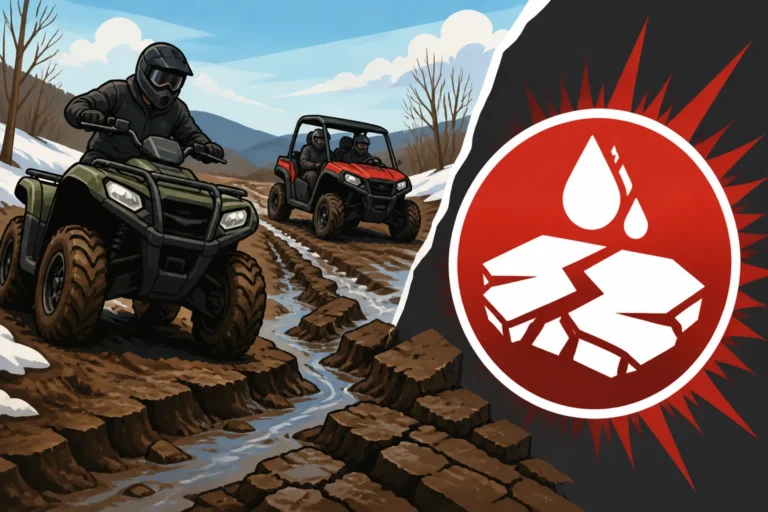
Many public ATV trails have defined riding seasons, and those windows can differ by forest or trail. Spring closures are common where saturated ground is vulnerable to tire damage. Some areas open later, close earlier, or have additional restrictions tied to weather, maintenance, or wildlife and hunting activity.
A calendar date alone does not guarantee that a trail is suitable or available. A route may be closed because of damage, maintenance, a storm, or a local notice. Conversely, a trail that is generally open may still be affected by temporary restrictions. Check the specific trail’s official information shortly before travel, especially if you are planning a long drive or booking lodging around a riding weekend.
Seasonal planning also affects crowds. Opening weekends and popular holiday periods can bring more traffic to trailheads. If you prefer a quieter ride, consider a less busy period, but do not trade convenience for uncertainty: confirm the route is open and that your group is prepared for the conditions. For seasonal context, read [Pennsylvania's ATV Trail Season], [Why Pennsylvania Trails Close April 1], and [Pennsylvania Trails Closed in Spring].
Rain, mud, and winter conditions change the ride
Heavy rain can turn a familiar trail into a slower, more demanding route. Water may collect in low spots, rocks can become slick, and soft ground may be more easily damaged by tires. Deep mud is not just a challenge for the rider; riding through it can widen ruts and damage the trail, affecting access for everyone who follows.
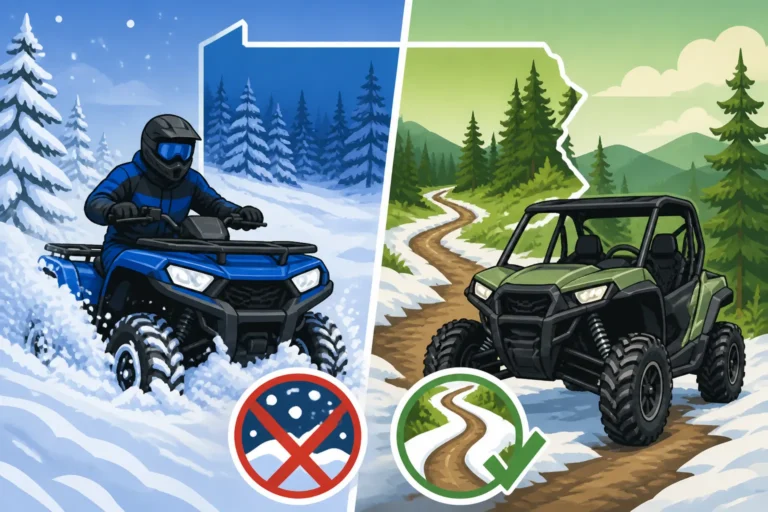
Winter riding brings its own considerations. Snow cover can hide rocks, drainage channels, and uneven ground. Cold temperatures affect riders and machines alike, and the available daylight may be shorter than you expect. If a route is open for winter use, confirm the applicable season and conditions, and do not assume that a snowmobile trail is automatically open to ATVs.
When conditions are poor, changing your plan is often the sensible choice. Choose a more suitable route, postpone the ride, or stick to a managed area whose operator has confirmed it is open. If you do ride after rain, reduce speed and avoid spinning tires. [Pennsylvania Trails After Heavy Rain], [Why Mud Season Closes Trails], and [Pennsylvania Trails Open in Winter] cover related planning issues.
Registration, permits, and access rules
Registration is not the same as a trail permit
Pennsylvania ATV registration and trail access are separate questions. Registration concerns the machine’s state registration status; a trail permit or park admission concerns permission to ride in a particular place. Having one does not necessarily satisfy the other. That distinction can be easy to miss when you are preparing for a trip, especially if a friend says, “I’ve got the paperwork.”
Before riding, identify every requirement that applies to the destination and the machine. A public trail system may require registration and a regional or land-specific permit. A private park may have its own entry rules. An out-of-state registration may be relevant, but you still need to confirm whether it is recognized for the riding area and whether additional documentation is required.
Keep proof accessible and protected from weather. A wallet card or permit tucked in a bag that is difficult to reach is less useful during a roadside or trailhead check. Review [Pennsylvania ATV Registration and Trail Access], [Why Both Might Be Required], and [Does Pennsylvania Honor an Out-of-State Registration?] before a trip involving public trails or a machine registered outside Pennsylvania.
Confirm machine and rider requirements
State forest trail access can depend on machine dimensions and class. Pennsylvania state forest trails commonly have limits that exclude some wide or heavy machines, so do not rely on the machine’s model name or appearance to decide whether it qualifies. Measure the actual vehicle as required by the applicable rule and confirm the limit for the specific trail system.
Rider requirements matter just as much. Age, supervision, safety certification, helmets, and insurance rules may apply depending on where and how you ride. Rules for a trail can be different from rules for a public road, and a route that briefly uses a road raises separate questions about whether that road is designated for ATV use. Never assume that a forest road or township road is open simply because an ATV can physically travel along it.
A quick pre-ride paperwork check can prevent a frustrating turn-around: verify the rider’s eligibility, the machine’s dimensions, registration status, permit coverage, and required safety equipment. Keep a copy of the official rules or trail notices available offline. See [The 64-Inch Width Limit in Pennsylvania], [Pennsylvania ATV Safety Certificate Requirements], and [Pennsylvania ATV Insurance Requirement] for more detail.
A practical plan for your first Pennsylvania trail day
Prepare the route and group before loading
Start with one destination rather than a vague plan to “ride somewhere north.” Identify the trailhead, the land manager, the expected route, and a reasonable turnaround point. Check whether the route is open, whether your machine is allowed, and what permits or registrations are required. If you are going with a group, make sure everyone understands the plan before the first engine starts.
Set a pace based on the least experienced rider. Agree on where the group will stop, how you will handle a separation, and what to do if someone has a mechanical issue. A simple plan can prevent the familiar trail-day problem where faster riders disappear around a bend while a newer rider is left wondering whether to continue or wait.
Use a current official trail map or notice alongside any navigation app. onX Offroad can be useful for reviewing a route and preparing offline navigation, but map layers and access information should be checked against the land manager’s latest instructions. A mapped line is not permission to ride a closed trail or cross private property. For route planning, [Pennsylvania Trail Maps From DCNR] and [Pennsylvania Trail Conditions Before You Go] are useful references.
Pack for delays, not just the ride you expect
Bring the basics that make a remote ride safer and less stressful: water, food, weather-appropriate layers, a first-aid kit, a charged phone, and equipment suited to your machine and terrain. Carry tools and recovery gear you know how to use. If your plan includes remote trails, think through what you would do after a flat tire, a stalled machine, or an unexpected closure.
Protect paperwork from rain, mud, and spills. A sealed pouch or suitable holder can keep registration and permit documents legible. Keep emergency contacts and your planned route somewhere another person can access if your phone fails. If you are towing machines, check straps, trailer lights, tires, and load security before setting out, not after reaching a narrow staging lot.
Leave the trail in good condition. Stay on designated routes, avoid cutting around closures, and slow down for other users and poor sightlines. Pack out trash, respect private boundaries, and do not create new tracks through wet ground. Responsible riding helps protect access and keeps a good day out from becoming a reason for a trail restriction.
Ride responsibly and keep access open
Share trails with other users
Pennsylvania’s forests and trail corridors are shared spaces. You may encounter hikers, cyclists, equestrians, hunters, maintenance crews, or other motorized riders. Slow down when visibility is limited, follow signs, and give other people room. Dust, noise, and speed can shape how welcome ATV riders feel to other users, particularly near parking areas and communities.
Forest roads may also be used by work vehicles. A loaded logging truck or maintenance vehicle needs far more room to stop and maneuver than an ATV. Stay alert around blind corners, avoid stopping where you cannot be seen, and yield according to posted instructions and safe conditions. A map can help you understand a route, but it cannot show every vehicle or hazard around the next bend.
Respecting access boundaries is part of the ride, not an extra courtesy. A gate, closure sign, or posted restriction applies even when the trail beyond it looks passable. Do not ride onto private land without permission or use an unmarked connector to bypass a closure. For more on etiquette and shared access, see [Pennsylvania Trail Etiquette on Narrow Trails] and [Sharing a Pennsylvania Road Open to ATVs and Cars].
Be a good steward of the trail
Stay on the marked route, especially where the ground is soft or where a trail passes near water. A short detour around a puddle can become a wider bypass as more riders follow it. If a section is damaged or blocked, do not create a new line through vegetation or private property. Turn around or follow the land manager’s directions.
Carry out anything you bring in, including food wrappers, drink containers, and damaged parts. Avoid unnecessary idling near homes and trailhead parking. If you see a hazard or a closure notice that may not be obvious to the next rider, report it through the appropriate land manager or park operator rather than trying to repair or remove signs yourself.
Access depends on riders showing that they can share these places responsibly. A careful approach protects the trail surface, helps maintain good relationships with neighboring communities, and gives managers fewer reasons to restrict use. The best ride is not only one where everyone gets back safely; it is one that leaves the route ready for the next group.
Disclaimer
This article is for general informational purposes only and does not constitute professional advice. Laws, prices and regulations vary by location and change over time. Consult a qualified professional for guidance on your specific situation.