Trails Damaged by Spring Thaw
Spring thaw can turn a familiar Pennsylvania trail into a soft, rutted mess almost overnight. Even when the surface looks rideable, saturated soil may give way under tires, widening damage that takes far longer to repair than a weekend to create. This guide explains why thaw-season trails are vulnerable, how to recognize trouble, and what to do before you unload your ATV or UTV.
Why Pennsylvania Trails Are So Vulnerable During Spring Thaw
Freeze-thaw cycles leave trails weaker than they look
A trail can appear firm on top while the soil below is still saturated. During winter, water in the ground freezes and expands. As temperatures rise, that frozen layer thaws unevenly, leaving the surface soft and the underlying soil prone to shifting. Rain or melting snow adds more moisture, and shaded hollows can stay wet long after an exposed ridge begins to dry.
That mismatch between appearance and strength is what catches riders out. You may pull into a sunny staging area, see a mostly dry trail entrance, and assume conditions are improving. A few hundred yards later, the trail may dip into a wooded low spot where water has nowhere to drain. Your tires can sink, spin, or push loose soil downhill before you realize how fragile the surface is.
Pennsylvania’s varied terrain makes conditions especially local. A ridge route can be firm while a nearby creek crossing, shaded hollow, or north-facing slope remains muddy. Conditions may also change within a single ride as the trail moves between exposed ground and damp forest cover. That is why a report from another trailhead—or from earlier in the week—may not tell you what you will find at your planned route.
Tire damage can grow quickly in saturated soil
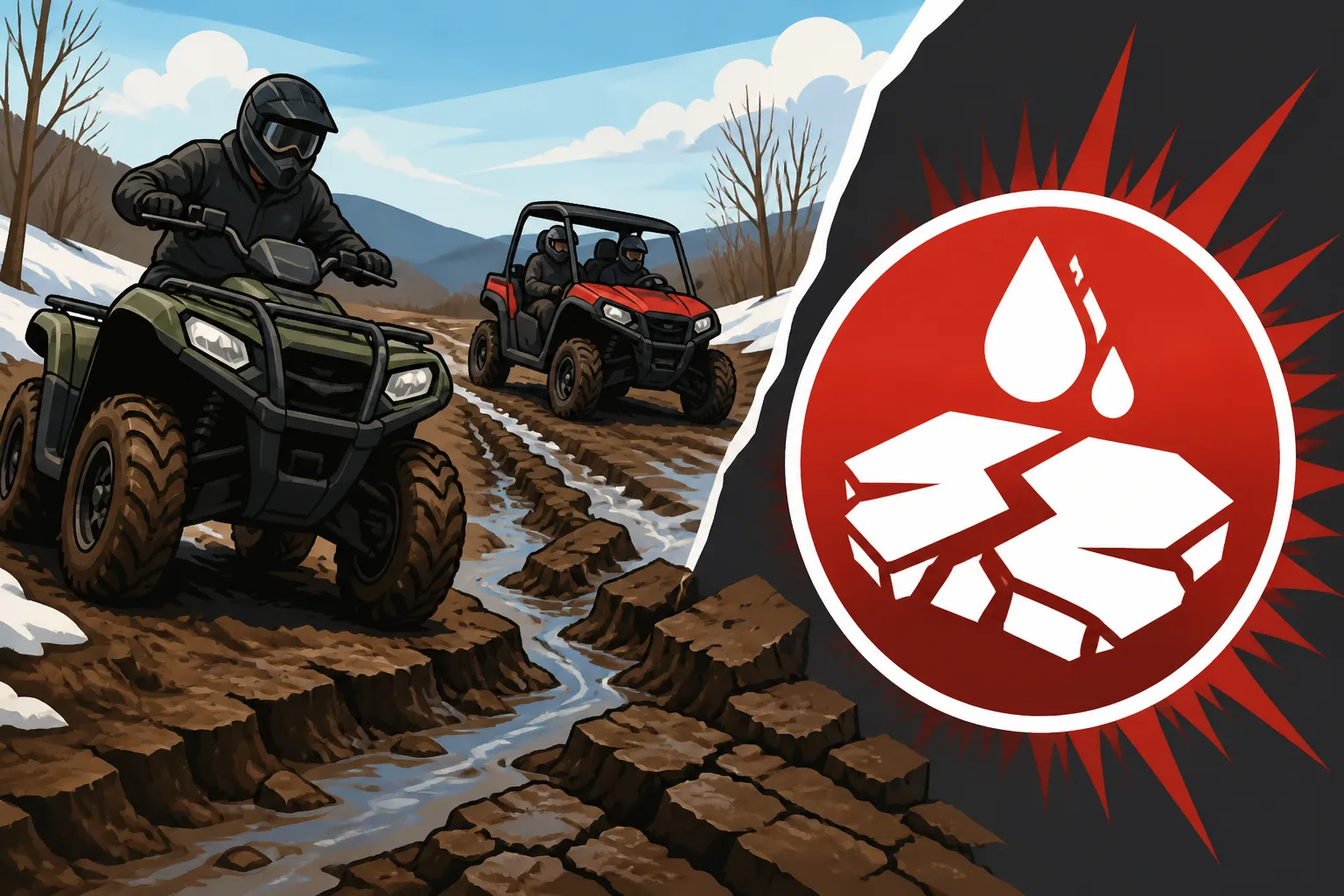
When a tire spins in wet soil, it can carve a rut that channels the next rainstorm. Water then follows the rut instead of spreading gently across the trail, washing away more soil and deepening the groove. The result may be an uneven, eroded surface that is harder for riders to navigate and more costly for land managers or trail groups to repair.
Trying to power through a muddy section can make matters worse. A rider may cut around a puddle to find firmer ground, but repeated detours gradually widen the trail. On a narrow route, one fresh bypass can become the new line for everyone who follows. Side-by-sides can affect a wider area when they squeeze around soft spots, especially where the trail edge is already unstable.
Mud season is not just an inconvenience or a test of tire grip. It is a period when the ground can be unusually easy to damage, even for experienced riders with capable machines. Why Mud Season Closes Trails explains why a temporary closure can help prevent longer-lasting trail damage.
Drainage problems are often the hidden issue
A puddle does not always mean a trail is poorly maintained. Some wet areas are part of the terrain, while others point to blocked drainage, a low spot, or water flowing onto the trail from a hillside. If a route has a worn channel down its center, water may be using the trail as a stream. Riding through it can deepen the channel and carry soil into nearby waterways.
Trail crews often need the ground to dry before they can make durable repairs. Bringing heavy equipment onto saturated soil can compact or disturb it further, and fresh grading may not hold if water continues to flow across the surface. A closure during thaw can give the ground time to firm up and allow repair work to be done when it is more likely to last.
How to Tell When a Trail Is Too Soft to Ride
Look beyond the trail entrance
A dry parking lot is not a reliable trail-condition report. Before heading out, look for recent rain, melting snow, standing water, and shaded sections that may remain frozen or wet. If you can, ask the local land manager, trail organization, or riding area for an update specific to your intended route.
Once you arrive, pay attention to the first section of trail without treating it as a green light for the whole ride. Look for standing water, tire grooves, exposed roots, loose soil, or a surface that moves underfoot. If the trail edge is crumbling or your tires leave deep tracks during a cautious approach, turn around rather than testing how far you can get.
A route can also be legally open but physically unsuitable. An official opening does not mean every stretch is dry, and weather can change quickly. Check Pennsylvania Trail Conditions Before You Go and Pennsylvania Trail Closures to Check First before leaving, then verify any posted signs or local notices when you arrive. Mapping tools such as onX Offroad can help you review a planned route and nearby options, but they do not replace current closure information from the land manager.
Use observable signs, not wishful thinking
It is tempting to interpret a shallow puddle as harmless, especially when other tire tracks pass through it. But tracks only show that someone went through; they do not prove the route can withstand more traffic. Deep ruts, a slick surface, mud that clings heavily to tires, or water flowing along the riding line are reasons to stop and reassess.
| Trail sign | What it may indicate | Safer response |
|---|---|---|
| Deep or fresh tire ruts | Soil is soft and easily displaced | Turn back before adding more damage |
| Water running along the trail | Drainage may be using the trail as a channel | Do not ride through or around the flow |
| A widening muddy section | Riders may be creating repeated bypasses | Stay off the section and report it |
| Surface shifting under tires | The ground may not support the machine | Stop in a firm area and reassess |
| Posted closure or barrier | The route is not available for riding | Do not go around the closure |
| Dry entrance but wet low ground | Conditions vary along the route | Avoid assuming the full trail is ready |
A good rule is to make the decision before you are committed to a difficult section. If turning around would require crossing a fragile shoulder or spinning in deep mud, the safest choice is usually to stop on firm ground while there is still room to change plans.
Treat posted closures as part of trail stewardship
A closure may be in place because the soil is saturated, a bridge or drainage feature needs attention, or a section has already been damaged. It can also reflect seasonal access rules or a temporary safety concern. The reason may not be obvious from the trailhead, but riding around a barrier can extend damage and may create access problems for everyone.
Do not use a bypass, service road, or adjacent path unless it is clearly open to your machine and intended for public riding. A line that looks like a convenient detour may cross private property, protected land, or a route closed to motorized use. If the closure information is unclear, contact the managing agency or local organization rather than guessing.
For broader context on seasonal access, see Pennsylvania Trails Closed in Spring. If a trail has been closed after rain or thaw, Pennsylvania Riding After a Storm offers useful perspective on why waiting for conditions to improve is often the better call.
What to Do Before You Ride in Thaw Season
Check access and conditions close to departure
Spring conditions can change between the time you plan a ride and the time you reach the trailhead. Start with the managing agency’s current notices, then check local trail-organization updates or contact the site if the status is uncertain. Make sure the route is open to your vehicle type; an ATV and a wider UTV may not have the same access options.
Use onX Offroad as a planning aid to review the route and identify alternatives, but confirm access and closures through the organization responsible for the land. A mapped line is not, by itself, proof that a road or trail is currently open to the public. Even a route you have ridden before may be closed for seasonal conditions or maintenance.
It also helps to make a backup plan that does not depend on finding an open trail at the last minute. Pick another confirmed riding area, choose a different day, or plan a non-riding outing if conditions are too wet. The frustration of changing plans is real—especially after loading machines and driving a long way—but it is still better than getting stuck or leaving damage behind.
Before you head out, use a simple check:
- Confirm that the riding area is open for the date you plan to go.
- Check for recent rain, snowmelt, and any local closure notices.
- Verify that your machine is permitted on the specific route.
- Look for posted restrictions when you arrive.
- Be ready to turn around if the surface is soft or visibly deteriorating.
For route planning, onX Offroad can help you keep your intended path and possible alternatives organized. Still, treat local signs and official updates as the authority on whether a route is open. A map can support a careful plan; it cannot make a closed trail legal to ride.
Prepare for a turn-around, not a recovery mission
A winch, recovery strap, and suitable gear can be useful on a responsible ride, but they should not be treated as permission to enter questionable ground. Recovering a machine from a soft shoulder can tear up vegetation, widen the trail, or put riders in a risky position. The best recovery is often the one you avoid by recognizing poor conditions early.
Travel with enough supplies for a delay, and tell someone where you expect to ride. If you are riding with others, agree ahead of time that anyone can call off a section when the trail looks unsafe or fragile. Peer pressure can make a bad decision feel easier in the moment; a shared plan makes turning around feel normal.
Park thoughtfully at the trailhead, too. Avoid blocking access or driving onto soft shoulders to create extra space. Information about Parking a Trailer at a Forest Trailhead can help you plan where to stage without damaging surrounding ground or interfering with other visitors.
How to Ride Responsibly When Trails Reopen
Stay on the established route
When a trail reopens, avoid assuming every wet patch needs a new line around it. Riding off the established route can damage vegetation and expand the disturbed area. If a puddle or soft section looks unsafe, turn around or follow guidance from the trail manager rather than creating a bypass.
Keep your machine at a controlled speed, particularly near drainage features, steep grades, and narrow sections. Spinning tires can loosen soil even when the trail seems mostly dry. In a group, leave enough distance to see what the rider ahead is encountering and avoid bunching up at a muddy bottleneck. The rider in front should not feel pressured to charge through just because others are waiting behind.
If you see fresh damage, note its location and report it to the appropriate land manager or trail group. A useful report describes the route or nearby marker, the kind of problem, and whether the issue blocks passage. Avoid posting a vague message that could send more riders toward a damaged section without explaining its status.
Give reopened trails time to settle
A trail opening is a welcome sign, but it does not mean the surface is indestructible. Follow any restrictions, watch for wet pockets, and avoid adding unnecessary traffic to an area that is still recovering. If several routes are available, spread out use only where each route is confirmed open and appropriate for your machine.
Think about the trail’s full season, not just the ride in front of you. A rut created during thaw can carry water for months, become rougher with repeated use, and require significant work to repair. Waiting for firmer conditions may preserve access for the next weekend, the rest of the season, and future riders.
The first week a route opens can be particularly tempting. You may be eager to get back out after winter, and a trail that looks dry from the staging lot can create a false sense of confidence. Check updates again before you go, then make your decision based on the conditions you actually find. Riding a Trail the Week It Opens and Pennsylvania Trail Etiquette on Narrow Trails are useful reading for riders trying to balance excitement with care for shared routes.
Make the decision that protects future access
Skipping a ride because of soft ground can feel disappointing, especially when the machines are ready and the weather finally looks inviting. But a wet trail is not a challenge that needs to be conquered. Choosing another day helps protect the route, reduces the chance of getting stuck, and makes it easier for trail managers to keep access available.
A quick check of local notices, careful observation at the trailhead, and a willingness to turn around are simple habits with an outsized effect. Use onX Offroad to organize your route planning, confirm access with the responsible authority, and let actual ground conditions guide the final call. When thaw has left a trail vulnerable, patience is part of being a good rider.
Disclaimer
This article is for general informational purposes only and does not constitute professional advice. Laws, prices and regulations vary by location and change over time. Consult a qualified professional for guidance on your specific situation.