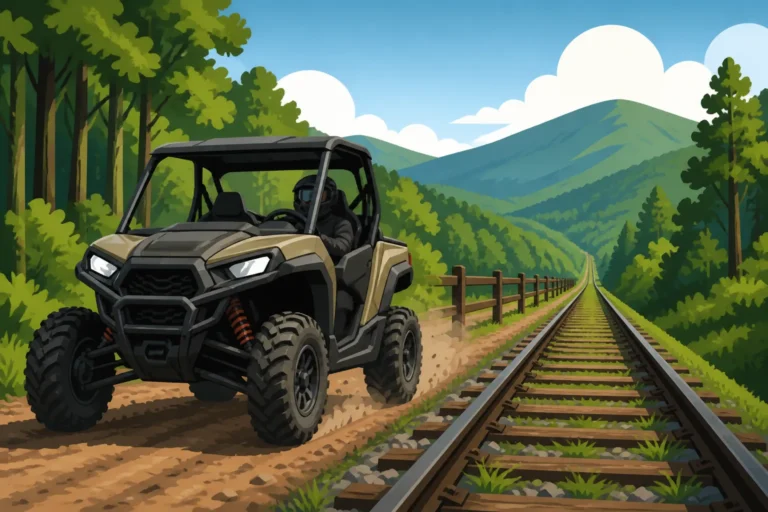
Pennsylvania Riding After a Storm
A Pennsylvania trail can look rideable from the staging area and still be slick, washed out, or closed around the next bend after a storm. That uncertainty is frustrating when you’ve loaded the machines and driven hours. This guide explains how to check conditions, spot storm damage, decide whether to ride, and protect trails when you do.
Check trail status before loading your ATV or UTV
Confirm that the route is open and permitted
A map can show where a trail runs, but it cannot tell you whether storm damage or a temporary closure has changed what you may ride today. Before leaving home, check the official information for the specific trail system, land manager, or riding park. State forest routes, private parks, club trails, and township roads may have different rules and closure notices.
Pennsylvania’s marked riding areas include places such as Whiskey Springs, Bloody Skillet, and trails in the Allegheny National Forest. Their conditions and access rules are not interchangeable. A trail being open in one forest does not mean another nearby route is open, and a familiar access road may have a separate closure. Start with [Pennsylvania Trail Closures to Check First] and confirm the route with the organization responsible for it.
For state forest riding, verify both the trail’s status and what access requirements apply to your machine and trip. A trail permit, where required, does not override a closure. Keep in mind that storm damage may affect only a section of a route, but a blocked or damaged section can still make an otherwise open loop impractical. [Pennsylvania ATV Trail Permits Explained] can help you understand the difference between trail access requirements and the condition of the trail itself.
Treat online maps as planning tools, not closure notices
A mapping app such as onX Offroad can help you follow a route, identify nearby junctions, and plan a backup route before you set out. It can be useful when a storm makes familiar landmarks hard to recognize or when you need to see how a proposed loop connects. But a digital map is not a substitute for a land manager’s current closure notice. Use it to plan, then verify that your intended route is open.
Download or save the information you’ll need before you lose cell service. A screenshot of a trail map, a list of key junctions, and the official contact or status page can be more useful than hoping your phone will load a page from a remote staging area. onX Offroad can also help you understand where you are relative to a planned route, but do not interpret a visible line on a map as permission to ride it.
If a route is closed, do not ride around a gate, barrier, or downed-tree closure simply because a map still displays the trail. A closure can protect riders from hazards that are not visible from the trailhead, and riding around it can create a new path that damages the land or confuses other visitors.
Make the go-or-no-go call before the drive
When status information is vague, try to contact the trail operator or land manager before loading up. Ask specifically about the route you plan to ride, not just whether the general area is open. A trail system may be partially open, have a damaged access road, or be operating with restrictions that affect your planned loop.
Use a conservative standard if you cannot confirm conditions. A long drive is disappointing to abandon, but it is better than discovering a washed-out crossing or a closed route after you have committed to a remote ride. If you do go, have a shorter alternative and a clear point at which you will turn around. [Pennsylvania Trail Conditions Before You Go] offers additional planning considerations for checking conditions ahead of a ride.
| What you find before the ride | Safer choice |
|---|---|
| The trail manager confirms the route is open and reports no relevant damage | Plan conservatively and reassess as you ride |
| A closure notice covers any part of your planned route | Choose a different open route |
| Recent heavy rain, but no reliable local condition update | Contact the operator or postpone |
| Water is crossing the trail or the surface is actively eroding | Turn around; do not ride through or around the damage |
| A route is open, but your machine does not fit posted width or access rules | Choose a route your machine is allowed to use |
Understand what a storm can change on the trail
Expect more than mud
Rain changes a trail in ways that may not be obvious from the staging area. Water can loosen gravel, uncover rocks, carry soil off a slope, and leave ruts where the surface was previously smooth. A dip that was easy to cross when dry may now hold water over a hole, a displaced rock, or a soft edge. A muddy surface can also hide the depth and firmness of the ground below it.
Storm effects vary by terrain. On a wooded hillside, runoff may cut channels down the trail or carry debris into a low spot. Along a creek or drainage, water can undercut a bank or move stones. In a rocky section, wet surfaces can reduce traction even when the trail itself has not visibly washed away. On a broad, open route, standing water may be the main concern; on a narrow trail, a single downed tree can leave no safe room to pass.
Take the first part of the ride slowly. Stop at a safe place to inspect unfamiliar puddles, slopes, and crossings rather than assuming the route is unchanged. If you cannot see the surface beneath standing water, avoid entering it. Turning around is a sensible decision, not a failure to complete the ride.
Watch for hazards that affect riders and machines
After a storm, branches can hang overhead, trees may be leaning, and debris can partially block the trail. A branch that looks stable from a distance may shift when the wind moves it or when a machine passes. Never try to move a large tree or unstable limb with an ATV or UTV; report the obstruction to the trail manager.
Water crossings deserve special caution. Rain can raise water levels, increase the force of a current, and hide a damaged approach or an uneven bottom. Do not assume a crossing is safe because you have ridden it before. If water is moving quickly, has risen over the banks, or obscures the route, turn back. Do not enter water when you cannot judge its depth, current, and exit.
Also consider the route you would use to get help. A trail can be technically passable but difficult to exit if another storm moves in, a vehicle becomes stuck, or a rider gets hurt. Before setting out, tell someone where you are going and when you expect to return. Carry enough supplies for a delay, and keep your phone, wallet card, and other paperwork protected from rain. [Keeping Paperwork Dry on a Wet Trail] has practical ideas for keeping essential documents usable.
Recognize when the ground needs time to recover
A trail may be open but still vulnerable. Saturated soil can rut under a machine’s tires, especially on a slope or soft section. Once deep ruts form, later rainfall can channel water through them and widen the damage. Repeated passes over a wet surface can turn a temporary muddy patch into a longer-lasting erosion problem.
This is one reason to distinguish between “open” and “good to ride.” The land manager decides access; you still need to use judgment about the ground beneath your tires. If the surface gives way, deepens with each pass, or causes your machine to slide unpredictably, stop and turn around. Avoid creating a new line around the soft section. A bypass often widens the damaged area and can lead riders onto an unauthorized route.
For more on why wet conditions can lead to closures, see [Why Mud Season Closes Trails]. If a trail has recently reopened, give it extra care rather than assuming it has fully dried or recovered.
Ride responsibly when a trail is open after rain
Slow down and leave extra room
Wet roots, rocks, leaves, and packed soil can all reduce traction. Lower speed gives you more time to respond to a rut, a blind corner, or a rider ahead who has stopped to assess a hazard. Increase your following distance, particularly when traveling in a group. The machine in front can throw water or loose material, and a sudden stop is harder to manage on a slick surface.
Use smooth inputs. Abrupt acceleration can spin tires and dig into soft ground; sudden braking or sharp steering can make a machine slide. If you feel the tires slipping, ease off rather than adding more throttle. Keep your weight balanced and follow the route’s posted rules. Do not speed through a puddle just to avoid getting stuck: you may splash another rider, conceal a hazard, or damage the trail surface.
On a UTV, remember that width and turning room matter. A wet shoulder may not support the machine, and a narrow section may not provide space to turn around safely. Check whether your machine is allowed on the route and within its posted width limits before riding. [Pennsylvania Trails for a Wide Machine] can help with route planning when you ride a larger vehicle.
Do not make a new trail around a problem
When a tree, washout, or deep puddle blocks the route, riders often feel tempted to go around it. That can make a difficult day worse. A detour may cross fragile vegetation, private property, or land that is closed to motorized use. It may also create a second track that draws future riders away from the marked route.
Instead, stop in a safe place and check whether the obstruction can be reported to the trail manager. If the route is clearly blocked or unsafe, turn around using an authorized route. Do not move signs, pass a gate, or ride along the edge of a closed trail. [Pennsylvania Rules for Riding Off the Trail] explains why staying on the designated route matters.
If you’re with a group, agree before the ride that everyone will turn back when a section is unsafe. That simple conversation helps avoid pressure to push ahead because one person is eager to finish the loop. A rider who wants to continue can put the rest of the group in a difficult position, particularly when visibility is poor or the route is remote.
Protect the trail as you travel
Keep your tires on the established trail and avoid spinning them to climb a wet incline. If a hill is slick enough that you cannot maintain control without digging in, stop and choose a safe way back rather than repeatedly attacking the slope. Do not ride through vegetation to bypass mud. The apparent shortcut can become an erosion channel or an unauthorized trail.
Give other riders, hikers, land managers, and maintenance crews room to work. After severe weather, crews may be clearing debris or assessing damage. Follow their directions and any temporary signs. If you come across a hazard, note a nearby trail marker, junction, or other clear landmark so you can report its location accurately. An app such as onX Offroad may help you describe where you are, but use the official channel for reporting and follow the land manager’s instructions.
Storm recovery is shared work. A responsible turn-around protects your machine, your group, and the trail for the next ride. [Pennsylvania Trail Etiquette on Narrow Trails] has more guidance on sharing trail space thoughtfully.
Prepare for a safer post-storm ride
Pack for delays, not just the planned loop
A post-storm ride can take longer than expected because you may need to stop, inspect conditions, or turn back. Bring water, food, weather-appropriate layers, and a basic first-aid kit. Carry a charged phone, but do not count on reliable reception everywhere. If you ride with a group, agree on a meeting point if anyone gets separated.
Before leaving, check fuel, tires, lights, and basic controls. Wet conditions can make a minor mechanical issue more troublesome, particularly if you are far from the staging area. Carry appropriate recovery gear, but use it only when you can do so safely and without damaging the trail. A winch is not a reason to enter a crossing or climb an unstable bank.
Tell someone who is not riding with you where you plan to go and when you expect to check in. Give them the trail system and a realistic return window. If your plan changes, update them when you have service. This is especially useful when the weather is unsettled or when you are riding in a remote part of a forest.
Adjust the plan to the conditions
A familiar route is not automatically the best choice after a storm. A short, well-known loop may be easier to assess than a long ride with several crossings and remote sections. Choose routes that allow you to turn around without leaving the authorized trail. If the forecast suggests more rain or high winds, postpone rather than trying to squeeze in a ride before conditions worsen.
Use mapping tools to prepare, not to push through. onX Offroad can help you review a planned route and identify alternatives, while official trail information tells you whether those alternatives are open. Keep a paper or saved offline backup if you expect limited service, and make sure everyone in your group understands the planned route.
If conditions feel worse than expected once you arrive, you can still change the plan. A short scouting ride or a decision to head home may feel like a wasted trip, but it can prevent a damaged machine, an injury, or avoidable trail damage. [Pennsylvania Riding After a Storm] is ultimately about making that call with enough information to choose caution over guesswork.
Report damage and respect closures
When you find a downed tree, washout, damaged crossing, or unsafe trail edge, report it to the trail operator or land manager. Be specific: identify the trail, the nearest junction or marker, what you observed, and whether the route appears passable. A clear report is more useful than a general message that a trail is “bad.”
Do not post a closure location as an invitation to find a workaround. Share verified information responsibly and direct other riders to official updates. If a route is closed, wait for the responsible organization to reopen it. Conditions can change quickly, and a trail that looks passable to one rider may be unsafe for another machine or group.
Before your next trip, check again. A storm can affect one part of a system while leaving another usable, and repairs or additional closures may follow the initial damage. Confirm access, prepare a backup plan, and be willing to turn around when the ground or weather tells you the ride should wait.
Disclaimer
This article is for general informational purposes only and does not constitute professional advice. Laws, prices and regulations vary by location and change over time. Consult a qualified professional for guidance on your specific situation.