Pennsylvania Trails for Beginners
Choosing a first Pennsylvania ATV trail can feel harder than choosing the machine: difficulty labels vary, conditions change, and a route that looks manageable on a map may feel very different from the seat. This guide explains where beginners can start, how to match a trail to their experience and machine, and what to check before loading up.
What makes a Pennsylvania ATV trail beginner-friendly
Look for a manageable route, not just a green rating
A trail marked easy can still include loose rock, steep sections, tight turns, water crossings, or uneven ground. Ratings are useful starting points, but they may not tell you how a trail will feel to a new rider on a particular machine. A short, well-marked route with places to stop and turn around is often a better first outing than a long loop with a reassuring label.
Think about the rider as well as the terrain. Someone comfortable on a farm lane may be new to narrow wooded trails. A side-by-side driver may have experience on roads but little practice judging clearance between trees. And a new rider on a small youth quad may need a gentler pace and closer supervision than an adult on a full-size ATV.
For a first ride, choose a route where you can comfortably slow down, stop, and assess an obstacle without feeling pressured by a group behind you. Check [Pennsylvania Trail Difficulty Ratings] alongside recent trail information, and treat any rating as a guide rather than a promise that every section will feel easy.
Pick the riding area to suit your first day
Pennsylvania has public trail systems and private riding parks, and they do not all offer the same kind of first ride. Public forest routes can be scenic and rewarding, but some are narrow or rocky and may share space with other trail users or forest-road traffic. A private park may offer a wider range of marked routes, but its terrain can still vary considerably.
For a beginner, the practical differences matter: Is there a staging area where you can unload without rushing? Can you choose a short route? Are there signs or maps at the trailhead? Will you be able to return to the parking area if a rider is tired or uncomfortable? These questions are often more useful than choosing a destination based on miles of trail alone.
Before deciding, compare the trail system’s rules and access requirements with your own needs. For example, [Pennsylvania's Free State Forest Trails] can help you understand the public-land option, while [Pennsylvania Trails With Staging Lot] is a useful topic to review when you want a straightforward place to park, unload, and prepare.
| Beginner concern | What to look for | Why it helps |
|---|---|---|
| Unfamiliar terrain | Short routes with clear markings | Makes it easier to build confidence gradually |
| A mixed-experience group | Trails with options to turn back or choose another loop | Lets riders progress at different paces |
| A new or wide machine | Posted width limits and current access rules | Reduces the chance of arriving with an unsuitable vehicle |
| Uncertain conditions | Recent notices and trail updates | Helps you avoid surprises from closures or changing surfaces |
| First-time unloading | A clear staging area | Gives you room to gear up and check the machine before riding |
Pennsylvania riding areas to consider as a beginner
Start with access and route options, not a famous name
A well-known trail system is not automatically the best beginner choice. Before you commit to a destination, look for practical signs that the day can be adjusted: multiple route options, understandable markings, a place to review the map, and a way to shorten the ride if someone gets tired.
Pennsylvania’s Northcentral riding opportunities, for example, involve checking the specific trail area and its access requirements rather than assuming one permit or one map covers every place you might want to ride. If you are considering that region, read [Pennsylvania's Northcentral Regional Trail Permit] and verify that the route you plan to use is open to your machine and registration type.
Private riding areas may also suit a first outing if their trail maps clearly distinguish route difficulty and you can choose an appropriate loop. That does not mean every route in a park is beginner-friendly. Ask the operator about current conditions, machine restrictions, and whether there is a short route that avoids the harder terrain. A marked beginner route is a better starting point than following experienced riders onto an unfamiliar trail.
Choose the right season and check conditions
A route that feels manageable when dry may be much more demanding after rain. Mud can hide ruts, make climbs slippery, and increase the effort needed to steer or stop. Loose stones can shift under tires, while standing water can conceal holes or rocks. New riders often underestimate how quickly those conditions can turn an easy pace into a tiring ride.
Check for closures, maintenance notices, seasonal access rules, and weather-related updates before you leave home. Use official trail or land-manager information as your primary source for whether a route is open. Mapping tools such as onX Offroad can help you plan and understand the area, but a digital route display should not be treated as proof that a trail is open or legal to ride.
If you arrive and the ground looks rougher than expected, it is fine to change the plan. A shorter ride on familiar-feeling terrain is a successful first day. Review [Pennsylvania Trail Conditions Before You Go] and [Pennsylvania Trail Closures to Check First] before setting out, especially if you are traveling a long distance or planning around a narrow seasonal riding window.
Prepare your machine, paperwork, and riding plan
Confirm that your machine is allowed on the route
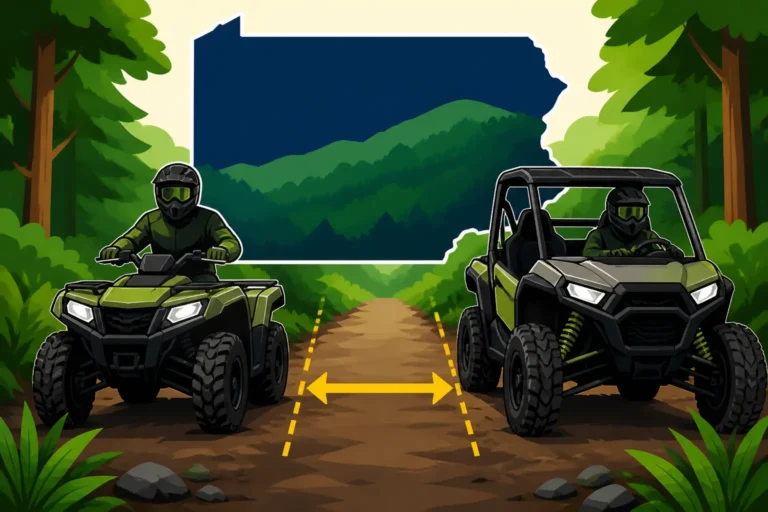
The size and type of vehicle can shape your trail choices. Pennsylvania state forest trails have machine restrictions, and a side-by-side that is too wide for a route may not be allowed even if it can physically fit between the trees. Check the specific width and access rules for your intended trail before you buy, borrow, or trailer a machine there. If you are still comparing options, [Pennsylvania's Class II Trail Width Limit] offers relevant context.
Also confirm that your ATV or UTV has the registration and any trail-specific permit required for the place you plan to ride. Requirements can differ between public land, private parks, and other riding areas. Do not assume that a registration from another state, a club sticker, or a permit for one forest automatically authorizes riding everywhere in Pennsylvania.
Make a simple pre-trip checklist: machine eligibility, registration, permit, helmet and protective gear, trail map, and a plan for carrying required documents. If the rules are unclear, contact the land manager or riding area before you travel. Sorting this out at home is much less stressful than finding out at the trailhead that your machine or paperwork does not meet the requirements.
Build confidence with a simple first-day routine
Start with a pre-ride check rather than heading straight onto the trail. Look over tires, brakes, throttle, lights, fuel, and visible leaks; make sure the machine is in good working order and that helmets fit securely. Pack water, a basic first-aid kit, a charged phone, and any tools or supplies that make sense for your machine and route.
Once you start riding, leave generous space between machines. Keep a speed that allows you to stop within the distance you can see, and do not feel obliged to follow someone else’s pace. On a narrow trail, pause in a safe, visible spot if you need to regroup rather than stopping around a blind corner. Review [Pennsylvania Trail Etiquette on Narrow Trails] before riding with a group or sharing a route with other users.
For a family outing, match the route and supervision to each child’s age, training, and ability. A young rider’s comfort on a familiar machine does not automatically mean they are ready for a longer or more technical trail. Check [Pennsylvania Trails Good for Kids] and [Pennsylvania ATV Safety Certificate Requirements] when planning for younger riders, and confirm the applicable rules for the specific place you intend to ride.
Make your first trail ride less stressful
Keep the plan flexible
A common first-ride mistake is planning around a fixed mileage target. Beginners may need more stops to adjust helmets, talk through trail signs, check a map, or take a break. A short route with time to learn is usually more enjoyable than pushing through a long loop just because it was the original plan.
Before unloading, agree on a few basics: who leads, who stays at the back, what to do if the group gets separated, and where everyone will stop for a break. If riders have different experience levels, choose a route that gives the newer person a comfortable pace rather than making them feel they have to keep up. An experienced rider can still enjoy the day by focusing on clear communication and safe spacing.
It also helps to decide in advance what would make you turn around. A machine that feels difficult to control, a route that becomes rocky or muddy, or a rider who is tired are all reasonable reasons to change plans. Turning back is not a failure. It is a way to leave enough energy and confidence for another ride.
Use maps as planning tools, then follow local rules
A map can help you understand where a trail goes, identify access points, and discuss a route with your group before the ride. onX Offroad can be useful for planning and orienting yourself, but always check current official information for access, restrictions, and closures. A line shown on an app does not replace signs on the ground or the rules set by the land manager.
At the trailhead, take time to read posted notices. Trail access, permitted vehicle types, seasonal restrictions, and route direction can vary by location. If a sign conflicts with a route you saved earlier, follow the posted restriction and check with the responsible authority rather than continuing based on the map.
Keep your first outing simple: choose one riding area, confirm the paperwork, check conditions, and pick a route that you can shorten. With a realistic plan and room to adapt, Pennsylvania’s trails are easier to approach—and a lot more enjoyable—whether you ride an ATV or a UTV.
Disclaimer
This article is for general informational purposes only and does not constitute professional advice. Laws, prices and regulations vary by location and change over time. Consult a qualified professional for guidance on your specific situation.