Pennsylvania’s ATV Trail Season
Pennsylvania ATV season planning can get confusing fast: one trail may be open while a nearby route is still closed, and a valid registration does not automatically grant trail access. This guide explains the typical riding windows, how seasons differ by land manager, what to check before loading your machine, and how to prepare for changing weather, closures, and busy weekends.
How Pennsylvania ATV Trail Seasons Work
There is no single statewide season calendar
Pennsylvania does not have one season that applies to every ATV and UTV trail. Riding dates depend on who manages the land, which trail system you plan to use, and whether a route has a temporary closure. State forest trails, Allegheny National Forest trails, club properties, and private riding parks can each follow different calendars.
That is why a date you heard from a friend may not apply to your planned ride. A trail open in one forest district may be closed in another, and a private park may use its own operating schedule. Treat the season as a collection of local schedules rather than one statewide opening day.
For example, a rider planning a long weekend around Memorial Day might find a state forest route approaching its regular summer opening while a private facility is already operating, or while another location remains closed for maintenance. Before traveling, identify the land manager for the exact trail and check its posted dates and alerts.
State forest trails often have seasonal riding windows
Many Pennsylvania state forest ATV trails use defined riding periods rather than staying open all year. Summer riding commonly begins around the Friday before Memorial Day and runs through the last full weekend in September. Some routes may also open during a winter window after the antlerless deer season, with trails typically closing again around April 1.
These dates are useful for planning, but they are not a promise that every route will be open throughout the window. A trail can be closed for thaw-related damage, storm cleanup, logging, construction, or another management reason. Weather and ground conditions can also affect access, especially during spring thaw.
Check the specific forest district and trail system before setting out. If your trip depends on a particular route, confirm its status shortly before departure rather than relying on an old social media post or a calendar saved from a previous season. For a broader overview, see [Pennsylvania's ATV Trail Season Dates] and [Pennsylvania's Winter Season Dates].
Private parks and club trails set their own schedules
Private riding parks and club-managed trail systems may offer a different season from public land. A park might open on selected weekends, close during heavy rain, require advance registration, or run a schedule that changes with staffing and maintenance. Club trails can also depend on membership, landowner agreements, or a limited operating calendar.
This can make a private facility a useful alternative when public trails are out of season, but it does not mean the trails will always be open. Check the operator’s official schedule and rules before you go. Confirm the type of machine allowed, any width restrictions, helmet requirements, passenger rules, and whether you need to register or reserve a ride.
A map can help you understand where a park sits and how to plan the drive, but it cannot establish that a trail is currently open or that you have permission to ride it. A route-planning tool such as onX Offroad can help you organize a trip and review mapped areas; use the land manager’s latest notices to confirm access.
| Riding area | Who sets the schedule | What to check before leaving |
|---|---|---|
| State forest ATV trails | Pennsylvania DCNR and the relevant forest district | Seasonal dates, closures, permit rules, and trail conditions |
| Allegheny National Forest trails | The U.S. Forest Service and relevant trail managers | Forest permit requirements, seasonal access, and route notices |
| Private riding park | The park operator | Operating days, machine rules, fees, and weather closures |
| Club or leased trails | The club and landowners | Membership or day-use access, permission, and current trail status |
| Township roads designated for ATV use | The township and applicable state rules | Posted road status, permitted hours or conditions, and legal equipment |
Pennsylvania’s Main Riding Windows
Summer riding from late spring into early fall
For many riders, summer is the easiest season to plan. State forest routes that follow the familiar summer calendar generally open around the Friday before Memorial Day and remain open through the last full weekend in September. That period offers a broad window for weekend trips, family rides, and longer stays near trail systems.
Opening weekend can be busy, especially at popular staging areas. A trail that feels quiet on an ordinary weekend may see more trailers and groups during a holiday. Arriving early, knowing where you plan to park, and having a backup route can make the day much less stressful. Be patient at narrow sections and keep enough space between machines to avoid dust, rocks, and sudden stops.
Late-season riding has its own considerations. Days become shorter, temperatures can change quickly, and wet leaves may hide rocks or ruts. If you are planning a September ride, check both the official closing date and any weather-related notices. Do not assume a route remains open simply because it was accessible earlier in the month.
Winter riding depends on specific dates and conditions
Some Pennsylvania state forest trails have a winter riding period after antlerless deer season. That does not mean every trail opens as soon as the season ends, or that every winter route remains rideable through the same dates. Winter access is controlled by the specific trail schedule, local conditions, and any closures posted by the land manager.
Snow can change the experience dramatically. A route that is manageable in dry weather may become difficult under packed snow, ice, or deep drifts. A thaw can leave soft ground that is vulnerable to tire damage, even when the trail looks firm from the staging area. If conditions deteriorate, turning around is often the most responsible choice.
Prepare for shorter daylight, cold starts, and slower travel. Check your lights, bring weather-appropriate layers, and tell someone where you expect to ride. Winter dates and conditions are explained further in [Pennsylvania Trails That Reopen for Winter] and [Pennsylvania Trails Open in Winter].
Spring thaw is a reason for patience
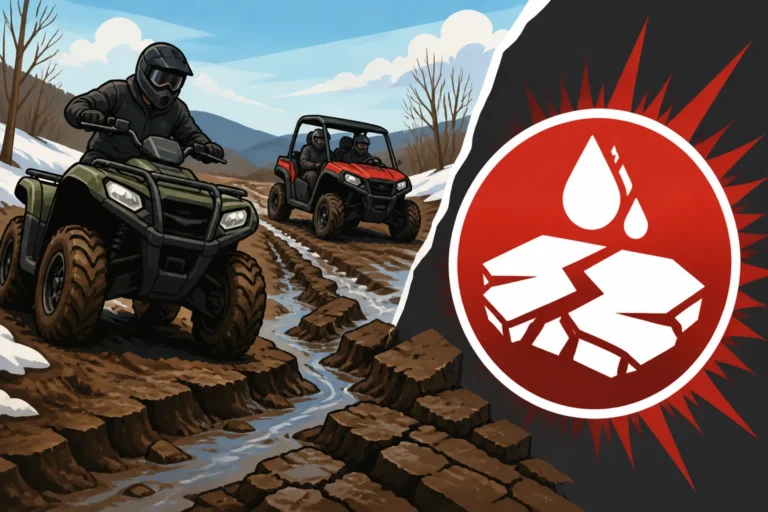
Spring is tempting: the days are getting longer, and the first warm weekend can make it feel as if riding season has started. But thawing ground is especially vulnerable. Waterlogged soil can rut under tires, and repeated traffic can turn a small soft patch into a damaged section that takes time to repair.
A trail may remain closed into spring even when nearby roads are dry. Elevation, shade, drainage, and soil type all affect how quickly a route firms up. The trailhead can look passable while a low section farther along remains muddy and fragile. A closure is not an invitation to find a way around a gate or ride beside the trail.
If you are eager to ride before the regular summer opening, look for a legal alternative that is open at that time, such as a private park that confirms it is operating. For an explanation of seasonal closures, see [Why Pennsylvania Trails Close April 1] and [Trails Damaged by Spring Thaw]. Respecting a closure helps protect the trail and supports a smoother opening later.
Find the Right Trail System Before You Go
State forest access is not the same everywhere
Pennsylvania has several state forest trail areas, and access rules can differ by location. The Northcentral Regional Trail Permit applies to designated trail miles in Clinton, Lycoming, Potter, and Tioga counties. Other state forest trails may be available under different access arrangements, while some roads or routes are not open to ATVs at all.
Do not assume that a forest road is an ATV trail simply because it appears on a map or is wide enough for a machine. A road may be closed to recreational ATV use, reserved for other traffic, or subject to a different permit. Look for official trail maps and signs, and confirm whether the route you want is part of the riding system you are allowed to use.
It is also important to distinguish registration from a trail permit. Registration is tied to the machine and its legal operation; a trail permit may be required for access to a specific network. One does not automatically replace the other. Start with [Pennsylvania's Northcentral Regional Trail Permit] and [Do You Need a Permit for Pennsylvania State Forest Trails?] when planning public-land rides.
Allegheny National Forest access has its own requirements
The Allegheny National Forest has a separate system of designated ATV trails and access requirements. Riders should check the Forest’s current rules, applicable permit requirements, seasonal dates, and route notices before heading to a trailhead. Do not assume that a state forest permit covers a National Forest route or that a rule from another Pennsylvania riding area applies there.
Route planning matters in a large forest. A trip can involve different trail surfaces, road crossings, staging locations, and connections, so decide where you intend to start and which marked routes you can legally use. Be ready to turn around if a trail is closed or conditions make it unsafe. Avoid creating unofficial bypasses around gates or damaged sections.
A digital map can be useful for organizing a route, but official maps and posted signs should guide the final decision. onX Offroad may help you review mapped areas and keep trip notes, while the Forest’s current information remains the place to verify access. See [Pennsylvania's Allegheny National Forest Permit] and [Allegheny Forest Season Dates] for more on this riding area.
Private trails require permission, not guesswork
Club land, leased property, and private trails may not be open to the public just because the entrance is visible or another rider has used the route. Access may depend on club membership, a day-use arrangement, a signed waiver, or direct permission from the landowner. When the trail crosses several properties, the club or operator may coordinate the permissions on your behalf.
Confirm who is allowed to ride, which machines are permitted, and whether access is restricted to certain dates or events. Ask whether you need a sticker, pass, or proof of insurance, and whether passengers are allowed. These details can vary even between nearby clubs, so do not rely on assumptions based on another riding area.
If a gate is closed, a sign says the route is closed, or access terms are unclear, do not ride through and hope it is acceptable. Contact the club or property manager first. For related guidance, read [Riding Private Club Land in Pennsylvania] and [Pennsylvania Landowner Permission Rules].
Check Trail Status and Plan the Route
Start with official maps, notices, and signs
Before a trip, look up the exact trail system on the land manager’s official website or current trail information. Check seasonal dates, temporary closures, permit requirements, staging areas, and any notices about road crossings or maintenance. If the trail manager offers alerts, review them close to your departure date rather than treating an old map as a live status report.
Then use the trailhead signs to confirm what you find. Signs may identify a closed route, a permitted trail, a road crossing, or a restriction that is not obvious on a phone screen. If signs and a digital map appear to disagree, do not choose the interpretation that gives you the longer ride. Stop and check with the managing agency or operator.
Planning a route on a map is still helpful. It can show where you might start, how far a loop could take, and where a group could regroup. Tools such as onX Offroad can assist with organizing a route and keeping track of trip plans, but they are planning aids—not permission to ride and not a substitute for current official closure information.
Check access rules as carefully as the season
A trail being open does not mean every machine or rider can use it. Confirm whether the route allows your ATV or UTV, whether the machine meets any width or weight limits, and whether a particular permit is required. Check passenger rules, age requirements, helmet rules, and insurance requirements that apply to your ride.
Also verify where you may ride. Designated state forest ATV trails are not a blanket authorization to use nearby forest roads, game lands, utility corridors, or township roads. Each type of land and road has its own access rules. A short connector that looks convenient on a map may be closed to ATV use or may require separate permission.
If you are riding with a group, share the rules before anyone unloads. One rider with the wrong permit or an oversized machine can disrupt the day for everyone. Review [Pennsylvania's Class II Trail Width Limit] and [Pennsylvania ATV Trail Permits Explained] if you need to check machine fit and permit basics.
Build a backup plan for closures and delays
A solid riding plan includes an alternative. Identify another legal trail area or an activity nearby in case your preferred route is closed, muddy, crowded, or unsuitable for your group. This is especially helpful when you are driving several hours to a trailhead or traveling with children who are counting on a full day outside.
Estimate travel time conservatively. A short trail distance can take much longer than expected when the route is rocky, unfamiliar, crowded, or interrupted by crossings and regrouping stops. Build in time to unload, check equipment, take breaks, and return before daylight fades. Avoid planning a ride that only works if everything goes perfectly.
Share your plan with someone who is not riding with you. Include the trail system, expected return time, and a contact method. If your group gets separated, agree on a meeting point and a simple response plan before setting off. For planning around conditions, see [Pennsylvania Trail Conditions Before You Go] and [Pennsylvania Trail Closures to Check First].
Prepare Your ATV or UTV for the Season
Inspect the machine before the first ride
A machine that has been sitting through winter needs more than a quick start-up. Check the battery, tire pressure, brakes, lights, throttle response, steering, and fluid levels. Look for cracked hoses, loose fasteners, corrosion, damaged wiring, and signs of fuel leakage. If you are not comfortable inspecting a component, have a qualified mechanic check it before you ride.
Pay attention to the parts that take a beating on Pennsylvania trails. Rocky sections can damage tires and rims, while mud can stress a belt, chain, or clutch system. Clean the machine after a ride and inspect it again before the next one. A small problem caught in the garage is easier to deal with than a breakdown deep into a route.
Carry a basic tool kit suited to your machine, along with the equipment needed to handle common trail-side issues. The right kit depends on your model and how far you ride from a staging area. Keep tools secured so they do not become loose cargo, and learn how to use them before an emergency.
Carry the essentials for a full day out
Pack water, food, first-aid supplies, a flashlight, a charged phone, and weather-appropriate clothing. A phone can be useful for navigation and communication, but reception may be limited in remote areas. If you use an electronic map, consider how you will navigate if your battery runs low or you lose service.
Secure registration and permit documents where they will stay dry and accessible. A wallet card holder or waterproof pouch can prevent a soaked pocket from turning paperwork into a soggy mess. Before leaving home, confirm that the documents match the machine you are bringing and that you can show them if asked.
If your group has different machines, check each one separately. A family member borrowing a quad or a friend bringing a UTV should not assume that the paperwork or equipment on another vehicle covers theirs. A pre-ride check-in prevents awkward surprises at the trailhead.
Match the machine to the route and the group
A UTV that fits comfortably on a private park trail may not fit the width limit for a narrow state forest route. Check machine dimensions against the rules for your destination before you tow it there. Also consider trail difficulty: a route with tight turns, rocks, or steep sections may be a poor fit for a wide or heavy machine, even where access is technically allowed.
Think about the least experienced rider in the group. A long, challenging loop can become frustrating if someone is learning the controls or struggling with a heavy machine. Choose a route that allows beginners to gain confidence, and agree that no one has to keep up by taking risks.
Passengers need suitable protective equipment and a machine designed to carry them. Do not treat a passenger seat as permission to overload the vehicle or ignore age and safety rules. For more preparation ideas, see [Pennsylvania ATV Trail Etiquette on Narrow Trails] and [Pennsylvania Trails for a Wide Machine].
Ride Responsibly During Every Season
Protect trails during wet or fragile conditions
The ground can look firm at the staging area and remain soft in shaded or low-lying sections. If tires begin to sink, rut, or push mud onto the trail, stop and reassess rather than powering through. Spinning tires can deepen damage quickly and make the route harder for everyone who follows.
Do not ride around a muddy section by widening the trail into vegetation or creating a new track. That can damage plants, disturb drainage, and turn one fragile area into several. If the route is deteriorating, turn back and report the problem to the managing agency or operator using its preferred contact method.
The same care applies after storms. Fallen trees, washouts, and debris can make a familiar trail unsafe or inaccessible. Do not move barriers or ride through a closure to see whether the route is passable. Wait for the trail manager’s direction or choose an alternative that is confirmed open.
Share trails and roads safely
Pennsylvania riding areas can include narrow trails, road crossings, and routes shared with other users or vehicles. Slow down where visibility is limited, stay to the designated route, and leave room for oncoming riders. On blind corners, approach cautiously and be ready to stop.
At road crossings, follow signs and applicable rules. Do not assume that a road is open to ATV traffic because another rider crossed it. Posted status matters, and crossings can be especially risky when vegetation, hills, or parked vehicles limit sightlines.
Be considerate when passing hikers, cyclists, horseback riders, or other trail users where such use is allowed. Reduce speed, give people room, and wait if the trail is too narrow for a safe pass. Noise, dust, and sudden approaches can unsettle both people and animals, so a calm, predictable ride goes a long way.
Adjust your riding to weather and daylight
Warm, dry weather can create dust that reduces visibility between machines. Leave extra space and avoid riding directly in another vehicle’s dust cloud. After rain, expect slick rocks, standing water, and changing traction. Use a pace that leaves room to respond rather than trying to maintain the same speed you would use on a dry trail.
In colder months, plan for temperature changes between the parking area and exposed sections of trail. Wet gloves and clothing can make a manageable ride uncomfortable quickly. Check that your lights work, keep your phone protected from cold and moisture, and leave enough daylight to return without rushing.
Seasonal conditions can change during a single outing. If the group becomes tired, visibility drops, or a route becomes unsafe, shorten the ride. Turning around is not a failed trip; it is a sensible decision that helps everyone get back to the trailer in one piece.
Plan Your Trip Around the Calendar
Choose a date that matches the kind of ride you want
For a first visit or a family outing, a regular summer weekend may be easier to manage than a holiday opening weekend. You may have more room at staging areas, less pressure to rush, and a better chance to learn the route at a comfortable pace. Still, check the trail status and operating schedule because conditions and closures can change.
If you want a winter ride, make the season and the weather part of the decision. Confirm that the trail system is open, then consider snow, ice, daylight, and the experience level of the group. A winter trail can be rewarding, but it calls for more preparation and a lower tolerance for risky shortcuts.
For a longer trip, contact the trail manager or park operator ahead of time if any details are unclear. Ask about the current access window, parking, permits, machine restrictions, and closures. A brief check before you leave can save a long drive to a gate.
Make a simple pre-trip checklist
A short checklist is easier to follow than trying to remember everything while loading. Before departure, confirm the destination is open, the route is legal for your machine, and the required permits and registration are in order. Check weather forecasts, trail notices, and the expected daylight window.
At home, inspect the machine and trailer, secure your load, and pack protective gear, water, food, tools, and first-aid supplies. If you are taking more than one machine, verify each one individually. Put essential documents somewhere dry and make sure everyone knows where the group is going.
At the trailhead, read posted signs, check that your group is ready, and agree on a pace and regrouping plan. If you discover a closure or a problem that changes the plan, pause and choose a legal alternative. Do not let the time and effort already spent getting there pressure you into riding somewhere you should not.
Keep the season enjoyable by staying flexible
A memorable Pennsylvania ride does not have to cover the longest loop or include the most difficult terrain. Some of the best days are the ones where the group chooses a suitable route, stops for breaks, and finishes without equipment trouble or a close call. The right plan leaves room for changing conditions.
Keep notes after each trip: which trails were open, where you parked, how long the route took, and what gear you wished you had brought. If you use onX Offroad or another mapping tool to organize your plans, keep your notes separate from official access information and verify the next trip’s rules again. A map that helped you last season is not a guarantee that a route is open today.
Respect closures, follow posted rules, and make a habit of checking the land manager’s information before each outing. Pennsylvania’s trail season is easier to enjoy when you plan around the specific riding area instead of assuming every trail follows the same calendar.
Disclaimer
This article is for general informational purposes only and does not constitute professional advice. Laws, prices and regulations vary by location and change over time. Consult a qualified professional for guidance on your specific situation.