Pennsylvania Trail Etiquette on Narrow Trails
A narrow Pennsylvania trail can turn a pleasant ride into an awkward standoff: two machines meet around a blind bend, there’s nowhere obvious to pull over, and nobody wants to damage the trail while making room. This guide covers practical etiquette for passing, yielding, riding in groups, and protecting shared trails so everyone can keep moving safely and respectfully.
Prepare for a Narrow Pennsylvania Trail
Check the route and its current rules before you unload
A trail that looks wide on a map can feel very different between the trees, especially where rocks, drainage, or overhanging branches squeeze the riding line. Before leaving home, check the route, trail access information, and any posted closures or restrictions. Pennsylvania trail systems can have different rules depending on who manages the land, so don’t assume the same machine, route, or riding behavior is allowed everywhere.
A mapping app such as onX Offroad can help you plan a route and get a better sense of the surrounding trail network. Treat the map as a planning tool, not as permission to ride. At the trailhead, follow posted signs and current land-manager instructions; if information conflicts, don’t use an app route to justify entering a closed or restricted area.
It also helps to agree on a plan before the group starts moving. Decide who will lead, who will bring up the rear, and what the group will do if machines get separated. If a route includes narrow sections, talk about passing and stopping before you reach them, rather than trying to sort it out while facing another group on a steep, rocky pinch point.
Set up your machine and group for considerate riding
A little preparation makes it easier to respond calmly when the trail narrows. Check that your brakes, tires, lights, and controls are working properly, and secure loose gear so it won’t fall into the riding line. If your machine has accessories that affect its width, such as a plow or cargo box, consider whether the route is suitable before you commit to a tight section. A machine that barely fits between trees can leave little room for safe passing.
Keep your group a manageable size and leave enough space between machines to react to changing conditions. Riding bumper-to-bumper can make it difficult to stop if the lead rider encounters another group, a fallen branch, or a rider on foot. It also means one small slowdown can turn into a pile-up. Establish a simple signal for stopping and make sure everyone knows not to pass the leader unless the group has agreed that it is safe.
Be realistic about the least experienced rider in the group. A new rider may need more time to choose a line over rocks or get comfortable on a narrow track. That is not a reason to rush them. A calmer pace and a little extra space often prevent the kind of sudden braking or awkward reversing that creates trouble for everyone. If you’re choosing where to ride, [Pennsylvania Trails for Beginners] can help you think about matching the route to your group’s experience.
Pass Safely and Yield Thoughtfully
Slow down before a blind corner or pinch point
On a narrow trail, the most useful courtesy often happens before you see another rider. Slow down as sightlines shrink, especially near bends, hill crests, dense brush, and rocky sections where the usable path funnels into one line. A speed that feels comfortable on an open stretch may leave you no time to react when another ATV or UTV appears just ahead.
Stay on the established trail rather than cutting a corner to improve your view or get around a slower rider. Cutting through brush can damage vegetation, widen the route, or expose soft ground that the trail is meant to avoid. If you can’t see far enough ahead to stop smoothly, ease off the throttle and be ready to pause. The goal is not to crawl everywhere; it’s to ride at a pace that leaves room for a normal, controlled response.
Dust and engine noise can make it harder to notice people approaching from the other direction. In a group, let the person in front set a cautious pace and pass along a clear stop signal if something changes. Avoid accelerating hard out of a blind turn, even if the stretch beyond it looks open. On a shared trail, there may be hikers, maintenance activity, or another rider just beyond the visible section.
Make a passing plan instead of forcing one
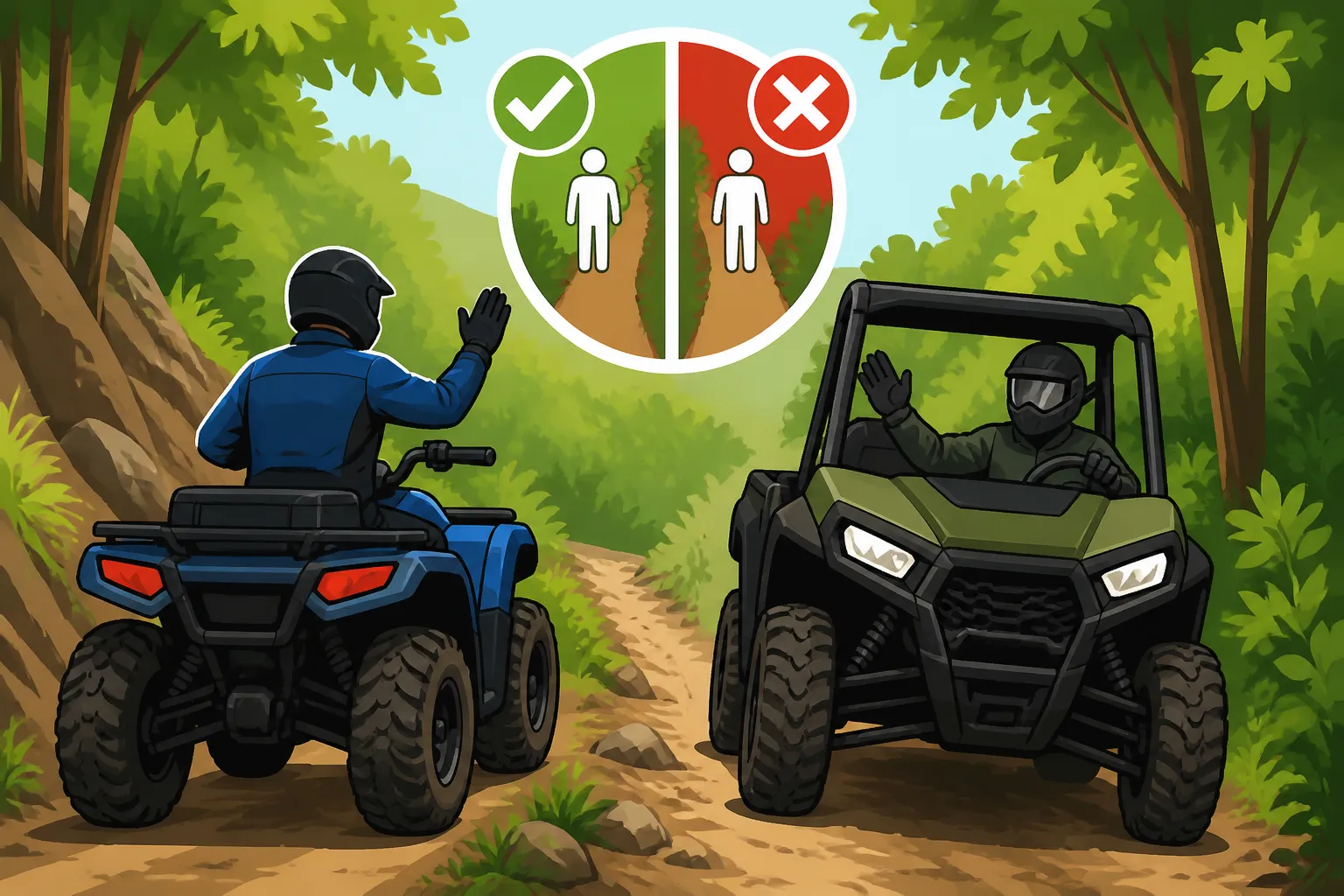
When you meet an oncoming rider, don’t assume both machines can squeeze past. Slow down, make eye contact if possible, and look for a stable, durable spot where one group can wait without blocking the trail or putting wheels onto fragile ground. If you’re on a side slope, a soft shoulder, or a rocky edge, pause before attempting a maneuver. A few moments of communication are better than a rushed pass that leaves one machine leaning toward a drop or wedged in the brush.
Use a clear, friendly signal to show that you’ve seen the other rider. A brief wave or gesture toward a safe pull-off can help, but avoid relying on gestures alone if the situation is unclear. One group can stop while the other moves through slowly, provided there is enough room and both riders understand the plan. If neither side has a safe place to pull aside, take time to assess the terrain rather than trying to muscle machines past each other.
Keep the pass slow and predictable. Don’t spin tires, push brush aside, or rev aggressively while the other rider is close. Once everyone is clear, give the waiting group a moment to get moving before accelerating away. That small pause helps prevent dust from engulfing the other machine and gives riders time to re-form their group.
| Situation | Considerate response | Avoid |
|---|---|---|
| You meet another group on a narrow straight | Stop at a safe, firm pull-off and agree who will pass first | Squeezing past without checking clearance |
| You approach a blind bend | Slow down and stay on the established line | Cutting the corner or accelerating through the turn |
| One rider needs extra time | Give them space and wait where the trail is stable | Pressuring them with close following or repeated revving |
| The trail edge is soft or steep | Look farther ahead for a safer place to yield | Pulling into fragile ground just to clear the trail quickly |
Handle Hills, Obstacles, and Tight Sections With Care
Give uphill riders room when the trail is steep
A rider climbing a steep or loose section may have limited ability to stop and restart without spinning tires or losing balance. When you meet a rider who is already committed to a climb, pause somewhere stable and let them continue if there is room to do so safely. Don’t charge uphill to claim the same line, and don’t stop in the middle of the climb just to negotiate a pass if there is a safer place to wait.
The terrain matters more than a rigid rule about who moves first. If you’re the uphill rider and stopping would create a hazard, signal your intention early and continue only if the other rider can stay clear. If you are on the downhill side, look for a secure spot to move aside without dropping wheels into a ditch or crushing the edge of the trail. When the ground is slippery, uneven, or covered in loose rock, a controlled pause is usually safer than a hurried maneuver.
Once the climb is clear, wait until the uphill rider has reached a stable area before following closely. This is especially important for a group: give the rider ahead enough room to climb without pressure, and avoid bunching up at the base where a stalled machine could block everyone. If the route includes challenging terrain, plan your pace and spacing around the slowest machine rather than assuming every rider can take the same line at the same speed.
Don’t widen the trail to get around an obstacle
A fallen branch, puddle, or rock ledge can tempt riders to make a new track around the obstacle. Repeated detours can gradually widen a narrow trail, damage plants, and turn a manageable feature into a broader area of churned ground. Before going around something, check whether there is an established bypass or an instruction from the trail manager. If no safe route is clear, stop and assess rather than creating one.
Avoid spinning tires to climb over an obstacle or power through soft mud. Wheel spin can rut the trail, send debris toward another rider, and leave the next person with a deeper, more difficult hole. If you need help, ask for it before attempting a move that could tip the machine or put a helper in the path of the tires. A spotter should stand where the operator can see them and should never place themselves between a moving machine and a fixed object.
Trail conditions can change after rain, thaw, or heavy use. A route that felt firm earlier in the season may become soft and vulnerable. When the trail is muddy, choose a line that avoids damaging the edges, and turn around if continuing would mean leaving the marked route. [Why Mud Season Closes Trails] explains why a short-term detour can have consequences beyond one ride.
Ride in Groups Without Crowding Other Users
Keep your group compact, but leave room to react
A long line of machines can make a narrow trail feel completely blocked to anyone coming the other way. Keep your group together enough that no one gets lost, but leave a safe following distance so riders can stop without colliding. On dusty stretches, increase the gap; being able to see the machine ahead is not worth riding so close that you can’t respond to a sudden stop.
If you meet another group, don’t assume the other riders know how many machines are behind the lead ATV. The first rider can signal that more are coming, while the rest of the group passes in a steady, controlled way. Avoid turning a brief encounter into a prolonged trail blockage by having every rider stop at a different point. When possible, choose one safe waiting area and keep machines out of the main line.
Be especially considerate when a group includes children, new riders, or people using different types of machines. A UTV may need more room to turn or pull aside than a smaller ATV. That doesn’t make one machine type more entitled to the trail; it means the group should make space and communicate before entering a tight section. For route planning, check whether your machine fits the trail restrictions before setting out; [Pennsylvania Trails for a Wide Machine] is a useful related topic.
Respect hikers, workers, and riders on foot
Not everyone on a trail is operating a machine. You may encounter hikers, trail workers, hunters, or someone inspecting a vehicle. Slow down early, give people room, and wait for a clear signal before passing. Never assume a person on foot has heard you, especially near a bend or where wind, water, or other engines mask sound.
When passing people, avoid spraying gravel, mud, or dust toward them. If the trail is so narrow that there is no safe passing space, stop and let them choose where they feel comfortable standing. Don’t crowd someone toward a steep shoulder, water, or unstable ground. A polite greeting and a few extra seconds can make the encounter feel safe rather than intimidating.
Trail etiquette also means respecting work in progress. If you come across maintenance crews or equipment, stop where you won’t obstruct their work and follow their directions. Don’t ride around barriers or through a closed section because it looks passable. Trail conditions, access, and operating rules can change; [Pennsylvania Trail Closures to Check First] is a helpful reminder to check before heading out.
Protect the Trail and Leave a Good Impression
Stay on the designated route and manage noise
A narrow trail stays narrow when riders keep to the established route. Don’t create parallel tracks to pass, avoid a puddle, or give your group more room. Those extra lines can damage vegetation and make the route harder to maintain. If a section feels too tight or challenging for your machine, turning back is a responsible decision, not a failure.
Keep noise controlled, especially near trailheads, camps, homes, and other places where people may be enjoying the outdoors. Avoid unnecessary revving while waiting for a group to assemble, and don’t race through a narrow section to get away from dust. A smooth, steady pace is easier on the trail and less unsettling for people nearby.
Following posted rules is part of being a good trail neighbor. Pennsylvania riding opportunities vary by location, and registration, permits, trail access, and machine restrictions may differ between sites. Before a ride, review the requirements that apply to the specific area rather than relying on what was allowed at another trail system. [Pennsylvania ATV Trail Permits Explained] offers related guidance on understanding access requirements.
Stop in safe places and keep the trail clear
If your group needs to regroup, move to a designated staging area or a wide, stable spot where you won’t block the trail. Avoid stopping just beyond a blind turn, on a steep grade, or in a narrow passage where another rider has no warning. The same goes for taking a break, checking a map, or troubleshooting a machine: choose a location where people can see you and pass safely.
Before stopping, let the rest of the group know and check that every machine is fully clear of the riding line. A parked ATV can be difficult to see behind brush or around a bend. If a machine is disabled, move it only when doing so is safe; don’t put helpers in a position where they could be pinned or struck. If the trail is blocked, alert approaching riders and work out a safe way to clear the route.
At the end of the ride, take out everything you brought in, including food wrappers, broken straps, and damaged parts. Don’t leave trash beside the trail or hide it in the brush. A clean trail is more pleasant for the next rider and shows respect for the people who maintain and share the area. If you want to review general expectations for courteous riding, [Pennsylvania Trail Etiquette on Narrow Trails] is the topic this guide is designed to support.
Disclaimer
This article is for general informational purposes only and does not constitute professional advice. Laws, prices and regulations vary by location and change over time. Consult a qualified professional for guidance on your specific situation.