Pennsylvania Riding in Hunting Season
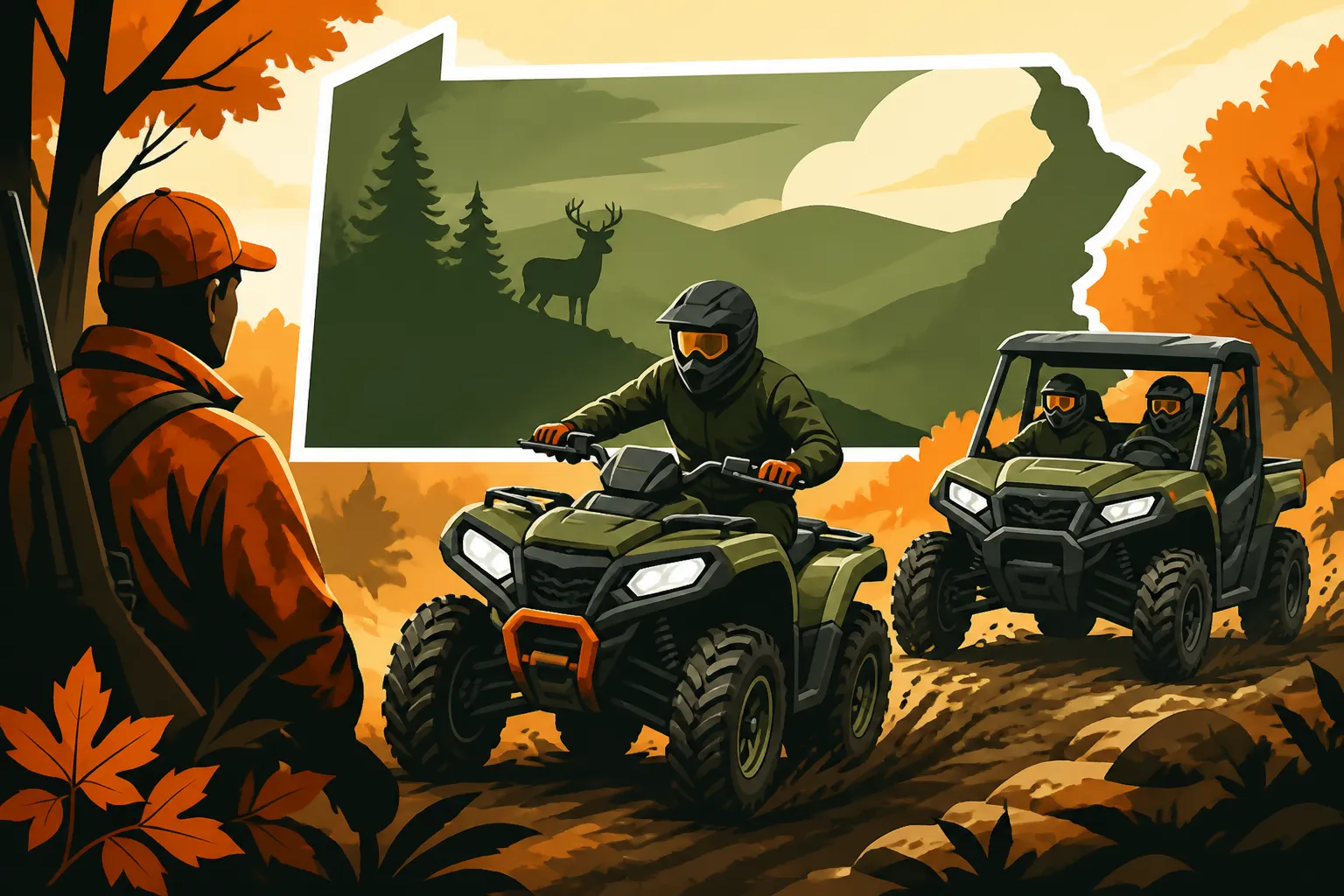
Hunting season can turn a familiar Pennsylvania ride into a very different day: trailheads fill early, hunters may be working in the woods nearby, and a route that was open last weekend may now have restrictions. This guide explains how to check access, share trails safely, plan around seasonal changes, and avoid assuming that a road or trail is open just because it appears on a map.
What changes for ATV and UTV riding during hunting season
Hunting season does not automatically close every riding area
Pennsylvania riding access depends on the specific place you plan to visit. A designated trail may have its own operating season, a forest road may have separate rules, and a privately managed riding area may set its own schedule. Hunting season alone does not tell you whether a route is open. Check the land manager’s current notices and posted signs before you unload.
This distinction matters on public land. State forest roads and designated ATV trails are not interchangeable with state game lands, where ATV access is generally restricted except where a specific authorization or exception applies. A route that looks connected on a map can cross from one type of property to another, so confirm the status of each section. [Pennsylvania State Game Lands and ATVs]
There are also different kinds of seasonal changes. A trail may close for the season, a road may be temporarily restricted, or access may be affected by weather, maintenance, or a special land-use notice. For an overview of how riding calendars can vary, see [Pennsylvania's ATV Trail Season]. Treat a familiar route as unconfirmed until you have checked its status for the day you intend to ride.
| Before your ride | What to check | Why it matters |
|---|---|---|
| Trail or route status | Official land-manager notices and signs at access points | Seasonal or temporary closures may affect familiar routes |
| Land ownership | Whether the route crosses state forest, game lands, private land, or a riding park | Rules can change at a property boundary |
| Hunting activity | Local season dates and any notices for the area | More people may be using the woods, parking areas, and access roads |
| Machine and rider requirements | Registration, permits, age rules, and any site-specific requirements | Access rules still apply during hunting season |
| Weather and trail condition | Recent rain, snow, thaw, or posted closures | Soft ground and poor visibility raise risk and can damage trails |
Separate hunting rules from riding rules
Hunters and riders may be using the same general area without having the same access rights. Being near a hunting area does not grant permission to ride through it, and seeing tire tracks does not prove that a route is legally open. Stay on routes specifically designated for your machine and do not cut across woods, fields, or closed roads to bypass a barrier.
The same caution applies when a trail passes near a hunting camp or a road used to reach one. A private driveway, logging road, or access easement is not automatically a public riding route. If you need a refresher on the rules for a particular kind of route, [Pennsylvania Rules for Riding a State Forest Road] is a useful place to start.
Also remember that an ATV or UTV registration is not, by itself, permission to ride anywhere in Pennsylvania. Registration, trail access, and landowner permission are separate questions. If you are unsure whether a route is open, do not rely on a nearby trail’s status to answer for it. Turn around and confirm access before continuing.
How to plan a ride when hunters are in the woods
Check dates, access notices, and local conditions
Start by identifying the exact riding area rather than searching only for a broad region such as “north-central Pennsylvania.” A notice for one forest district or trail system may not apply to another nearby area. Check the official information for the land manager or facility, then review any posted closures or notices close to your departure. Hunting dates, riding seasons, and temporary access restrictions are not always the same thing.
Planning early also helps with practical details. A trailhead may be busier than usual, parking may be limited, and a route that is straightforward in summer can feel less comfortable when visibility is reduced by rain, fog, or early darkness. If you are taking a longer ride, identify a legal turnaround point and a shorter alternate loop. That way, a closure or crowded staging area does not force a rushed decision in the woods.
Mapping tools can help you understand the shape of a route and prepare a backup plan. For example, onX Offroad can help riders review mapped routes and nearby trail connections before leaving home. Use a mapping app as a planning aid, not as proof that a road is open: land status, signs, gates, and current notices should take priority. [Pennsylvania Trail Maps From DCNR]
Build a flexible route and a clear turnaround plan
A good hunting-season ride is often less ambitious than a mid-summer outing. Choose a route that leaves time to stop, assess conditions, and turn around without pressure. If your group is unfamiliar with the area, agree in advance on a meeting point in case riders become separated. Make sure everyone knows the intended route and understands that a marked closure means the group changes plans rather than trying to find a way around it.
Think through what could slow you down. A narrow rocky section may take longer when the trail is wet, and a busy access road may require extra attention when vehicles are entering or leaving a hunting area. In remote places, such as forest riding areas around Potter, Clinton, or Tioga counties, mobile service may be limited. Save route information for offline use where possible and carry a paper or downloaded backup if you depend on a phone for navigation.
onX Offroad may be useful for comparing a planned route with nearby alternatives, especially when you want to avoid backtracking. Still, do not treat a line on a screen as permission to cross a gate, private parcel, or closed trail. Keep the group together when conditions are confusing, and stop in a safe place to check your route rather than making a last-second turn at a blind corner.
Sharing trails safely with hunters and other visitors
Slow down, make yourself visible, and expect people on foot
Hunting-season traffic is not limited to hunters walking through the woods. You may encounter a vehicle parked near an access point, someone carrying equipment along a road, a dog, or another rider moving slowly through a narrow section. Reduce speed well before you reach a person or vehicle. Give people room, avoid sudden revving, and wait until you can pass without forcing anyone off the trail.
Visibility deserves extra attention. Wear conspicuous clothing, keep your machine’s required lighting equipment in working order, and avoid blending into the background at dawn, dusk, or in dense woods. Blaze orange is a sensible visibility choice around hunting activity, but riders should check the rules that apply to their location and situation rather than assuming a general recommendation replaces a legal requirement.
Noise can startle wildlife and people alike. A loud exhaust, unnecessary acceleration, or repeated throttle bursts can make a shared area unpleasant and may create a safety problem around blind bends. Keep your machine under control, use a courteous pace, and be prepared to stop. For more guidance on sharing narrow routes, see [Pennsylvania Trail Etiquette on Narrow Trails].
Treat parked vehicles and camps as signs to use extra care
A truck or trailer parked near a forest road can indicate that someone is using the area, but it does not tell you that the road is closed—or that it is open. Do not block access, park in a way that traps another vehicle, or assume that an empty-looking track is abandoned. If a route is gated, signed closed, or outside the designated riding network, turn around regardless of whether you see other people using it.
When passing a hunting camp or a group of people, slow to a crawl or stop if needed. Keep a respectful distance, avoid lingering near equipment or campsites, and do not enter a campsite to ask for directions. If you need to stop to check a map, choose a safe, visible place that leaves the route clear for others.
Crowding can also create conflict at trailheads. Load and unload efficiently, keep trailers within marked parking areas, and leave room for emergency or work vehicles. A little patience goes a long way when several groups are arriving at the same access point, particularly on popular riding weekends. If you are uncertain whether a road is open to ATVs, [Spotting a Posted ATV Road] can help you think through what to look for, but current signs and official information remain decisive.
Rules and restrictions to confirm before you ride
Verify the route, not just the region
Pennsylvania has different rules for state forest roads, designated ATV trails, private property, roads opened by a municipality, and other public lands. Do not assume that because a machine is registered, or because you have a trail permit for one area, you can ride a nearby road or trail. Access can change at a property boundary, and permission for one land parcel does not carry over to another.
For state forest riding, confirm that the particular road or trail is designated and open to your class of machine. A UTV’s width can matter, as can other machine restrictions. If the planned trip includes a public road, check whether that specific road is legally open to ATV use and whether the applicable requirements are met. A road that appears on a navigation map may simply be a road, not an authorized ATV route.
You can use onX Offroad to get a broader view of a planned ride and identify where you may need to check route details. Then verify those details through the appropriate official channel and at the trailhead. When a map, sign, and online notice seem to conflict, do not choose the interpretation that lets you keep riding. Stop and get clarification. [Pennsylvania Trail Closures to Check First]
Keep registration, permits, and safety requirements current
Hunting season does not suspend the ordinary requirements for riding. Depending on where you go, you may need valid registration, a trail permit, proof of insurance, or permission from a landowner. Requirements can differ between a state forest trail, a private riding park, and a route on private property. Check the rules for every destination in your itinerary, not just the first trailhead.
Carry the documents you need in a way that protects them from rain and mud. Keep a phone charged, but do not rely on a dead battery to explain why you cannot confirm your route or show required information. If a permit must be displayed on the machine, make sure it is mounted as directed and remains readable after the ride begins.
Youth riders and passengers need extra attention. Confirm age, supervision, helmet, and machine requirements before setting out, and do not assume that a rule for one setting applies everywhere. A family outing may cross areas with different rules, so plan a route that suits the youngest rider and the least experienced person in the group. [Pennsylvania ATV Safety Certificate Requirements]
Weather, daylight, and trail conditions in hunting season
Expect changing ground conditions and protect the trail
Fall weather can change quickly in Pennsylvania. Rain may make rocks slick, leaves can hide ruts and roots, and a cold overnight freeze can leave shaded sections slippery even when the trailhead looks dry. Later in the season, snow, thaw, or a sudden warm spell can change a route’s condition in a short time. Ride within your ability and the capability of your machine, and do not force your way through a section that is becoming unsafe.
Avoid creating new ruts or widening a muddy route to get around a difficult patch. Riding around a soft or blocked section can damage vegetation, create an unauthorized bypass, and make the problem worse for the next group. If an official closure or barrier is in place, do not move it or ride around it. For more on how wet conditions affect access and trail surfaces, see [Pennsylvania Trails After Heavy Rain].
A UTV can feel stable on rough ground, but that does not make a steep, slick, or narrow section risk-free. Keep a safe distance between machines so the rider ahead has room to stop, and avoid crowding someone who is negotiating an obstacle. If the group cannot cross safely, turn back. A planned destination is never worth damaging the trail or risking a rollover.
Plan for shorter days and slower travel
Daylight shrinks as the season moves toward winter, and a ride that starts comfortably in the morning can end in darkness if the group gets delayed. Set a firm turnaround time that leaves a margin for unexpected stops, navigation questions, or a mechanical problem. Check that required lights work before leaving and make sure every rider knows the plan if the group is separated.
Carry clothing appropriate for a long stop, not only the temperature you expect while moving. Riders can cool quickly when they stop to deal with a flat tire, recovery, or a route check. Bring water, basic repair supplies, and a way to contact help where possible. Tell someone who is not riding where you are going and when you expect to return, especially if your route is remote.
A practical checklist helps prevent small problems from becoming stressful ones:
- Confirm the riding area is open and the route is designated for your machine.
- Check hunting-season notices, access restrictions, and the forecast.
- Review registration, permit, insurance, and rider requirements for the destination.
- Choose a main route, a shorter alternative, and a clear turnaround time.
- Tell someone your plan and expected return.
- Ride slowly near people, vehicles, camps, and blind corners.
- Turn around when a route is closed, unclear, or beyond the group’s ability.
For a focused look at the extra care needed during one of Pennsylvania’s busiest hunting periods, see [Pennsylvania Riding During Rifle Season]. The same basic habits—checking access, keeping visible, and yielding space—are useful throughout the hunting calendar.
Disclaimer
This article is for general informational purposes only and does not constitute professional advice. Laws, prices and regulations vary by location and change over time. Consult a qualified professional for guidance on your specific situation.