Pennsylvania Trails With Mud Holes
A muddy stretch can turn a Pennsylvania ATV ride into a slow crawl, especially after rain or during spring thaw. But a “mud hole” is not automatically a legal place to ride, and trail conditions can change quickly. This guide explains where muddy terrain may occur, how to plan responsibly, and when it is safer to turn around.
Where Pennsylvania Riders May Encounter Mud
Public trails and changing conditions
On Pennsylvania’s designated public ATV trails, mud is usually a condition to manage rather than a feature you can count on finding. Low spots, shaded hollows, and poorly drained sections can hold water after rain, but the same stretch may be firm and dry later. Spring thaw can make a trail particularly vulnerable to damage, and a closure may be put in place to protect the surface.
That distinction matters. A trail that looks muddy is not an invitation to ride around a wet section, cut a new bypass, or spin the tires until the ground gives way. Those choices can widen the trail, damage drainage, and create ruts that remain after the water is gone. Read posted signs and respect barriers even when a section appears passable.
Pennsylvania’s state forest riding areas—including Potter County Trail, East Kettle, and trails in the Allegheny National Forest—have specific routes and access rules. Don’t assume that an unmarked forest road, muddy track, or path visible on a phone map is open to ATVs. Start with [Pennsylvania ATV Trail Maps From DCNR] and check [Pennsylvania Trail Closures to Check First] before loading up.
Private riding parks and purpose-built features
A privately managed riding park may offer a different experience from a public forest trail. Some parks have a mix of terrain and obstacles, and riders may find wet or muddy stretches depending on the layout, weather, and maintenance. Areas such as Anthracite Outdoor Adventure Area near Shamokin and Rock Run Recreation Area near Patton are examples of organized riding destinations, but conditions and available routes can vary.
A muddy spot that is part of an open, designated park route is different from a saturated section on a public trail. At a park, follow that property’s rules, difficulty guidance, and staff instructions. Ask about current conditions before unloading, especially if your group includes new riders or machines that are not set up for deep mud.
Tools such as onX Offroad can help you plan around a riding area and review mapped routes, but a map is not a live guarantee that a trail is open or passable. Combine it with the park’s own information, current signs, and local guidance. For a broader comparison of riding options, see [Pennsylvania Pay-to-Ride Parks Worth the Drive].
How to Plan a Ride When Mud Is Part of the Forecast
Check weather, closures, and the trail season
Look beyond the weather at your starting point. Rain in the surrounding hills can affect trail surfaces even if the staging area feels dry, and shaded or low-lying sections may stay wet longer than exposed ground. If heavy rain has fallen recently, check conditions again on the day you plan to ride. [Pennsylvania Trail Conditions Before You Go] and [Pennsylvania Trails After Heavy Rain] are useful topics to review before making the drive.
Season matters too. Pennsylvania’s public trail areas operate within designated seasons and may close temporarily when conditions are poor. A planned trip can be frustrating to cancel, but riding a closed or badly saturated trail can create lasting damage and put you at odds with posted restrictions. Confirm the applicable dates and closures through the relevant official or land-manager information; don’t rely on an old forum post or a map screenshot from a previous season. You can also review [Pennsylvania's ATV Trail Season] when planning dates.
Use onX Offroad as one planning layer rather than your sole authority. It can help you orient yourself and prepare a route, but it does not replace trailhead notices, official maps, or instructions from the land manager. Download or save the information you need before leaving reliable service, and tell someone where you expect to ride.
Match the route to your group and machine
Before setting out, be honest about what the least experienced rider in your group is comfortable handling. A shallow puddle on a familiar route is one thing; a deep, rutted crossing with an uncertain bottom is another. A heavy side-by-side, a youth machine, and a narrow utility ATV will not behave the same way in the same mud.
Consider ground clearance, tires, machine width, and recovery equipment—but don’t treat equipment as permission to push through a questionable section. A winch can help recover a stuck machine when used appropriately, yet a recovery attempt can become risky if riders are standing in a vehicle’s path or attached to an unstable anchor. If you cannot judge the route safely, turn around or choose a different trail.
For newer riders, a route with predictable surfaces is often a better first outing than one chosen specifically for mud. [Pennsylvania Trails for Beginners] can help you think about route difficulty, while [Pennsylvania Trails With Rock Sections] offers a useful contrast: rocky terrain creates different challenges, but the same principle applies—choose a route that suits your group rather than trying to prove what the machine can do.
| What to check | Why it matters | Practical choice |
|---|---|---|
| Recent and forecast rain | Wet ground may be soft even when the trailhead is dry | Recheck conditions before departure |
| Official closure notices | A familiar trail may be temporarily closed | Do not ride past a barrier or closure sign |
| Route difficulty | Mud can hide ruts, rocks, and changing depth | Choose a route that fits the least experienced rider |
| Machine width and clearance | A machine may not fit the route or clear obstacles | Confirm trail limits and machine suitability |
| Recovery plan | A stuck machine can create risks for the whole group | Carry suitable gear and agree on safe recovery roles |
| Phone coverage and maps | Service may be unreliable in remote areas | Save route information and share your plan |
Riding Muddy Sections Without Damaging Trails
Slow down and assess before entering
If you come to a muddy section on an open, designated route, stop somewhere safe and look before committing. Check for visible ruts, rocks, washouts, standing water, and signs that the trail is eroding. Don’t assume a puddle is shallow because its edges look firm; water can conceal a hole or debris.
If the route remains within your ability and the trail is open, move steadily and avoid sudden, aggressive throttle inputs. Spinning tires can dig into the surface, deepen ruts, and make a manageable section worse for everyone behind you. Keep enough space between machines to avoid crowding, and don’t stop in a spot where another rider has no room to maneuver.
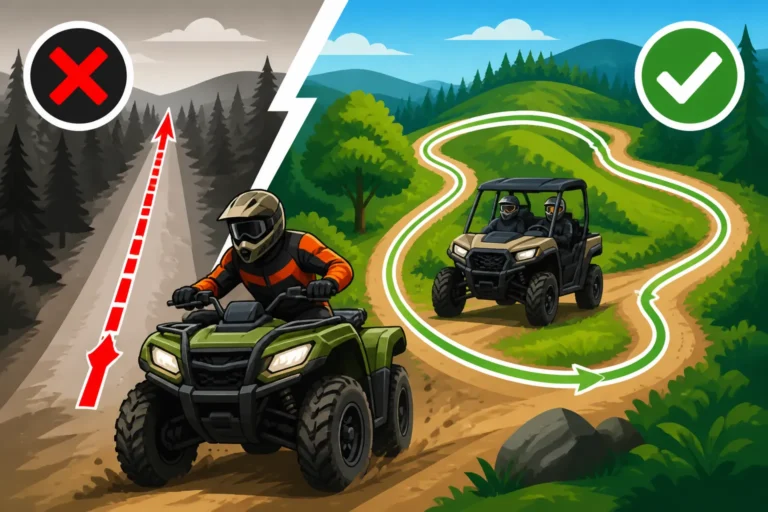
If the section looks unsafe, too deep, or damaged, turn around when you can do so without leaving the designated trail. Don’t ride around the muddy area through vegetation or along the edge of the trail. That “quick bypass” can create a second track, damage plants and soil, and encourage the next group to do the same. Good [Pennsylvania Trail Etiquette on Narrow Trails] is especially important when visibility is limited or riders are approaching from the other direction.
Keep the group safe and recover thoughtfully
Before a ride, agree on a simple plan: who leads, where the group waits, and what everyone should do if a machine gets stuck. Keep passengers and bystanders away from recovery lines, wheels, and the likely direction of movement. Avoid pulling from a part of the machine that is not intended as a recovery point, and stop if the setup is unstable or the group is unsure how to proceed.
A recovery should not turn into a contest to see who can force a machine through. If repeated attempts are making the rut deeper, pause and reassess. You may need to use a safer route back, wait for assistance, or leave the machine for a controlled recovery. A second machine should not be put at risk simply to rescue the first.
Mud also affects what happens after the ride. Clean the machine before packed soil hardens around brakes, suspension, and other components. Check for damage, and make sure you have not carried mud or debris from one riding area to another. If the trail was unusually wet or visibly deteriorated, report the condition through the appropriate land-manager or park channel rather than assuming someone else has already done it.
Choosing a Pennsylvania Mud Ride That Fits
Ask the right questions before you go
When you call or check a park’s official information, ask about more than whether it is “muddy.” Find out which routes are open, whether recent weather has affected access, what machine widths are allowed, and whether the terrain is suitable for your group. If you want to avoid deep mud, say so directly; if you are hoping for challenging terrain, ask what is available without assuming a particular obstacle will be open.
For public trails, use official trail information and respect temporary restrictions. Pennsylvania trail conditions can shift between visits, so an account of a ride from last weekend may not describe what you will find today. onX Offroad may be useful as a route-planning reference, but verify access with the responsible land manager and follow signs on the ground.
Also consider the drive and staging logistics. A route that sounds appealing may be a poor fit if your group is inexperienced, your machine exceeds trail limits, or you are arriving without the right equipment. For a destination-specific overview, you can explore [Pennsylvania's Sproul State Forest Trails] and compare it with organized riding areas before deciding where to go.
Know when to skip the mud
Sometimes the best ride is the one you postpone. If a trail is closed, conditions are saturated, or you cannot safely assess a flooded section, choose another open route or wait for conditions to improve. A missed riding day is disappointing, particularly after arranging transport and time off, but rutting a trail or getting a group into a difficult recovery can cost much more in time and trouble.
Don’t confuse access with suitability. A trail may be legally open yet still be beyond your group’s comfort level on a particular day. Turn around if you see fresh washouts, deep uncontrolled ruts, damaged drainage, or signs asking riders to avoid an area. A responsible decision protects both the people riding and the trails everyone hopes to use again.
For a smoother trip, plan a backup destination, check conditions close to departure, and keep your expectations flexible. Mud may be present, absent, or too risky to ride through. Treat it as a variable—not the main attraction—and you’ll be better prepared to enjoy Pennsylvania’s trails in changing conditions.
Disclaimer
This article is for general informational purposes only and does not constitute professional advice. Laws, prices and regulations vary by location and change over time. Consult a qualified professional for guidance on your specific situation.