East Kettle’s 20 Miles
East Kettle’s roughly 20 miles of ATV trail can look simple on a map, but forest-road access, changing conditions, and seasonal closures can complicate a ride. This guide explains what to expect, how to prepare, and what to check before loading your machine so you can plan a safer, less stressful day in Bald Eagle State Forest.
What to expect on the East Kettle ATV trail
Treat 20 miles as a trail network, not a guaranteed loop
East Kettle is associated with Bald Eagle State Forest in central Pennsylvania. Its commonly described 20 miles give riders a useful sense of the area’s scale, but that number does not guarantee one continuous loop of exactly that length. Connections, closures, and your starting point can affect how much riding you can actually do.
That distinction matters when you’re planning around daylight, fuel, or a group with different experience levels. A rider who expects to complete a tidy loop may be surprised if the route involves an out-and-back section, a junction that requires retracing part of the ride, or a segment that is unavailable. Plan with a little flexibility instead of building the day around a precise mileage target.
Before leaving home, look at the official forest trail information and map. [Pennsylvania Trail Maps From DCNR] is a helpful place to start, and [Pennsylvania Trails With Long Loops] can help you think through route shape when comparing possible rides. Use onX Offroad as a supplementary planning tool if you already rely on it, but check its mapped lines against the official information rather than assuming every mapped route is open to ATVs.
Expect a forest ride, not a groomed recreational-park course
A state forest trail can feel different from a privately operated riding park. You may encounter uneven ground, rocks, changing traction, tight turns, and stretches where the surface varies with recent weather. Conditions can also change along the same ride: a dry stretch may give way to damp ground, loose stone, or a rougher section that slows the group.
That variety is part of the appeal for many riders, but it can make a day tiring for someone expecting smooth, fast riding. If you’re bringing a newer rider, a less experienced passenger, or a machine that has not been tested on rough terrain, keep the first outing conservative. Take time to assess a section before entering it, and turn around if it is beyond your comfort level.
Your machine’s width matters, too. A side-by-side that feels manageable on a broad trail may be uncomfortable where the route narrows or turns between trees. Check the requirements for the specific trail system and compare them with your machine before you tow it there. [Pennsylvania's Class II Trail Width Limit] explains a key consideration for riders choosing a machine for Pennsylvania state forest trails.
Plan the ride before you leave home
Check access, closures, and conditions together
A trail can appear on a map without being available for riding on the day you visit. Seasonal operating periods, maintenance, weather damage, or temporary closures can affect access. This is why it’s worth checking both the trail’s general operating information and any current notices before you load the trailer.
Rain can turn a manageable ride into a slippery one, while thawing ground can be especially vulnerable to damage. Riding around a closure or through a soft section can harm the trail and create trouble for other users. If conditions are uncertain, choose a shorter ride or postpone the trip rather than treating an open gate or a visible tire track as proof that a route is available.
Build a simple pre-trip check into your routine: confirm that the trail is open, review the official map, check weather and recent conditions, and make sure your planned route stays on legal ATV trails. [Pennsylvania Trail Conditions Before You Go] and [Pennsylvania Trail Closures to Check First] are useful reminders of what to verify. If you use onX Offroad to review your planned route, compare it with the latest official trail information before setting out.
Confirm registration, permits, and any rider requirements
Do not assume that one registration or permit automatically covers every place you might ride. Pennsylvania’s rules can vary by land type and trail system, and a route that crosses into a different area may have different requirements. Check the rules that apply to East Kettle specifically, including what documentation riders must carry and whether any additional trail access requirement applies.
It’s also sensible to check requirements for every rider, not just the person driving the lead machine. Keep required documents accessible and protected from rain, mud, or a washout in your pack. If you are visiting from another state, confirm how your home-state registration is treated and what proof to bring. The guide to [Pennsylvania's ATV Trail Season] can help you think through the seasonal side of planning, while [Where to Ride an ATV in Pennsylvania] provides broader context on how riding areas differ.
A quick planning table can keep the most important checks from getting lost in the excitement of the trip:
| Before the ride | What to confirm | Why it matters |
|---|---|---|
| Trail access | East Kettle is open and the intended sections are available | Closures can change your route or cancel the ride |
| Route | The route follows approved ATV trails | A line on a map is not proof of legal access |
| Machine | Width and condition suit the trail and rules | A too-wide or poorly maintained machine can limit the ride |
| Paperwork | Registration and any applicable permit requirements are met | Requirements may differ by area and land type |
| Weather | Recent rain, thaw, or other conditions have not made the trail unsuitable | Surface conditions affect safety and trail damage |
| Group plan | Riders know the route, meeting point, and turnaround plan | Groups can separate at junctions or slow sections |
Make the trailhead and the ride easier
Arrive ready to unload and get organized
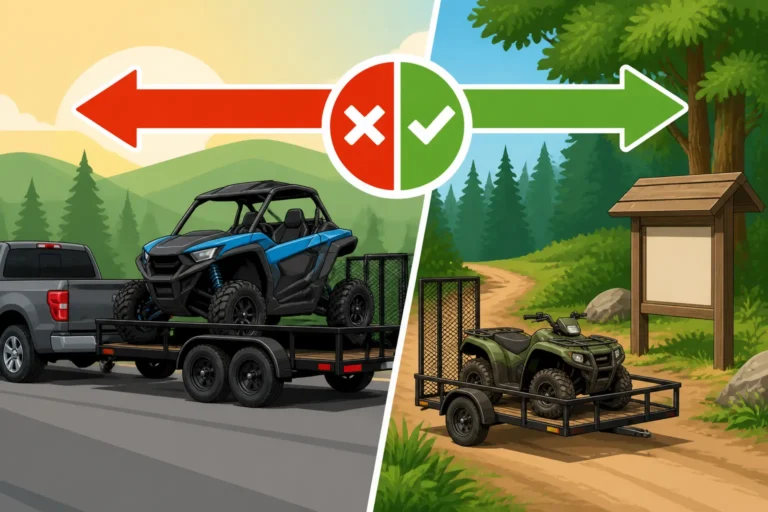
A little trailhead preparation can prevent a frustrating start. Before the trip, confirm where parking is permitted and whether the lot can accommodate your tow vehicle and trailer. Forest access points are not all built for the same size rig, so avoid assuming there will be room for a long trailer just because a road appears on your navigation app. [Parking a Trailer at a Forest Trailhead] covers the kind of practical detail that’s easy to overlook when you’re focused on the ride itself.
Once parked, give yourself time to unload without blocking other visitors. Secure loose equipment, check that the plate and required markings are visible, and make sure everyone knows where the group will regroup if riders get separated. If you’re meeting another party, agree on a precise meeting point rather than relying on intermittent cell service or vague directions such as “near the entrance.”
Use a paper or downloaded map as a backup to your phone. onX Offroad can be useful for reviewing your route in advance, but battery life, signal, and app settings can become real concerns in a forest. Check your map before starting, know the key junctions you expect to pass, and carry a way to contact your group if plans change.
Ride at a pace that suits the narrowest or least experienced rider
On a group ride, the fastest person should not set the pace. Choose a speed that gives the least experienced rider room to react, especially on rough or unfamiliar ground. Keep enough distance to avoid dust, flying debris, and sudden stops, while staying close enough that the group does not lose track of one another around bends.
At junctions, pause long enough to make sure everyone has followed the correct route. If the group is large, designate a lead rider and a sweep rider who stays behind the last person. That arrangement can help prevent a common problem: experienced riders continue ahead while a newer rider is left trying to decide which turn the group took.
Be considerate of other trail users and avoid unnecessary damage. Stay on the marked route, slow down around blind corners, and do not widen a trail by riding around puddles or obstacles. [Pennsylvania Trail Etiquette on Narrow Trails] is especially relevant when the trail leaves little room for passing or when several machines are traveling together.
A practical plan for your East Kettle day
Use a simple step-by-step checklist
Start by checking official information for trail access, seasonal operation, closures, and any applicable registration or permit requirements. Then map a conservative route that fits your group’s skill level and machine types. A shorter plan is often better than trying to cover every available mile on a first visit, particularly if you don’t know how quickly rough sections will affect your pace.
Next, check the trailer and machine. Confirm that the tow vehicle and trailer are ready for the drive, that tie-downs are secure, and that the ATV or UTV has been inspected. Bring water, basic tools, suitable riding gear, and any required documentation. Tell someone who is not on the ride where you expect to be and when you plan to return.
At the trailhead, confirm the map and route one more time. Make sure the whole group understands where to regroup, what to do if a machine has a problem, and when to turn back. If actual conditions are worse than expected, adjust the plan. A useful day is not measured by whether you ride every mapped mile; it’s measured by getting everyone home safely and leaving the trail in good condition.
Keep expectations flexible
East Kettle can be a rewarding option for riders looking for a forest setting, but the best experience comes from planning for the trail you actually find—not the idealized version of it. The familiar “20 miles” figure is a starting point for understanding the area, not a promise about a specific route, riding time, or trail condition.
For a first visit, treat the day as a chance to learn the layout. Check the official information again before departure, use mapping tools such as onX Offroad as a supplement rather than the final authority, and be willing to shorten or change your route. That approach is especially helpful when you’re bringing a mixed group, towing a large rig, or riding after unsettled weather.
Disclaimer
This article is for general informational purposes only and does not constitute professional advice. Laws, prices and regulations vary by location and change over time. Consult a qualified professional for guidance on your specific situation.