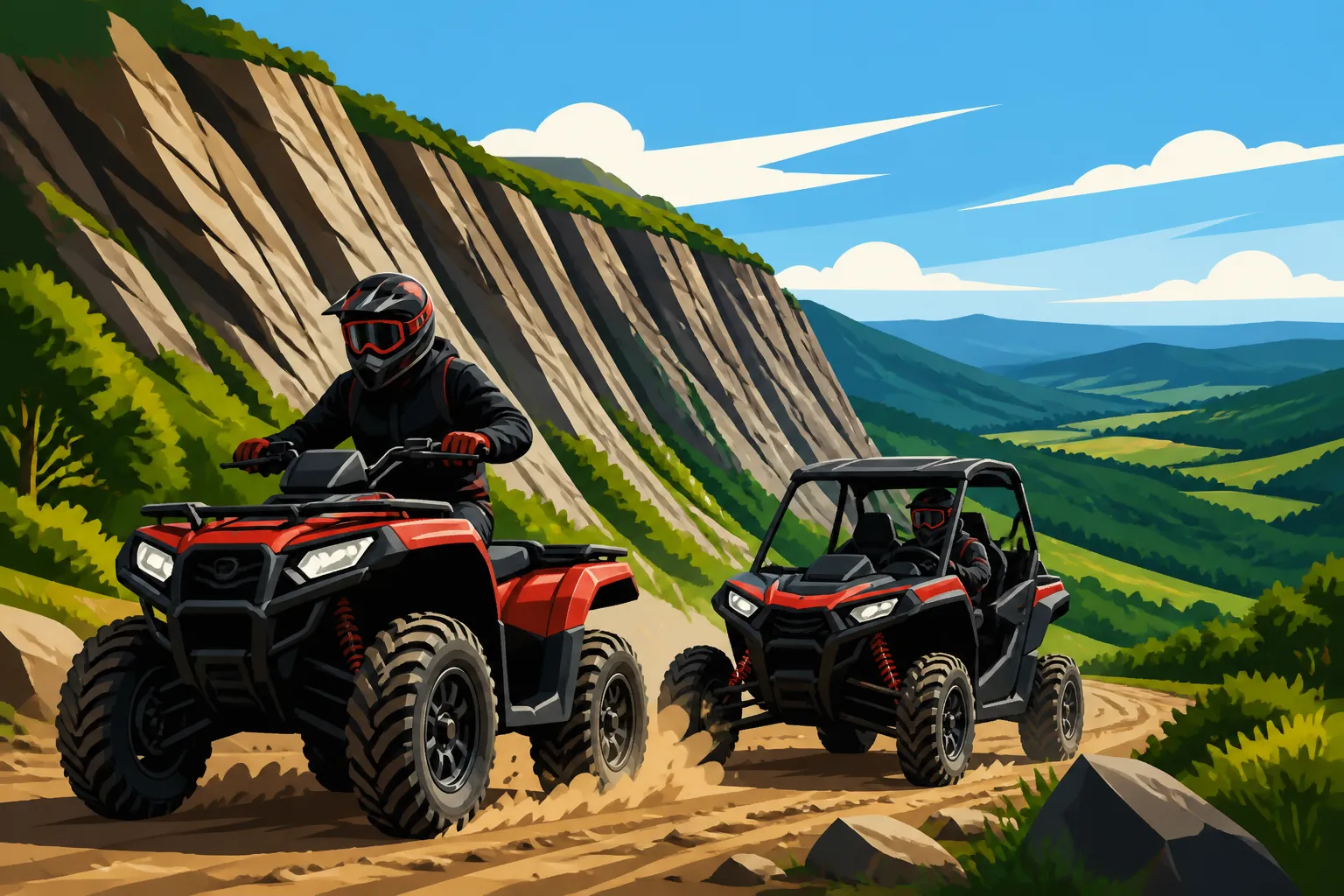
Sideling Hill in Fulton County
Sideling Hill can look straightforward on a map, but a missed turn, a closed trail, or a machine that is too wide can quickly derail a Fulton County ride. This guide explains what to expect, how to prepare, and what to check before unloading your ATV or UTV, so you can plan a safer outing without treating a map pin as permission to ride.
What to know about Sideling Hill in Fulton County
The trail and its setting
Sideling Hill is a popular ATV riding area in Fulton County, within the region of Buchanan State Forest. The route is commonly described as roughly 15 miles long, but the distance you ride can depend on the sections open to you and the route you choose. Check [Sideling Hill's 15 Miles] alongside an official trail map before setting out, rather than relying on a mileage estimate alone.
The surrounding country is a mix of wooded ridges, rocky ground, and rural roads. That makes the ride appealing, but it also means conditions can change from one stretch to the next. A trail that looks manageable in a broad map view may include slower, rougher sections where a stock machine needs careful line choice. Leave room in your schedule for breaks, navigation checks, and a slower return than you might expect.
Fulton County is not a place where you should assume every road or track shown on a phone map is an ATV route. Public roads, forest roads, private access lanes, and designated trails are not interchangeable. Keep your wheels on routes that are open and authorized for your machine, and use posted signs and official maps to confirm what you are approaching.
Why route details matter
Trail mileage does not tell the whole story. It will not tell you whether a route is currently open, whether it has a difficult rocky section, or whether a staging area can handle your trailer. Before you leave home, check the trail map, current notices, and any seasonal restrictions that apply. [Pennsylvania Trail Maps From DCNR] is a useful starting point for understanding designated riding areas and official route information.
Navigation apps can help you keep track of your position, but they should support—not replace—land-manager information. For example, onX Offroad can help riders review mapped routes and follow their location in the field. Download maps for offline use before you lose cell coverage, and compare what you see on screen with signs at the trail. A track displayed in an app is not, by itself, proof that riding is allowed there.
That distinction matters when a route crosses or approaches a road, a property boundary, or a closed section. If the map and the sign do not agree, do not ride through simply because the route line continues. Stop in a safe place, check the official information you have, and turn back if you cannot confirm that the trail is open.
Plan around seasons, weather, and trail conditions
Check dates and closures before you travel
Pennsylvania riding seasons and closures can affect when a trail is available. Do not assume Sideling Hill is open just because the weather is pleasant or another nearby riding area is operating. Seasonal dates, maintenance, weather damage, and land-management decisions can all change access. Review [Pennsylvania's ATV Trail Season] before planning a trip, then look for current closure notices close to your departure date.
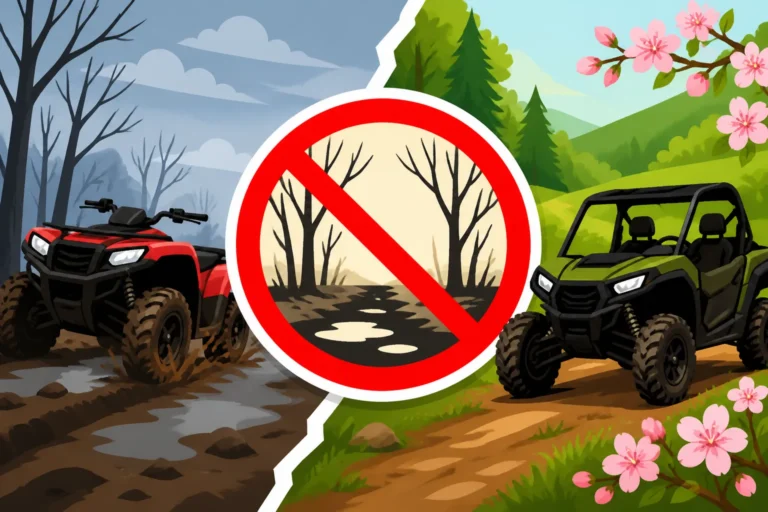
Rain deserves particular attention. A wet stretch can turn rocks slick, hide ruts, and make a trail much harder to manage. It can also increase the risk of damaging the route. If heavy rain is in the forecast, or if the trail authority has posted a closure, rescheduling is usually better than trying to push through. [Pennsylvania Trail Conditions Before You Go] can help you build a pre-ride check into your plans.
A practical routine is to check the official information once while planning and again before loading the trailer. The second check catches changes that may have happened after you made reservations or arranged time off. If you cannot confirm that the trail is open, do not treat silence from a map app as an all-clear.
Match your machine to the route
Pennsylvania state forest trails have machine requirements that riders should confirm before arriving. One important restriction is the trail width limit. Check [The 64-Inch Width Limit in Pennsylvania] and measure your ATV or UTV as it is equipped—not just the advertised factory width. Wider tires, aftermarket accessories, or other modifications may affect whether the machine fits the rule.
A UTV that feels compact in a driveway can be a different story on a narrow, rocky trail. Before making the trip, verify that your exact machine is allowed on the route and that it meets applicable width and weight requirements. Do not rely on another rider’s experience with a similar-looking model; configurations can differ, and access restrictions may apply to the machine rather than the person driving it.
Trail conditions also affect suitability. A rocky incline may be manageable for an experienced rider on an appropriate machine but stressful for someone new to the area. Keep your group within the ability of its least-experienced rider, and be willing to turn around rather than force a difficult climb. A conservative choice often makes for a better day than trying to prove a machine or rider can handle every section.
| Before the ride | What to verify | Why it matters |
|---|---|---|
| Trail access | Current opening status and any posted closures | A mapped route may be temporarily or seasonally closed |
| Machine fit | Width, weight, and other applicable restrictions | A machine that exceeds the rules may not be permitted |
| Registration | Required registration and proof for your machine | Public riding areas may have registration requirements |
| Trailer plan | Staging access, parking space, and any posted limits | A narrow or crowded access point can complicate unloading |
| Navigation | Offline map, official route information, and a charged device | Cell service may be unreliable in wooded areas |
| Weather | Recent rain, forecast, and trail advisories | Wet rocks and damaged trail surfaces can change ride difficulty |
Registration, access, and riding rules
Sort out registration before you unload
Do not confuse registration with permission to ride every trail. Registration identifies your machine under the applicable rules; access depends on where you are riding and whether that specific route is open to your type of machine. Pennsylvania’s state forest system also differs from private riding parks and other public lands. Read [Pennsylvania's Free State Forest Trails] as part of your planning, and confirm which requirements apply to the particular area you intend to ride.
Keep required paperwork with you, and make sure the plate or registration identification is mounted and readable as required. For Pennsylvania registration details, see [Pennsylvania's Two-Year ATV Registration]. If your machine is registered in another state, check the rules that apply to visitors instead of assuming your home-state registration will be accepted everywhere. Requirements can depend on the place you are riding and the machine’s registration status.
If you are unsure whether a particular route requires an additional permit, ask the relevant land manager before travelling. A permit for one forest, park, or private trail system does not automatically cover another. Likewise, a registration or sticker should never be treated as permission to ride on a road or track that is not open to ATVs.
Follow signs and respect road boundaries
Forest roads can be confusing because some are open to particular vehicles while others are closed or restricted. A road that appears on a navigation app may be a maintenance road, a private access route, or a route intended for highway vehicles—not an ATV trail. Read signs at entrances and junctions, and do not use an unmarked road as a shortcut.
For a broader explanation of road restrictions, review [Pennsylvania Rules for Riding a State Forest Road]. If your route approaches a public road, do not assume you may ride along it to reach another trail segment. Road use has separate rules, and designated ATV access is not the same as ordinary road access.
Ride at a speed that lets you respond to blind corners, loose stones, other trail users, and changing surfaces. Leave space between machines so the rider behind you has time to react if the lead machine slows or stops. Avoid cutting around puddles or rocks into the vegetation: going off the trail can damage the area and may violate land-use rules.
A practical trip plan for Sideling Hill
Make the staging and navigation plan first
Before you load up, identify the approved access point and confirm that parking is suitable for your tow vehicle and trailer. Do not assume a small pull-off can fit a large rig or several trailers. [Parking a Trailer at a Forest Trailhead] offers useful considerations for choosing a staging plan, but check local signs and current access information for the place you intend to use.
Save your map for offline use and bring a charged phone or GPS device. If you use onX Offroad, download the relevant map area before reaching the trail, then carry a backup plan such as a printed map or a second charged device. A phone that has lost service—or a battery drained by navigation—can leave a group uncertain about its position at the worst moment.
Agree on a simple group plan before starting: who leads, who rides at the back, where you will stop, and what everyone should do if the group gets separated. At a junction, wait until the last rider arrives before continuing. These small habits prevent a short pause from becoming a search for a missing rider on unfamiliar ground.
Pack for a full day, not just the mileage
A roughly 15-mile route may sound short, but rocky terrain, stops, and navigation can make the outing take longer than expected. Bring water, food, basic first-aid supplies, and the tools needed for minor problems with your machine. Wear suitable protective gear, and make sure every rider understands the plan and knows how to contact the group if separated.
Check the machine before leaving the staging area. Look over tires, brakes, lights, fuel, and any loose accessories. Secure cargo so it cannot shift on rough ground, and avoid carrying more than your machine can safely manage. If you are riding with a passenger, confirm that the machine is designed for one and that the passenger can hold on securely.
Finally, set a turnaround time. It is easy to keep exploring when the group is enjoying the ride, but daylight, weather, and trailer logistics still matter. If conditions worsen, a machine develops a problem, or the route becomes more difficult than expected, turn back while you still have time and energy to do so safely.
Disclaimer
This article is for general informational purposes only and does not constitute professional advice. Laws, prices and regulations vary by location and change over time. Consult a qualified professional for guidance on your specific situation.