Why Pennsylvania Trails Close April 1
April 1 can feel like an abrupt end to riding season, especially when the ground near home looks dry and your machine is ready to go. In Pennsylvania, spring closures help protect trails during a vulnerable thaw, when tires can quickly turn soft ground into deep ruts. This guide explains why closures happen, what they mean for riders, and how to plan legal alternatives.
Why Pennsylvania ATV trails close on April 1
Spring thaw makes trails unusually easy to damage
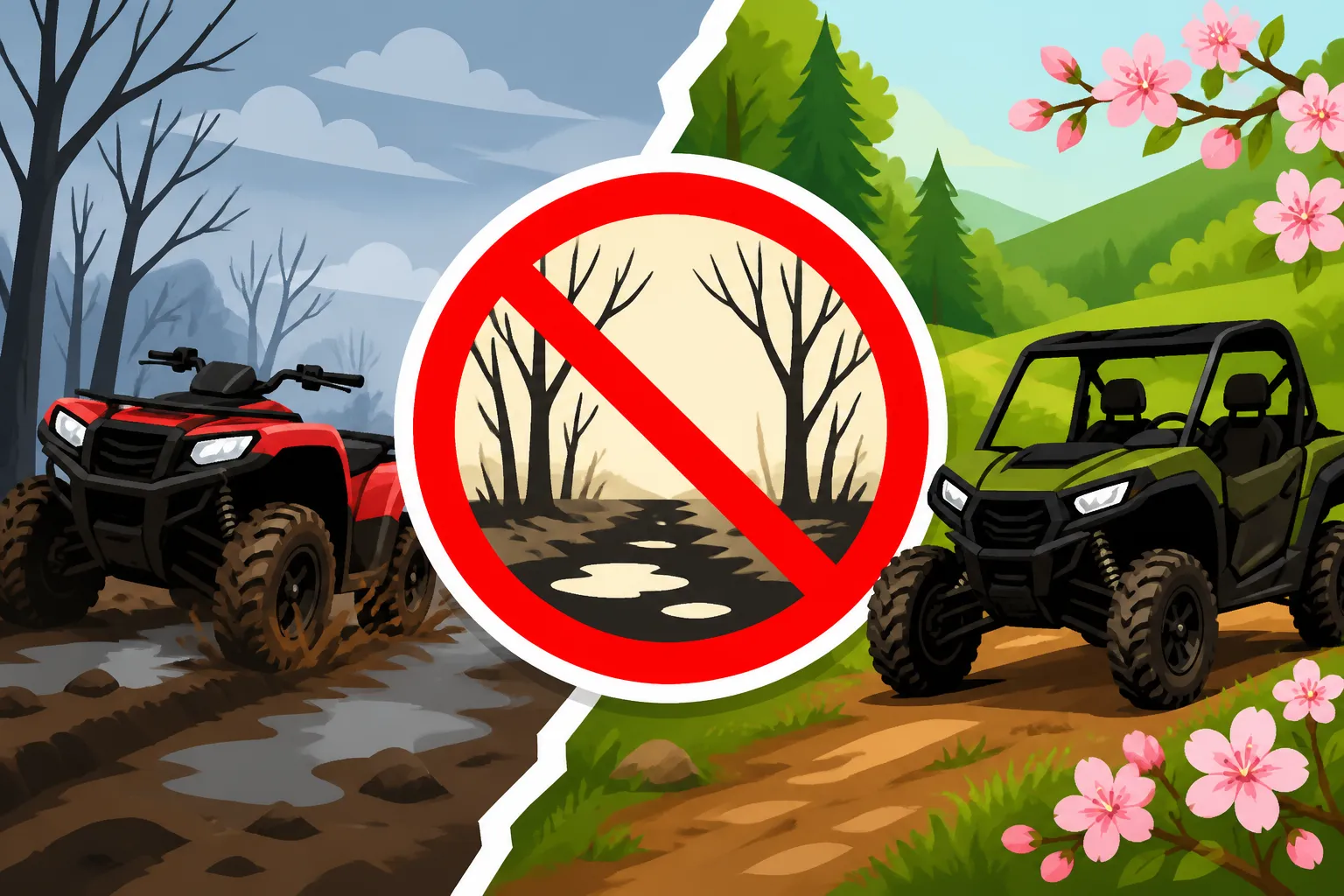
A trail can look firm on the surface while the soil beneath it is still saturated from melting snow and seasonal rain. As the ground thaws, water loosens the soil and reduces its ability to support a heavy ATV or UTV. Tires that would leave shallow marks in summer can sink, spin, and carve deep grooves in spring.
Those ruts do not necessarily disappear when the weather gets warmer. They can collect water, channel runoff downhill, and erode further with each storm. On wooded trails, damage may also spread beyond the track as riders try to steer around muddy sections. A short ride through a soft stretch can leave a trail in poor condition for much longer than the thaw itself.
This is one reason an April 1 closure may apply even when a particular weekend seems sunny and pleasant. The issue is not simply whether the air feels warm or whether the trail entrance looks dry. It is whether the route can handle repeated traffic without being damaged. The seasonal schedule and the reasoning behind it are covered in [Why Pennsylvania Trails Close April 1] and [Pennsylvania's ATV Trail Season Dates].
The calendar date is a management rule, not a weather forecast
A closure date gives land managers and riders a clear boundary. It avoids asking every rider to judge soil conditions independently, which can be difficult even for experienced locals. A trail may be dry near a parking area but soft farther into the woods, shaded by trees, or crossed by a small stream.
Spring conditions also vary across Pennsylvania. A trail in a higher-elevation part of the state may remain wet after a lower route has dried. Even within one forest, sunny slopes and shaded hollows can behave very differently. A fixed seasonal schedule helps make access rules understandable without requiring riders to interpret every stretch of trail themselves.
That does not mean every Pennsylvania riding location follows the same calendar. State forest routes, private riding parks, club properties, and other managed areas may have different seasons or temporary restrictions. Read the rules for the specific property before planning a trip, and do not assume that a route is open simply because the gate is unlocked or another rider is already there. [Pennsylvania's ATV Trail Season Dates] and [Pennsylvania Trails Closed in Spring] are useful companion topics when sorting out seasonal access.
What the closure means for riders
A closed trail is still closed when it looks rideable
The hardest part of a seasonal closure can be seeing a trail that appears dry and deciding whether the rule really applies. The safest answer is to follow the land manager’s posted dates and current notices. A rider’s personal assessment of the ground does not replace a closure, and a trail that seems firm at the entrance may change farther along the route.
Avoid riding around a closed gate, moving a barrier, or looking for an unofficial bypass. Those choices can damage nearby land and may create access problems for other riders. They can also put you somewhere you are not authorized to ride. If a sign is missing or unclear, check with the property manager rather than treating the uncertainty as permission.
The same caution applies when a trail closure is announced after heavy rain or an unexpected thaw. A route that is usually open at that point in the season may be temporarily restricted because conditions have changed. Check [Pennsylvania Trail Closures to Check First] and [Pennsylvania Trail Conditions Before You Go] as part of your ride planning, especially if you are travelling a long distance.
Closures can differ by property and by trail
The date is a useful cue, but it is not a substitute for checking the rules where you intend to ride. Pennsylvania includes state forest trail systems, private off-road parks, club-managed land, and other places with their own operating plans. One area may close for spring conditions while another has a different schedule or makes decisions based on local weather and trail condition.
Even within a larger recreation area, not every road, trail, or connector necessarily has the same status. Some routes may be restricted for maintenance, forestry work, public safety, or other land-management reasons. A map that shows a trail does not, by itself, establish that the trail is open to ATVs on the day you arrive.
Use a map to understand the area and plan a route, then confirm access with the land manager. onX Offroad can help riders explore mapped routes and organize a trip, but it should not be treated as the final word on a temporary closure or local access rule. Where there is a conflict between an app map and a posted notice or official update, follow the current direction from the property manager.
| Riding location | Why its status may differ | What to check before leaving |
|---|---|---|
| State forest trail system | Seasonal schedule, soil conditions, maintenance, or forest operations | The relevant forest district’s current notices and trail rules |
| Private riding park | The operator sets its own hours, seasons, and closures | The park’s official operating information |
| Club-managed property | Access may depend on membership, event dates, or land agreements | The club’s current rules and access arrangements |
| Connector or local road | Road access and ATV permission can depend on separate rules | Posted signs and the authority responsible for the route |
How to plan a ride during spring closures
Confirm access before you load the trailer
A quick check before departure can prevent a frustrating drive to a closed trailhead. Start by identifying the exact riding area and the agency, park, or club responsible for it. Then look for seasonal dates, temporary closure notices, parking restrictions, and any separate requirements for the machine or rider.
Do not rely only on an old screenshot, a saved route, a social media post from a prior season, or a friend’s memory. Trail conditions and access rules can change, and a route that was open on one visit may be closed on another. If a notice is unclear, contact the land manager or the organization that operates the property.
It helps to check more than one source when the trip is important. Use an official map or property page for the rules, then use a mapping tool such as onX Offroad to review the general route and nearby geography. The map can support trip planning, but confirmation of access should come from the responsible land manager. For broader context, see [Pennsylvania Trail Maps From DCNR] and [Pennsylvania State Forest Trails].
Build a backup plan that is actually legal
A backup destination should be confirmed as open before you start driving, not chosen in a parking lot after discovering a closure. Look for a managed riding area with current access information, and verify what machines it allows. Width limits, rider age rules, registration, permits, helmets, and insurance requirements can vary depending on the location and type of route.
Be careful about substituting an ordinary forest road, a game lands road, or a route shown on a recreational map. A road’s presence on a map does not mean ATVs are permitted there. Likewise, a trail that appears to connect two riding areas may cross land with different ownership or access rules. Check each segment rather than assuming the whole line is rideable.
If no suitable legal alternative is open, postponing the ride is better than improvising on a closed trail. That can be disappointing when everyone has taken time off and the trailer is already packed, but an unplanned detour can create safety, trespass, and trail-damage problems. [Pennsylvania's Free State Forest Trails] may help you understand where free state forest riding is available, but always verify the specific route and its current status before setting out.
How to prepare your machine and riding group
Use the closure as a natural maintenance window
A forced break from riding can be a good time to deal with jobs that are easy to put off during a busy season. Inspect the tires for cuts, worn tread, or damage from sharp rock. Check brakes, lights, steering, suspension, and the condition of any belts or chains according to the manufacturer’s instructions. If the machine has been exposed to mud or standing water, clean it carefully and look for debris around moving parts.
Check your registration and paperwork, too. A plate that is loose, bent, or difficult to read is easier to fix in the garage than at a trailhead. Keep required documents protected from water and make sure the machine is ready for the rules that apply to the next place you ride. A seasonal closure does not remove separate registration, insurance, or permit requirements.
This is also a practical time to review your setup. A winch, tire repair kit, first-aid supplies, and reliable communication plan can make a ride safer when the season resumes. Carrying more equipment will not make an unauthorized route legal, but being prepared can help you handle ordinary problems on an open trail. For riding behavior that protects narrow routes once they reopen, see [Pennsylvania Trail Etiquette on Narrow Trails].
Set expectations with your group before the trip
Group rides are especially vulnerable to confusion: one person checks a map, another remembers a route from last year, and someone else assumes the usual trailhead is open. Before meeting up, agree on the destination, the access source you checked, and the plan if conditions or a closure notice changes. Share the rules with everyone, including passengers and newer riders.
If you are riding with children or visitors, explain that a closed trail is not an invitation to explore a side path. Make sure the group understands where it is permitted to ride, where it should stop, and how to regroup if someone falls behind. Clear expectations help prevent a casual detour from becoming a trespass or trail-damage issue.
A little preparation also makes it easier to turn a disappointing closure into a useful day. You might choose a legal alternative, take care of machine maintenance, or simply reschedule for a better time. Keeping the group informed is more effective than making a last-minute decision at a gate, particularly when people have travelled from different parts of the state.
What riders can do to help trails reopen in good shape
Stay off soft ground and respect barriers
If a trail is closed, stay off it even if you believe your machine will make it through without leaving a mark. Repeated traffic is the concern: one tire track can become a rut, and other riders may follow it. Going around a gate can also widen the damaged area and create a new path that land managers did not authorize.
When a trail is open but visibly soft after rain, use good judgment and follow any local restrictions. If the route is turning into a muddy channel, stop rather than spinning the tires or pushing onward. A rider who turns back helps protect the trail for the next visit. [Pennsylvania Trails After Heavy Rain] offers additional context for deciding when conditions call for patience.
Do not treat another rider’s tracks as proof that a route is open. Someone may have entered before a closure, misunderstood a sign, or simply ignored the rules. Posted notices, official updates, and the land manager’s directions are more reliable than tire tracks or word of mouth.
Report problems without creating new ones
If you encounter a damaged sign, blocked route, washout, or confusing closure notice, record what you observed and share it with the responsible agency or property operator. A location description and a clear account of the issue are more useful than vague reports such as “the trail is bad.” If you use a mapping app, a saved location can help you describe where the problem occurred, but do not leave the trail to get a better signal or photograph.
Avoid moving signs, clearing obstacles, or attempting repairs unless the land manager has asked you to help. A blockage may be intentional, and work on a trail can create safety or environmental problems if it is done without authorization. The right contact is the organization responsible for the property, not a neighboring trail system that happens to be nearby.
When access resumes, ride in a way that helps the trail hold up. Keep to the marked route, leave space between machines, and avoid aggressive wheelspin in soft spots. If a narrow section is already showing damage, do not widen it to pass. A few patient choices from each group can reduce the repair burden and help keep riding areas usable.
Give closures the time and respect they need
An April 1 closure can interrupt plans, but it is part of managing trails that face changing conditions from snowmelt, rain, shade, and heavy use. The calendar date does not tell you exactly what every trail will look like; it tells you to check the applicable rules and avoid assuming access. When in doubt, confirm with the land manager.
Before your next ride, check the location’s seasonal schedule, current notices, machine requirements, and any permits or registration rules. Use maps to plan, not to overrule signs or official updates. That simple habit can save a wasted trip and help protect the trails people want to ride when they reopen.
Disclaimer
This article is for general informational purposes only and does not constitute professional advice. Laws, prices and regulations vary by location and change over time. Consult a qualified professional for guidance on your specific situation.