Trailer Size Limits at a Small Trailhead
A small ATV trailhead can turn a simple ride into a stressful parking puzzle when your truck and trailer barely fit—or block the only way for another vehicle to turn around. Pennsylvania does not have one trailer-length limit that applies to every trailhead. This guide explains how to check local restrictions, judge whether your rig will fit, and arrive with a safer backup plan.
How trailer limits work at Pennsylvania trailheads
There is no single statewide parking limit
A trailer that fits comfortably at one Pennsylvania trailhead may be awkward or prohibited at another. The space available depends on the individual lot, the road leading to it, who manages the property, and any rules posted at the entrance. A small gravel pull-off, for example, may have room for a pickup and a short trailer but not enough space to turn around with a longer combination.
It helps to separate two questions: whether your truck and trailer may travel on the road, and whether they can safely enter, park, turn, and leave at the trailhead. Road restrictions and vehicle requirements are not the same thing as a trailhead’s parking capacity. A lot can be physically too small even when your combination is otherwise roadworthy.
Rules may also differ between a state forest trailhead, a township parking area, a private riding property, and a club-managed staging lot. Look for posted signs about parking, overnight use, vehicle size, or keeping access clear. If a sign or the property manager sets a restriction, don’t treat an open patch of gravel nearby as permission to park there.
For a broader sense of what to check before setting out, see Pennsylvania Trail Conditions Before You Go and Pennsylvania Trail Closures to Check First. A trail being open does not necessarily mean every access point has space for a large truck-and-trailer setup.
Physical fit matters as much as posted rules
A trailhead can look roomy in a map view but be difficult to use in person. A narrow entrance, drainage ditch, steep shoulder, soft ground, tight turn, or limited sightline can make the difference between an easy arrival and a trailer that has to be backed out onto a public road. Snow, mud, fallen branches, and parked vehicles can shrink the usable area further.
Think about the whole movement of your rig, not just the trailer’s parked footprint. Can you turn into the entrance without crossing into oncoming traffic? Is there enough space to straighten the truck and trailer? Can you back into a space without blocking the trail entrance or another vehicle’s exit? If the only possible maneuver depends on another driver moving, the lot may not be a good fit at busy times.
This is especially important at smaller access points around rural roads, forest edges, and trail corridors. A map may help you see the general approach, but it cannot reliably tell you whether a turn is tight, the shoulder is soft, or a gate is narrower than expected. Treat digital mapping as a planning aid, then confirm access and parking details with the land manager or official trail information.
Measure your rig and assess the approach
Use the full truck-and-trailer length
When estimating whether your setup will fit, measure the complete combination from the front of the truck to the rearmost point of the trailer. Include a hitch extension, spare tire, ramps, or other equipment that sticks out. A trailer’s advertised deck length is not the same as the space your entire rig occupies.
Also note the trailer’s width, axle arrangement, turning behavior, and how much room you need to open doors or unload machines. Two trailers with similar deck lengths can behave differently when backing or turning, particularly if one is wider or carries its weight farther behind the hitch. If you haul multiple ATVs or a side-by-side, account for the machines and loading ramps too.
A quick measuring routine at home can prevent a frustrating surprise:
- Measure the truck and trailer as one connected combination.
- Record the trailer’s widest point, including fenders or accessories.
- Measure the space needed to open ramps and unload safely.
- Identify how much straight-line room you need to back up and turn.
- Keep those measurements with your trip notes so you can compare them with a lot or route description.
If you are considering a small access point, ask the manager a specific question: “Can a pickup and a trailer approximately this long and wide turn around and park without blocking the entrance?” That is more useful than asking only whether trailers are allowed.
Check the route, not only the parking area
A suitable lot does not help if the access road is too narrow, steep, soft, or restricted for your combination. Before leaving, check for low branches, sharp turns, narrow bridges, weight or width restrictions, seasonal closures, and any road that is not appropriate for a truck towing a trailer. Do not assume a route that works for a pickup alone will work with a long trailer behind it.
A mapping tool such as onX Offroad can help you review the general route and nearby access points while planning. Use it to identify possible approaches and compare alternatives, not as proof that a particular lot allows trailer parking or that a road is suitable for your exact rig. Confirm details with the relevant land manager, trail operator, or local authority, especially when the route includes forest roads or small township roads.
For example, someone hauling to the Whiskey Springs area may want to review the approach from Westport and confirm the intended parking location before committing to a narrow access road. The route information in Getting to Whiskey Springs From Westport can help frame that planning, but your final check should still be against the applicable access and parking guidance.
Choosing a trailhead that works for your setup
Compare staging areas before you leave
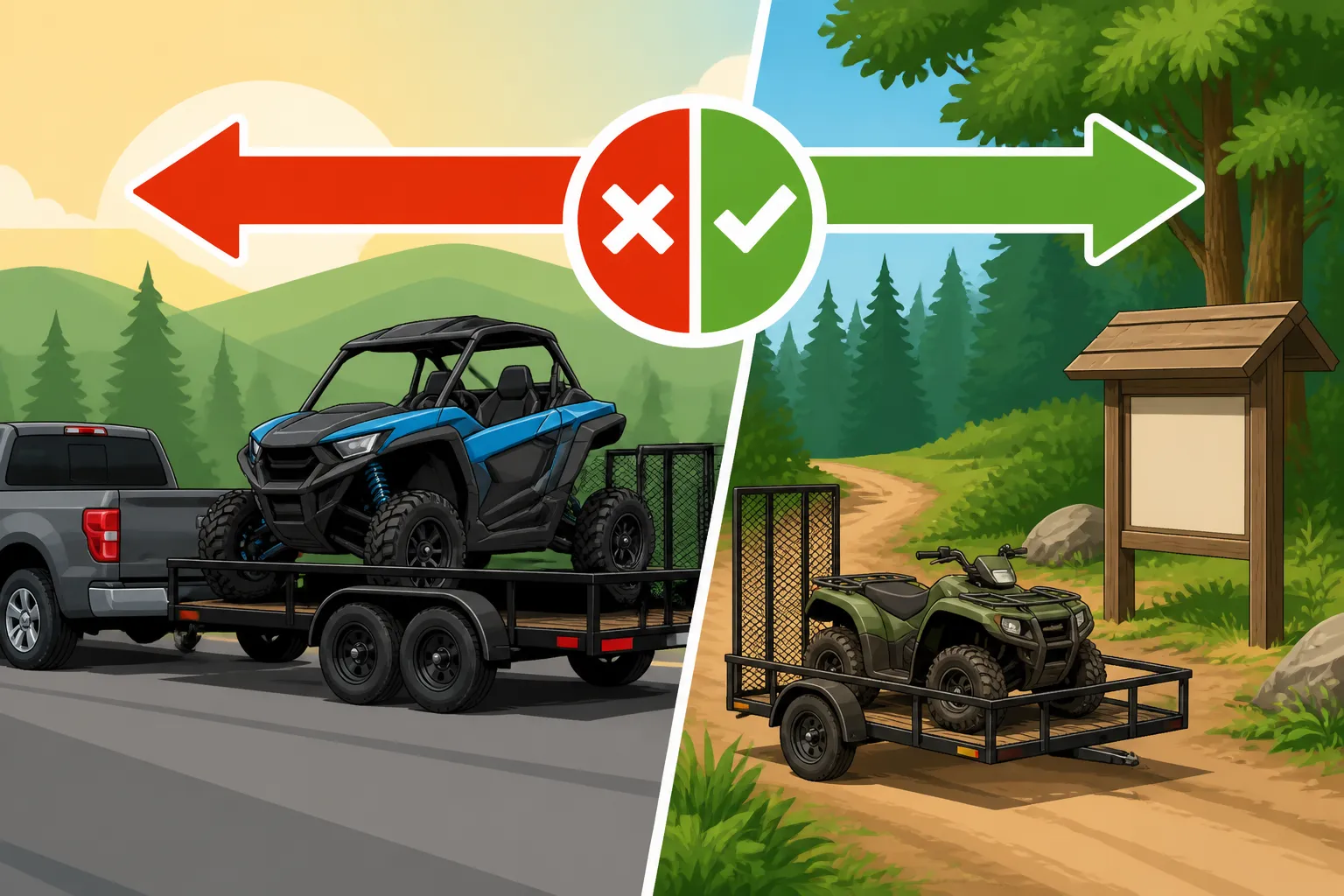
When you have more than one possible access point, prioritize the one that clearly accommodates trailers rather than the one that merely looks closest to your preferred trail. A larger staging area may mean a longer ride to the route, but it can make unloading, parking, and leaving much safer.
Look for official descriptions that mention a staging lot, parking area, or designated trailer space. Pennsylvania Trails With a Staging Lot is a useful starting point when comparing ride locations. Confirm whether the area is open for your planned visit and whether the parking information applies to your machine and vehicle combination.
A useful comparison should include more than the number of apparent parking spaces:
| What to check | Why it matters | What to confirm |
|---|---|---|
| Lot size and layout | A long rig needs room to park and maneuver | Whether trailers are allowed and whether turnarounds are available |
| Entrance width and turning space | Tight approaches can make backing into traffic necessary | Whether the access is suitable for your full truck-and-trailer combination |
| Surface and slope | Gravel, mud, or a steep grade can affect traction | Whether the lot is usable after rain or during seasonal conditions |
| Posted restrictions | Signs may limit parking, overnight use, or vehicle access | Which rules apply at that specific access point |
| Alternative parking | A backup can prevent an unsafe roadside stop | Whether another authorized staging area is available |
Do not park on a shoulder, in front of a gate, across a trail entrance, or in a place that prevents emergency or maintenance access. If the lot is full, the safest choice may be to use a different authorized staging area rather than improvise.
Have a backup plan for busy days
Opening weekends, holiday periods, and favorable-weather days can fill a small lot quickly. Even if your trailer fits the space on a quiet weekday, other vehicles may leave little room to turn around when you arrive. Plan for the possibility that your intended spot is full, temporarily closed, or difficult to access because of weather.
Before the trip, identify another legal place to stage or a different trailhead that can handle your rig. Check whether the alternate option has its own access rules and whether it leads to the type of riding you want. A backup is only useful if it is both open and appropriate for your setup.
If you use onX Offroad to compare nearby access points, mark potential alternatives before you lose cell service. Then verify the locations through official trail or land-manager information. A phone map can help with orientation, but it cannot grant permission to use private land or override a posted restriction.
For trips toward Bloody Skillet, reviewing Getting to Bloody Skillet From Snow Shoe can help you think through the approach and access planning. Build in time to reassess if conditions or parking differ from what you expected.
A practical arrival and parking routine
Check signs and conditions before unloading
When you reach the trailhead, pause before pulling into the lot. Look for signs at the entrance and check whether the surface, available space, and traffic flow match what you expected. If the lot appears too tight to turn around safely, do not drive in simply to see if you can make it work.
Once parked, keep the truck and trailer within the designated area. Leave room for other drivers to pass, turn, and access the trail. Do not block gates, roads, fire lanes, or maintenance access, even if the lot seems quiet. If a ranger, land manager, or property operator gives you instructions, follow them.
Unload on stable ground and make sure ramps are secure before bringing machines down. Keep people clear of the trailer’s path, especially when backing or repositioning. If you need to move the trailer after unloading, confirm that the area is still clear and that you are not forcing other vehicles into a dangerous maneuver.
Know when to choose another access point
Sometimes the right decision is to leave and use a better-suited lot. That can be frustrating after a long tow, especially when the ride was planned around one specific entrance. But backing a long combination down a narrow road, blocking a public route while you unload, or leaving a trailer on an unsafe shoulder can create a bigger problem than changing plans.
Use a simple decision check:
- Is trailer parking allowed here?
- Can the entire combination enter and leave without unsafe reversing?
- Can you park without blocking traffic, gates, or other users?
- Is there enough stable space to unload and reload?
- Do current conditions make the approach riskier than expected?
If any answer is no or uncertain, stop and verify before proceeding. A quick call to the property manager or a move to a larger authorized staging area is usually less costly—in time and stress—than getting stuck or having to maneuver in a crowded lot.
For trip planning, onX Offroad may help you keep routes and possible alternates organized. Still, rely on posted signs and the responsible land manager for permission and parking rules. The safest trailhead is not always the closest one; it is the one your vehicle, trailer, and riding plan can use without obstructing others or putting anyone at risk.
Disclaimer
This article is for general informational purposes only and does not constitute professional advice. Laws, prices and regulations vary by location and change over time. Consult a qualified professional for guidance on your specific situation.