Overnight Parking at a Trailhead
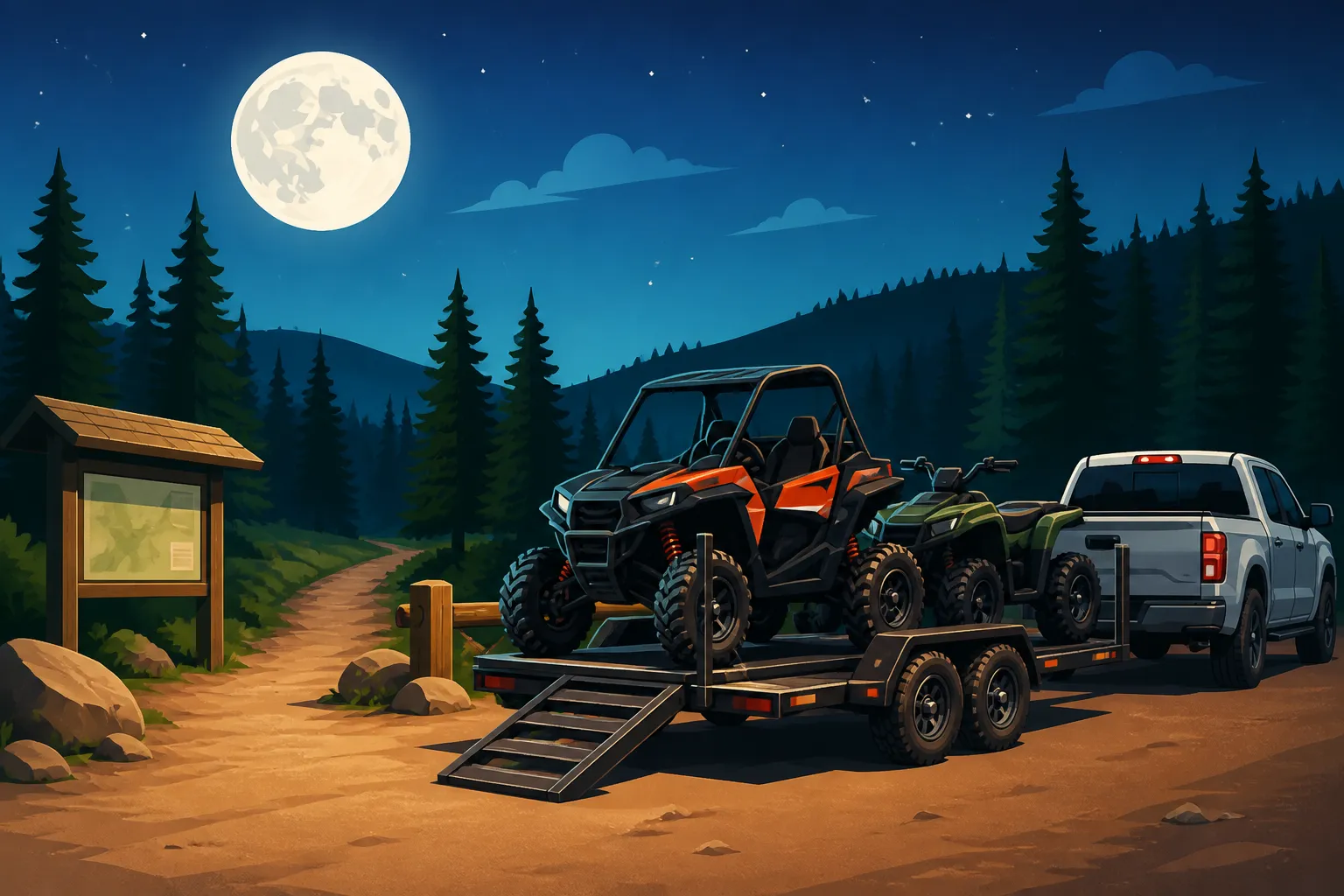
Leaving a truck and ATV trailer overnight at a Pennsylvania trailhead can feel like the easiest way to get an early start—and the quickest way to discover that parking rules vary by land manager. This guide explains how to check whether overnight parking is allowed, plan for a long stay, and reduce the risk of a ticket, tow, or difficult morning.
Check who manages the trailhead before you park
A trailhead’s location does not tell you who controls its parking lot. A lot may be managed by the Pennsylvania Department of Conservation and Natural Resources, the U.S. Forest Service, a township, a private riding park, or a club. Each can set different rules for parking, access hours, and overnight stays.
That distinction matters because “overnight parking” usually means leaving a vehicle in a designated parking area, not camping there. Sleeping in a truck, setting up a tent, or leaving a camp stove beside your trailer may be treated differently from parking alone.
Identify the land manager and the lot
Start with the trail system’s official information, then look for the manager of the specific lot you plan to use. Do not assume every trailhead serving a popular route follows the same rules. One access point may have a large lot with posted hours, while a smaller pull-off nearby may be subject to a different restriction—or have no legal parking at all.
For example, riders heading to Allegheny National Forest trails near Marienville should check information for the particular forest access point they intend to use. A nearby road shoulder or informal pull-off is not automatically an approved overnight lot. The same caution applies around state forest trail systems, club trails, and private riding areas such as Rock Run or the Anthracite Outdoor Adventure Area. A park’s riding access does not necessarily mean its parking area remains open after hours.
If the rules are not clear, contact the land manager or trail operator before you leave home. Ask specifically whether a truck and trailer may remain overnight, whether the lot has a closing time, and whether you need to register your vehicle or display a permit. “Can I ride there?” and “Can I leave my rig there overnight?” are separate questions.
A mapping app can help you locate possible access points, but treat it as a planning aid rather than permission. onX Offroad may help you compare routes and identify mapped access areas, but confirm the parking rules with the organization responsible for the lot. A mapped trailhead does not guarantee that parking is allowed at night.
Read signs at the entrance and inside the lot
When you arrive, slow down and read every posted sign before unloading. Look for restrictions on overnight parking, vehicle length, trailer parking, hours, permits, and where you may leave an unattended vehicle. A sign at the entrance may apply to the whole lot, while a second sign may mark a section reserved for day use, staff, or another group.
Pay attention to wording. “No camping” may not answer whether unattended overnight parking is allowed, and “day use only” may signal that the lot is not intended for an overnight stay. If the sign is unclear or partly obscured, do not guess that the most permissive interpretation is safe. Call the manager or choose a confirmed option.
Also check for temporary notices. A lot that normally accommodates trailers may be restricted during maintenance, a public event, storm cleanup, hunting season, or a seasonal closure. Conditions can change between the day you first research a trip and the evening you arrive.
Confirm the details that affect your truck and trailer
A compact car can fit in a space that will not work for a pickup towing a long trailer. Before planning an overnight stop, check not just whether parking is permitted, but whether the lot can safely accommodate your entire rig without blocking access.
Make sure the lot fits your setup
Estimate the full length of your truck and trailer together, including room to turn around. Look for information about narrow entrances, steep approaches, tight corners, limited spaces, and designated trailer areas. A small trailhead may be workable for a vehicle alone but awkward for a long trailer, especially if other riders arrive early.
Avoid planning to leave the trailer on a road shoulder or in a nearby business lot unless the owner or agency has explicitly allowed it. An improvised overflow spot can obstruct traffic, create a hazard, or leave the equipment outside the area you thought was secure. For more planning considerations, see Trailer Size Limits at a Small Trailhead and Parking a Trailer at a Forest Trailhead.
If you are unsure whether your rig fits, ask the trail operator about the actual parking layout rather than relying only on a map view. Mapping imagery may be old, and a satellite image cannot tell you whether a gate is locked, a turnaround is usable, or a trailer section is reserved.
| What to confirm | Why it matters | What to ask or check |
|---|---|---|
| Overnight permission | A lot may be day-use only | Is unattended overnight parking allowed on this date? |
| Access hours | Gates or roads may close | When does the lot close, and when does it reopen? |
| Trailer space | A long rig may block circulation | Is trailer parking designated, and what size can fit? |
| Permit or registration | Parking and riding rules may differ | What documents or permits must be displayed? |
| Temporary restrictions | Seasonal or event rules can change | Is there a closure, maintenance notice, or special rule? |
| Camping rules | Parking permission may not include sleeping there | Is sleeping in a vehicle or setting up camp allowed? |
Separate parking permission from riding permission
An overnight parking plan does not establish that your ATV or UTV is legal to ride on the adjoining route. Registration, trail permits, land-specific access rules, machine-width limits, and seasonal openings may apply independently. Check the rules for the trail system you intend to use, especially if your trip includes more than one area.
Pennsylvania’s public trail options vary widely. Riders comparing destinations can begin with Where to Ride an ATV in Pennsylvania, then verify the rules for the specific trail and access point. If your plan involves a designated forest trail system, also check Pennsylvania Trail Conditions Before You Go and Pennsylvania Trail Closures to Check First.
Parking in a permitted lot does not authorize riding on a closed trail, a nearby road, or land that is not open to ATVs. Likewise, a trail permit or vehicle registration does not automatically provide overnight parking rights. Treat each requirement as its own check: one for the machine, one for the route, and one for the place where your truck and trailer will stay.
Plan for an overnight stay without turning it into unauthorized camping
Even when unattended parking is allowed, the permission may be limited. Keeping your visit low-impact and following the lot’s posted rules helps protect the access point for other riders and reduces the chance of conflict with land managers or nearby residents.
Keep parking and camping separate
Do not assume that permission to leave a vehicle overnight includes permission to sleep in it, pitch a tent, cook, build a fire, or occupy a picnic area. These activities may fall under camping rules rather than parking rules. Check [Pennsylvania Rules for Camping at a Trailhead] before planning to spend the night at the access point.
This is an easy detail to overlook when you are arriving late or trying to avoid paying for a separate campsite. But a truck parked quietly in an approved overnight area is different from a group spreading out chairs, cooking gear, and sleeping bags. If you want to camp, book or identify a location where camping is expressly allowed rather than treating the trailhead lot as a campsite.
Leave the space clean and usable. Take trash with you, keep the trailer within the marked area, and do not block gates, access lanes, or spaces intended for other visitors. Avoid running a generator or playing loud music late at night, particularly at small lots near homes or rural roads.
Prepare for gates, weather, and limited service
A legal overnight space may still be inconvenient if you do not know when the access road or gate closes. If the lot has a closing time, confirm whether you must arrive before it and whether you can leave after it opens. Do not count on being able to move your vehicle at an hour when the gate may be locked.
Weather can also change the plan. Heavy rain, snow, mud, or fallen branches may make a narrow access road difficult for a truck towing a trailer. Check Pennsylvania Trails After Heavy Rain and any land-manager notices before setting out. A parking area that was easy to enter in dry conditions may become difficult to turn around in after a storm.
Cell service can be unreliable in remote forest areas. Save the address or coordinates of the parking area, the manager’s contact details, and the route back to a main road before you lose reception. onX Offroad can be useful for offline trip planning where you have prepared the relevant map in advance, but verify that the selected trailhead and access route are the correct ones. It is also sensible to share your itinerary with someone at home and agree on when you will check in.
Reduce risk and have a backup plan
Even permitted parking is not risk-free. A truck, trailer, and machine can attract attention, and a lot may be farther from help than it appears on a screen. A few practical steps can make the overnight stop less stressful without giving you a false sense of security.
Secure the equipment and document your setup
Park where you are instructed, keep valuables out of view, and secure the trailer to the truck with appropriate locks. Lock the ATV or UTV to the trailer when practical, and take documents, keys, and small high-value items with you. Do not leave fuel cans, tools, or riding gear openly displayed if you can store them out of sight.
Before leaving the rig, take a quick photo of how it is parked and note any nearby signs. This gives you a record of the location and can help if you return to find the lot rearranged or temporarily restricted. Keep your registration and permit information accessible, but do not leave sensitive paperwork visible inside the vehicle.
If you are meeting friends, agree on the exact parking location rather than saying “the trailhead.” Several access points can serve one riding area, and a group arriving at different lots can create confusion. Share a pin or coordinates, and confirm that everyone is using the same entrance.
Build a second option into the trip
Have a backup parking plan before you tow into a remote area. If the lot is full, closed, or clearly marked against overnight stays, do not leave the rig on a shoulder and hope nobody minds. Use a confirmed campground, lodging option, or other approved parking arrangement instead. A campground near the riding area may be a better choice if you need to sleep, use facilities, or keep the trailer in a managed space.
For riders visiting the Allegheny National Forest or a busy weekend destination, check whether the intended lot is likely to fill early and identify another legal place to stage. A backup should be confirmed—not simply another pin on a map. onX Offroad can help organize candidate access points and route notes, but the land manager’s posted rules remain the deciding factor.
Finally, check the plan again shortly before departure. Revisit trail and parking notices, confirm that the area is open, and verify any permit or operating requirements for your machine. A little extra checking at home is far easier than discovering after dark that the gate is closed or your trailer cannot fit.
Disclaimer
This article is for general informational purposes only and does not constitute professional advice. Laws, prices and regulations vary by location and change over time. Consult a qualified professional for guidance on your specific situation.