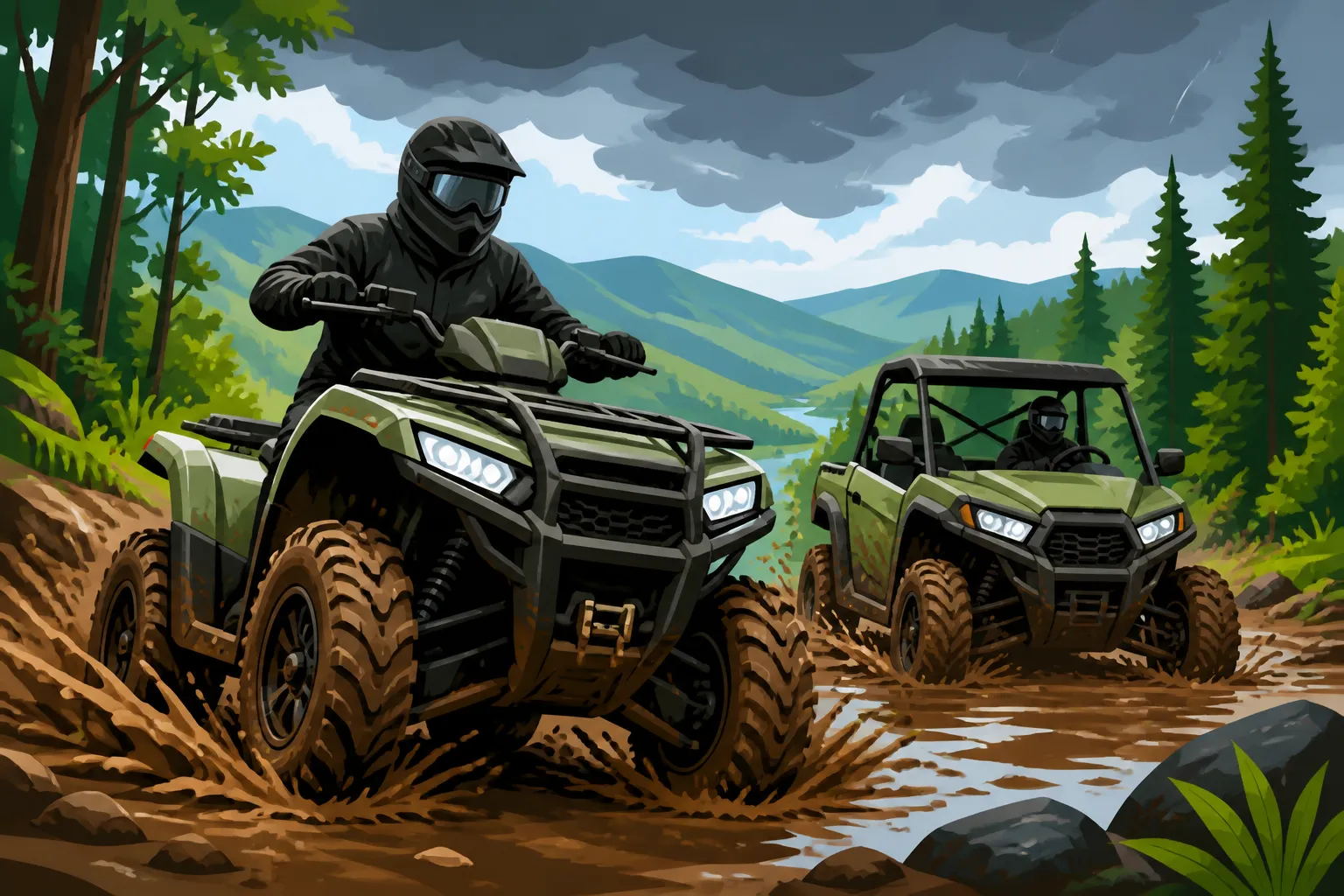
Pennsylvania Trails After Heavy Rain
Heavy rain can turn a familiar Pennsylvania ATV trail into a slippery, rutted route with rising water, hidden washouts, and limited room to turn around. The safest ride may be to wait, choose a durable open route, or head home early. This guide explains how to assess conditions, protect trails, and make a practical ride-or-no-ride decision.
Why Heavy Rain Changes Pennsylvania ATV Trails
Mud, erosion, and hidden obstacles
Rain does more than make a trail wet. Water running downhill can carry loose soil away, deepen existing ruts, expose rocks, and create channels that were not there on your last ride. A shallow depression may become a muddy hole, while a rocky section that usually provides traction can turn slick with a film of water and soil.
Pennsylvania’s wooded trails add their own complications. Leaves can cover washed-out spots, and water can hide branches or rocks in low areas. On a narrow route, a rut may leave very little room to steer around an obstacle. If your machine begins to slide, correcting course can be harder than it would be on a broad, level surface.
The condition of a trail depends on more than how much rain fell at your house. Soil type, slope, drainage, recent maintenance, traffic, and the timing of the storm all matter. A short downpour over saturated ground can do more damage than a longer rain after a dry stretch. Conditions may also change from one part of a trail system to another.
The difference between wet and unsafe
A damp, firm trail is not automatically unsafe. The bigger warning signs are standing water over an unknown bottom, fast-moving water, fresh erosion, deep mud that may trap a machine, and slopes where tires cannot maintain a predictable grip. A route that was manageable on the way in can also become more difficult if rain continues while you are riding.
Think about the least capable rider and machine in your group, not just the most experienced one. A confident rider on a well-equipped quad may handle a muddy hill that is a poor choice for a newer rider, a youth machine, or a loaded side-by-side. If someone would need a risky recovery to get through, the route is already too challenging for the group.
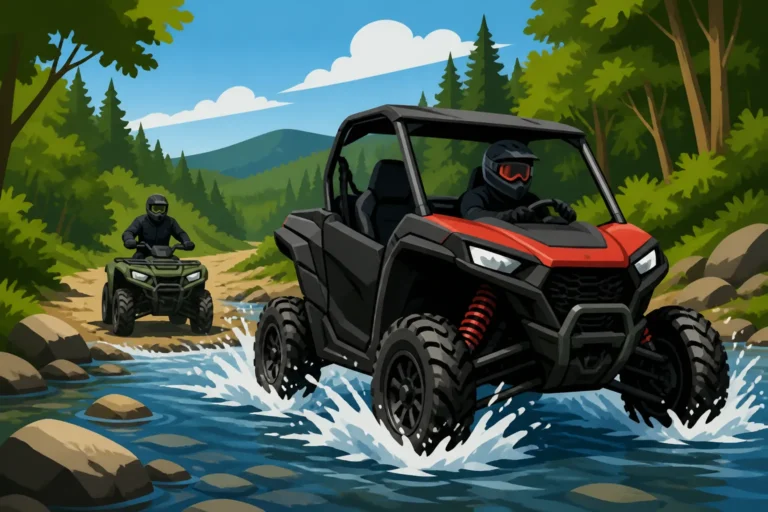
Use the same caution around water crossings. A familiar stream can rise quickly, and the visible surface does not reveal the depth, current, or condition of the bottom. For practical examples of what to assess before approaching a crossing, see [Water Crossings on a Pennsylvania Trail]. If water is moving strongly, has risen above its usual level, or obscures the route, turn around rather than test it.
Check Conditions Before You Leave
Confirm that the trail is open
Do not assume a trail is open simply because it appears on a map, a club page, or an older ride report. Heavy rain can prompt temporary closures, maintenance work, or restrictions that vary by property and trail operator. Check the official information for the specific place you plan to ride, including any posted notices from the managing agency, club, or private park.
Pennsylvania offers several kinds of riding areas, and their rules and updates do not all come from the same place. State forest trails, private riding parks, club-managed routes, and roads open to ATV use can each have different contacts and closure procedures. A route shown on one map does not necessarily mean that it is currently open or suitable for ATVs.
Before setting out, review [Pennsylvania Trail Closures to Check First] and [Pennsylvania Trail Conditions Before You Go]. If the official source does not give a clear answer after a major storm, call the relevant office or operator rather than relying on a social media post from someone who rode a different section. A closure sign on site takes priority over a planned route.
Build a route with a conservative exit plan
Plan a shorter ride than you would choose in dry conditions. Identify the staging area, likely turnaround points, and the route back before entering narrow or unfamiliar terrain. Keep enough daylight and fuel for a slow return. Mud, cautious spacing, and recovery stops can make a short loop take much longer than expected.
A map app such as onX Offroad can help you review terrain and orient yourself while planning, but it should be one tool among several. Compare the route with official trail information, posted signs, and local updates. Map layers cannot tell you whether a storm has washed out a crossing that morning, whether a gate has been closed, or whether a trail has become too soft to ride responsibly.
Download or carry the information you need before you lose cell service. In parts of the Allegheny National Forest, Potter County, and the central Pennsylvania mountains, coverage may be limited or inconsistent. Mark a safe fallback route and make sure everyone in the group knows the plan. If the route is no longer suitable, the group should be comfortable turning back without pressure to “finish the loop.”
| Before leaving | What to check | Why it matters |
|---|---|---|
| Trail status | Official closure notices and posted restrictions | A route shown on a map may be closed |
| Recent weather | Rainfall, ongoing showers, and local conditions | Nearby conditions can differ from the trail area |
| Route plan | Short loop, turnaround points, and return route | Wet terrain can make travel slow |
| Group readiness | Rider experience, machine capability, and recovery gear | One stuck machine can put the whole group at risk |
| Communication | Offline maps, charged devices, and a meeting plan | Cell service may be unreliable in wooded areas |
Decide Whether to Ride, Reroute, or Turn Around
Use a simple go-or-no-go check
Before unloading, look at the trailhead and immediate surroundings. Is water flowing across the access road? Are there fresh tire ruts through soft soil? Is the staging area itself muddy enough that vehicles are struggling? These clues do not tell you everything about the route, but they can help you reconsider before committing to a ride.
If you do begin, reassess at every major change in terrain. Pause before a steep hill, low drainage, stream crossing, or visibly damaged section. Ask whether the route remains safe for the least experienced rider and whether there is room to turn around. Do not let the distance already covered make the decision for you. Turning around early is often the most responsible choice.
The following guide is not a substitute for posted rules or a local closure notice. Use it to organize your judgment:
| Trail condition | Safer response |
|---|---|
| Firm surface with light dampness and no new damage | Proceed carefully if the trail is open and riders remain in control |
| Soft soil with fresh tire marks or shallow standing water | Slow down, avoid unnecessary passes, and consider rerouting |
| Deep mud, expanding ruts, or exposed drainage channels | Turn around or choose a different route |
| Water over a crossing with unknown depth or a strong current | Do not cross; find a safe alternative or return |
| Posted closure, barrier, or instruction from the operator | Stop and comply |
| Machine stuck or rider injured in a risky location | Prioritize people, use a safe recovery plan, and seek help if needed |
Know when a wet section becomes a recovery problem
A common mistake is to continue because the machine has already entered the mud. A tire spinning in place can dig a deeper hole, damage the trail, and leave the rider more deeply stuck. If you lose traction, stop applying throttle and assess the situation. Spinning harder is rarely a good recovery plan.
Keep people clear of moving machines, winch lines, and tow straps. Use recovery equipment only if you know how to operate it safely, and follow the equipment manufacturer’s instructions. Avoid improvised towing from unsuitable points on a machine. If recovery would require someone to stand in a dangerous position, or if the machine is close to fast-moving water or an unstable slope, do not attempt a risky pull.
A side-by-side may feel more stable than a quad, but its weight can make recovery harder and deepen ruts. A larger machine can also be difficult to turn around on a narrow trail. Check the route’s width and conditions before bringing a wide rig; [Pennsylvania Trails for a Wide Machine] can help you think through machine fit, while posted restrictions and current conditions still determine whether a specific route is appropriate.
Ride in a Way That Limits Trail Damage
Keep tires on the established route
When a trail is wet, riding around a muddy patch can look like the easiest fix. But cutting a new line around it widens the trail, crushes vegetation, and can create another drainage path. If the designated trail is too soft to ride without rutting or leaving the route, turn around rather than making your own bypass.
Stay on the marked route, keep spacing between machines, and avoid repeated passes over a soft spot. If the rider ahead is struggling, do not crowd them or rush them into a risky move. On a narrow trail, wait in a stable, safe place until the path is clear. Good habits matter even more when everyone is trying to avoid the same muddy section.
Use gentle throttle and smooth steering. Sudden acceleration can dig deep holes, while sharp turns can tear up a soft surface. If your machine begins to lose traction, ease off and reassess rather than turning a small patch into a long rut. For more on sharing constrained routes respectfully, see [Pennsylvania Trail Etiquette on Narrow Trails].
Treat closures and trail damage as useful information
A closed trail is not an invitation to find another way around a gate. Closures may protect a damaged surface, allow crews to make repairs, or prevent riders from entering a hazardous area. Riding around a barrier can worsen the damage and may create access problems for other riders.
Spring thaw deserves particular care. A trail can look passable at the entrance while the ground farther along is saturated and vulnerable to deep tire damage. A route that dried out after rain may still be fragile during thaw. Read [Why Mud Season Closes Trails] and [Trails Damaged by Spring Thaw] before planning a shoulder-season outing, and check the specific trail operator’s instructions.
If you encounter fresh washouts, damaged signs, blocked access, or a dangerous crossing, note the location as accurately as you can and report it through the proper managing organization. Do not move a barrier or attempt repairs that could put you in danger. A clear report can help the operator assess the problem and decide what work or closure is needed.
Adjust Your Plan for Pennsylvania Riding Areas
State forest trails and remote routes
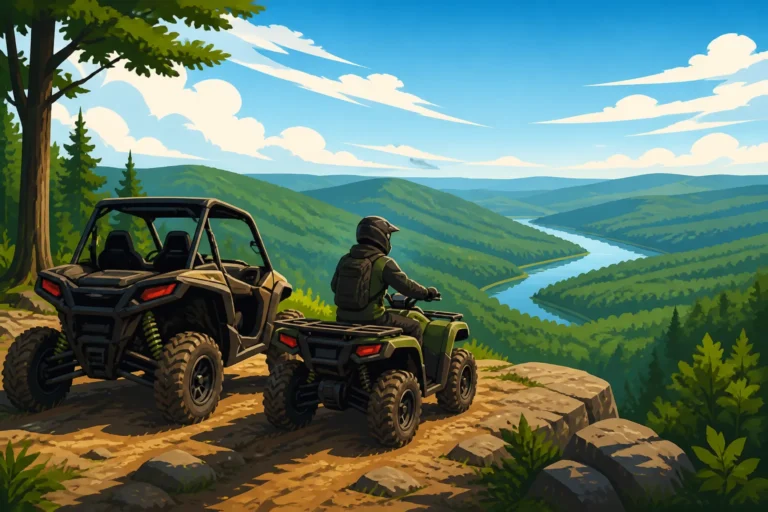
State forest riding areas can feel remote, especially when wet weather slows travel and cell service is weak. The route may pass through steep terrain, drainage areas, or long stretches without nearby services. Build in extra time, bring drinking water and basic tools, and make sure someone outside the group knows where you are going and when you expect to return.
Do not treat a forest road as a guaranteed alternative to a closed or muddy trail. Roads may have different vehicle rules, seasonal restrictions, or local closures. Logging activity and maintenance vehicles can also change what is safe. Review [Log Trucks on Forest Roads] when planning a route that shares space with work traffic, and obey signs and instructions on site.
A mapping tool such as onX Offroad can be useful for understanding the general route and nearby access points, especially when planning a conservative out-and-back ride. Still, use official trail maps and local notices to confirm access. [Pennsylvania Trail Maps From DCNR] is a helpful starting point for understanding mapped state forest routes, but a map is not a real-time report on mud, storm damage, or temporary restrictions.
Private parks, clubs, and trail systems
Private riding parks and club-managed areas may have their own rules for wet-weather riding. Some may close particular sections or the entire property to protect trails; others may keep selected routes open. Check with the operator before traveling, and do not assume that a route is open because a friend rode there before the storm.
The terrain can vary significantly within a single property. At places such as Rock Run or the Anthracite Outdoor Adventure Area, a maintained route may drain differently from a nearby low spot or steep section. Follow the difficulty markings and staff instructions, and be honest about your group’s experience. A wet route that is manageable for one rider can be unsuitable for a family group or a machine with limited ground clearance.
Do not use a riding park’s public roads or neighboring property as an unofficial way around a closure. Stay within authorized boundaries and use designated staging and return routes. If the operator closes part of the system, ask whether another open route is appropriate rather than improvising a detour.
Change the day’s goal when conditions change
A good ride does not have to mean covering every planned mile. If the first section is wetter than expected, shorten the route, spend time on a suitable open area, or pack up. That can be frustrating after arranging a trailer, coordinating a group, and driving to the trailhead, but it is far better than damaging a trail or putting someone in a dangerous recovery situation.
For a practical way to think about changing conditions, see [Pennsylvania Riding After a Storm]. The key is to distinguish between “not as enjoyable as expected” and “not responsible to continue.” If riders are losing control, water is rising, or the trail is being visibly damaged, the decision should be clear.
Make the return trip part of the plan from the beginning. Leave enough fuel and daylight, keep the group together, and be ready to take the same cautious approach on the way out. Conditions can deteriorate while you ride, and the safest choice may be to turn around long before anyone is stuck.
Disclaimer
This article is for general informational purposes only and does not constitute professional advice. Laws, prices and regulations vary by location and change over time. Consult a qualified professional for guidance on your specific situation.