Pennsylvania’s $100 Nonresident Permit
Pennsylvania’s nonresident permit is for visitors who want to ride designated ATV trails in the state’s northcentral region. The $100 figure in the permit’s name is a useful starting point, but a permit is not statewide trail access, vehicle registration or a substitute for checking whether your machine qualifies. Here’s how to understand what it covers and what to confirm before you travel.
What Pennsylvania’s $100 nonresident permit covers
The nonresident permit is associated with the Northcentral Regional Trail Permit. It provides access to eligible, designated ATV trails in parts of four counties: Clinton, Lycoming, Potter and Tioga. Those miles are spread across a large area, so having the permit does not mean you can ride any road, trail or forest route in those counties.
The permitted routes are specific. You still need to follow signs, maps, seasonal closures and any restrictions for the trail you intend to ride. A forest road may look rideable and still be closed to ATVs; a nearby trail may have a different access rule. Before setting out, check the current official trail information and make sure the particular route you plan to use is included. Pennsylvania’s Northcentral Regional Trail Permit explains the permit area, and The Four Pennsylvania Counties the Permit Covers is useful if you are choosing where to stay or stage.
| Question | Practical answer |
|---|---|
| Who is the permit for? | Riders whose residence is outside Pennsylvania and who want to use eligible trails covered by the Northcentral permit |
| Where does it apply? | Designated permit trails in Clinton, Lycoming, Potter and Tioga counties |
| Does it cover every trail in those counties? | No. Access depends on the designated route, current trail status and applicable restrictions |
| Does it replace ATV registration? | No. Registration and the trail permit serve different purposes |
| Does it guarantee access to a private park or club trail? | No. Those properties set their own access and fee requirements |
| Is the fee fixed forever? | No. Confirm the current fee and application details with the official program before paying |
The permit is not a general Pennsylvania riding pass. It does not automatically authorize you to ride on private property, state game lands, roads that are not open to ATVs or a commercial riding park. Each location can have its own rules, hours, admission process or membership requirements. If your trip includes more than one kind of riding area, check access separately for each one.
The permit should also be treated as machine-specific unless the current application instructions say otherwise. Do not assume one permit covers every ATV in a family, a borrowed machine and a rental. Check the form and program instructions for how the permit is issued, what vehicle details it asks for and how it must be displayed. The guide to Buying a Northcentral Permit for Each Machine You Own can help you think through which machines need to be included.
The title’s $100 amount is the stated nonresident fee associated with this permit, but fees and application processes can change. Confirm the current amount with Pennsylvania’s official program before applying, and check whether any separate charges apply to your particular transaction. A cached page, old form or another rider’s past receipt is not a reliable substitute for the current instructions.
Permit access is not the same as trail mileage
The Northcentral system is often described as offering nearly 1,000 miles of riding, but that figure does not mean every mile is open at every time or to every machine. Routes can close seasonally or temporarily, and trail conditions can affect whether a route is safe or passable. Some trails have machine-width limits, and the permitted route network may not suit every side-by-side.
Use the mileage figure to understand the scale of the region, not as a promise that every route will be available on your dates. Check the current map and notices shortly before leaving. Pennsylvania’s Nearly 1,000 Permit Miles provides additional context about the system, while Pennsylvania Trail Closures to Check First is a useful reminder to verify conditions rather than rely only on a map saved weeks ago.
Who needs the permit and what it does not replace
If you live outside Pennsylvania and plan to ride the Northcentral permit trails, first determine whether your planned trails require this permit. Then separately confirm that the machine itself meets Pennsylvania’s registration and insurance requirements for your visit. A trail permit is access authorization for a particular riding area; it does not register your ATV or make an otherwise ineligible machine legal to operate.
Visitors often mix up three separate questions:
- Is the ATV properly registered? Your home-state registration may be relevant, but Pennsylvania’s recognition of another state’s registration depends on the applicable rules.
- Does the rider have the required proof and documents? Carry the documents required for the machine and the riding area.
- Does this trail require a separate permit? A valid registration does not automatically satisfy a Northcentral trail permit requirement.
A visitor with a properly registered machine may still need the Northcentral permit to ride a trail that requires it. Conversely, buying the trail permit does not cure an expired or invalid registration. Does Pennsylvania Honor an Out-of-State Registration? and Carrying Proof of an Out-of-State Registration address the separate registration questions. For the trail side of the issue, Do You Need a Permit for Pennsylvania State Forest Trails? explains why location matters.
Reciprocity does not mean free trail access
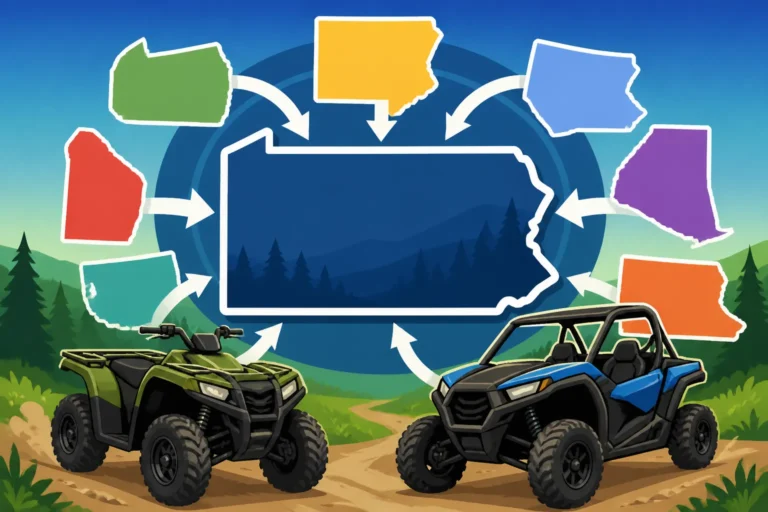
Reciprocity concerns whether Pennsylvania recognizes a machine’s registration from another state under the relevant conditions. It is not the same as a trail permit. Even if Pennsylvania accepts your home-state registration, a separate permit can still be required for the Northcentral system.
Do not assume reciprocity applies just because your ATV has a plate or registration sticker. Rules can depend on the states involved and the machine’s registration status. Confirm the details for your home state before your trip, and carry proof that shows the registration is current. Pennsylvania’s Conditional Reciprocity Rule and Pennsylvania ATV Reciprocity With Other States help explain why the answer can vary.
A useful way to plan is to treat registration, insurance and trail access as three separate boxes to check. One document may help establish that the machine is registered, but it does not necessarily satisfy the other two requirements. Keep the permit confirmation and vehicle documents together so you can produce the right proof if asked.
The permit does not open every kind of property
A regional trail permit is not permission to ride wherever the map shows open ground. Private land requires the landowner’s permission, and a club trail may require membership or another form of authorization. A commercial park may have its own admission, machine and safety rules. State game lands and other public properties have their own restrictions; do not treat them as part of the Northcentral trail system unless official information specifically says they are open to your type of riding.
When in doubt, identify the land manager for the route. A trail shown on a map can cross or approach land with different rules. If a route is posted closed, gated or marked for another vehicle type, do not assume your permit overrides that restriction.
How to apply without getting caught by an old form
Application details can change, so start with Pennsylvania’s current official permit information rather than a form saved from a prior season. Check the current fee, application method, deadline, documents required and instructions for displaying the permit. If you are applying close to a planned trip, allow time for the application to be processed and for any required permit material to reach you.
A practical application sequence is:
- Confirm that your destination is covered. Match the trail or trailhead to the current permit map. Do not rely on the county name alone.
- Check the machine requirements. Confirm that your ATV or UTV is eligible for the route and meets any applicable width or other limits.
- Gather current documents. Have the machine’s registration details and any proof required by the application instructions ready.
- Use the current application channel. Follow the official instructions for applying online, by mail or in person. Do not assume every option is available throughout the year.
- Verify the fee before payment. The amount in the permit title is not a guarantee that the current charge or transaction details are unchanged.
- Save proof of application and payment. Keep the confirmation until you have the permit and know how it must be displayed.
- Check trail status again before departure. A valid permit does not prevent a seasonal or temporary closure.
Look closely at the application’s vehicle fields. Make sure the identifying details match the machine you plan to ride. If the permit is issued for a specific ATV, do not move it between machines unless the instructions expressly allow that. If you are applying for several machines, verify whether each one needs a separate application or permit rather than inferring the answer from another rider’s experience.
Use the current program guidance for the application window. Older forms or saved instructions can have outdated dates, addresses or processing options. When Pennsylvania Trail Permits Go On Sale and Pennsylvania Trail Permit Application Deadline are relevant planning topics, but the official source should settle the current schedule and requirements.
Before sending an application by mail, check that the address and required enclosures are current. Before making an in-person trip, confirm that the office you plan to visit handles applications and is open for the service you need. If an online option is available, make sure you complete the application through the official channel and retain the confirmation. Pennsylvania Trail Permit Mail-In Window and Pennsylvania Trail Permit In-Person Locations can help you organize the logistics, but verify current details before relying on them.
Keep your documents accessible and protected
Pack the permit and registration proof where you can reach them without unloading your machine. A small waterproof document pouch can help protect paper from rain, mud and a wet ride. Amazon is one place riders may look for a basic pouch, but a local outdoor shop or a simple sealed bag can do the same job. Choose a setup that keeps documents dry without obscuring any required permit display.
Do not laminate, cover or alter a permit unless the official instructions allow it. Some permits need to remain visible in a particular way, and a protective sleeve should not hide identifying information or make the permit hard to inspect. Follow the current display instructions rather than guessing based on how another rider attached theirs.
A phone is useful for maps, but it should not be your only plan. Cell service may be weak in remote riding areas, and a dead battery can turn a saved route into a problem. Download or print the current map before leaving. If you use a paper map, a weather-resistant map sleeve from Amazon or an outdoor retailer can keep it readable; make sure you can still check the official version for any later closure notice.
Plan the ride around the permit, not just the destination
A permit is most useful when you plan your trip around the routes it actually covers. Start with the trail system, then choose a staging point and lodging that make sense for those routes. A place that looks close on a road map may still require a long drive to a legal trailhead, and a nearby trail may belong to a different system with different access rules.
Before you leave home, confirm:
- The trailhead and intended route are within the permit area.
- Your planned trails are open on your travel dates.
- Your machine fits the route’s restrictions.
- You know where to park and whether overnight parking is allowed.
- Your registration and insurance documents are current and accessible.
- You understand how the permit must be carried or displayed.
- You have a backup route in case of a closure, poor conditions or an access restriction.
Trail conditions matter as much as legal access. Rain, thawing ground, fallen trees or maintenance work can make a trail difficult or temporarily unavailable. A large side-by-side may be legal to register and still be too wide for a particular trail. Check the machine restrictions before loading it onto a trailer, especially if you are traveling with a UTV. Pennsylvania Rules for a Side-by-Side on a Trail and Pennsylvania Trails That Allow Full-Size Rigs can help with machine-fit questions.
Be realistic about your riding group’s pace. A permit may provide access to an extensive area, but that does not mean you need to cover as many miles as possible in one day. Build in time for map checks, fuel, weather and trail conditions. Carry basic repair supplies and avoid splitting up if riders have different navigation experience.
If you plan to visit a paid riding park as well as the Northcentral trails, treat them as separate destinations. The regional permit does not automatically pay for park entry or club access. Contact the park or club directly for its current admission rules, hours and machine requirements. This is also important if you are renting: ask the rental provider whether registration, insurance and any trail permits are included, and get a clear answer for the exact place you will ride.
Make a simple document kit
Keep a small riding packet with the permit, registration proof, insurance information, emergency contacts and a printed map. You do not need a complicated organizer; the goal is to have essential items together and protected. A waterproof pouch from Amazon can be a convenient option if you do not already have one, but check that it does not interfere with any required permit placement.
Carry a charged phone and a backup power source if you use digital navigation, but do not treat a phone screen as proof of everything. Follow the official rules for the permit and other documents. If the permit must be physically displayed or a particular document must be available for inspection, a screenshot alone may not meet the requirement.
Common mistakes nonresidents can avoid
The most expensive trip-planning mistakes are often simple assumptions: that the permit covers all trails, that a registration from another state is automatically accepted, or that a permit for one machine can be used on another. A few minutes checking official instructions can prevent a long drive to a trail you cannot legally ride.
Assuming the permit is statewide. The Northcentral permit is tied to designated trails in a defined region. It is not a blanket pass for every Pennsylvania state forest, trail, road or park. Match your route to the current map.
Treating a county as a trail map. Being in one of the four counties does not make every route in that county permit-accessible. Check the route itself and its status.
Confusing reciprocity with permit access. An out-of-state registration and a trail permit answer different questions. Verify both. Riding Pennsylvania With an Out-of-State Plate is a useful companion if your machine is registered at home.
Assuming one permit covers several machines. Check the current application instructions for how permits are issued and whether the permit is tied to a particular vehicle. When a group has multiple ATVs, sort this out before submitting applications.
Using an old application or fee amount. Forms and costs can change. Confirm the current version and current total with the official program rather than relying on a prior season’s paperwork.
Arriving without a display plan. Read the instructions for how the permit must be carried or attached. Do not wait until you are at the trailhead to figure out where it goes.
Riding a closed or unsuitable trail because the permit is valid. A permit does not cancel closures or machine restrictions. Recheck trail information before each ride, especially after bad weather or during seasonal transitions.
Assuming a private trail is included. A club, park or landowner can require separate permission, a membership or an admission charge. Contact the property manager directly.
The permit works best as one part of a complete ride plan: choose eligible trails, confirm your machine is allowed, keep registration and insurance in order, and check current conditions before driving to the trailhead. If any piece is uncertain, resolve it with the responsible agency or property manager before riding. For a broader visitor checklist, see What a Weekend Visitor Needs to Ride Pennsylvania.
Disclaimer
This article is for general informational purposes only and does not constitute professional advice. Laws, prices and regulations vary by location and change over time. Consult a qualified professional for guidance on your specific situation.