Do You Need a Permit for Pennsylvania State Forest Trails?
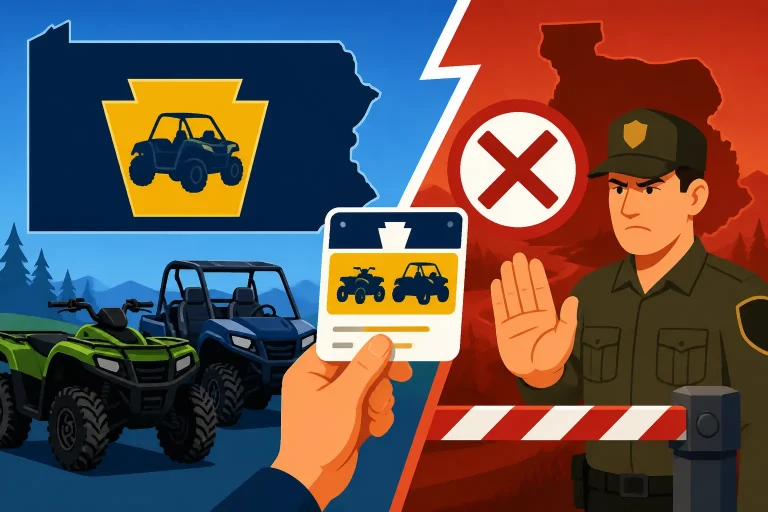
A Pennsylvania ATV registration does not automatically grant access to every state forest trail. Some designated trails require a separate permit, while other routes may not. The key is to match your machine and paperwork to the specific trail system before you set out, especially if you are visiting from another state or riding a UTV.
When a Pennsylvania state forest trail permit is required
Pennsylvania does not require one permit for every state forest road or trail. A separate permit applies to particular designated ATV trail systems, including the Northcentral Regional trail system. Those trails are in Clinton, Lycoming, Potter, and Tioga counties. The permit is for access to those designated routes, not a general pass for all state forest land.
That distinction matters because a state forest can contain several kinds of routes. A marked ATV trail, a forest road, and a route closed to motorized recreation are not interchangeable. A permit does not give you permission to ride a road or trail that is not open to ATVs.
| Where you plan to ride | Is a separate trail permit generally required? | What to check |
|---|---|---|
| Designated Northcentral Regional ATV trails | Yes | Permit, registration, insurance, machine eligibility, and seasonal access |
| Other state forest routes | Not automatically | Whether that exact route is open to ATVs and whether it has a separate permit requirement |
| Allegheny National Forest routes | A separate federal permit may apply | The current forest permit rules and eligible routes |
| Private or club trails | It depends on the landowner or club | Permission, membership, event, and insurance requirements |
For the Northcentral system, plan to obtain a permit for each machine you intend to ride there. The permit does not replace Pennsylvania registration, an eligible out-of-state registration, or insurance requirements. Check the current application instructions with DCNR before applying, since application procedures and permit details can change.
For an overview of that permit system, see Pennsylvania’s Northcentral Regional Trail Permit. If you are mapping out routes elsewhere, Pennsylvania’s Free State Forest Trails can help you understand why “state forest trail” does not always mean “permit required.” Still, confirm the status of the exact route you intend to ride rather than relying on a general map or a trailhead sign you saw on an earlier visit.
A permit is not blanket permission
A permit gives access only within its stated scope. It does not authorize riding off a designated trail, entering a closed route, or using a machine that exceeds the trail’s restrictions. It also does not replace landowner permission where a route crosses private property.
Think of the permit as one item in an access checklist, not as permission to ride anywhere in a county or forest. Before leaving home, verify:
- The trail system requires the permit you plan to buy.
- Your machine is eligible for that system.
- The routes you want to ride are open during your planned visit.
- You have the registration and insurance documents the permit requires.
- You understand any local closures or posted restrictions.
If your route includes federal land rather than state forest land, confirm that separately. The Allegheny National Forest is managed separately from Pennsylvania’s state forests, and its permit rules are not interchangeable with the Northcentral Regional permit. See Why the Allegheny Forest Sells Its Own Permit for the practical distinction.
What to have besides the trail permit
Riders often use “registration” and “permit” as if they were the same thing. They are different documents. Registration identifies the ATV under the applicable registration system; a trail permit provides access to certain trails. Having one does not necessarily satisfy the other.
Pennsylvania registration rules are another part of the checklist. A Pennsylvania ATV used on public trails generally needs the appropriate registration, and a visitor should not assume that a plate from another state will automatically be accepted for every purpose. Pennsylvania’s reciprocity rules are conditional. Check Pennsylvania ATV Reciprocity With Other States before relying on a home-state registration, and carry proof of the registration if you are riding as a visitor. Carrying Proof of an Out-of-State Registration covers what to keep available.
Insurance is a separate requirement. Pennsylvania requires insurance in circumstances that include operating an ATV away from land you own, subject to applicable exceptions. The permit itself should not be treated as proof of insurance. Keep your policy information or other accepted proof with you, and confirm the current requirements before riding.
The current permit application is the best place to confirm what the issuing office asks you to show. Requirements can differ depending on where your machine is registered and how you apply. As a practical preparation list, have these details ready:
- The machine’s registration information and registration number.
- Proof of insurance that meets the applicable rules.
- The machine’s identifying details, including its VIN if requested.
- The permit application information for the rider or owner.
- A way to keep required documents dry and readable on the ride.
A waterproof document holder can help keep a registration card or insurance proof from getting soaked or muddy. A simple wallet-style holder from a retailer such as Amazon may be useful, but it does not replace carrying the actual documents required for the ride.
If you are bringing a UTV
Do not assume that a permit for an ATV trail automatically makes every UTV suitable. Trail systems can restrict machines by width, weight, or class. Pennsylvania’s state forest ATV trails have limits that can rule out wider or heavier side-by-sides, even when the owner has a valid registration and permit.
Measure the machine at its widest point using the method specified by the trail system, and check its weight against the current rules. Accessories such as tracks, plows, or other fitted equipment may affect the machine’s overall dimensions. A UTV can be registered and insured yet still be too large for a particular trail.
If you are buying or choosing a machine specifically for these routes, check the trail limits before committing. Pennsylvania’s Class II Trail Width Limit explains why width matters, and Pennsylvania Rules for a Side-by-Side on a Trail is useful for checking UTV-specific restrictions.
How to check the route before riding
Start with the trail system, not the county name. A county may contain public trails, closed routes, private land, and roads with different access rules. A permit for one trail network does not automatically apply to every route nearby.
Use the current DCNR trail information and permit instructions to confirm the exact route. Pay attention to notices about seasonal access, maintenance, weather-related closures, and hunting-season restrictions. Trail availability can change, so an old map or a past trip is not a reliable guarantee that a route is open today. Pennsylvania Trail Maps From DCNR is a useful starting point for route planning, but check current notices as well.
A careful pre-ride check can prevent the common mistake of arriving with the right paperwork for the wrong trail system:
- Name the trail system. Confirm whether it is the Northcentral Regional system, another state forest route, the Allegheny National Forest, a private park, or a club trail.
- Check the permit rule for that system. Do not infer the rule from a neighboring trail or another forest district.
- Verify machine limits. Check class, width, and weight restrictions, particularly for a UTV or a machine fitted with accessories.
- Confirm registration and insurance. Visitors should verify that their home-state registration qualifies and bring proof.
- Check current access conditions. Look for seasonal openings, temporary closures, and restrictions that apply to the intended route.
- Keep documents accessible. Store them so they remain legible and can be shown if requested.
If your route crosses more than one land-management area, check each part independently. A state forest permit does not cover an adjacent private trail, and a federal forest permit does not substitute for a state-required permit. Likewise, riding permission from a club or landowner does not cancel registration and insurance obligations.
The practical answer is: you need a separate permit for the Pennsylvania state forest trail systems that require one, including the designated Northcentral Regional ATV trails. You do not need to assume that every state forest route requires that same permit, but you do need to confirm that each route is open and that your machine and paperwork qualify. When in doubt, check directly with the agency or land manager responsible for the route before you load the trailer.
Disclaimer
This article is for general informational purposes only and does not constitute professional advice. Laws, prices and regulations vary by location and change over time. Consult a qualified professional for guidance on your specific situation.