Pennsylvania ATV Safety Certificate Requirements
Pennsylvania’s ATV safety certificate rules can be confusing because the answer depends on the rider’s age and where the machine will be used. Riders ages 8 to 15 face requirements that adults generally do not. Here’s what young riders need to know about approved training, carrying proof, age limits, and the difference between a certificate and permission to ride.
Who needs a Pennsylvania ATV safety certificate
In Pennsylvania, riders ages 8 to 15 generally need to complete an approved ATV safety training course before operating an ATV on public land. They must also carry their certificate while riding where the requirement applies. The certificate is proof of training; it is not a registration, trail permit, or guarantee that a particular rider can use every trail.
The age range matters. The requirement is aimed at riders who are at least 8 but have not yet turned 16. Riders under 8 are not allowed to operate an ATV on public land, so taking a course does not make a child under 8 eligible to ride there. Read Why Under Eights Cannot Ride Pennsylvania State Land for the distinction between training and the minimum age to ride.
For a rider in the 8-to-15 age group, the safest approach is to confirm the current course and certificate requirements before planning a ride. Check the Pennsylvania Department of Conservation and Natural Resources (DCNR) information for the type of land and trail you intend to visit. A trail operator, club, or private park may also have its own rules, which can be more restrictive than the general state requirements.
| Rider and setting | What to check |
|---|---|
| Ages 8 to 15 on public land | Approved safety training and certificate requirements |
| Under age 8 on public land | The rider is not permitted to operate an ATV there |
| Age 16 or older | Youth certificate requirements generally no longer apply, but other riding rules still do |
| Private land or a privately operated trail | Landowner or operator rules, plus any state rules that apply |
| Any rider visiting a particular trail | Registration, permits, machine limits, and site-specific conditions |
The certificate requirement is one part of the rules for youth riders, not a substitute for checking the rest. Age-related limits can also affect what size machine a young rider may operate. For example, the smallest riders face an engine-size restriction; see A 70cc Cap for the Youngest Riders and Pennsylvania Rules for Riders Aged 8 to 15.
Public land does not mean every trail is open
A safety certificate does not open land to riding. Pennsylvania state forest and other public lands have designated routes and separate access conditions. Some routes require a trail permit, and some public land is closed to ATVs altogether. Riders should confirm that the specific route is open to the machine they plan to use.
Private property is a separate consideration, but “private” does not automatically mean unrestricted. The property owner or trail operator may require a course certificate, a membership, a permit, or additional supervision. A rider should ask before arriving rather than assume that a certificate alone is enough.
What the course and certificate prove
An approved safety course teaches basic skills and safety practices for ATV operation. It helps young riders understand how to handle a machine, recognize hazards, and make safer decisions. Completing the training results in a certificate that serves as evidence of completion when a rider is subject to the requirement.
The certificate is not a driver’s license, road-use permit, or machine registration. It does not authorize a rider to use public roads, ride an unapproved trail, operate a machine beyond the rider’s age limits, or ignore supervision rules. These are separate questions. A rider may have completed training and still be too young for a particular machine or route.
Pennsylvania’s course arrangements can differ by age. Youth courses for riders ages 8 to 15 are generally arranged through approved instruction, including in-person opportunities. Older riders may have different training options. Course availability, format, registration steps, and certificate delivery can change, so check current DCNR guidance before signing up. Where to Take a Pennsylvania ATV Safety Course has more information about finding instruction, while Pennsylvania ATV Course for Ages 8 to 15 focuses on the youth course.
Adults may also choose to take safety training even when they are not subject to the youth certificate requirement. Training can be useful for a new rider, someone returning to the sport, or a parent who wants a consistent safety foundation for a family ride. Available formats and course details should be verified with the current provider. See Pennsylvania ATV Course for Adults for the adult-course question.
Keep proof available on the ride
When a certificate is required, the rider should carry it while operating the ATV in the setting covered by the rule. Do not assume that a parent’s copy, a phone photograph, or a saved email will be accepted as proof unless current instructions say that format is acceptable. Confirm what form of documentation is recognized and keep it protected from rain, mud, and damage.
A practical pre-ride check is to place the rider’s certificate with the other papers they need, then make sure the rider can produce it if asked. Registration proof and any required permit are separate documents. Keeping them together can make a trailhead check easier, but one does not replace another. For certificate-specific guidance, see Carrying the Certificate on a Ride. If the document has been lost or damaged, check [Replacing a Lost Pennsylvania Certificate] for the current replacement process.
A certificate is only one part of youth eligibility
A young rider’s eligibility depends on more than course completion. Age, machine size, the kind of land, the trail operator’s conditions, and any supervision requirements can all matter. Before riding, match the rider and machine to the exact rules for the planned location.
Check age and machine size separately
Passing a course does not cancel age-based machine restrictions. Pennsylvania places limits on the machines younger riders may operate, including a smaller engine-size limit for riders ages 8 and 9. As the rider gets older, different limits may apply. Use the current state requirements rather than relying on a seller’s description, a family member’s memory, or what another rider uses.
Also consider whether the machine is physically suitable. A child should be able to reach and operate the controls properly and stop the ATV safely. A certificate indicates training completion; it does not show that a particular machine fits the rider or that the rider has enough experience for a challenging route.
Check supervision rules and trail rules
Some youth riding situations include supervision requirements. Confirm who must accompany the rider, where that person must be, and whether the rule applies to the land or activity planned. A responsible adult should stay close enough to respond if the young rider needs help, even when a specific rule does not require that adult to ride directly beside the child.
Trail operators may set conditions for age, machine type, protective equipment, or adult accompaniment. Those conditions can differ between public trails, club properties, and commercial riding areas. Contact the operator before travel if the rules are not clear. A course certificate does not override a more restrictive site policy.
Do not confuse training with reciprocity
Visitors sometimes assume that a certificate earned elsewhere will automatically meet Pennsylvania’s requirements. That may depend on the certificate, the issuing program, and the rule being applied. Before bringing a young rider from another state, verify whether Pennsylvania accepts that rider’s existing proof. Does Pennsylvania Accept an Out-of-State Safety Certificate? addresses that question.
The same caution applies in reverse: a Pennsylvania certificate does not guarantee that another state or private riding area will accept it. If a trip crosses state lines, check the destination’s requirements as well as Pennsylvania’s. Carry the certificate and be prepared to show it in the form accepted by the relevant authority.
A practical checklist before a young rider goes
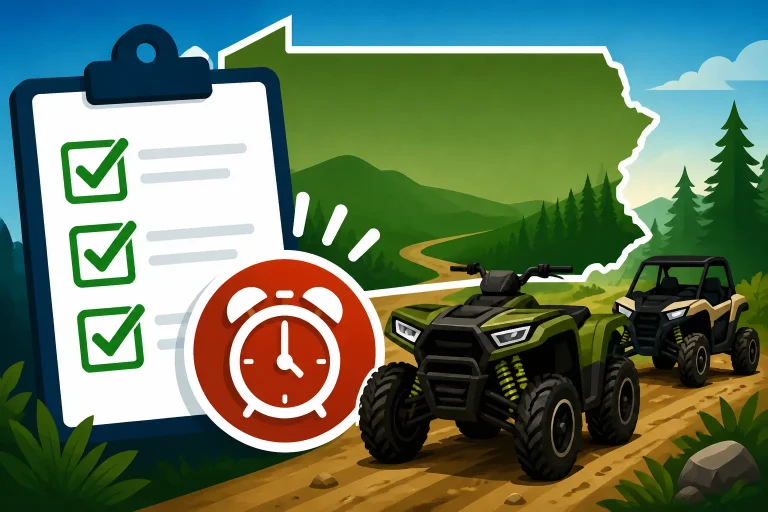
Checking the rules before leaving home can prevent a wasted trip or an avoidable citation. Use this sequence for a rider ages 8 to 15:
- Confirm the rider’s age. A rider under 8 cannot operate an ATV on Pennsylvania public land. For riders ages 8 to 15, check the course requirement and all age-based restrictions.
- Verify the course. Make sure the course is approved for the rider’s age and that the certificate has been issued or can be documented as required.
- Confirm the machine is allowed. Check engine-size limits, the rider’s ability to operate the machine, and any restrictions imposed by the trail or property.
- Identify the land and route. Confirm that ATVs are allowed there and that the route is open to the planned machine. Public land may include closed areas and routes with additional conditions.
- Check supervision requirements. Find out whether an adult must accompany the young rider and what that means for the specific location.
- Gather separate documents. Bring required registration documents, permits, and the safety certificate. Each serves a different purpose.
- Check current instructions. Course availability, accepted proof, permit rules, and trail access conditions can change. Use current DCNR and trail-operator information before setting out.
For example, a 12-year-old with a valid certificate may still be unable to ride a particular machine if its size exceeds the limit for that rider’s age. The same rider may also be turned away from a trail that is closed, restricted to a different machine class, or subject to a permit requirement. Treat the certificate as one item on the checklist, not as a general pass.
If the ride is on public forest trails, also check whether the location requires a separate permit. The Northcentral permit system and the Allegheny National Forest permit are separate from ATV safety training. A certificate does not replace either one, and a permit does not excuse a youth rider from training requirements.
Cost and enrollment details may vary by course and provider. Before paying or making travel plans, confirm current options through the relevant official channel. More information is available in [Pennsylvania ATV Safety Certificate Cost]. If you are also preparing machine paperwork, Registering an ATV in Pennsylvania explains the separate registration process.
The key point is straightforward: for riders ages 8 to 15, confirm approved training and carry the required proof, but also check age, machine, supervision, land-access, and permit rules. That complete check is what determines whether the young rider and ATV are ready for the planned route.
Disclaimer
This article is for general informational purposes only and does not constitute professional advice. Laws, prices and regulations vary by location and change over time. Consult a qualified professional for guidance on your specific situation.