Why Under Eights Cannot Ride Pennsylvania State Land
A child under eight may be eager to ride, but Pennsylvania’s public-land age rule can stop a family outing before it starts. The key is knowing what the rule covers, how it differs from registration and trail permits, and why riding with an adult does not automatically make a prohibited ride legal. Here’s how to plan around the restriction.
What Pennsylvania’s under-eight rule means
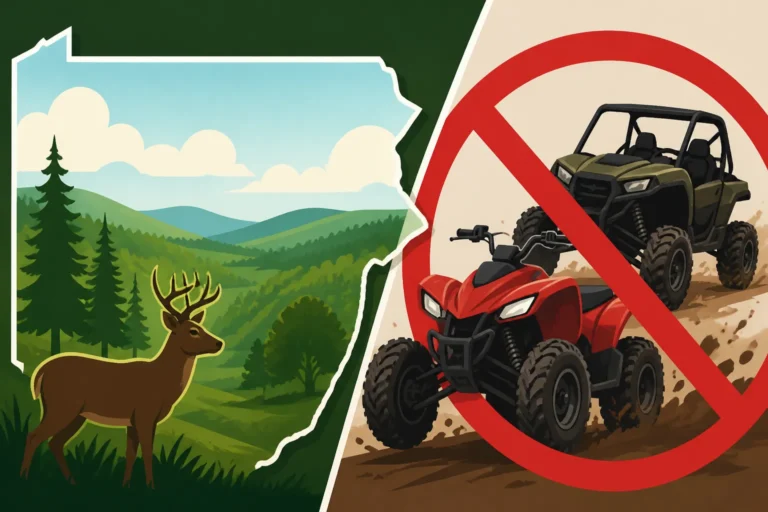
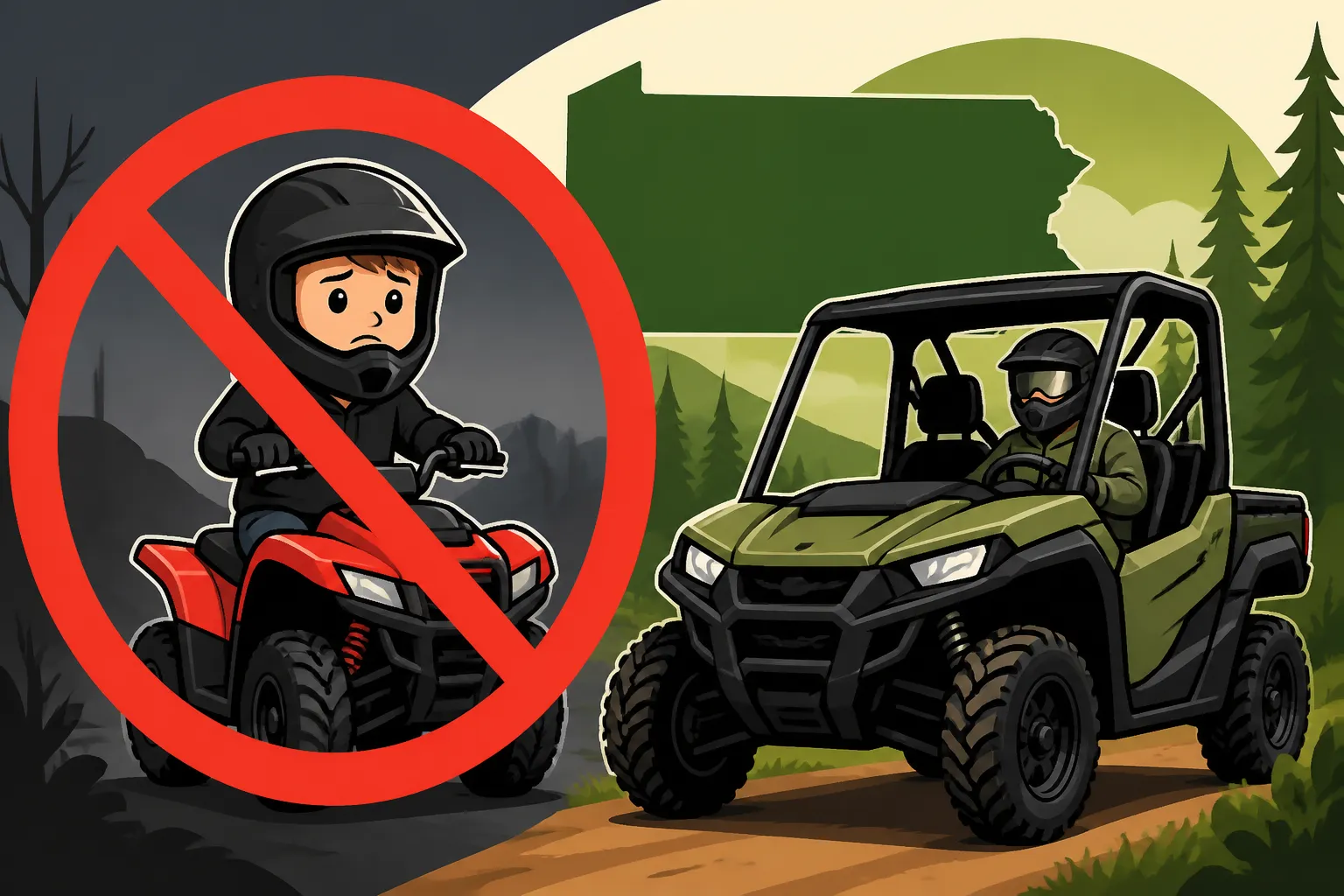
Pennsylvania does not allow a child under eight to operate an ATV on public land. That includes public riding areas where ATVs are otherwise permitted, such as designated trails on state forest land. The minimum age is not waived because a parent is present, the child has experience, or the machine is small.
The important word is operate. The rule is about who controls and drives the machine. It is separate from rules about whether an ATV is registered, whether a rider needs a safety certificate, and whether a trail permit is required. Meeting one requirement does not cancel another: a properly registered ATV does not become legal for a child under eight to operate on state land.
This restriction is also not limited to large, powerful machines. A youth quad or other small ATV is still subject to the public-land age rule. Nor does an out-of-state plate, rental agreement, or family membership create an age exemption. Before a ride, check the requirements for the machine, the rider and the specific land or trail.
“State land” can mean different things in everyday conversation. Pennsylvania state forests, state parks and state game lands do not all have the same access rules. Some state forest areas have designated ATV trails; state game lands generally are not open for ordinary ATV riding, aside from limited exceptions such as authorized access routes. A state-owned property is not automatically an ATV riding area.
| Situation | What the under-eight rule means | What else to check |
|---|---|---|
| Child under eight operating an ATV on a public trail | Not allowed | Whether that trail is open to ATVs |
| Child aged eight or older operating on public land | The under-eight bar no longer applies | Safety certificate, supervision, machine-size and access rules |
| Child riding on private land | The public-land age restriction is not the same rule | Owner permission, safe supervision and any other applicable rules |
| Child riding as a passenger | Do not assume the operator-age rule answers this | Passenger rules, machine design and land-manager requirements |
| ATV parked or trailered on state land | The child is not operating it simply by being present | Whether the location allows the vehicle and activity |
For a broader look at the minimum age and related requirements, see [Pennsylvania Minimum Age to Ride an ATV] and Pennsylvania Rules for Riders Aged 8 to 15.
Why adult supervision does not create an exception
A common misunderstanding is that a child can operate on public land if an adult rides alongside, follows on another machine, or holds the child’s ATV steady. Supervision may be an important safety requirement for young riders who are old enough to operate, but it does not lower the minimum age.
The same is true if the adult owns the ATV, pays for the permit, or is responsible for the trip. The rule concerns the person operating the machine, not whose name appears on its paperwork. If a child under eight is driving, an adult’s presence does not turn that operation into a permitted ride.
A short distance does not change the answer either. Letting a child drive only in a staging area, on a connecting stretch, or for “just one turn” on a public trail still involves operation on public land. A quiet trail, an empty parking area or a familiar route is not an age exemption.
Nor does taking a safety course grant permission to ride before the minimum age. Training can help an eligible rider develop safer habits, but it cannot override the legal age limit. The certificate requirements for riders aged eight to fifteen are a separate issue; they apply once a child is old enough to operate, and other requirements can still apply. See [Pennsylvania ATV Safety Certificate Requirements] for the related rules.
The reason to keep these requirements separate is practical: a family can have the right machine and the right paperwork but still have a rider who is not eligible to operate. Before leaving home, identify the intended operator and confirm that person meets the requirements for the exact location. Don’t rely on a general statement that “kids can ride there” when the rules may differ by age, property and trail.
What changes when a child turns eight
Turning eight removes the specific under-eight barrier to operating an ATV on public land. It does not automatically give a child permission to ride every trail or on every machine. For riders from eight through fifteen, age-related certificate and supervision requirements may apply, along with the conditions set by the trail or land manager.
A particularly important restriction concerns machine size for the youngest riders. Pennsylvania has a 70cc cap for riders aged eight and nine in the circumstances covered by its youth rules. Don’t assume that a child who has turned eight can move directly to any family ATV. Review A 70cc Cap for the Youngest Riders and check the current requirements for the child’s age and the vehicle.
Once a rider is eligible by age, work through the requirements one at a time:
- Confirm the land is open to ATVs. A state forest, state park or game lands property may have different rules, and even within an area, access may be limited to signed or designated routes.
- Check the rider’s age-related requirements. This may include an ATV safety certificate and supervision. Don’t substitute an adult’s experience or certificate for the child’s own requirement.
- Match the machine to the rider. Check the youth machine-size rules and make sure the child can control the ATV safely. A machine that is too large or heavy can be difficult to handle even where its use is otherwise allowed.
- Check registration and any required access permit. These are separate from the rider’s age and certificate requirements.
- Carry required proof. Have the documents required for the machine, the trail and the rider available during the outing.
For public riding, there can be multiple layers of permission. A machine may need registration, while a particular trail system may require an additional permit. A safety certificate concerns the rider; a permit concerns access to a specific area. Neither one acts as a replacement for the other.
Pennsylvania has extensive public-land riding opportunities, but not every trail system follows the same access process. The Northcentral permit area, for example, has its own trail-access requirements. Read Do You Need a Permit for Pennsylvania State Forest Trails? before planning a trip, and check the rules for the particular trail you intend to ride.
State land, private land and the passenger question
The under-eight restriction discussed here is about operating an ATV on public land. Private property is a different setting, but that difference should not be treated as a blanket guarantee that every child can ride any machine there. The property owner’s permission, the child’s ability, the vehicle’s design and other safety or legal rules still matter.
On private land, get clear permission from the owner before riding. Permission for one field or track does not automatically extend to neighboring property, a public road or a route that crosses land owned by someone else. If the ride connects private ground to a public trail, the public-land age requirement applies as soon as the child would operate on that public portion. See [Pennsylvania Rules for Riding Private Land] for more on where landowner permission fits.
The word ride can also refer to operating or being carried as a passenger. The under-eight rule is specifically about operating. That distinction does not mean that carrying a child passenger is automatically allowed. Passenger rules may depend on whether the machine is designed to carry a passenger, how the passenger is seated and secured, and the rules of the land or trail system. A child should never be carried on a machine in a way the manufacturer or applicable rules do not allow.
If a family is considering a passenger ride, check the passenger requirements separately instead of treating it as a workaround for the operator age limit. In particular, don’t carry a young child on a single-rider machine or assume that an adult driving makes every passenger arrangement acceptable. When requirements are unclear, ask the land manager before the trip.
A UTV does not necessarily provide an exception just because it has a passenger seat, seat belts or a roll cage. The rules can depend on how the vehicle is legally classified and where it is being used. Confirm that the specific machine is permitted on the route and that the child meets the applicable passenger and safety requirements. A vehicle that is suitable for family use on private property may not be eligible for the same route as an ATV.
State game lands deserve special care. They are public land, but that does not make them open riding areas. Ordinary recreational ATV riding is generally restricted there, and a limited authorized route or access arrangement should not be mistaken for general permission to explore. Check Pennsylvania Rules on State Game Lands before taking any vehicle onto game lands.
Planning a ride when your child is under eight
If your child is not yet eight, the simplest plan is to keep them from operating an ATV on public land and choose an activity that fits the rules and the child’s experience. A family can still visit a trail area, watch other riders from an appropriate location, or arrange an outing on private property with the owner’s permission. The important step is to avoid turning a family day into an unplanned public-land ride for a child who is not old enough to operate.
Before setting out, use this checklist:
- Name the operator. Decide who will actually control each machine. Don’t treat a short turn at the controls as something other than operating.
- Identify the property. Confirm whether the route is a state forest trail, a state game lands route, a private trail or another type of property.
- Verify that ATVs are allowed there. A public trail or road is not automatically open to off-road machines.
- Check every rider’s age and credentials. Confirm the applicable safety certificate, supervision and youth-machine rules for each child who is old enough to operate.
- Check the machine and access documents. Verify registration, trail permits and any vehicle restrictions that apply to the route.
- Ask about passengers separately. Confirm the machine is intended to carry a passenger and that the child can be carried under the relevant rules.
- Recheck before travel. Closures, access conditions and permit procedures can change. Use the responsible land manager’s current information rather than relying only on an old map, online post or a friend’s recollection.
A child’s age does not tell you whether a route is open, and a route’s open status does not tell you whether a particular child may operate there. Treat those as two separate checks. For example, the fact that an adult can ride a designated public trail does not mean every family member can operate a machine on it.
Keep the explanation to the child calm and direct: the rule is about the location and the age for operating, not a judgment about how responsible the child is. You can set a clear boundary now and plan ahead for the requirements that apply when the child is eligible. When that time comes, a safety course, a correctly sized machine and a route suited to the rider’s ability are sensible parts of preparation.
For a child under eight, do not rely on a registration card, trail permit, adult escort or small engine size as permission to operate on state land. Confirm the rules for any private-property ride and any passenger arrangement separately, and check with the relevant land manager whenever the route or vehicle classification is uncertain.
Frequently Asked Questions
Can a child under eight drive a small quad on a Pennsylvania state forest trail?
No. A small engine or youth-sized machine does not remove the minimum age for operating on public land. Check youth machine rules as well as the age requirement.
Does riding with a parent make it legal?
No. An adult’s presence does not waive the under-eight restriction. Supervision requirements for eligible young riders are separate from the minimum age.
Can a child under eight ride on private property?
The public-land operating restriction is not the same as a private-land rule. Get the owner’s permission and check the machine, safety and any other applicable requirements before allowing a child to ride.
Can an under-eight child be a passenger?
The operator-age rule and passenger rules are different questions. Do not assume that carrying a child is allowed just because an adult is operating. Check the machine’s passenger design and the rules for the location.
Disclaimer
This article is for general informational purposes only and does not constitute professional advice. Laws, prices and regulations vary by location and change over time. Consult a qualified professional for guidance on your specific situation.