Pennsylvania Online Courses for Riders Sixteen and Over
An online ATV safety course can be a useful way to build confidence before riding in Pennsylvania, even if you are already 16. The key is knowing what the course does—and what it does not do. This article explains who adult courses are for, how to approach enrollment, what completion means, and why a course certificate is separate from registration, trail permits, and permission to ride.
What an online ATV course offers riders 16 and older
A safety course for an adult or older teen is training, not just a box to check. It can help a rider understand how an ATV handles, identify common hazards, and make better decisions on trails and roads. That matters whether you are new to riding, returning after a long break, or moving from a smaller youth machine to a larger ATV or UTV.
Courses may cover topics such as:
- Basic controls and pre-ride checks
- Starting, stopping, and turning
- Shifting weight and managing hills
- Braking and responding to changing terrain
- Choosing protective equipment
- Riding with passengers, where the machine is designed for them
- Sharing trails and roads responsibly
- Recognizing hazards such as loose rock, mud, blind corners, and other trail users
- What to do if a rider is injured or a machine breaks down
An online format is convenient for learning rules and principles at your own pace. It can also make it easier to revisit a topic before a ride. But online instruction has a real limitation: reading about body position or braking does not demonstrate how your machine responds on a slope or loose surface. A new rider should treat online learning as a starting point, then practise in a legal, controlled area with the owner’s permission and suitable supervision.
The right course depends on why you are taking it. You might want to improve your skills, meet an insurer’s or club’s expectations, or understand what training is required for a younger rider. Before enrolling, identify that purpose. If you need a certificate for a particular program or activity, confirm that the provider and course format meet that program’s requirements. A course completion record is useful only for the purpose it is accepted for.
Pennsylvania’s rules for younger riders are not the same as a voluntary adult course. Start with [Pennsylvania ATV Safety Certificate Requirements] and Pennsylvania ATV Course for Ages 8 to 15 if you are helping a child or teen meet a training requirement. An adult course may be a good learning resource, but do not assume it replaces a youth-specific course or certificate.
Who can take a course and what Pennsylvania requires
Online safety training is generally presented as an option for riders who are 16 or older. That does not mean every adult rider must take a course just to operate an ATV in Pennsylvania. For riders in this age group, training is best understood as a way to build knowledge and reduce avoidable risks, rather than as a substitute for registration, insurance, permits, or permission to ride.
The rules for a person under 16 are different. Pennsylvania has safety-training requirements for younger riders in specified circumstances, and age restrictions can also affect where and how a minor may ride. The course, certificate, supervision, and machine-size rules need to be considered together. Do not assume that a 15-year-old can meet a requirement by completing the same online option designed for older riders. Check Pennsylvania Rules for Riders Aged 8 to 15 and Pennsylvania Supervision Rules for Minors for the age-specific details.
Age is only one part of the decision. The type of machine, the land where you plan to ride, and the activity itself can bring separate requirements. A safety course does not make an otherwise prohibited ride legal. For example, taking a course does not authorize a rider to use a closed trail, travel on a road that is not open to ATVs, or operate on private land without permission.
It helps to separate the questions below:
| Question | What to check |
|---|---|
| Can I take an online course? | Confirm the provider’s minimum age and eligibility rules before enrolling. |
| Do I need a safety certificate? | Check the rule for the rider’s age and the location or activity involved. |
| May I ride this machine? | Confirm the machine, rider age, and location comply with applicable rules. |
| Is the ATV registered? | Check registration requirements separately from training. |
| Is a permit needed? | Check the land manager’s permit and access requirements for the route. |
| Am I allowed on this property or road? | Confirm it is open to ATV use or obtain the required permission. |
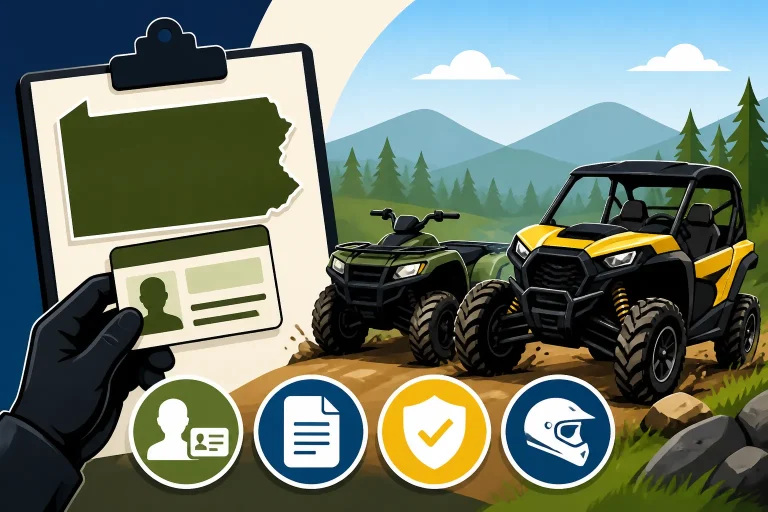
A course certificate is not an ATV registration card or a trail permit. Pennsylvania registration and trail access are separate subjects; see Registering an ATV in Pennsylvania and Pennsylvania ATV Trail Permits Explained for those distinctions. Likewise, a safety certificate does not give you permission to ride private property. Landowner permission and the rules for the specific trail or road still apply.
If you are taking a course because another organization asked for proof of training, ask that organization what it accepts before you start. A club, riding school, event organizer, insurer, or land manager may have its own requirements. The fact that a course is online does not automatically mean every organization will recognize it for every purpose.
How to choose and complete an online course
The course enrollment process can vary by provider, so check the current instructions before you begin. Some programs use an online learning platform; others may offer different formats or separate training for adults and minors. Do not rely on a course name alone to determine whether it meets your needs. Confirm the provider, intended age group, course format, and what proof of completion is issued.
A practical way to approach enrollment is:
- Decide what you need from the course. Are you taking it for general knowledge, an age-specific requirement, or an organization’s condition for participation? Write down the purpose before choosing a program.
- Confirm the age range. Check the provider’s eligibility rules. If the rider is close to an age cutoff, ask whether age is assessed at enrollment, course completion, or the date of riding.
- Check the format. Confirm whether the course is entirely online or includes any in-person instruction or skills assessment. Do not treat an online knowledge course as hands-on practice.
- Ask what record you receive. Find out whether completion produces a certificate, a card, an account record, or another form of proof, and how you can retrieve it later.
- Check acceptance with the organization that needs it. If you are taking the course to meet a club, event, land manager, or insurance requirement, confirm acceptance directly with that organization.
- Complete the lessons carefully. Give yourself time to read the material and understand it rather than rushing through only to reach the final assessment.
- Save the completion record. Keep a digital copy and, if useful, a printed copy with other riding documents. Check the provider’s process for replacing or retrieving a lost record.
The course may include questions or a final assessment. If so, read each question carefully. The point is to understand the reason behind safe riding practices: a rider who knows why a technique matters is more likely to apply it when conditions change.
It is also worth checking what the course does not cover. An ATV course may explain general safe operation, but it cannot give you route-specific information such as current trail closures, seasonal access, local road designations, or landowner restrictions. Check the route before you travel and again before you ride. Rules can differ between state forest trails, club land, private property, and roads designated for ATV use.
If a provider asks for personal information, review what it needs to issue a completion record and how the record can be accessed later. Use the provider’s own enrollment instructions rather than links or forms shared in an informal post. If you are uncertain whether a course is recognized for a legal or organizational requirement, ask the relevant agency or organization before paying or completing it. Current course availability, enrollment steps, and any associated costs can change, so confirm details with the provider.
What a course certificate does not replace
A common source of confusion is treating “safety course,” “certificate,” “registration,” and “permit” as interchangeable. They are not. Each answers a different question:
- Safety training addresses knowledge and riding practices.
- A safety certificate documents course completion when a certificate is issued and is relevant to the requirement at hand.
- Registration identifies the machine under Pennsylvania’s registration system when registration is required.
- A trail permit may be needed for access to particular riding areas.
- Permission establishes that you may use private land or a specific route.
- Insurance is a separate financial and legal consideration, with requirements that depend on where and how the machine is used.
Taking an online course does not register your ATV. It does not put a plate on the machine, create a right to ride a state forest trail, or authorize use of a public road. It also does not make an out-of-state registration automatically valid for every Pennsylvania riding area.
For example, before a ride you may need to confirm that the machine’s registration is current, that the trail is open, that any required permit is valid for the machine and area, and that you have permission to use the land. A safety certificate addresses none of those access checks by itself. Review Does Pennsylvania Honor an Out-of-State Safety Certificate? if the rider completed training elsewhere, and Pennsylvania ATV Reciprocity With Other States if the machine is registered in another state.
The same distinction matters when you ride with a club or attend an organized event. The event may require proof of insurance, a particular registration, a permit, or a waiver. A training certificate might be requested too, but completing one does not satisfy the other items. Ask the organizer for a list of required documents well before departure.
Keep the course record in a place you can find it, but do not rely on it as your only riding document. If a requirement applies to your ride, carry or retain the specific proof that requirement calls for. For a young rider, make sure the certificate is the one required for that rider’s age and situation. Carrying the Certificate on a Ride can help you think through keeping proof available.
This distinction is especially important for riders who cross between different types of land. A machine may be properly registered and its rider may be trained, yet the route can still be closed or require an additional permit. Before setting off, check the trail manager’s current rules and map. For access questions, Where to Ride an ATV in Pennsylvania and Pennsylvania Trail Closures to Check First are useful starting points.
Making online training useful on the trail
An online course is most valuable when its lessons shape what you do before and during a ride. The learning should not stop when the completion screen appears. Use the course to build a routine that fits your machine, your ability, and the conditions you expect.
Start with the machine
Before riding, read the owner’s manual for the specific ATV or UTV. Controls and handling vary between machines, and a lesson written for a general audience cannot replace instructions for your model. Check the tires, brakes, throttle, lights, steering, and other items identified in the manual. Make sure the machine is appropriate for the rider and that any passenger is permitted by the machine’s design and applicable rules.
A pre-ride inspection is particularly important after a machine has been stored, transported, or used in rough conditions. Look for loose or damaged parts, leaks, low tire pressure, and anything that could affect control. If you find a problem that could make the machine unsafe, address it before riding rather than hoping it will hold up on the trail.
Practise in a controlled setting
A rider who has never operated an ATV should not make a challenging trail the first practice session. Begin in a legal, open area with room to manoeuvre and a surface that is suitable for basic practice. Learn how the machine starts, stops, turns, and responds to braking at low speed. Build gradually; do not move to steep hills, deep mud, loose rock, or tight trail sections before the rider can handle basic control.
For a new rider, a qualified instructor or experienced adult can help identify mistakes that an online lesson cannot see. That does not mean a friend’s advice replaces an approved course where a formal course is required. It means practical coaching can complement online learning, especially for machine handling.
Match the ride to the conditions
Trail difficulty is affected by more than the map. Rain can change traction and visibility; loose stone can make braking less predictable; a narrow trail may leave little room to avoid another rider. A route that felt manageable in dry weather may be a poor choice after heavy rain. Check current conditions, closures, and restrictions before travelling, and be willing to turn back if the route exceeds the rider’s skill or machine’s capability.
Online lessons often discuss hazards in general terms. Apply them to the specific route by considering:
- Whether the rider can stop safely in the available distance
- Whether there is a clear view around bends or over a crest
- How the machine will handle the surface and slope
- Whether other users, vehicles, or wildlife may be present
- Whether the route is open to the machine’s width and type
- What to do if the group becomes separated or a machine fails
Make a simple ride plan
Let someone know where you intend to ride and when you expect to return. Carry water, suitable protective gear, and the documents required for your ride. If you are riding with others, agree on a pace and regrouping points before leaving. Keep enough distance between machines to avoid a collision if the rider ahead slows unexpectedly.
For an adult taking a course before a first ride in Pennsylvania, a sensible sequence is: complete the learning, inspect the machine, verify registration and access requirements, choose an appropriate route, and practise at a conservative pace. Riders who need age-specific guidance should check [Pennsylvania Minimum Age to Ride an ATV] alongside the training rules. Being 16 or older may affect which training options are available, but it does not remove the need to follow the rules that apply to the machine, route, and land.
Frequently Asked Questions
Is an online ATV course required for every Pennsylvania rider aged 16 or older?
An adult course is generally a voluntary way to improve knowledge and riding habits, rather than a requirement solely because a rider is 16 or older. Requirements for younger riders and specific locations or activities can differ. Check the rule that applies to the rider and intended ride.
Can a rider under 16 use an adult online course to meet a training requirement?
Do not assume so. A youth rider may be subject to age-specific training and supervision rules. Confirm that the course format and certificate are accepted for the particular requirement before enrolling. See Pennsylvania ATV Course for Ages 8 to 15.
Does an online course give me permission to ride a Pennsylvania trail?
No. A course does not replace registration, a required trail permit, landowner permission, or confirmation that the trail is open to your machine. Check each access requirement separately.
Should I keep proof that I completed the course?
Yes, if the provider issues a completion record, save it where you can retrieve it. If a club, event, or other organization requires proof, ask what form it accepts and keep the record available for the ride.
Does a course completed in another state automatically count in Pennsylvania?
Not necessarily. Acceptance can depend on the course and the requirement. Confirm with the relevant Pennsylvania authority or organization; Does Pennsylvania Accept an Out-of-State Safety Certificate? addresses that question.
Disclaimer
This article is for general informational purposes only and does not constitute professional advice. Laws, prices and regulations vary by location and change over time. Consult a qualified professional for guidance on your specific situation.