Pennsylvania ATV Trail Permits Explained
A Pennsylvania ATV ride can require more than one piece of paperwork, and the rules change depending on whether you’re riding state forest trails, Allegheny National Forest routes, private club land, or a trail system in another state. This guide explains how registration, trail permits, insurance, and reciprocity fit together so you can sort out what your machine needs before you unload it.
Start by separating registration from trail permits
Registration identifies the machine
Pennsylvania ATV registration and a trail permit are different requirements. Registration identifies the machine under the state’s registration system; a trail permit grants access to particular trails or public riding areas. Having one does not automatically give you the other.
That distinction matters on a trip. A rider might have a current registration plate and still need an additional permit for the trail system they plan to use. Another rider might have permission to enter a private riding park but still need to meet Pennsylvania’s registration and insurance rules. Treat each requirement as its own checkbox rather than assuming one sticker covers everything.
Pennsylvania offers different registration types, including limited and general registration. Which one fits depends on where and how the ATV is used. For an overview of the difference, see Pennsylvania’s Limited and General Registrations. If you’re unsure whether your machine is registered correctly, Registering an ATV in Pennsylvania explains the basic process.
Trail permits apply to particular places
A trail permit is tied to the land or trail system that requires it. A permit for a Northcentral Pennsylvania state forest route does not automatically authorize riding at a private park, on a club trail, or in the Allegheny National Forest. Those areas can have separate access systems, rules, and proof requirements.
This is easy to miss when you’re planning a weekend that includes more than one riding area. A family might spend Saturday on a state forest trail and Sunday at a privately operated park. Even if the same ATV is used both days, the permit needed for Saturday may not satisfy Sunday’s admission or access rules.
Before leaving home, identify the trail system by name and check its own access requirements. Confirm the permit applies to the specific machine, dates, and trail network you intend to use. If a trail is closed, a permit does not make it open.
Build a requirement checklist for each ride
A useful way to avoid last-minute surprises is to write down the requirements for each location separately. Include registration, trail permit, insurance, safety certificate if applicable, identification, and any club membership or landowner permission. Then check the machine itself: its plate, registration sticker, lights, tires, and width may affect whether it can use a particular route.
| Riding area | Registration or proof | Separate access requirement | What to confirm |
|---|---|---|---|
| Pennsylvania state forest ATV trails in the Northcentral permit area | Current registration and other required documentation | Northcentral Regional Trail Permit | Eligible trail, current application process, machine-specific requirements |
| Allegheny National Forest ATV routes | Registration and any documentation the forest requires | Allegheny National Forest permit | Open route, season dates, permit display and purchase rules |
| Private riding park | Follow Pennsylvania law and park rules | Park admission, pass, or event requirement | Age rules, machine limits, hours, required gear |
| Club or leased land | Follow applicable state rules and landowner conditions | Club membership, permission, or event access | Whether a guest may ride and which routes are included |
| Out-of-state trail system | Follow that state’s rules | That system’s permit or entry requirement | Whether Pennsylvania registration is accepted |
The table is a planning aid, not a substitute for the rules of a specific property. Start with the trail operator or land manager, then check that the machine’s registration and insurance documents meet the requirements for that location.
Understand Pennsylvania’s Northcentral Regional Trail Permit
Know which trail network the permit covers
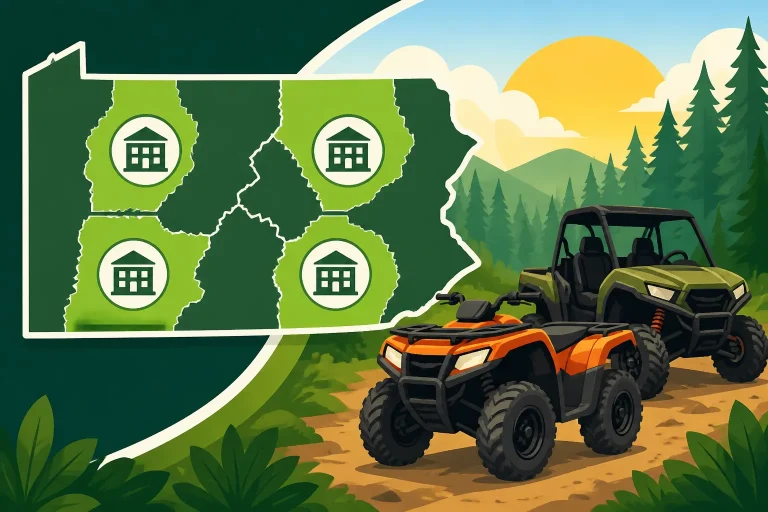
The Northcentral Regional Trail Permit is associated with designated ATV trails in four north-central Pennsylvania counties: Clinton, Lycoming, Potter, and Tioga. It is not a general permit for every public road, state forest road, or ATV route in Pennsylvania. Its purpose is to provide access to the designated trail network included in the program.
That geographic boundary is important when planning a route. A trailhead in Potter County may be part of the permit network, while a road a short distance away may be closed to ATVs or governed by a different rule. A county name alone does not tell you that every trail within the county is open or included.
Use the official trail information and maps to confirm each segment before riding. For additional context about the permit’s footprint, see Pennsylvania’s Northcentral Regional Trail Permit and The Four Pennsylvania Counties the Permit Covers. Do not rely only on a friend’s description of where a route goes; gates, seasonal closures, and land access can change the practical route.
Check the application and machine requirements
Permit applications can require identifying information about the rider and machine, as well as documentation such as registration and proof of insurance. Requirements and accepted application methods may vary with the program’s current instructions, so read the application carefully before sending anything. If a document is missing, unclear, or out of date, resolve that before you travel to an office or mail an application.
A permit is commonly tied to an individual machine rather than being a transferable pass for every ATV in a household. Don’t assume one permit covers a family’s entire trailer load. If you own several machines, check whether each one needs a separate permit and what information is required for each application.
Keep a copy of the completed application and any confirmation you receive. If the permit is issued as a sticker or other physical credential, follow the display instructions. For the application process and office details, consult Pennsylvania Trail Permit Application Deadline and Which Forest District Office to Visit. Verify the currently accepted filing method directly before you apply.
Plan around closures and seasonal access
A permit does not guarantee that every trail is open on the day you arrive. Pennsylvania trail access can be affected by seasonal operating dates, maintenance, weather, timber activity, and damage from rain or thawing conditions. A route that was open during your last visit may be closed for a later trip.
This is particularly frustrating when you have already arranged lodging, loaded machines, and driven several hours. Before leaving, check current trail notices and closures. If a route is temporarily closed, do not ride around a gate or use an unmarked side road as a workaround. Those choices can create safety problems and jeopardize future access.
Build a backup plan. Identify another permitted trail or riding area within a reasonable drive, and check its requirements in advance. For a broader guide to access rules, see Pennsylvania ATV Trail Permits Explained and Pennsylvania Trail Closures to Check First. Remember that the right permit and an open trail are separate pieces of the plan.
Know when the Allegheny National Forest needs its own permit
Treat the Allegheny permit as a separate system
The Allegheny National Forest has its own ATV permit system for designated routes in the forest. A Northcentral Regional Trail Permit does not automatically replace the Allegheny permit, and an Allegheny permit should not be assumed to authorize access to Northcentral trails. They are separate systems for different lands.
This distinction can matter even for riders who live nearby and visit several Pennsylvania trail areas in the same season. Keep the permits organized by destination. A simple note on your phone listing the permit name, machine, and covered location can prevent a mix-up at the trailhead.
Review the Allegheny National Forest’s own information before your ride. Confirm the routes covered, the permitted season, how the permit must be displayed, and which documents you need to show. For more on the forest-specific requirement, see Pennsylvania’s Allegheny National Forest Permit and Why the Allegheny Forest Sells Its Own Permit.
Match your route to designated trails
A permit only applies to routes the land manager has opened for ATV use. Forest roads, access roads, and roads used by highway vehicles are not automatically ATV routes. A trail may also be open to a different class of vehicle than the one you’re riding, or may have a restriction that makes it unsuitable for a wide side-by-side.
Before heading out, compare your route against the official map and any posted notices. Pay attention to the trail entrance, not just the general area you’re visiting. If a road is gated or signed as closed, do not treat a valid permit as permission to pass through.
It’s also sensible to check your machine’s dimensions and equipment against the trail rules. Some Pennsylvania trails have width or weight limits, and those limits can exclude a machine even when the rider has the correct permit. See Pennsylvania’s Class II Trail Width Limit for background on trail fit and Where a Wide Machine Can Still Ride if you’re traveling with a larger UTV.
Carry proof in a way you can access
Keep your permit and registration documentation where you can produce them without digging through a packed trailer or leaving them exposed to rain. A sealed document pouch or small waterproof wallet can help protect a wallet card or paperwork. Some riders look for these basic organizers on Amazon, while others use an inexpensive dry pouch already in their riding gear.
Do not put essential documents somewhere so secure that you can’t reach them during a roadside check. A zipped jacket pocket or a protected compartment on the machine may be more practical than a storage box buried under cargo. Keep digital copies as a backup, but don’t assume a phone image will satisfy every requirement.
Before the ride, confirm that the permit credential is displayed where the issuing authority requires. A permit stored safely in a pocket may still fail a display rule. Check that stickers are legible, attached firmly, and not obscured by mud, a cargo rack, or aftermarket accessories.
How reciprocity works for out-of-state riders
Do not assume another state’s registration is automatically accepted
Reciprocity concerns whether Pennsylvania recognizes a machine registered in another state for particular riding purposes. It is not a blanket promise that every out-of-state plate permits riding on every Pennsylvania trail. Recognition can depend on the home state’s rules, the type of registration, the machine, and where you plan to ride.
For example, a visitor may arrive with a valid home-state registration and still need a Pennsylvania trail permit for a designated state forest system. The visitor may also need to satisfy insurance and documentation requirements. Registration reciprocity and trail access are separate questions.
Check the current Pennsylvania requirements for your home state before traveling. Ask specifically whether your registration is recognized for the intended type of riding, whether a separate Pennsylvania permit is required, and what proof you should carry. See Pennsylvania ATV Reciprocity With Other States and Does Pennsylvania Honor an Out-of-State Safety Certificate? for related issues. A safety certificate and a registration are different documents, so do not confuse their acceptance rules.
Confirm reciprocity with the exact state and machine
A general statement such as “Pennsylvania accepts out-of-state ATVs” may leave out an important condition. The home state might need to issue a registration that Pennsylvania recognizes, or its registration system may not be equivalent for the machine you own. An ATV, UTV, homemade machine, or older vehicle may be treated differently.
When contacting the relevant agency or trail operator, describe the situation precisely: your state of residence, the machine type, the registration credential you have, and the Pennsylvania trail system you intend to use. Ask whether the credential must be current, mounted on the machine, or accompanied by a wallet card or insurance proof.
For a practical checklist, see Carrying Proof of an Out-of-State Registration. Bring the actual registration document and insurance evidence rather than relying on a screenshot of a renewal email. If the machine’s status is unclear, resolve it before loading up. A gate or trailhead is a poor place to discover that the paperwork does not qualify.
Understand a Pennsylvania resident’s out-of-state plate
A Pennsylvania resident registering an ATV in another state should not assume that the arrangement will automatically be treated like a visitor’s temporary ride. Residence, the machine’s use, and the reason for out-of-state registration can affect the analysis. The fact that a plate is valid somewhere does not necessarily settle whether Pennsylvania recognizes it.
This can be especially confusing for someone who bought a machine near a state border, keeps it at a hunting camp, or previously lived elsewhere. The machine’s registration history may not match the owner’s current residence or intended use. Keep purchase records, registration records, and any correspondence about the machine together.
Before riding, confirm the rules that apply to a Pennsylvania resident and the specific registration involved. For more detail, see A Pennsylvania Resident Registered in Another State and When a Pennsylvania Resident’s Quad Is Plated Elsewhere. If you have recently moved, Pennsylvania ATV Registration After Moving to the State can help you identify the next questions to resolve.
Check the rules for private parks, clubs, and other land
Private parks set their own access conditions
A private ATV park may require admission, a day pass, a membership, event registration, or proof of insurance. It may also set rules about helmet use, age, passenger equipment, machine width, noise, and riding hours. These conditions are separate from Pennsylvania registration law and any public-land permit.
Read the park’s rules before your trip, especially if you are bringing a passenger or a youth rider. A machine that is legal to own and registered for use may still be prohibited on a particular park’s trails. Some facilities have different routes for different machine sizes or skill levels, while others restrict access to certain events.
Call or check the park’s official information if a rule is unclear. Ask whether the vehicle needs a state registration plate, whether a park credential must be displayed, and whether the park accepts a particular insurance document. Avoid assuming that a paid entrance fee makes every machine eligible.
Club trails and leased land require permission
Club access can depend on membership, a guest pass, an organized event, or a landowner agreement. Some clubs manage trails on private or leased property, which means access is controlled by the club and the underlying landowner arrangement. A trail shown on an old map is not proof that the route is currently open to the public.
If a friend invites you to ride, ask whether guests are permitted and whether you need to register in advance. Confirm that the invitation covers the whole route, not just the staging area. On club land, a trail can pass through multiple parcels, and the access rules may differ between them.
Written permission is safer than relying on a casual understanding. Keep any event confirmation or club authorization with your ride documents. For background, see Riding Private Club Land in Pennsylvania and Asking a Landowner for Permission. Be respectful of gates, signs, neighboring properties, and posted restrictions; unauthorized shortcuts can damage relationships that keep trails open.
Do not treat roads and trails as interchangeable
A permit for an off-road trail does not automatically allow an ATV or UTV to travel on a nearby public road. Pennsylvania road use is governed by separate rules, including restrictions on which roads may be designated for ATV use and what conditions apply. A road that looks like a convenient connection may not be legal to ride.
This matters when a trailhead is on the other side of a township road or when a group wants to ride into town for fuel. Check whether the particular road is designated or otherwise open to ATVs, and confirm any applicable age, equipment, insurance, and crossing rules. Do not infer permission from tire tracks or from seeing another rider use the road.
Plan trail connections using official maps and signs. If a road is not posted as open or its status is uncertain, stop and verify rather than continuing. For more on the road distinction, see Pennsylvania’s Designated ATV Roads and Why There Is No Conversion Path in Pennsylvania.
Prepare your documents and machine before the trip
Gather the paperwork that may be requested
The exact documents depend on the trail system, but riders commonly need to be ready to show registration, permit evidence, and proof of insurance where required. Visitors may also need their out-of-state registration and any supporting paperwork that demonstrates the machine is eligible for use. A youth rider may have additional safety-certificate or supervision requirements.
Keep the original documents protected and accessible. If you carry copies, make sure they are readable and current. A document in a phone’s photo library can be helpful as a backup, but it is unwise to rely on it as the only proof unless the applicable authority explicitly accepts digital copies.
Create a folder or pouch for each machine if you transport more than one. Label the documents clearly so a passenger or family member can help retrieve the right registration or permit. A waterproof sleeve or dry bag—whether found on Amazon or already in your gear—can protect paperwork from rain, splashes, and mud.
Inspect plate and permit display
Before loading, check that the registration plate is mounted securely and can be read from the required direction. Make sure the registration sticker and any trail permit are placed according to their instructions. Mud, a bent plate, a cargo rack, or a poorly positioned accessory can obscure the information an officer or trail manager needs to see.
A plate that is clean at home can become unreadable after one muddy section. Bring a rag and check the plate at breaks, particularly after riding through water or sticky clay. If a plate is damaged or lost, address the replacement before the next ride rather than improvising a temporary display.
When buying replacement fasteners or protective document sleeves, Amazon is one possible retailer, but choose equipment that fits the machine and does not cover the plate or interfere with the required display. The goal is reliable visibility and protection, not simply adding more accessories.
Verify insurance and rider-specific rules
Insurance requirements can depend on where the ATV is operated. A machine used only on the owner’s land may be treated differently from one ridden on public land, and a trail operator may impose its own proof requirement. Read the policy carefully to confirm that it covers the kind of off-road riding you plan to do.
Do not assume that a homeowner’s policy, auto policy, or credit-card benefit covers an ATV accident. Ask the insurer what the policy covers, who is insured, and whether passengers or borrowed machines are included. Carry proof in the format accepted for your ride area.
If children are riding, confirm age, supervision, helmet, machine-size, and safety-certificate rules before the trip. These requirements can vary by land type and riding situation. For the Pennsylvania basics, see Pennsylvania ATV Safety Certificate Requirements and Pennsylvania Supervision Rules for Minors. A permit does not override age or equipment rules.
Common permit and reciprocity mistakes to avoid
Assuming one permit covers an entire trip
The most common planning error is treating a permit as a statewide pass. A Northcentral permit, an Allegheny Forest permit, a private park pass, and a club membership each relate to different access arrangements. A rider who buys the first permit they find may still be missing the one required at the destination.
Make a route list before purchasing anything. For each stop, write down the land manager, trail system, permit name, registration requirement, insurance requirement, and open dates. If the route crosses a boundary, check whether the next section is governed by a different organization.
This also helps avoid paying for an access credential that does not match your trip. Confirm the permit’s actual coverage and validity before applying. If you are riding multiple trail systems, treat each one as a separate destination even if they appear close together on a map.
Relying on old forms or outdated directions
Applications, office procedures, and trail conditions can change. A form saved from a previous season may no longer be accepted, and an office that once processed applications may no longer handle them. Mailing a form to the wrong place can cost time and leave you without the permit when your trip arrives.
Use the issuing authority’s current application and instructions. Check the application window, acceptable payment methods, supporting documents, and where to submit it. If applying in person, confirm the office is an authorized location and verify its hours before making the drive.
The same caution applies to trail maps and reciprocity claims shared in forums. They can be helpful starting points, but they may not reflect a new closure or a revised rule. Confirm the details through the relevant agency or trail operator before relying on them.
Riding beyond what the credential allows
A permit is not permission to leave the trail, bypass a closure, use an unauthorized connector, or ride a public road that is not open to ATVs. It also does not excuse unsafe or unlawful operation. Following a marked route and respecting boundaries protects both the rider and the future of the trail system.
When you reach a confusing junction, stop and check the map or signs rather than following another group automatically. A local rider may have a different permit, club permission, or access arrangement. If you cannot confirm that a route is open to your machine, turn back and choose a verified route.
Keep in mind that trail access depends on landowner cooperation, maintenance, and responsible use. Avoid rutting wet trails, riding around gates, or creating new paths. These choices can damage a trail and contribute to closures for everyone.
A practical pre-ride checklist
Use this sequence when planning a Pennsylvania ATV or UTV trip:
- Name every riding area. Identify the exact state forest trail system, national forest route, private park, club property, or public road you expect to use.
- Check registration. Confirm the machine’s registration is current and appropriate. If it is registered outside Pennsylvania, verify whether that credential is recognized for the planned ride.
- Identify each permit separately. Find out whether the Northcentral Regional Trail Permit, Allegheny National Forest permit, park pass, club membership, event credential, or another permission is required.
- Confirm the machine qualifies. Check vehicle type, width, weight, age-related limits, and any equipment requirements.
- Verify insurance and rider documents. Carry required proof and confirm that the policy covers the intended off-road use.
- Check dates and closures. Look for seasonal access dates, temporary trail closures, weather damage, and route restrictions.
- Prepare the display and paperwork. Mount plates and stickers as instructed, protect documents, and keep them easy to reach.
- Plan a legal route to the trailhead. Do not assume nearby roads are open to ATVs simply because they connect to a trail.
- Recheck before departure. Revisit official notices shortly before the trip, especially after storms or during seasonal transitions.
The main idea is simple: match the machine, the paperwork, and the land. When registration, permit, insurance, and trail access are checked independently, it becomes much easier to spot a missing requirement before it turns into a wasted drive or a citation.
Disclaimer
This article is for general informational purposes only and does not constitute professional advice. Laws, prices and regulations vary by location and change over time. Consult a qualified professional for guidance on your specific situation.