Pennsylvania Rules for Riding a Closed Trail
A trail shown on an old map or remembered from last season is not automatically open today. In Pennsylvania, riding a closed ATV trail can mean a citation, damage to sensitive ground, or a risky encounter with work crews and other users. The safest approach is to confirm the route’s current status, understand who manages it, and turn around whenever a closure applies.
What a closed trail means in Pennsylvania
A closed trail is a route the responsible land manager or property owner has not authorized for riding at that time. The closure may apply to a whole trail system, one segment, or a route during a particular season or condition. It can be temporary or ongoing.
The reason for a closure does not usually change the practical rule for riders: don’t enter or continue along the closed route unless the authority responsible for it has clearly reopened it or given you permission. A trail can look passable and still be closed. A lack of a gate, barrier, or fresh sign does not prove riding is allowed.
Closures can happen for several reasons:
- Seasonal schedules: Some designated trails have set operating seasons and are closed outside those dates.
- Wet ground or thaw: Riding soft trails can rut the surface and create damage that takes significant work to repair.
- Maintenance or construction: Crews may need a route clear for repairs, drainage work, logging, or other activity.
- Storm damage: Trees, washouts, unstable slopes, or damaged bridges may make a trail unsafe.
- Wildlife or land-management concerns: A land manager may close an area to protect resources or manage access.
- Property or access changes: A private landowner or club may change access conditions on land it controls.
A closure can be broader than the trail itself. A staging area, access road, or connector may also be closed, leaving a route unavailable even if the main trail appears open. Check the status of the whole ride, not just the destination.
Pennsylvania’s state forest trails, private riding areas, club trails, and public roads can have different rules and managers. A permit or registration does not override a closure. For background on which state forest routes may require a permit, see Do You Need a Permit for Pennsylvania State Forest Trails?. Registration is a separate requirement; it does not grant permission to ride any particular trail. Pennsylvania ATV Trail Permits Explained covers the distinction between permits and other riding requirements.
How to check a trail’s status before riding
The most reliable check is information from the agency, property owner, club, or park that manages the route. Start with the manager’s current trail notices and maps. If the closure language is unclear, contact the manager directly rather than relying on an old map, a social media post, or a rider’s recollection.
Use this process before leaving:
- Identify the land manager. Confirm whether the trail is on state forest land, a private riding property, club land, or another type of property. Different managers may issue separate notices.
- Check current notices. Look for closure dates, affected trail numbers or segments, access-point restrictions, and reopening conditions.
- Confirm the riding season. A trail may be closed because it is outside its normal operating window even when no temporary closure notice is posted. Pennsylvania’s ATV Trail Season explains why the calendar matters.
- Check access routes and staging areas. Make sure the trailhead, connector, and planned return route are open too.
- Recheck close to departure. Weather, maintenance, and damage can change conditions after you first plan the trip.
- Keep a backup route. Choose another trail or riding area that is currently open, rather than assuming a closed segment will be passable.
Maps are useful for planning, but they can lag behind conditions on the ground. A map may show a trail that is closed for the season, temporarily shut for repairs, or no longer open to the public. Likewise, a route appearing on a phone’s mapping app does not establish that ATV riding is allowed there. The presence of a track, tire marks, or other riders is not proof of permission.
| What you find | What it tells you | Safer response |
|---|---|---|
| A current closure notice from the land manager | The listed route or area is closed under the stated conditions | Stay out and use an open alternative |
| A map showing a trail, but no current status | The route may exist, but its present access is uncertain | Verify with the manager before riding |
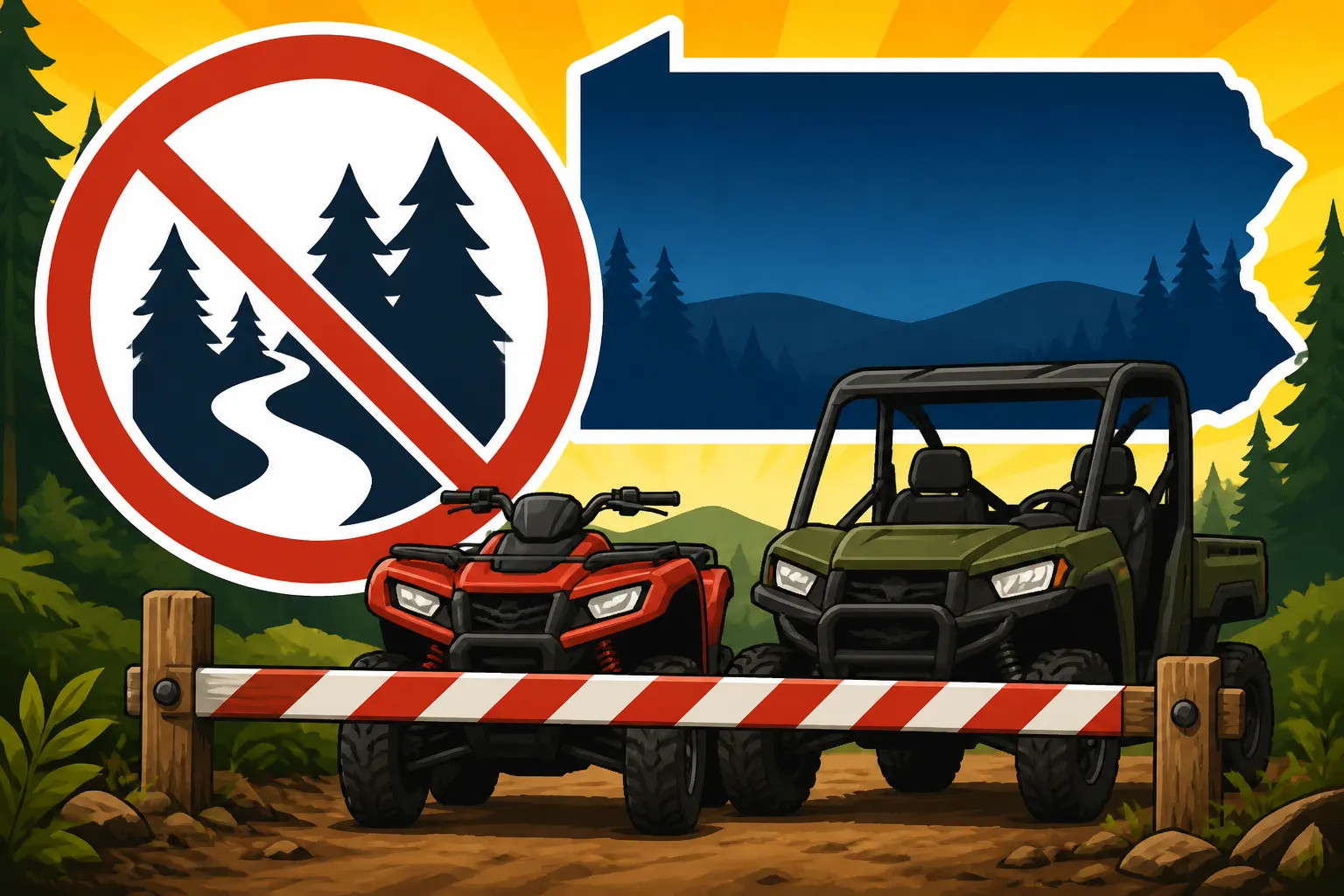
| A barrier, closed sign, or blocked trail entrance | Access is restricted or the route is not safe to enter | Turn around; do not go around or move the barrier |
| An open trail that becomes blocked or damaged | Conditions may have changed since the last check | Stop, turn back safely, and report the issue if appropriate |
| Riders continuing past a closure sign | Their presence does not establish legal access | Follow the closure, not the crowd |
For state forest routes, make sure you are checking information for the right forest and trail area. For private or club land, confirm access with the property or club manager; a state trail permit does not open privately controlled trails. You can also review Pennsylvania Rules for Riding a Club Trail and Pennsylvania Rules for Riding Private Property when your route includes those places.
What to do when you encounter a closure
When a sign, gate, barrier, or current notice shows that a trail is closed, stop before entering the restricted section. Turn around at a safe place and use a route that is open and authorized. Do not ride around a gate, move a barricade, follow another rider through, or continue because the closure appears inconvenient.
If you discover the closure after entering the trail, stop as soon as it is safe to do so. Retrace your route if that is safe and permitted. Do not create a new route around the closed segment: leaving the designated trail can cause further damage and may itself violate land-use rules. If returning the way you came would put you in immediate danger, prioritize safety and contact the land manager or emergency services as appropriate. A closure is not a reason to take a hazardous shortcut.
Be especially cautious around work zones and damaged sections. A trail that is closed for repairs may have equipment, unstable ground, exposed drainage work, or workers who cannot see or hear approaching riders. After storms, a blocked route may conceal a washout or unstable edge. Don’t assume a short detour around a fallen tree or muddy section is harmless; the apparent bypass may leave the authorized trail.
If a closure sign is missing, damaged, or hard to interpret, don’t treat the uncertainty as permission to proceed. Note the location, trail name or number if available, and the wording on any nearby notice. Contact the manager for clarification. If the issue is that a sign appears to have fallen or a barrier is damaged, report it rather than trying to fix or reposition it yourself.
These steps help prevent avoidable damage as well as citations. Seasonal and weather-related closures often protect trails when they are most vulnerable. Pennsylvania trail managers may close routes during spring thaw or after heavy rain because tires can cut deep ruts into soft ground; Why Mud Season Closes Trails explains why riding during these conditions can have lasting effects.
Permits, citations, and common misunderstandings
A valid ATV registration, trail permit, club membership, or out-of-state credential does not automatically authorize riding on a closed trail. Each requirement serves a different purpose. Registration identifies a machine under the applicable rules; a permit may provide access to certain trails or areas; the land manager still controls whether a route is open. Before a trip, check both the paperwork you need and the route’s current status. Pennsylvania ATV Reciprocity With Other States can help clarify what an out-of-state registration does and does not establish.
The same principle applies to a route that is open to another kind of user but closed to ATVs. A road, walking trail, snowmobile route, or utility corridor is not automatically an ATV trail. Follow the signs and the manager’s rules for the specific route. Riding a Snowmobile Trail on a Quad explains why a trail’s existence does not necessarily make it available to every vehicle type.
Riding past a closure can expose you to enforcement action under the rules that apply to the property and activity. Penalties can vary with the location, the conduct, and the applicable law, so don’t rely on a general fine amount or a story about what happened to someone else. For related information, see Pennsylvania Fines for Riding Without a Permit and Pennsylvania Rules for Riding a Closed Trail. If you receive a citation, read the notice carefully and use the process and deadline stated on it; Appealing a DCNR Citation may be relevant when the citation was issued by DCNR.
These are common but unsafe assumptions:
- “There’s no gate, so it must be open.” Closures may be marked with signs, notices, or other controls; a gate is not the only way to close a route.
- “The map shows the trail.” A map may show a route without showing current access conditions.
- “I have a permit, so I can use every trail.” Permits apply only where their terms and the land manager’s rules allow.
- “Other riders are going through.” Their choice does not establish that the route is open.
- “It’s only closed because of mud.” A temporary closure remains a closure until the responsible manager reopens the route.
- “I’ll just go around the barrier.” Bypassing a closure may take you off the authorized route, damage land, or put you in a work zone.
If you want to avoid a wasted trip, plan around confirmed open routes and leave room for a change of plans. Keep the trail manager’s contact information handy, check conditions before you unload, and treat a closure as a firm boundary until you receive clear, current authorization to ride there.
Disclaimer
This article is for general informational purposes only and does not constitute professional advice. Laws, prices and regulations vary by location and change over time. Consult a qualified professional for guidance on your specific situation.