Pennsylvania Rules for Retrieving Game by ATV
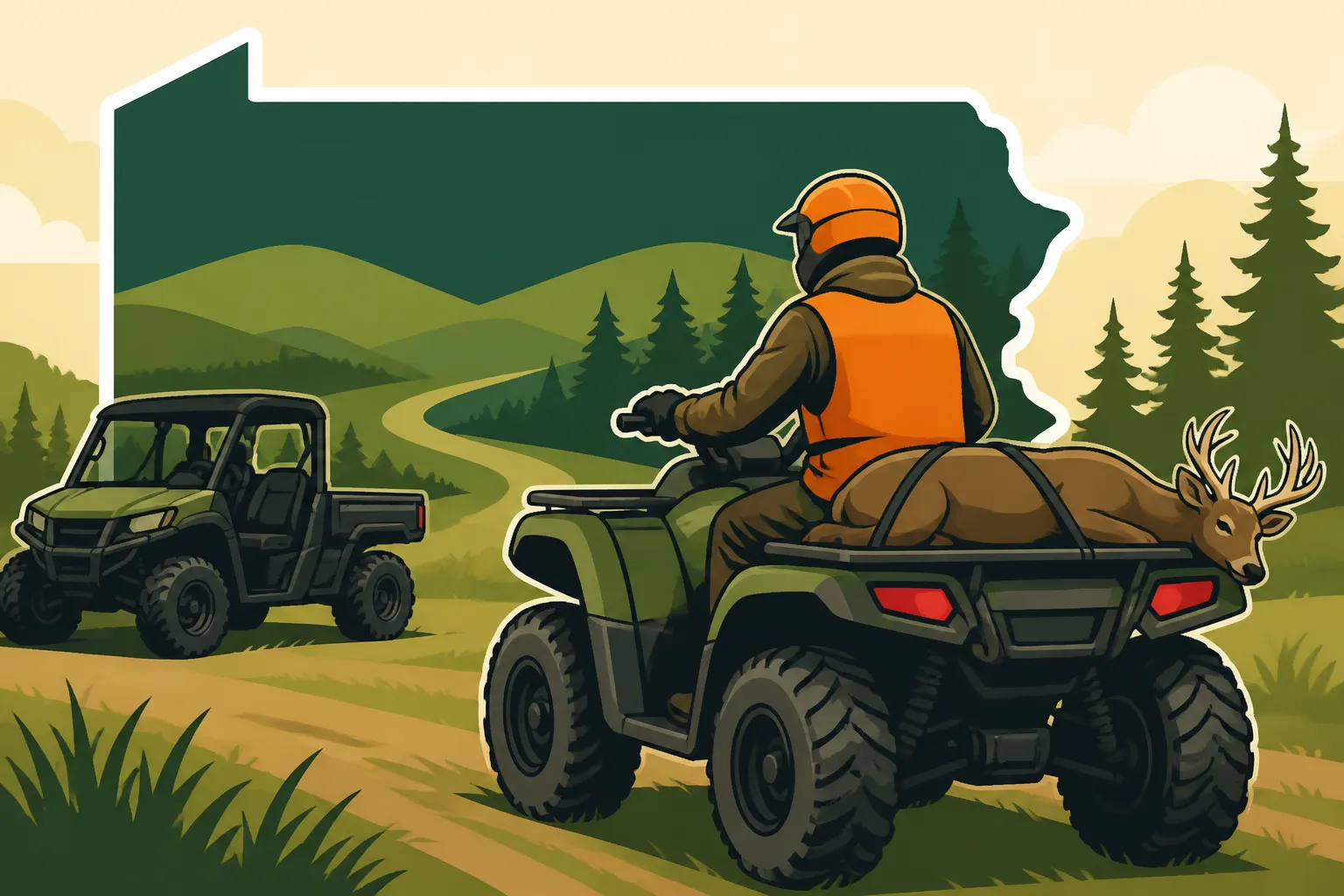
A harvested deer can be heavy, and a long drag through rough Pennsylvania terrain can turn a hunt into a difficult recovery. An ATV may help, but a hunting purpose does not automatically make a route legal. The key is to check who controls the land, whether motorized travel is allowed there, and what hunting and vehicle rules apply before moving the animal.
First Check Whether the Route Is Open to ATVs
The most important question is not whether you have an ATV or a hunting license. It is whether you are allowed to operate that machine on the specific land and route where the animal lies.
Permission to hunt and permission to drive are separate. A landowner may let you hunt without allowing motorized access, and a public hunting area may be open to hunters on foot while prohibiting ordinary ATV use. A registration, trail permit, or legal harvest does not override a land-use restriction.
Private land
On private property, get permission from the landowner or person authorized to grant access before riding in to retrieve game. Be specific about the route, the machine, and whether you may cross gates or travel through fields, woods, or neighboring parcels. A general invitation to hunt may not clearly include permission to bring an ATV onto the property.
If the animal crossed a boundary, do not assume permission on one parcel covers the next. Ask the owner or manager of each property involved. A trail, logging road, or farm lane that looks accessible is not necessarily open for motorized use.
For more on access boundaries, see Pennsylvania Landowner Permission Rules and Pennsylvania Rules for Riding Private Land. Written permission can help prevent misunderstandings, especially if access involves more than one owner or a route you have not used before.
State Game Lands
Treat Pennsylvania State Game Lands as closed to ordinary ATV travel unless the Pennsylvania Game Commission’s current rules specifically authorize the route or use. A hunting license, a successful harvest, or the need to recover an animal does not by itself create permission to ride an ATV across game lands.
There may be limited access provisions for eligible users with disabilities, but those are not general-purpose ATV permissions. Follow the conditions of any permit and confirm that it covers the particular route and activity. Do not assume that an access route authorized for one purpose can be used for routine game retrieval.
The distinction between hunting access and motorized access is easy to miss. Pennsylvania Rules on State Game Lands and How the Disabled Access Permit Works on Game Lands provide related context. If the land is game-commission property, check the current rules and posted signs before entering with a vehicle.
State forests and other public land
State forests, parks, public roads, and State Game Lands are not interchangeable. Each has its own manager, access rules, and designated routes. A road open to ATVs in one jurisdiction may be closed just beyond a boundary or may allow travel only for a different purpose.
A trail permit or route designation is not automatically permission to leave the route and ride cross-country to a downed animal. Stay on routes that are open to the machine and to your type of use. If the permitted route does not reach the recovery location, stop and ask the land manager what options are allowed.
A disability access authorization, a trail permit, or permission to use a particular road should be read narrowly: follow its conditions rather than treating it as general access. For related distinctions, see Pennsylvania ATV Registration and Trail Access and Pennsylvania Game Lands and Why Quads Are Banned.
What to Do Before Moving the Animal
Once you have confirmed that ATV use is allowed, handle the harvest and the recovery in a way that keeps both the animal and the machine under control. A careful plan can prevent a legal problem, damage to the land, or an injury during loading.
- Confirm the property boundary and route. Identify the parcel where the animal is located and the route you are allowed to use. If there is any doubt, contact the landowner or land manager before riding.
- Check the current hunting requirements. Follow the rules for tagging, reporting, and transporting the species you harvested. Requirements can vary by species and season, so do not rely on memory or on a rule that applied to a previous hunt.
- Secure the hunting equipment. Do not use an ATV as a platform from which to shoot, and do not ride while handling a bow or firearm unsafely. Follow the rules that apply to carrying hunting equipment on a vehicle. See Pennsylvania Rules for Carrying a Bow or Rifle for more on that issue.
- Choose a route that can support the machine. Avoid soft ground, wet trails, steep banks, stream edges, and routes where the tires could cause erosion or rutting. A route that is physically passable may still be closed or damaging.
- Plan the load before lifting. Consider the animal’s weight, the ATV’s capacity, the rack or trailer, and how the load will be secured. Keep the load balanced and away from moving parts, controls, exhaust, and the operator’s view.
- Use a safe recovery method. If the terrain is steep or unstable, or the load is too heavy to handle safely, stop and use another method or get help. Do not put yourself beneath an unstable load or attempt a lift that exceeds your ability.
- Leave the route as you found it. Avoid spinning tires, cutting around a barrier, or widening a trail to reach the animal. If the authorized route does not provide access, do not create a new one.
Tagging and transport
Follow the current Pennsylvania Game Commission instructions for tagging and reporting the animal. In general, complete required harvest steps promptly and before transporting the animal away from the kill site. The exact requirements depend on the species and applicable regulations, so check the current season materials rather than assuming the same procedure applies to every animal.
Keep the tag and any required documentation with the animal as directed. If you are transporting game for another licensed hunter, make sure you understand who must complete the reporting and identification steps. Do not remove a tag, alter it, or leave required information behind during the recovery.
The ATV changes how you move the carcass; it does not change who harvested it or what reporting duties apply. If you are uncertain about a particular species, season, or transfer, contact the Game Commission before the trip rather than trying to resolve the issue after the animal has been moved.
ATV Access, Registration, and Common Mistakes
Legal access and legal operation are different questions. A machine can be properly registered and still be prohibited from a particular property or route. Likewise, permission from a landowner does not necessarily replace registration or other requirements that apply to the machine and the place where it is being operated.
| Question | What to check | Common mistake |
|---|---|---|
| May I enter this property? | Land ownership, manager rules, and specific permission | Treating a hunting invitation as ATV permission |
| Is this route open to my ATV? | Posted signs, current route designations, and local restrictions | Assuming any woods road or trail is open |
| Is my machine properly documented? | Applicable registration and proof requirements | Assuming registration grants access |
| Is a separate permit needed? | Rules for the particular trail system or land | Treating a trail permit as permission to ride off-route |
| Can I move the animal this way? | Current species-specific harvest and transport rules | Moving the carcass before completing required steps |
| Is the load safe? | Machine capacity, attachment points, balance, and terrain | Carrying a heavy, loose load on a rack |
For registration questions, start with Pennsylvania ATV Registration and Trail Access. Registration and trail access rules are not the same as landowner permission or hunting regulations. Visitors should also check whether Pennsylvania recognizes their home-state documentation for the intended use; Pennsylvania ATV Reciprocity With Other States explains why reciprocity should not be assumed to cover every situation.
Do not treat a route as open just because it is passable
A two-track road, utility corridor, field edge, or trail may be physically easy to ride but legally closed to ATVs. A gate that is open is not necessarily an invitation to enter, and the absence of a barrier does not prove that motorized use is allowed. Follow posted restrictions and the land manager’s current route information.
Do not ride around a locked gate, cut a new path, or use a closed road because it shortens the recovery. These choices can damage land and may lead to enforcement action, even when the underlying harvest was lawful. If a route is blocked or unclear, turn back and contact the owner or agency.
A valid plate does not make a machine street legal
An ATV registration does not automatically authorize travel on public roads. If a public-road segment seems necessary to reach the property or recovery site, confirm that the specific road is legally open to the machine and that all applicable road-use requirements are met. Do not use a road simply because it connects two trail areas or because other riders have used it.
If you are bringing a machine from another state, carry the required proof and check the rules for out-of-state machines. Reciprocity is about whether certain home-state documentation is recognized; it does not make closed Pennsylvania land or roads open to ATVs.
Do not assume recovery is an exception
The most common planning error is waiting until after the harvest to ask whether an ATV can reach the animal. A lawful kill does not automatically authorize travel across private property, State Game Lands, or a closed public route. If ATV access is important to your hunt, settle the access question beforehand.
The same caution applies if an animal is wounded and moves onto land where you do not have permission. Follow applicable hunting and trespass rules, and contact the landowner or the appropriate agency for guidance. Do not ride onto property or into a closed area simply because you are trying to recover an animal.
A Practical Pre-Hunt Check
Before hunting in an area where an ATV might be useful, make a short access plan. Confirm who owns or manages the land, identify routes that are actually open to your machine, and ask for permission that clearly covers motorized travel. Save the relevant contact details and check signs when you arrive, since access conditions can change.
Use this checklist:
- Identify the parcel and its land manager.
- Ask whether ATV access is allowed for retrieval, not just for hunting.
- Confirm the exact route and any limits on where you may ride.
- Check current game regulations for tagging, reporting, and transport.
- Confirm registration, permit, and road-use requirements for your machine.
- Check the weather and ground conditions so the recovery will not cause avoidable damage.
- Bring suitable straps or other securement equipment, and do not exceed the machine’s load capacity.
- Have a non-ATV plan if access is denied or conditions make riding unsafe.
A simple question to ask the landowner is: “May I use this ATV on this route to retrieve legally harvested game, and are there any areas or conditions I need to avoid?” That is clearer than asking only whether you may hunt. For managed public land, contact the responsible agency and describe the exact location and intended route.
If a route crosses different types of property, check each section separately. A landowner’s permission does not extend across an adjacent public parcel, and a designated public route does not grant access to private land beside it. When the boundary or rule is unclear, pause and verify rather than relying on what another rider says.
The safe rule is straightforward: secure the right to ride before relying on an ATV for game recovery. Use only authorized routes, complete the required harvest steps, and do not treat a successful hunt as permission to drive anywhere. That approach protects your access, the land, and your ability to hunt there again.
Disclaimer
This article is for general informational purposes only and does not constitute professional advice. Laws, prices and regulations vary by location and change over time. Consult a qualified professional for guidance on your specific situation.