Pennsylvania ATV Registration and Trail Access
Many folks new to the world of Pennsylvania ATV and UTV riding find themselves scratching their heads when it comes to registration. It’s not just about getting a piece of paper; it’s directly tied to where you can actually take your machine out for a spin. This guide aims to clear up that confusion, diving deep into the different types of registration in Pennsylvania and, more importantly, how your choice impacts your access to the amazing trails our state has to offer.
Understanding Pennsylvania's ATV Registration Types
Pennsylvania offers two main types of ATV registration, and knowing the difference is absolutely crucial before you even think about hitting the throttle. It’s not a "one size fits all" situation, and each type dictates exactly where you are legally permitted to operate your machine. Many new riders assume that if they have a plate, they can ride anywhere, and that's simply not the case in our state.
Limited Registration for Private Land Use
If your main goal is to ride on your own property, or perhaps on a friend's private land with their express permission, then "Limited Registration" is likely the path you'll take. This type of registration is specifically designed for machines that will primarily be operated off the state's public trail systems. It acknowledges that you own a quad and want to use it, but it restricts that use to private grounds. Think of it as a personal identifier for your machine, proving ownership and ensuring it's on file, without granting you open access to the vast DCNR trail network.
The purpose of this registration is straightforward: to track ATVs within the state for ownership and identification, while clearly delineating that their use is not for public recreational trails. When you obtain a limited registration, the DCNR will issue you a specific plate. This plate often has a distinct color or marking that immediately identifies it as a limited registration. It's a visual cue that tells any law enforcement or park ranger that your machine is not permitted on general use trails. For a deep dive into this specific registration, check out [Pennsylvania's Limited Registration for Your Own Land].
What a limited registration absolutely doesn't allow you to do is ride on state forest trails, DCNR-approved public areas, or most other public recreational riding opportunities. Showing up at a state trail head with a limited registration plate would be akin to trying to enter a private club without a membership; you simply won't be allowed in, and you could face fines. It's a common misconception that having any plate means you're good to go, but the type of plate matters immensely. The physical plate itself, and how it differs from a general use plate, is important to understand when considering your riding intentions. More details on the physical plate can be found here: [The Plate Pennsylvania Gives Limited Registrants].
General Registration for Public Trail Access
Now, if you're dreaming of exploring Pennsylvania's incredible network of state forest trails, venturing through designated DCNR riding areas, or hitting up one of the fantastic pay-to-ride parks like the Anthracite Outdoor Adventure Area (AOAA) or Rock Run Recreation Area, then "General Registration" is your golden ticket. This is the registration type that unlocks the door to most public, legal ATV riding opportunities across the state. It signals that your machine meets the requirements for broader recreational use and that you're contributing to the maintenance and oversight of those public resources.
The benefits of opting for general registration over limited are clear: unparalleled access. Without it, you're severely restricted in where you can legally ride outside of private property. This registration is a commitment to the Pennsylvania riding community, as a portion of the fees directly supports the trails we all love. It's not just about legality; it's about being a responsible rider who contributes to the system. You’ll be issued a plate, a specific sticker for that plate, and a wallet card that contains all your registration details. This card is important to keep on your person or with your machine while riding.
The physical items you receive with a general registration are distinctive. You'll get a specific registration plate, and crucially, a sticker that must be affixed to that plate. This sticker typically indicates the expiration year, making it easy for officials to see if your registration is current at a glance. [The Sticker Pennsylvania Adds to General Registration] explains where this sticker needs to go. Furthermore, every general registration comes with a wallet-sized registration card, which serves as your proof of current registration. It’s critical to have this with you whenever you ride, as rangers or law enforcement may ask to see it. Why both a plate and a wallet card are part of the process is detailed in [Why Both Pennsylvania Registrations Include a Wallet Card].
Exemptions from Registration
While most ATVs operating in Pennsylvania require some form of registration, there are a few specific scenarios where your machine might be exempt. These exemptions are typically for very specific uses or historical reasons, and it's vital to ensure your situation truly fits the criteria before assuming you don't need a plate. Misinterpreting an exemption can lead to significant fines and hassle.
One of the most common exemptions is for certain farm use. If your ATV is primarily used for agricultural purposes on land you own or lease for farming, and it's not being operated on public roads or trails, it might qualify. However, this isn't a blanket "farm quad" exemption. The machine's primary purpose and location of use are key. Similarly, machines held as dealer inventory, not for personal use, also fall under an exemption, typically covered by a dealer certificate. This ensures that a dealership doesn't have to register every single ATV on their lot. For more information on the agricultural and business exemptions, refer to [The Farm and Business Exemption in Pennsylvania].
Another interesting exemption applies to very old machines. If your ATV was registered in Pennsylvania before February 1987, it might be exempt from the current registration requirements. This is a specific historical date that applies to a relatively small number of machines still in operation today. For many riders, especially those with newer quads, this exemption won't apply. Additionally, machines owned and operated by townships or other government units for official purposes may also be exempt. It's always best to verify your specific situation with the DCNR to avoid any potential issues, as the rules can be quite specific. If you own an older machine, you might find the information in [A Machine Registered Before 1987] useful.
The Link Between Registration and Trail Access
The relationship between your ATV's registration type and where you can legally ride in Pennsylvania is perhaps the most critical piece of information for any rider. It's not just a bureaucratic hurdle; it's the fundamental distinction that opens or closes doors to recreational opportunities. Without understanding this link, you could inadvertently find yourself on the wrong side of the law, facing fines, or simply unable to access the trails you intended to enjoy.
State Forest and DCNR-Managed Trails
For any rider hoping to experience the vast and varied landscapes of Pennsylvania's state forest trails or other DCNR-managed riding areas, a General Registration is not just recommended, it's an absolute must. These trails are maintained and overseen by the state, and part of the agreement for their use is that your machine is properly registered for general recreational purposes. There's no getting around this requirement; park rangers and DCNR officials routinely check for valid registration at trailheads and during patrols. Riding a state trail with a limited registration, or no registration at all, is a quick way to earn a hefty citation. This direct link between your registration and trail access is fundamental to the state's system, as highlighted in Pennsylvania ATV Registration and Trail Access.
Beyond just general registration, some of Pennsylvania's most extensive state forest trail systems, particularly those in the northcentral region and the Allegheny National Forest, also require an additional trail permit. This means you’ll need your General Registration and a specific permit for that region. These permits are typically purchased annually and help fund the ongoing maintenance, signage, and oversight of those particular trail networks. It's an extra step, but one that directly benefits the trails you ride. Understanding these additional requirements can save you a lot of frustration. More about these permits can be found in [Pennsylvania ATV Trail Permits Explained].
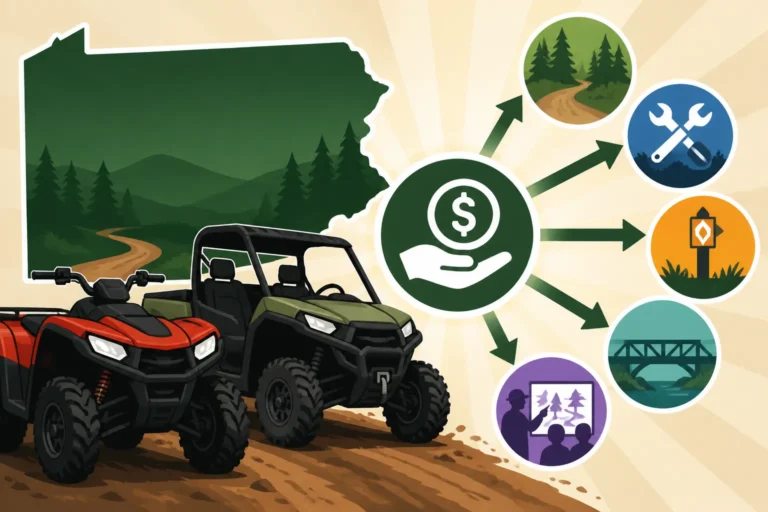
It's also worth noting that the fees collected from ATV registrations play a vital role in sustaining Pennsylvania's riding infrastructure. A portion of these funds is dedicated to trail maintenance, development, and administrative costs, meaning your registration isn't just a fee; it's an investment in the future of riding in the state. So, when you pay for your general registration, you're directly contributing to the very trails you hope to enjoy. Curious about where your fees go? [What Pennsylvania ATV Fees Pay For] provides more insight.
Pay-to-Ride Parks and Private Lands
While state forest trails are strictly regulated by DCNR registration, what about the growing number of fantastic pay-to-ride parks and private riding areas across Pennsylvania? The good news is that most reputable pay-to-ride parks, such as the AOAA or Rock Run Recreation Area in Cambria County, will also require your ATV to have a valid registration, typically a General Registration. Even though these might be privately owned or managed, they often operate under agreements that require registered machines for liability, safety, and operational reasons. They want to ensure machines on their property are traceable and that riders are complying with basic state requirements.
For example, places like Rock Run Recreation Area, a popular destination for many riders, have specific requirements for registration before you can even purchase a day pass. These parks are usually very clear about their rules on their websites or at their gates, so it's always wise to check ahead. You don't want to drive all the way there, only to be turned away because your ATV isn't properly registered. This requirement helps them maintain a safer, more accountable riding environment for everyone. Find more information on Rock Run in [Rock Run Recreation Area in Cambria County].
When it comes to riding on purely private land, such as a large piece of property owned by a friend or family member, the state's registration requirement (Limited or General) still applies for ownership and identification purposes, though enforcement of trail type might be less stringent if you're not crossing public land. However, for both your protection and the landowner's, having formal, written permission is always a good idea. This can prevent misunderstandings and legal issues down the road. Services like LawDepot can provide templates for landowner permission agreements or even bills of sale when buying or selling a machine privately, helping to ensure everything is legally documented. It's about protecting yourself and those around you, regardless of where you ride. For details on private land access rules, see [Pennsylvania Landowner Permission Requirements].
Road Riding and Registration (The Short Answer)
This is a point of frequent confusion and often, frustration, for ATV owners in Pennsylvania. Let's be very clear: in most of Pennsylvania, ATVs are generally not street legal. Having a General Registration for your ATV in Pennsylvania does not grant you permission to ride on public roads, streets, or highways. This is a crucial distinction that many riders misunderstand, often leading to fines and citations. The registration is for off-highway use on designated trails, not for navigating paved roads like a car or motorcycle. The quick answer to whether ATVs are street legal is explored further in [Are ATVs Street Legal in Pennsylvania?].
There are, however, very specific and limited exceptions. Pennsylvania does have some designated "joint-use roads" or "connector roads" in certain townships or state forest areas where ATVs are permitted to operate under extremely strict conditions. These roads are typically clearly marked with specific signage. Even on these designated roads, there are usually age restrictions (typically 16 years old), helmet requirements, and other safety stipulations. You cannot just assume any dirt or gravel road is open to ATVs. It must be explicitly designated.
The takeaway here is that while your General Registration is essential for legal trail riding, it does not convert your ATV into a road-legal vehicle. If you're caught riding an ATV on an undesignated public road, even with a valid General Registration, you will face consequences. The rules for these rare designated roads are very specific and must be followed to the letter. Don't let your registration give you a false sense of security when it comes to road use; always check local ordinances and DCNR regulations before venturing onto any public road. More information on where these machines can be ridden is provided in [Pennsylvania's Designated ATV Roads].
The Registration Process and What You Need
Navigating the registration process for your ATV in Pennsylvania doesn't have to be a headache, but it does require attention to detail and ensuring you have all the correct documentation. Whether you're buying a brand-new machine from a dealer or picking up a used quad from a private seller, the steps you take to get that DCNR plate on your machine are important. Getting it wrong can cause delays and frustration, keeping you off the trails longer than necessary.
How to Register Your ATV
The path to registration varies slightly depending on where you acquired your ATV. If you bought your machine from a Pennsylvania dealer, they will typically handle most of the paperwork for you. They'll submit the necessary forms, collect sales tax, and process your title and registration applications with the DCNR. They often provide you with a temporary sticker that allows you to ride for a short period while the official plate and documents are processed. This streamlined process is a major convenience of buying new or from a licensed dealer.
For those purchasing an ATV through a private sale, the responsibility falls squarely on your shoulders. You'll need to obtain the original title from the seller (or a notarized bill of sale if the machine is old enough to be exempt from titling), along with a bill of sale proving the purchase price. This bill of sale is crucial for calculating sales tax, which you'll typically pay when you register. Tools like LawDepot can offer reliable bill of sale templates, which can be invaluable in ensuring all necessary information is captured for a smooth transfer and registration. Once you have your documents, you'll need to complete a DCNR registration form (Form DCNR-43), which asks for detailed information about your machine and yourself. More on registering after a private sale can be found in [Registering After a Private Sale in Pennsylvania], and a checklist of required paperwork is available in [Pennsylvania ATV Bill of Sale Requirements].
After gathering all your paperwork, you can submit your application in several ways: online through the Pennsylvania DCNR's Snowmobile and ATV Portal, by mail, or in person at a DCNR regional office. Using the online portal is often the quickest method for new registrations and renewals, but make sure you have digital copies of all required documents ready to upload. Regardless of the method, you'll need to provide proof of the vehicle identification number (VIN) to ensure the machine is properly identified and isn't stolen. This usually involves tracing the VIN from the frame directly onto a form or having it verified by a notary or dealer. The importance of the VIN cannot be overstated, as explained in [VIN Proof for a Pennsylvania Registration]. For instructions on how to register online, refer to [Registering Online at Pennsylvania's DCNR Portal].
Costs and Renewal
Understanding the financial side of ATV registration is key for budgeting your riding adventures. When you register your ATV in Pennsylvania, you'll incur a fee for the registration itself, which covers a two-year period. This fee is distinct from the one-time title fee you'll pay when first establishing ownership. It's important to keep these separate costs in mind. While I can't provide current specific figures, you can expect the registration fee to be a set amount that contributes to the DCNR's work, as explained in [Pennsylvania ATV Registration Cost]. There's also a separate fee for the initial titling of your machine, which is a one-time cost associated with establishing legal ownership, detailed further in [Pennsylvania ATV Title Cost].
A major advantage of the Pennsylvania system is that registrations last for two years, meaning you don't have to worry about renewing every single year. This provides a good period of riding before you need to revisit the process. Your registration expiration date will be clearly marked on your sticker and wallet card, so make a note of it. When it's time to renew, the process is generally straightforward and can often be completed online through the DCNR portal, by mail, or in person. This biennial renewal ensures that the state has current information for all active machines and continues to fund essential trail maintenance and safety programs. For specific details on how long your registration will be valid, check out [How Long a Pennsylvania ATV Registration Lasts].
Renewing your registration is a relatively simple process once you've gone through the initial setup. The DCNR typically sends out renewal notices as your expiration date approaches, but it's ultimately your responsibility to ensure your registration remains current. Missing the renewal deadline can lead to your registration lapsing, which would mean riding with an expired sticker – a violation that can carry fines. The renewal process is very similar to the initial registration, often requiring you to verify your information and pay the applicable fee for another two-year period. More information on this process can be found in [Renewing a Pennsylvania ATV Registration].
Displaying Your Registration
Once you've successfully registered your ATV, the final crucial step is correctly displaying your registration plate and sticker, and ensuring you carry your wallet card. This isn't just a formality; it's a legal requirement that allows law enforcement, DCNR rangers, and park officials to quickly verify that your machine is properly registered and ready for the trails. Improper display can lead to questions or even citations, even if you are fully registered.
The registration plate issued by the DCNR must be securely mounted on the rear of your ATV. It needs to be clearly visible from behind, free from obstructions like mud, bags, or other accessories that might obscure the numbers and letters. The plate should be mounted in a way that allows it to swing freely if necessary to avoid damage from rough terrain, but always remain readable. It's surprisingly easy for a plate to get caked with mud or bent out of shape on the trail, making it unreadable. You can learn more about proper mounting in [Pennsylvania ATV Plates and Where They Mount].
The validation sticker, which indicates the expiration year, must be affixed to the upper right corner of your DCNR-issued registration plate. This specific placement is important for quick visual identification by officials. Make sure the surface is clean and dry before applying the sticker to ensure it adheres properly and doesn't peel off during your rides. A missing or unreadable sticker is as problematic as a missing plate. The exact location for the sticker is detailed in [Where the Sticker Goes on the Plate]. Finally, remember the DCNR wallet card you received. This card contains all your registration information and serves as official proof that your machine is registered. It must be carried on your person or within your ATV whenever you operate it off your own land. This card is what a ranger will ask to see if they stop you on a trail. Keeping it dry and protected, perhaps in a waterproof holder, is always a good idea. To understand the full purpose of this card, check out [What the DCNR Wallet Card Is For]. Ensuring your plate is always readable from behind is a simple but critical part of compliant riding, as discussed in [Keeping Your ATV Plate Readable From Behind].
Pennsylvania ATV Registration Comparison
| Feature | Limited Registration | General Registration |
|---|---|---|
| Primary Use | Private land owned/leased by registrant, adjacent land | State Forest trails, DCNR-approved areas, pay-to-ride parks |
| Public Trail Access | No | Yes (often requires additional trail permit) |
| Physical Plate | Distinctive DCNR plate (often specific color/marking) | Standard DCNR plate |
| Sticker on Plate | Yes, with expiration year | Yes, with expiration year |
| Wallet Card | Yes | Yes |
| Road Use | Generally No | Generally No (except designated joint-use roads) |
| Duration | Two Years | Two Years |
| Renewal Required | Yes | Yes |
| Contribution to Trails | Indirectly (via DCNR admin) | Directly (fees support trail maintenance) |
Disclaimer
This article is for general informational purposes only and does not constitute professional advice. Laws, prices and regulations vary by location and change over time. Consult a qualified professional for guidance on your specific situation.