A Business Machine and Pennsylvania Registration
It’s a common scenario: you’ve got an ATV or UTV, but it’s not just for weekend trail rides. Maybe you're using it to check fences on your sprawling farm, navigate a large construction site, or move equipment around a vast property. Business machines present a unique twist to the typical recreational registration process in Pennsylvania, and figuring out what applies to your specific situation can feel like untangling a ball of yarn. This guide will walk you through the ins and outs of registering an ATV or UTV for business use in the Keystone State, ensuring you stay compliant and avoid unnecessary headaches.
Why Business ATVs Aren't Always Obvious for Registration
When most folks think about registering an ATV, they picture someone signing up for a plate to hit the state forest trails or a local riding park. But when your quad or side-by-side is a workhorse, part of your livelihood, the rules can seem a little less clear. You might assume that because it's "for business," it operates under different regulations, or perhaps even that it’s exempt. Unfortunately, that's often not the case, and misunderstanding these nuances can lead to fines or unexpected interruptions to your operations.
The Pennsylvania Department of Conservation and Natural Resources (DCNR) views ATVs and UTVs primarily through the lens of off-highway recreational vehicles. While they acknowledge different uses, the fundamental requirement for registration often stems from where and how the machine is operated, not solely its purpose. This means a construction company using a UTV to transport tools across a job site might have the same registration needs as a leisure rider, depending on the specifics of the land.
The Overlap of Recreational and Commercial Use
Many business uses blur the lines with recreational riding. For example, a landscaper might use a UTV to haul mulch on a large estate. Is that "recreational" because it’s on private property, or "commercial" because it’s part of a paid service? Pennsylvania law generally doesn't distinguish between these in the same way your accountant might. If the machine is leaving your own private, completely enclosed property to access public or shared land, even for business, it almost certainly needs a plate.
Consider a tour guide business operating on private, permitted land. Even though it's a commercial venture, the ATVs used for guiding tours still require proper registration because they're being used off-road in a manner consistent with other ATV activities. The state is concerned with safety, environmental impact, and identification in case of an incident, regardless of whether you're making money or just having fun. This can be a point of frustration for business owners who feel their specific operational needs aren't perfectly aligned with the standard recreational framework.
Misconceptions About Exemptions for Work Vehicles
It's common to hear myths circulating about certain "work vehicle" exemptions. While some very specific exemptions exist, such as for government units or machines primarily used for farming on your own land, these are often much narrower than people assume. For instance, the thought that "it's on private property, so it's exempt" only holds true if that private property is entirely self-contained, meaning the machine never crosses public roads or interacts with any state-managed land.
Many businesses operate on mixed-use properties, or need to cross a township road to get from one part of their property to another. Even if you're only driving 100 feet on a public road, Pennsylvania's registration rules generally kick in. You can't just slap a "for business use only" sticker on your UTV and expect it to bypass the requirements that apply to every other off-highway vehicle in the state. Always default to assuming you need to register unless you've thoroughly reviewed the specific exemptions for your situation, which are few and far between.
Understanding Pennsylvania's Registration Categories for Business Use
Pennsylvania offers two main types of ATV registration: Limited and General. For a business machine, understanding which one applies is crucial, as they dictate where you can operate. It's not a matter of "business registration" versus "recreational registration," but rather fitting your business use into one of these established categories. Most often, a business machine will fall under either the [Pennsylvania's Limited and General Registrations] or a more common General Registration.
The DCNR wants to know who owns the machine and where it's typically going to be ridden. Your business name will be on the registration, just like your personal name would be for a recreational machine. The process doesn't change much, but the reason for choosing Limited or General registration becomes critical based on your operational needs.
Limited Registration for Private, Contained Operations
Limited Registration is often misunderstood but incredibly useful for specific business scenarios. This type of registration is primarily for machines used on private land where public access is not permitted, and the machine doesn't travel on any roads or trails managed by the state. Think of a large quarry where UTVs are used exclusively within the quarry's fenced boundaries, or a private hunting club that uses ATVs only on its owned, self-contained property for management and member access.
With [Pennsylvania's Limited Registration for Your Own Land], you get a registration plate that clearly indicates its limited status. This plate allows identification but signifies that the machine is not authorized for state-managed trails or designated ATV roads. The cost is often lower, and it's a perfect fit for businesses whose ATVs or UTVs truly never leave their own property. However, the moment that machine needs to cross a township road to reach another part of your property, or if you plan on using it on a local designated ATV route, Limited Registration falls short. It's vital to be honest about your operating environment; claiming Limited Registration for a machine that frequently crosses public thoroughfares is a recipe for trouble.
General Registration for Broader Business Access
For most businesses, General Registration is the way to go. This type of registration allows your ATV or UTV to be ridden on state-designated ATV trails, approved township roads, and any other public or private land where you have permission to ride. If your business involves anything that might take your machine off your immediate, enclosed property, or onto a public access point, this is your safest bet.
A landscaping company that moves between clients, a utility company inspecting power lines across various properties, or a construction firm working on multiple sites that require road crossings will all benefit from General Registration. This ensures your machine is fully compliant if it ever encounters a game warden, park ranger, or local law enforcement while operating outside of a strictly private, contained environment. The cost is a bit higher, but it unlocks the flexibility most commercial operations need. You'll receive a plate and a sticker, along with a wallet card, all essential for proving compliance. [Pennsylvania General Registration Cost] is a small price to pay for peace of mind.
The Practical Steps to Registering Your Business ATV or UTV
Registering a business machine in Pennsylvania follows much the same path as registering a personal one. The key difference is ensuring all the paperwork accurately reflects your business's ownership. You'll primarily deal with the DCNR, not PennDOT, which often surprises new business owners. [Why PennDOT Does Not Register Pennsylvania ATVs] is a common question, but DCNR is the governing body for off-highway vehicles.
Gathering the correct documentation and understanding the fees are paramount. The state needs to identify the machine, prove ownership, and collect sales tax if it hasn't already been paid. This process helps the DCNR maintain records, fund trail maintenance, and enforce safety regulations across the state.
Required Paperwork and Information
When you're ready to register your business ATV or UTV, you'll need a few key pieces of information and documents. The most important form you'll encounter is DCNR-43, the application for Pennsylvania ATV and Snowmobile Registration and Title. On this form, you'll clearly indicate your business name as the owner.
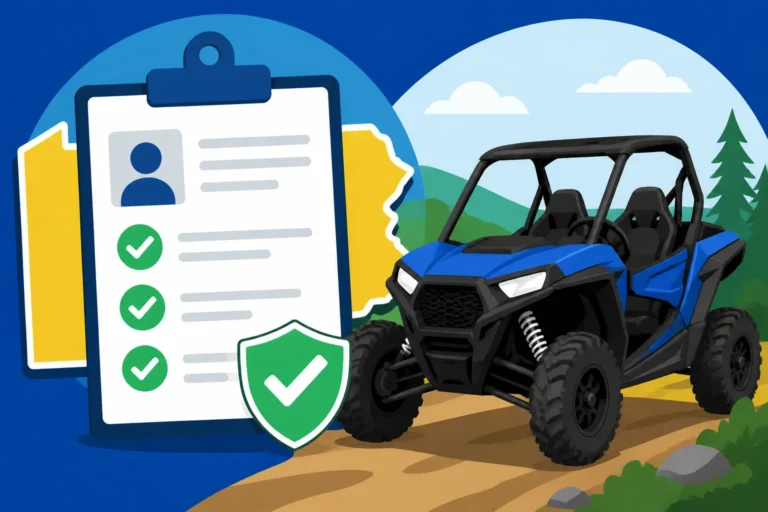
Here’s a checklist of what you’ll generally need:
- Completed Form DCNR-43: Ensure all sections are filled out accurately, including your business name, address, and federal EIN (Employer Identification Number) if applicable, in place of a personal Social Security Number. [What Pennsylvania Asks on Form DCNR-43] will guide you.
- Proof of Ownership: This is typically the Manufacturer's Certificate of Origin (MCO) for a new machine, or a title from a previous owner if it's used. If you bought it used and there's no title, you'll need to follow specific procedures for [Pennsylvania ATV Registration Without a Title], which can involve a VIN verification.
- Proof of Sales Tax Payment: If you purchased the machine from a dealer, sales tax was likely collected at the point of sale. If you bought it privately, you’ll need to remit the [Pennsylvania Sales Tax on a Private Purchase] to the DCNR during registration.
- Proof of VIN (Vehicle Identification Number): The VIN must be verified. If you bought from a dealer, they handle this. If it was a private sale, you might need a pencil tracing or photo for [VIN Proof for a Pennsylvania Registration].
- Payment for Fees: This includes the registration fee and potentially a title fee. [Pennsylvania ATV Registration Cost] and [Pennsylvania ATV Title Cost] apply just as they would for a personal machine.
For businesses with multiple machines, keep organized records for each one. Some businesses even utilize templates from services like LawDepot to help manage their internal purchase agreements or bills of sale when acquiring or divesting fleet vehicles, ensuring all legal bases are covered for ownership transfer.
Dealer Assistance vs. Private Sale Registration
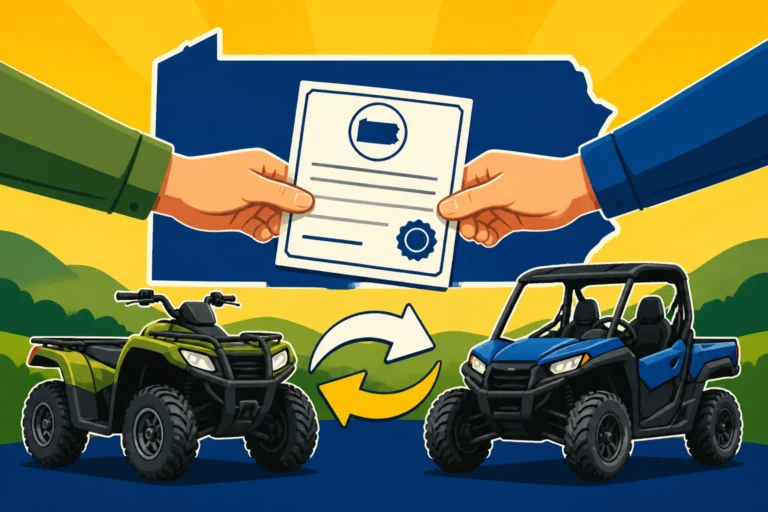
The easiest way to register a business ATV or UTV is often through a licensed Pennsylvania dealer. When you buy a new machine, or even a used one, from a dealer, they typically handle all the registration and titling paperwork on your behalf. They'll collect the necessary information from your business, submit Form DCNR-43, remit sales tax, and handle the title application. They'll even provide you with a temporary 45-day sticker, allowing you to use your machine while the DCNR processes your official plate and documents. [What a Pennsylvania Dealer Handles for You] really streamlines the process.
If you acquire a business machine through a private sale—perhaps from another company, a farmer selling an old work quad, or an individual—the responsibility for registration falls entirely on your business. This means you'll need to gather all the documents, complete Form DCNR-43 yourself, and submit it directly to the DCNR. This route requires more attention to detail but is certainly manageable. [Registering After a Private Sale in Pennsylvania] is a comprehensive guide for this scenario, which applies equally to business transactions. Remember, proving you paid sales tax is crucial, and if it wasn't collected, you'll need to pay it as part of the registration process.
Exemptions and Special Considerations for Business Machines
While the general rule is "if it rides, it registers," Pennsylvania does offer a few specific exemptions that might apply to certain business machines. It’s absolutely critical to understand these thoroughly, as incorrectly claiming an exemption can lead to significant fines. Always err on the side of caution and register if there’s any doubt.
Remember, even if you are exempt from registration, you are never exempt from safe operation, adhering to noise limits, or environmental regulations. These machines still need to be operated responsibly, regardless of their plate status.
The Farm and Business Exemption
There is a narrow exemption for certain agricultural and business uses, but it's often misinterpreted. [The Farm and Business Exemption in Pennsylvania] generally applies to machines that are exclusively used for agricultural purposes on a farm, or for specific business purposes entirely on property owned or leased by the business, and never operated on land open to the general public or on roads. This means if your farm quad is only ever used within the perimeter of your farm to check livestock or haul feed, and never crosses a public road, it might qualify.
However, the moment that "farm quad" takes a shortcut across the township road to get to the back forty, or if you take it to a neighboring farmer's property that involves public access, the exemption likely vanishes. The keyword here is "exclusively." Any deviation from strictly private, contained use, especially involving public roads or designated trails, typically negates this exemption. Many agricultural businesses still opt for Limited Registration to cover those edge cases where a brief road crossing might be unavoidable, simply for peace of mind.
Rental Fleets and Dealer Inventory
If your business involves renting out ATVs or UTVs, or if you're a dealer with inventory, there are specific provisions that apply. Rental fleets must have all their machines registered. This is non-negotiable, as these machines are explicitly intended for use by the public (your customers) on trails and other designated areas. The DCNR needs to have these machines on record for safety and accountability.
For dealers, machines held in inventory for sale are typically covered by a Dealer Certificate, which is a special type of registration that allows them to be demonstrated or moved around for business purposes without individual registration. However, once a machine is sold, it's the new owner's responsibility (or the dealer's, if they're handling the paperwork) to get it registered under the appropriate Limited or General categories. This ensures a clear chain of ownership and accountability from the moment it leaves the dealer's lot. [Dealer Inventory and the Dealer Certificate] clarifies this specific business scenario.
Government and Other Special Unit Exemptions
Certain government-owned machines, such as those used by state park staff, local municipalities for property maintenance, or emergency services, are typically exempt from standard registration. These machines serve a public function and are identified through other means by their respective agencies. [Township Machines on the Exempt List] outlines how these units operate.
Similarly, specific organizations or historical machines may have unique considerations. However, for the vast majority of private businesses, these specialized exemptions will not apply. Always check with the [Pennsylvania's DCNR Snowmobile and ATV Section] if you believe your unique business operation might qualify for a specific exemption, but be prepared for a rigorous interpretation of the rules. It's almost always better to register than to risk a fine, especially when your business operations are on the line.
Table: Comparing Registration Types for Business Use
Here's a quick comparison to help you decide which registration type might be best for your business ATV or UTV in Pennsylvania:
| Feature | Limited Registration | General Registration |
|---|---|---|
| Primary Use | Exclusively on private, self-contained property | On state trails, designated roads, private land |
| Operational Scope | Very restricted to owner's land or leased land | Broad access, including public trails and approved roads |
| Road Crossing | Generally not permitted on public roads | Permitted on approved, designated public roads |
| Plate Type | Specific "Limited Use" plate | Standard ATV/UTV plate |
| Typical Business Fits | Large farms (never leaving property), quarries, private hunting clubs with contained land | Landscapers, construction, utility, tour guides, rental fleets |
| Funding Contribution | Minimal contribution to state trail systems | Direct contribution to state trail maintenance funds |
| Enforcement Risk | High if used outside defined limited scope | Low, as long as rules of operation are followed |
This article is for general informational purposes only and does not constitute professional advice. Laws, prices and regulations vary by location and change over time. Consult a qualified professional for guidance on your specific situation.