Carrying the Certificate on a Ride
If a young rider needs an ATV safety certificate, it is easy to confuse it with the registration card or assume a parent can keep it back at camp. Pennsylvania treats these as separate documents. Here’s who needs a certificate, when to carry it, how it differs from other ride paperwork, and what to check before heading out.
Who Needs to Carry a Pennsylvania ATV Safety Certificate
Pennsylvania’s certificate rule is aimed at youth riders. According to the Pennsylvania Department of Conservation and Natural Resources (DCNR), children ages 8 to 15 must complete an ATV safety course and obtain a certificate to ride on land that does not belong to their parents or guardians. DCNR also says riders in that age group must carry a valid safety certificate when riding away from a parent’s or guardian’s property.
That can include a ride on land where the family has permission to ride, as well as a designated trail. Permission to use someone else’s property does not remove the certificate requirement for a rider in this age group. The owner’s permission and the rider’s safety certificate serve different purposes: one allows access to the land, while the other shows the young rider has met the safety-training requirement.
| Rider or situation | What to know |
|---|---|
| Rider ages 8 to 15 away from a parent’s or guardian’s property | DCNR requires the rider to complete a safety course, obtain a certificate, and carry a valid certificate. |
| Rider on a parent’s or guardian’s property | The certificate requirement described by DCNR applies to riding on other land; other safety rules still matter. |
| Rider younger than 8 on state-owned property | DCNR does not permit children under 8 to operate an ATV on state-owned property. |
| Rider ages 8 and 9 | DCNR restricts these riders to ATVs with engines of 70cc or smaller. |
| Rider age 16 or older | DCNR encourages online ATV safety training for riders 16 or older. Its guidance also says children 16 and older must take the online course, so check DCNR’s current course instructions if an older teen is riding. |
The age and machine rules can overlap with the certificate requirement. For example, a young rider might have completed the course and carry a certificate but still be too young for a particular machine or location. According to DCNR, children ages 8 and 9 are restricted to ATVs with engines of 70cc or smaller, and no one under 8 may operate an ATV on state-owned property. A certificate does not override those separate limits.
For more on course eligibility and training, see Pennsylvania ATV Safety Certificate Requirements, Pennsylvania ATV Course for Ages 8 to 15, and A 70cc Cap for the Youngest Riders. If a certificate has been misplaced, Replacing a Lost Pennsylvania Certificate covers that related problem.
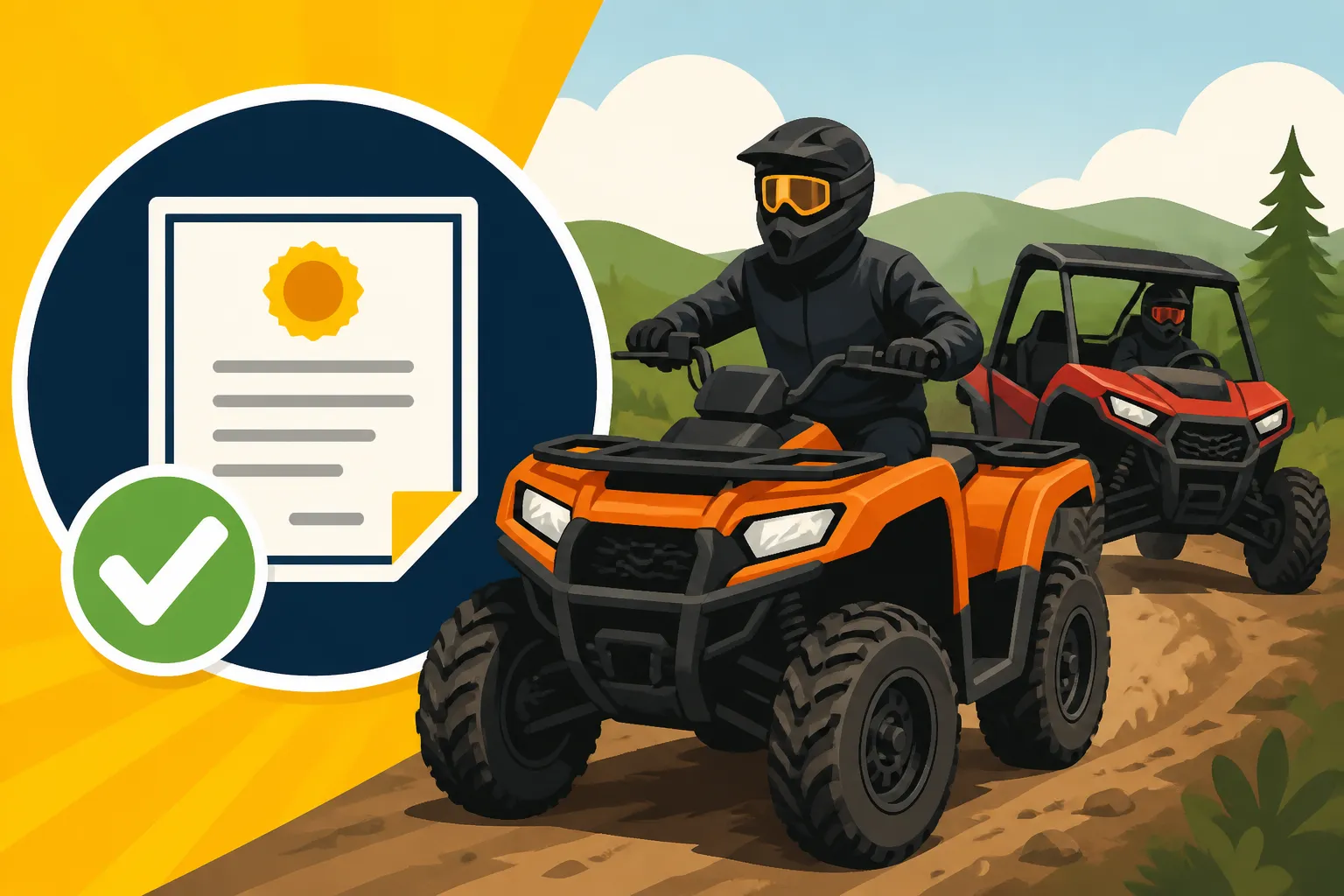
The practical takeaway is straightforward: if the rider is in the required age group and is riding away from a parent’s or guardian’s property, plan for the rider to have the certificate with them. Do not treat a parent’s memory of course completion, a registration card, or a trail permit as a substitute.
Keep the Certificate Separate From Registration and Insurance
A safety certificate is not the same thing as an ATV registration card. DCNR issues registration documents for the vehicle; the safety certificate belongs to the rider. One may show that a machine is registered, while the other shows that a young rider has completed the required safety training. A machine’s documents do not establish that its operator has a certificate.
This distinction matters when several family members share one ATV. The registration relates to the machine, but the certificate requirement applies to the individual young rider. Each youth rider who needs a certificate should have their own proof available. For broader registration context, see Registering an ATV in Pennsylvania and What the DCNR Wallet Card Is For.
Insurance proof is another separate document. According to DCNR, a rider must carry proof of liability insurance at all times when operating an ATV on property the rider does not own or lease. That requirement applies independently of the safety-certificate rule. Having a certificate does not prove insurance, and carrying insurance proof does not meet the training requirement.
Registration requirements also depend on the machine and how it is used. DCNR says ATVs in Pennsylvania generally must be registered and titled, with exceptions that include machines used solely for business or agricultural purposes. A registration card, plate, sticker, insurance document, and safety certificate each have a distinct role; do not assume one document covers another.
| Document or item | What it relates to | Practical point |
|---|---|---|
| ATV safety certificate | The rider’s training | A youth rider who needs one should carry it when riding away from a parent’s or guardian’s property. |
| Registration card | The ATV’s registration | It is vehicle paperwork, not proof that a young rider completed safety training. |
| Liability insurance proof | Insurance for the ATV | DCNR requires it to be carried when riding on property the rider does not own or lease. |
| Trail permit or access authorization | Permission or eligibility to use a particular trail system | It does not replace a safety certificate, registration, or insurance proof. |
A trail system may have its own access requirements, too. A safety certificate does not automatically authorize access to a trail, and a trail permit does not replace the certificate. Before riding, check the rules for the specific land or trail as well as the statewide requirements. The related posts Pennsylvania ATV Safety Certificates and Pennsylvania ATV Trail Permits Explained help separate these requirements.
How to Prepare the Certificate for a Ride
DCNR’s rule is that the required rider must carry a valid certificate. The available information does not specify that a phone image, photocopy, or other substitute will be accepted in place of the certificate. If you are unsure whether a particular format is acceptable, confirm it with DCNR before relying on it. The safest approach is to carry the certificate in the format DCNR recognizes, rather than assuming a picture stored on a phone will be enough.
A few simple habits help keep the paperwork accessible without mixing it up with the ATV’s registration:
- Check the rider, not just the machine. Confirm whether each young person riding off a parent’s or guardian’s property needs a certificate.
- Put the certificate with that rider’s ride gear. Keep it somewhere the rider can access if asked, rather than buried in paperwork at home or in a vehicle that is not going on the ride.
- Protect it from water and dirt. A clear, waterproof sleeve or document pouch can help protect paper. A retailer such as Amazon may carry basic sleeves, but a protective holder does not change which certificate formats DCNR accepts.
- Keep separate paperwork in separate places or clearly marked pockets. A wallet card, insurance proof, and safety certificate are easy to confuse when they are all loose in the same bag.
- Check everything before leaving. Confirm the certificate is present and legible, and check the separate registration and insurance requirements for the ride.
The key is not to carry a pile of paperwork without knowing what it proves. Make sure the right rider has the safety certificate, and keep the machine’s registration and insurance documentation available when those rules apply. For help with what to carry for insurance, see Carrying Proof of Insurance in Pennsylvania.
A document sleeve can make a paper certificate easier to protect, but it cannot correct a missing, invalid, or unreadable certificate. If it has been lost or damaged, resolve that before the ride rather than assuming another family member’s paperwork will cover the rider.
A Pre-Ride Check for Youth Riders
Before leaving, match the rider and the ride location to the applicable rules. For a rider ages 8 to 15, ask whether the ride will be on property belonging to a parent or guardian. If not, confirm that the rider has completed the required course, has a valid certificate, and is carrying it. Then check any additional limits that apply to the rider’s age, the ATV, or the property.
The certificate is only one part of a safe and lawful ride. DCNR requires ATV operators to wear a securely fastened helmet and eye protection. It also says riders must stay on trails specifically designated for ATVs when riding on state-owned property. These rules are separate from the certificate requirement, so a rider who has the right paperwork still needs to follow them.
Use this quick check:
- Is the rider in an age group that requires a safety certificate for this ride?
- Is the rider carrying the certificate, rather than relying on a registration card or a parent’s paperwork?
- Does the machine meet any age-related limits?
- Are the ATV’s registration and insurance requirements covered for the property being ridden?
- Is the planned route open to ATVs, and does it have any additional access requirements?
- Does the rider have the required helmet and eye protection?
If a ride crosses onto a different property or trail system, review the rules again. A certificate can satisfy the training requirement, but it does not grant permission to enter private land or guarantee that a route is open. For more on access and landowner permission, see Pennsylvania Landowner Permission Rules.
Making the certificate part of the pre-ride routine is a small step that avoids a common paperwork mix-up. For young riders who need one, keep the safety certificate with the rider, and treat registration, insurance, and trail access documents as separate requirements.
Sources
- Pennsylvania Department of Conservation and Natural Resources — Home Page – Snowmobile/ATV Registration (checked November 3, 2026)
- Pennsylvania Department of Conservation and Natural Resources — Request Youth ATV Rider Training | Commonwealth of Pennsylvania (checked November 3, 2026)
- Department of Conservation and Natural Resources — Riding Rules and Enforcement | Department of Conservation and Natural Resources| Commonwealth of Pennsylvania (checked November 3, 2026)
- Pennsylvania Department of Conservation and Natural Resources — Trail Conditions – Snowmobile/ATV Registration (checked November 3, 2026)
Disclaimer
This article is for general informational purposes only and does not constitute professional advice. Laws, prices and regulations vary by location and change over time. Consult a qualified professional for guidance on your specific situation.