The 70cc Cap for Ages Eight and Nine
The 70cc Cap for Ages Eight and Nine
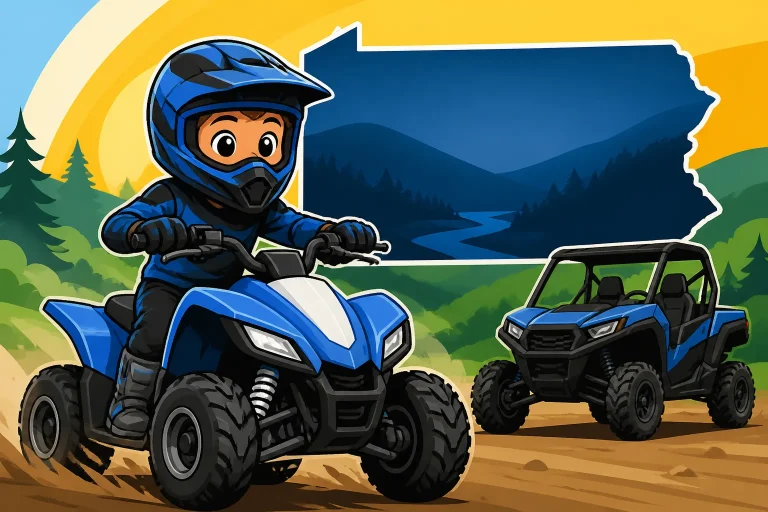
Choosing a machine for an eight- or nine-year-old in Pennsylvania means checking more than whether the child can reach the controls. On public land, the 70cc limit is a legal cap on engine displacement, and it sits alongside age, training, supervision and trail-access rules. Here’s how to apply the limit and avoid confusing it with registration or a trail permit.
What the 70cc cap means
In Pennsylvania, a rider who is eight or nine may not operate an ATV with an engine displacement greater than 70cc on public land. A machine rated at exactly 70cc is within that displacement limit; one rated above it is not. Check the manufacturer’s specifications rather than relying on a model name, appearance or seller’s description.
“CC” means cubic centimeters, a measure of engine displacement. It does not tell you the machine’s top speed, horsepower or overall size. Those things matter for choosing a machine a child can control, but they do not replace the displacement test. A machine that has a speed limiter can still exceed 70cc. Conversely, a small-looking machine is not necessarily under the limit.
The cap is about the machine’s engine, not how gently the child plans to ride. A parent’s promise to keep the throttle low does not make an over-limit ATV suitable under the rule. Nor does riding slowly, using a lower gear or staying on a short trail change its displacement.
| What to check | Why it matters |
|---|---|
| Rider’s age on the day of the ride | The 70cc cap applies to riders who are eight or nine |
| Manufacturer’s engine-displacement specification | The ATV must be rated at 70cc or less for this age group on public land |
| Any engine modifications | Changes may affect whether the original specification still describes the machine |
| Where the ride will take place | Public-land requirements may differ from private-property rules |
| The trail’s own conditions | A permit or registration does not guarantee that every machine or rider is allowed |
A common shopping mistake is to treat “youth ATV” as a legal category that guarantees the machine is right for every young rider. It does not. Youth models vary, and some can exceed 70cc. Read the specifications for the exact model and year, and ask the seller for documentation if the displacement is unclear.
The number also does not decide whether a machine is physically appropriate. A 70cc ATV can still be too heavy, too powerful for a particular child’s ability, or difficult to control on steep or rough ground. Check the owner’s manual for the intended rider, fit and operating instructions. Have the child demonstrate that they can reach and operate the controls comfortably while wearing riding gear.
Where the rule applies, and what it does not replace
The key setting for this age-based cap is public land. That includes land where a public agency or other authorized operator allows riding, subject to its rules. Pennsylvania’s public-land restrictions are only one part of the decision: access may also depend on the property, trail, season and machine.
Do not assume that a route is open simply because it looks like a trail or appears on a map. State forest trails, private club trails, permitted trail systems and public roads can have different requirements. Some places may be closed to ATVs altogether, or may set conditions that are more restrictive than the general rules. Check the specific land manager or trail operator before the ride.
Private property is a separate question. The public-land age and displacement rules should not be treated as a blanket statement about every private driveway or field. But permission from a landowner does not make an unsafe setup sensible, and other rules may still apply. Confirm the requirements for the exact place and activity rather than carrying a public-land rule over to every setting—or assuming private land has no rules.
A trail permit, registration and rider eligibility are different things:
- Registration identifies a machine under the applicable registration system.
- A trail permit may be needed to ride a particular trail system or area.
- Rider eligibility concerns whether the person may operate that machine in that place, including age and displacement restrictions.
- A safety certificate documents completion of required training where applicable.
Having one of these does not automatically satisfy the others. An ATV may be registered and display the right paperwork while still being too large for an eight- or nine-year-old to operate on public land. Likewise, a child’s course certificate does not authorize riding on a closed trail.
The same distinction matters for visitors. An out-of-state registration or plate may be relevant to whether a visitor can ride in Pennsylvania, but it does not automatically remove Pennsylvania’s operating rules for the location. See Pennsylvania ATV Reciprocity With Other States and Does Pennsylvania Honor an Out-of-State Safety Certificate for the separate questions of registration and training recognition. Confirm the current rules for the specific land or trail before traveling.
Road use is another separate issue. A trail-eligible ATV is not automatically permitted on a road, and the 70cc rule should not be read as road authorization. Pennsylvania has distinct restrictions for ATV use on designated roads, including age-related requirements. Check [Pennsylvania Minimum Age to Ride an ATV] and Pennsylvania Rules for a Fifteen-Year-Old Rider if the planned route involves a road.
Choosing and checking a machine
For an eight- or nine-year-old, start with the displacement limit, then consider fit and the child’s actual ability. A machine that complies with the cap is not automatically a good choice. The child must be able to operate it safely, and the adult responsible for the ride should be comfortable with the terrain, conditions and supervision plan.
Verify the exact engine size
Look for the displacement in the manufacturer’s specifications or owner’s manual. Don’t rely only on an online listing, a badge on the bodywork or a seller’s verbal estimate. Model names can be confusing, and a used machine may not match its original configuration.
If the paperwork says 70cc or less, check that the machine has not been modified. If specifications are missing, contradictory or difficult to interpret, pause the purchase or ride until you can verify them. A quick search based on a partial model name may return information for a different year or version.
An electric machine needs extra care. A displacement figure may not be listed because it has no conventional gasoline engine. That does not automatically mean the machine is exempt from age or operating restrictions. Ask the relevant land manager or state authority how the machine is classified before taking it onto public land.
Look beyond the number
A child’s age and engine size do not tell you whether the ATV fits. Use the manufacturer’s guidance and inspect whether the rider can:
- Reach the handlebars and controls without stretching or shifting awkwardly.
- Operate the throttle and brakes with control.
- Sit securely and keep their feet in the intended position.
- Understand how to stop, turn and respond to changing ground.
- Handle the machine’s weight at a stop as well as while moving.
A child who cannot manage a machine confidently should not ride it just because its engine is within the cap. Adult supervision is not a substitute for a machine the child can control.
Avoid modifications intended to make an over-limit machine seem suitable, such as a throttle stop or reduced-speed setting. Those changes do not alter engine displacement. They may also affect the machine’s safe operation or conflict with the manufacturer’s instructions.
Treat a UTV carefully
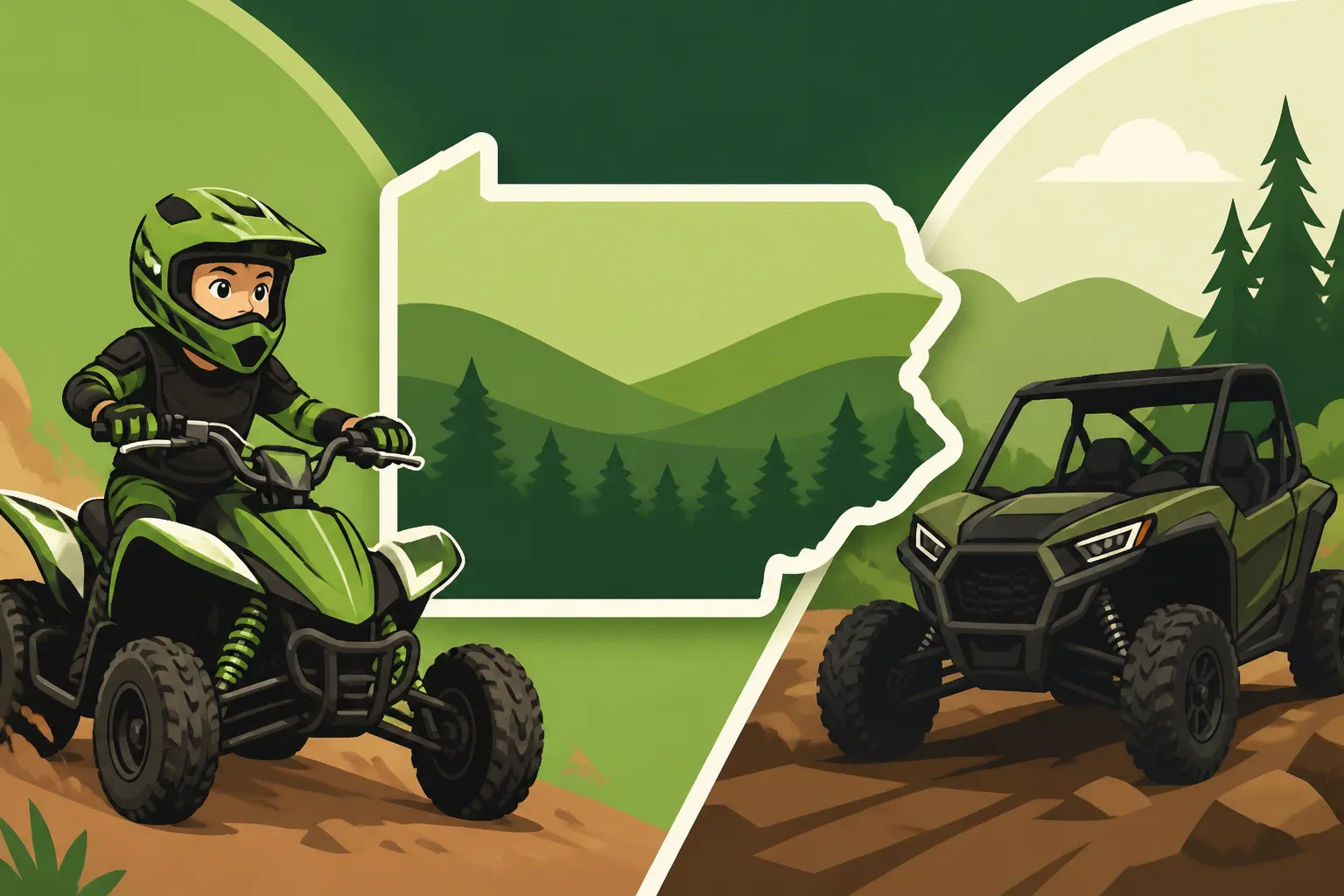
Do not assume that an adult-sized side-by-side is acceptable for a child because it has a speed limiter, a passenger seat or an enclosed cab. A UTV’s classification and engine size matter, and many models are far above 70cc. The 70cc limit is not a general permission for a child to operate any machine marketed for young riders.
For a UTV or an electric vehicle, verify the machine’s classification, age requirements and the rules of the land manager before use. If the vehicle’s specifications do not clearly show that it meets the applicable limit, do not treat uncertainty as permission. The separate rules in Pennsylvania Rules for a Side-by-Side on a Trail can help with trail eligibility, but the rider’s age and the exact machine still need to be checked.
Training, supervision and safe riding
The displacement cap is only one requirement. Pennsylvania has safety-training rules for young riders, and the details depend on the rider’s age and where the ATV will be used. Check Pennsylvania Safety Certificates for Ages 8 to 15 and Pennsylvania ATV Course for Ages 8 to 15 for the training requirements that apply to the child. Keep any required proof available during the ride.
A certificate is not a substitute for adult judgment. Before riding, review how to start and stop the machine, use the controls and respond to hazards. Choose ground appropriate for the child’s skill, and stay close enough to intervene. A narrow, unfamiliar trail with steep slopes, loose rocks or blind turns can be a poor place for a first ride even when the ATV is within the legal displacement limit.
Do not confuse supervision with permission to ignore age or machine limits. An adult riding beside the child does not make an ATV above 70cc compliant for an eight- or nine-year-old on public land. Nor should an adult assume that a child can safely ride alone because they have completed a course.
Use a properly fitted helmet and suitable protective gear. Pennsylvania’s helmet rules are a separate requirement from the displacement cap, and the child’s helmet should fit securely and be appropriate for ATV use. Review Pennsylvania Helmet Law for ATV Riders and Pennsylvania Rules for a Child Passenger if the ride involves a passenger. Do not carry a child as a passenger on a machine unless the vehicle is designed for that use and the applicable rules allow it.
Make the ride plan match the child, not the other way around. Keep the first trips short, use terrain the child can handle and avoid riding when visibility or trail conditions make control difficult. Stop if the child is tired, frightened or losing focus. These practical safeguards do not replace legal requirements, but they help prevent the common mistake of treating a compliant engine size as proof that the whole ride is safe.
A practical check before riding
Before taking an eight- or nine-year-old onto public land, use this sequence:
- Confirm the child’s age. The 70cc limit discussed here applies to riders who are eight or nine.
- Verify the exact machine. Find the manufacturer’s displacement specification and confirm that it is 70cc or less. Check for modifications.
- Check the place. Verify that the land or trail is open to that type of machine and that its operator has no additional conditions.
- Confirm rider requirements. Check applicable training, supervision, helmet and other safety rules.
- Sort out paperwork. Determine whether registration, a trail permit, insurance or other documents are required for that ride. Do not treat paperwork as a replacement for age eligibility.
- Assess fit and conditions. Make sure the child can control the machine and that the route suits their skill.
- Carry proof. Bring required registration, permit and training documents, and keep them protected from water and damage.
If any step is uncertain, delay the ride and verify it with the relevant authority or land manager. A seller’s assurance that a machine is “for kids” is not a substitute for checking the specifications and rules yourself.
Keep a copy of the machine’s specifications with its paperwork. This is especially useful for a used ATV, an older model or a machine with a name that is easy to confuse with a larger version. If the child will ride at more than one location, check each location separately; a rule that allows access at one trail system does not establish access elsewhere.
As the child grows older, do not assume that one birthday resolves every issue. Age may change which restrictions apply, but training, supervision, machine suitability, registration and access rules remain separate checks. Use Pennsylvania Rules for Riders Aged 8 to 15 for the broader age-specific requirements, and confirm current details before each season.
Frequently Asked Questions
Can an eight- or nine-year-old ride a 70cc ATV in Pennsylvania?
The 70cc limit allows a rider in this age group to operate an ATV rated at 70cc or less on public land, subject to the other applicable requirements. Check the rules for the specific land or trail before riding.
Does a speed limiter make an ATV over 70cc legal for this age group?
No. A speed limiter does not change engine displacement. The cap is based on the engine’s rated size, not the speed at which the ATV is operated.
Does a safety certificate allow a child to ride a larger ATV?
A certificate does not override the machine-size restriction. Training, age eligibility, machine displacement and trail access are separate requirements.
Does the 70cc cap apply to every private property ride?
The public-land rule should not be assumed to apply identically to every private-property situation. Confirm the rules for the location and activity, and obtain permission where required.
Can an eight- or nine-year-old operate an electric ATV?
Do not assume that an electric machine is exempt because it has no gasoline-engine displacement rating. Ask the relevant authority or land manager how it is classified and what age restrictions apply.
Disclaimer
This article is for general informational purposes only and does not constitute professional advice. Laws, prices and regulations vary by location and change over time. Consult a qualified professional for guidance on your specific situation.