Where Pennsylvania Permit Money Goes
Pennsylvania riders may pay for registration, state forest access, or a separate permit for a particular trail system, and those payments do not all go into the same pot. Knowing which one you bought helps explain what your money supports—and what it does not cover.
First, identify which payment you mean
“ATV permit” can refer to different things in Pennsylvania. The money from a state forest trail permit is not the same as money from ATV registration, and neither is automatically the same as a permit for the Allegheny National Forest or a private riding park.
A quick way to sort them out is to look at who issued the document and what it authorizes:
| Payment or document | What it generally covers | Where its revenue is directed |
|---|---|---|
| Pennsylvania ATV registration | Registration of the machine under state rules | A restricted state account that supports ATV-related programs, including trail work and administration |
| Northcentral Regional Trail Permit | Access to designated permit trails in the covered state forest system | The permit program and its trail operations, maintenance, and improvements |
| Allegheny National Forest ATV permit | Access to designated ATV routes in the national forest, subject to its rules | The federal forest’s recreation program and related site work |
| Private park admission or permit | Access to that operator’s property and trail system | The private operator’s costs and business operations |
These categories are easy to mix up because riders may need more than one. A machine can need registration even when the rider also needs a trail permit. A permit for one forest or park does not automatically authorize riding on another system.
For a broader explanation of the different payments, see Pennsylvania ATV Trail Permits Explained and What Pennsylvania Charges Visitors to Ride. The useful first question is not simply “Where did my permit money go?” but “Which agency or operator collected it, and what did that payment authorize?”
Pennsylvania registration money supports ATV programs
ATV registration is a legal requirement for covered machines, not a general trail pass. Registration and trail access are separate questions: paying to register a machine does not, on its own, grant access to every public trail.
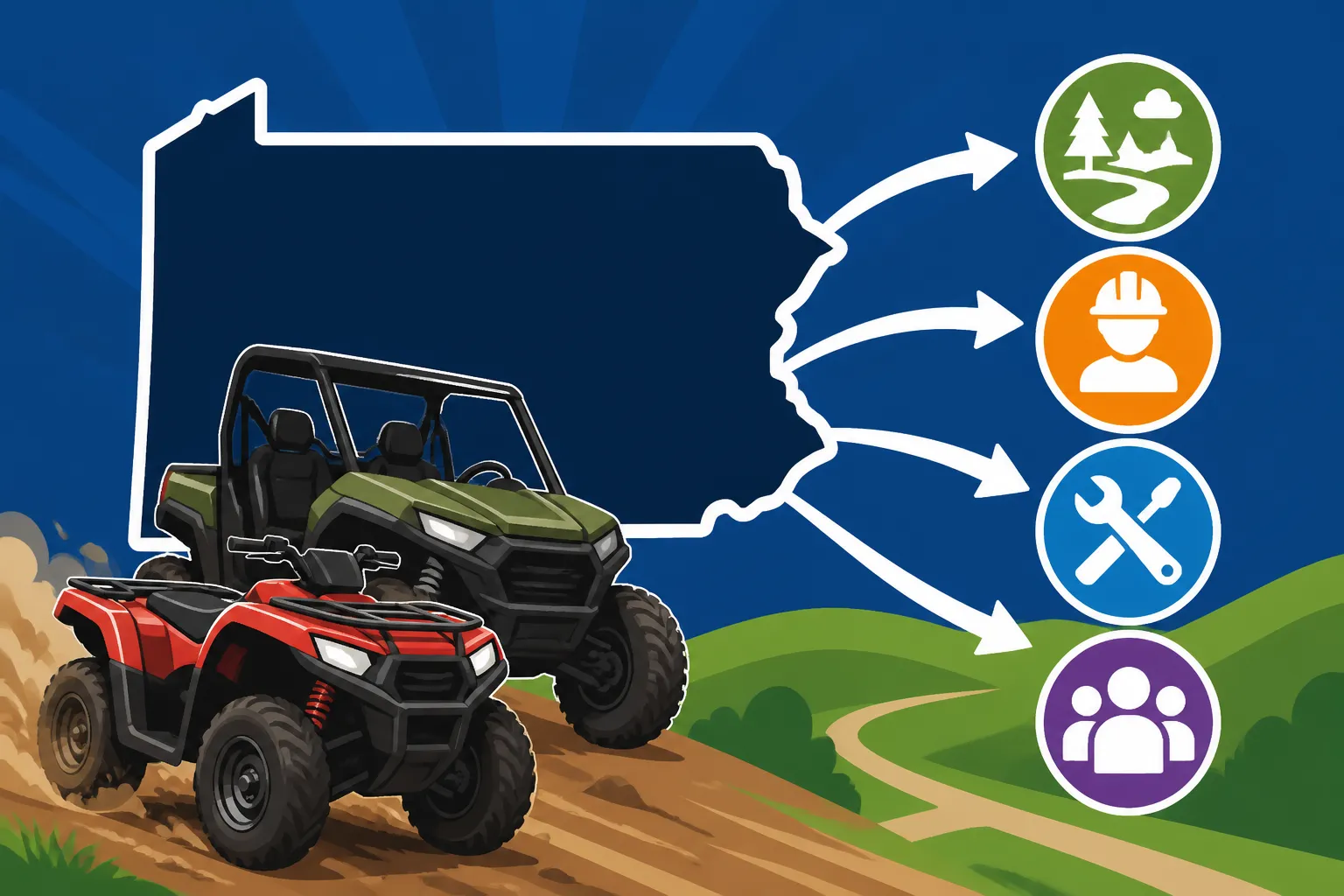
Pennsylvania uses ATV registration revenue for ATV-related purposes rather than treating it as an unrestricted trail-use payment. The state’s ATV program can use these funds to support trail development and maintenance, grants, and the administrative work needed to manage the program. In practical terms, that can mean money helps make trail opportunities possible even when the individual rider’s registration document does not name a specific trail.
Registration revenue can support work such as:
- Building or improving trails and related riding facilities.
- Maintaining trail surfaces, drainage, signs, and access points.
- Supporting eligible local organizations or public bodies that carry out trail projects.
- Administering registration and related ATV programs.
The precise mix depends on program decisions, eligible projects, and available funds. It is better not to assume that a particular registration payment was assigned to one trail, county, or maintenance task. A registration fee contributes to the state program; it is not normally a personalized donation tied to the location where a rider plans to ride.
That distinction matters if you mostly ride a single forest trail. Your registration still serves a different function from the trail permit that may be required there. To understand the registration side, see Pennsylvania ATV Registration Cost and What Trail Work Registration Funds. For the access side, check the rules for the specific trail system you plan to use.
State forest permit revenue supports a defined trail system
The Northcentral Regional Trail Permit is a separate payment associated with a designated state forest trail network. It applies to its covered routes rather than acting as an all-purpose Pennsylvania trail pass. The system includes routes in four northcentral counties; the exact routes, seasons, and machine rules should be checked before a ride.
Permit revenue supports the operation and care of that permit system. Depending on the work needed and the program’s budget, this can include trail maintenance, repairs, signs, access facilities, and improvements intended to keep designated routes usable and safe. There is also administrative work involved in issuing permits and managing access.
That does not mean every dollar from a permit is spent on the precise trail a rider uses. A trail network has shared costs: a damaged section may need repair, signs may need replacing across several routes, and access points require upkeep even for riders who use a different part of the system. The agency and its partners decide how to address needs across the covered network.
The permit also does not mean that every state forest trail is open to ATVs. Some state forest routes are designated for permitted riding; other trails have different rules or are closed to ATV use. The permit’s scope is limited to the routes included in the program. See Pennsylvania’s Northcentral Regional Trail Permit and Pennsylvania’s Nearly 1,000 Permit Miles for the system’s coverage, and compare it with Pennsylvania’s Free State Forest Trails if you are trying to find routes that do not require that particular permit.
A practical way to think about the payment is that it helps fund access to a managed trail network, not unrestricted use of state forest land. The permit’s value depends on whether the routes it covers fit your plans and whether they are open on your intended riding dates.
The Allegheny National Forest has a separate permit system
The Allegheny National Forest is federal land, so its ATV permit is separate from Pennsylvania state registration and the Northcentral Regional Trail Permit. A state permit should not be treated as a substitute for the forest’s own requirements.
Revenue from a federal recreation permit generally supports recreation services and facilities associated with the site or program that collected it. For ATV riders, relevant work may include maintaining designated routes and related recreation facilities. The federal forest also has its own operating rules, seasonal access details, and permit requirements, so riders should check current information from the forest before making plans.
This distinction can be confusing when a ride includes several public systems. A machine may be registered with Pennsylvania, while the rider also needs a permit for the particular federal forest routes. Each payment has its own purpose and limits. A permit bought for one system does not turn a nearby road or trail into an authorized ATV route.
For the forest-specific details, start with Pennsylvania’s Allegheny National Forest Permit and Why the Allegheny Forest Sells Its Own Permit. Those pages can help clarify what the federal permit covers; the forest’s official information should be checked for current conditions and requirements.
Do not assume that all money collected on federal land goes into Pennsylvania’s state ATV account, or that state registration revenue is the funding source for every project in the national forest. Different owners and managers have separate budgets and responsibilities.
What permit money does not guarantee
A permit payment contributes to a program, but it is not a promise that a particular trail will be open, freshly graded, or free of rough spots on the day you arrive. Weather, seasonal closures, damage, maintenance schedules, staffing, and land-management decisions can all affect trail conditions.
It also does not necessarily cover every cost a rider encounters. A permit may authorize access to a defined trail system, while registration, insurance, safety requirements, or a park’s admission rules remain separate obligations. For example, a rider may still need valid registration even after buying a trail permit. Riders should check both the machine rules and the land manager’s access rules.
A permit also does not give access to:
- Routes outside the permit system’s boundaries.
- Trails that are closed for seasonal, safety, or maintenance reasons.
- Private property without the landowner’s permission.
- Roads or trails that are not designated for ATV use.
- A separate park or forest that has its own payment requirement.
This is why it is worth checking the permit map and route information before buying. A permit can be the right purchase for a planned ride and the wrong one for a different destination. The state’s general information on permit coverage and where to obtain one is available through Where to Buy a Pennsylvania ATV Trail Permit.
There is also a difference between “the permit funds trail work” and “every dollar is spent directly on trail surfaces.” Trail programs need planning, administration, signs, access management, and coordination with partners as well as physical maintenance. Those are all parts of operating a public riding system, even if they are less visible than a repaired trail section.
How to check what a payment supports
If you want a more specific answer than “it supports the program,” identify the payment first, then ask the issuing agency or operator for its current budget or program explanation. A useful inquiry names the permit, the trail system, and the year or season involved. That makes it easier to distinguish registration revenue from permit revenue and from general agency funding.
Use this process:
- Check the issuer. Look at the registration card, permit, receipt, or account record. Note whether it came from Pennsylvania’s ATV program, a state forest permit program, the federal forest, or a private operator.
- Confirm what the payment covers. Read the permit’s terms and trail map. Make sure the system, machine type, and dates match your intended ride.
- Look for program or budget information. The issuing agency may publish details about trail maintenance, grants, facilities, or recreation spending. Do not assume that a headline total explains how funds were allocated.
- Ask about the category of spending. If no clear breakdown is available, ask whether revenue supports maintenance, improvements, administration, or a combination of those program needs.
- Keep the paperwork separate. Registration proof and trail permits serve different purposes. Carry the documents required for the specific ride rather than relying on one to stand in for another.
The practical takeaway is that Pennsylvania ATV payments are not one universal trail fund. Registration supports the state’s ATV program; the Northcentral permit supports its designated state forest trail system; and the Allegheny National Forest has a separate federal permit program. Checking the issuer and coverage is the clearest way to understand what a particular payment is intended to support.
Frequently Asked Questions
Does Pennsylvania ATV registration pay for trail maintenance?
Registration revenue supports ATV-related state programs, which can include trail work, grants, and program administration. It is separate from a permit that grants access to a particular trail system.
Does the Northcentral permit cover every state forest trail?
No. It applies to the designated routes included in that permit system. Check the current map and rules before riding.
Does a Pennsylvania registration replace an Allegheny National Forest permit?
No. Registration and the forest’s permit serve different purposes. Confirm the federal forest’s current requirements before riding there.
Can I find out exactly which trail received my permit money?
A permit payment generally supports a program or network rather than one rider-selected trail. Ask the issuing agency or operator for current budget or spending information if you need a more detailed breakdown.
Disclaimer
This article is for general informational purposes only and does not constitute professional advice. Laws, prices and regulations vary by location and change over time. Consult a qualified professional for guidance on your specific situation.