Taking a Dog Along on a Forest Trail
Taking a dog along on a Pennsylvania forest trail can sound like a good way to share a ride, but an ATV or UTV trail is a noisy, moving environment with little room to avoid hazards. Whether a dog is allowed depends on who manages the trail and what its rules say. Check access first, then decide whether the ride is safe and comfortable for your dog.
Check the trail rules before bringing your dog
Pennsylvania does not have one simple dog rule that automatically covers every forest road and trail. The land manager may be the state, the federal government, a private club, or another landowner, and the rules can differ. A permit or vehicle registration is not permission to bring a pet: it covers specific riding access, not every use of the property.
Start by identifying the exact trail or riding area and checking its current rules. For a state forest route, contact the relevant state forest district or check its official trail information. For a national forest, confirm with the U.S. Forest Service. A private riding area or club trail may have its own pet policy. If a rule is unclear, ask the land manager before you go rather than relying on a general assumption that dogs are allowed in forests.
Also distinguish a forest trail from a forest road. A road open to highway vehicles, a designated ATV trail, and a route on private club land may have different access conditions. A route that allows your machine does not necessarily allow a dog beside it or on it. For background on where a machine may be ridden, see Pennsylvania ATV Trail Permits Explained, Pennsylvania’s Free State Forest Trails, Pennsylvania Rules for Riding a National Forest, and Pennsylvania Rules for Riding a Club Trail.
| Where you plan to ride | What to verify before bringing a dog |
|---|---|
| Pennsylvania state forest trail | Whether pets are permitted on that route, any leash or control requirements, and seasonal closures |
| National forest route | The managing authority’s pet rules and any restrictions on the specific road or trail |
| Club or privately managed trail | The operator’s pet policy, including rules for trailheads, parking areas, and riding routes |
| Trailhead or campground near a route | Whether pets are allowed there, and whether those rules differ from the trail rules |
Check for temporary notices, too. A trail may be closed, rerouted, muddy, or busy during the dates you plan to ride. A permitted route may also pass through places where walking a dog would put you close to moving machines, other riders, or wildlife. Pennsylvania Trail Conditions Before You Go and Pennsylvania Trail Etiquette on Narrow Trails can help you plan around access and shared-trail concerns.
A permit does not settle the pet question
Pennsylvania riding permits and registrations serve different purposes from pet rules. A state trail permit, for example, does not automatically establish that a dog may accompany you, and an out-of-state registration recognized for riding does not change the land manager’s pet policy. Check the separate requirements for your machine and your dog.
If you are visiting from another state, confirm that your registration and any required trail access are in order, then ask the trail operator about dogs. Reciprocity between states concerns vehicle access requirements, not whether a dog is permitted on a particular route. For more on the riding side of the trip, see Pennsylvania ATV Reciprocity With Other States.
Why riding with a dog is often a poor fit
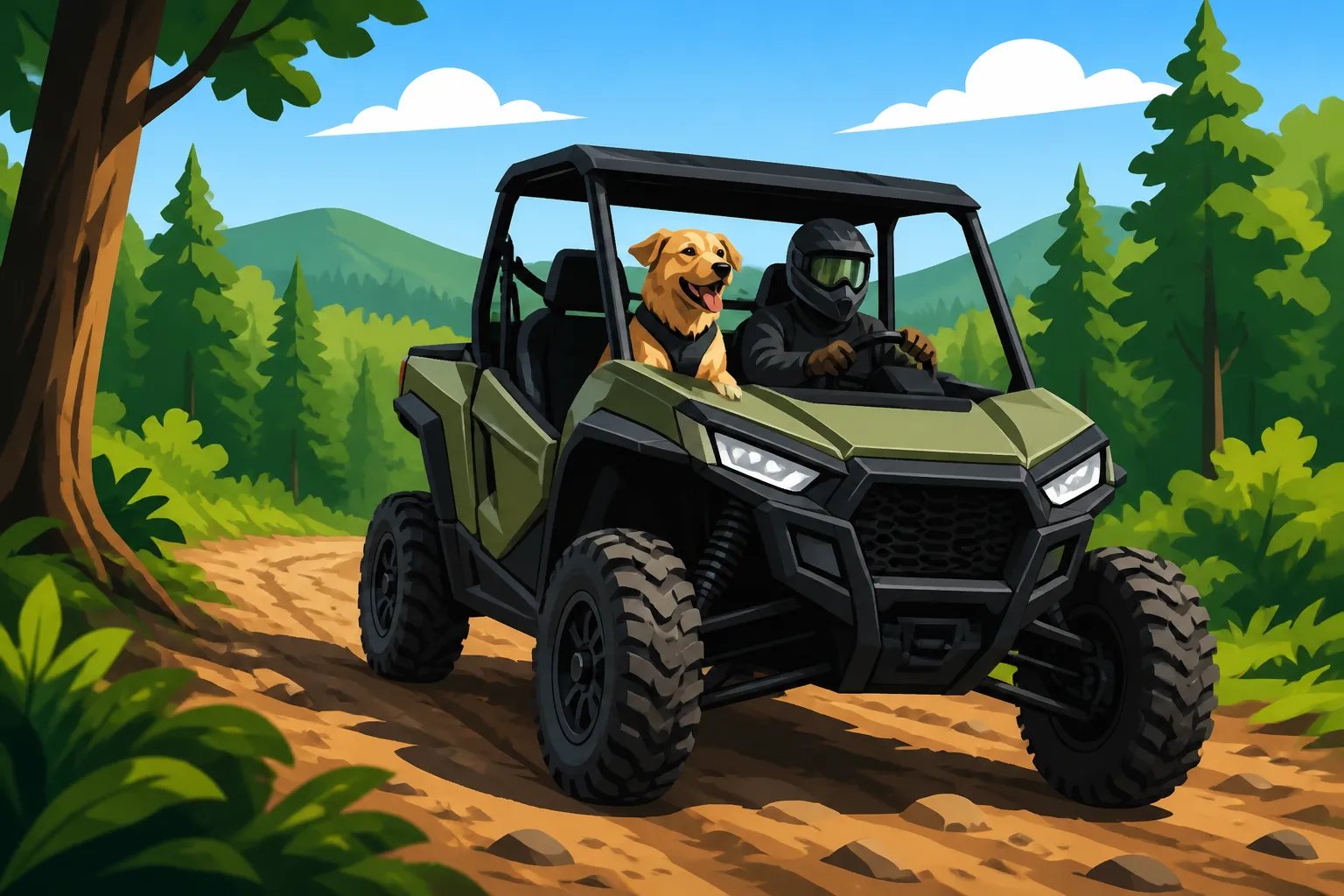
Even where pets are allowed on the property, riding with a dog can be hazardous. ATV and UTV engines, exhaust, vibration, sudden braking, rough ground, and close encounters with other machines can frighten or injure an animal. A dog may shift its weight unexpectedly, jump off, or move toward a tire. On a narrow trail, there may be no safe space to stop or move aside.
A UTV’s enclosed or partially enclosed cab does not automatically make it suitable for a dog. The dog still needs secure footing, room to remain safely contained, and protection from hot surfaces, moving parts, and sudden movement. A dog loose in a cab can interfere with the driver or become injured in a sharp turn or stop. Do not assume that a lap, open cargo bed, or passenger’s arms are safe restraint systems.
An ATV usually gives a dog even less protection. There may be no stable, secure place for the animal that keeps it away from the rider’s controls and the machine’s hot components. Do not put a dog in front of the operator, between an operator and passenger, or loose on a rack or cargo area. A crate or carrier also does not make a moving off-road vehicle safe by itself; it must be designed for the use, correctly secured, and accepted by the trail operator.
Noise and heat are easy to underestimate. A dog may seem calm at the trailhead but become distressed after a long stretch of engine noise or dust. Heavy panting, frantic movement, repeated attempts to escape, tucked posture, or unusual lethargy are reasons to stop in a safe place and reassess. On a warm day, a dog can overheat more quickly than people expect, particularly if it cannot get away from the engine or sun.
The dog’s temperament matters, but a familiar pet is not automatically prepared for this setting. A dog that is comfortable in a parked vehicle or around household equipment may still react badly to a loud machine, unfamiliar dogs, wildlife, or passing riders. There is no useful way to train around every risk while moving on a busy trail.
For most riders, the safest option is to leave the dog at home with a suitable caregiver or plan a separate dog-friendly outing away from motorized traffic. If your goal is to exercise your dog, choose a route where the animal can walk safely under control rather than trying to combine exercise with an ATV ride.
If dogs are allowed, plan for control and emergencies
When the land manager confirms that dogs are permitted, plan around the dog’s safety as carefully as the machine’s. The most important decision is whether your dog can be kept out of the riding area while machines are moving. A leash can help control a dog at a parking area, but it is not a safe way to walk beside a moving ATV or UTV. Never attach a leash to the machine or let a dog run alongside it.
At the trailhead, keep the dog clear of vehicle traffic, trailers, loading ramps, and reversing machines. Riders may not see a small animal near a tire. Keep the dog with one responsible handler while another person unloads or prepares the machine. If the dog is anxious, barking, pulling hard, or reacting to passing vehicles, treat that as a reason to leave rather than expecting the trail to calm it down.
Before setting out, make sure you have:
- The trail manager’s confirmation that dogs are permitted, plus any required leash or control instructions.
- A secure method to keep the dog away from machines at the staging area.
- Water and a way to offer it without leaving the dog beside a hot vehicle.
- Identification on the dog and current contact information.
- A plan to leave promptly if the dog becomes distressed or the trail gets crowded.
Do not rely on a leash as protection from a moving machine. Keep it short enough to maintain control in the parking area, but never wrap it around a hand, wrist, or body where a sudden pull could cause injury. If the trail’s rules call for a particular form of restraint, follow those directions. If they do not explain how dogs should be controlled near motorized traffic, ask the operator rather than improvising on the route.
Think through the return trip, too. A dog that becomes tired, overheated, injured, or frightened may not be able to walk back. If there is no safe way to remove the animal without riding with it, the trip is not a good fit. Carrying a dog in a way that puts it in contact with hot exhaust, moving parts, or unsecured cargo creates another risk instead of solving the problem.
A first-aid kit for people is not a substitute for a plan for veterinary help. Know where you can reach a veterinarian or emergency clinic from the trail area, and do not assume cell service will be available. If a dog is hurt or overheated, get it away from engine heat and traffic as soon as it is safe, and seek appropriate veterinary care.
Choose a safer outing when the trail is not suitable
Sometimes the rules are clear but the practical answer is still no. A crowded opening weekend, a narrow route, poor weather, rough sections, or a dog that cannot tolerate noise can make the outing unsafe even if pets are technically allowed on the property. Trail conditions and traffic can change during the day, so leave room in your plan to turn back or choose another activity.
If you are unsure whether your dog can cope, do not test that on an active trail. Visit a permitted staging area only if the dog rules allow it, keep the animal away from machines, and observe how it responds to the sounds and activity from a safe distance. That does not guarantee the dog will be comfortable on a ride, but it may help show that the environment is already too stressful.
A useful decision check is:
- Confirm the exact land manager and route.
- Ask whether dogs are allowed on that route and at its trailhead.
- Consider whether your dog can be kept safely away from moving machines.
- Check conditions, expected traffic, and a plan for leaving early.
- If any answer is uncertain, make a separate plan for the dog.
A forest ride can be enjoyable without bringing every family member along. If the dog cannot safely remain away from the machine, or the trail operator’s policy is unclear, leave the dog with a caregiver and ride without it. That avoids putting the animal, the operator, passengers, and other trail users in a difficult situation.
Disclaimer
This article is for general informational purposes only and does not constitute professional advice. Laws, prices and regulations vary by location and change over time. Consult a qualified professional for guidance on your specific situation.