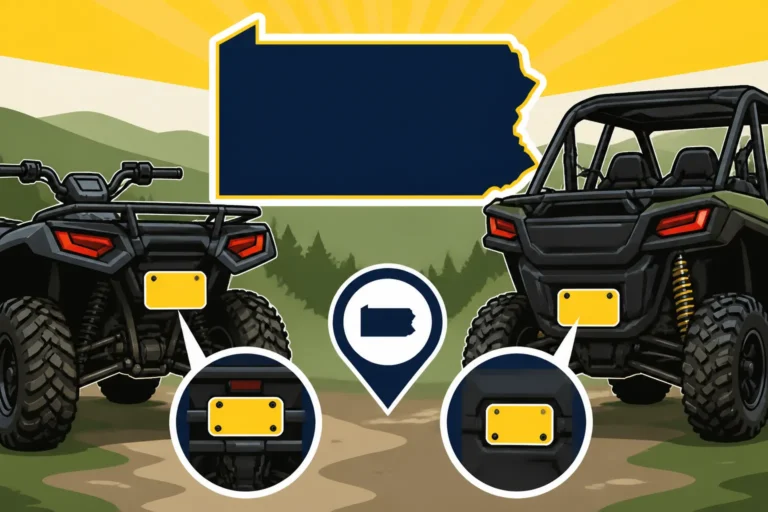
When a Pennsylvania Resident’s Quad Is Plated Elsewhere
It's incredibly frustrating when you're a Pennsylvania resident, you've got your ATV or UTV all set to hit the trails, but your machine is registered in another state. You might think, "Hey, it's registered, what's the big deal?" But Pennsylvania has its own rules, and they're pretty specific about where a resident's machine should be plated. This guide will clarify exactly why your out-of-state plate might cause problems and what you need to do to get your quad properly registered right here in the Keystone State.
The Core Problem: Why Pennsylvania Wants Its Own Plate
You're a resident of Pennsylvania. You pay your taxes here, you vote here, your mail comes here. It stands to reason that the state expects your vehicles, especially those designed for off-highway use within its borders, to be registered here too. It might seem like a bureaucratic headache, especially if you bought your ATV out-of-state or moved here recently, but there are solid reasons behind it. Pennsylvania's Department of Conservation and Natural Resources (DCNR) isn't just trying to make your life harder; they're trying to manage resources and maintain the trails we all love.
Understanding Pennsylvania's DCNR Authority
Unlike your car or truck, which is registered with PennDOT, your ATV or UTV falls under the watchful eye of the DCNR. This is a crucial distinction that often trips people up. PennDOT handles highway-legal vehicles, while DCNR is all about recreation and natural resources. When it comes to off-highway machines, DCNR is the authority. They manage the trails, enforce the rules, and collect the fees that directly fund the maintenance and expansion of our riding areas. So, when you're thinking about [Registering an ATV in Pennsylvania], remember it's DCNR, not PennDOT, you're dealing with. They have a vested interest in knowing which machines are operating on state lands and where those machines are primarily based.
If you live in Pennsylvania, the DCNR considers your state of residency to be the primary place where your ATV should be registered. This isn't just a suggestion; it's a fundamental principle of how they govern off-road vehicle use. They want to ensure that if you're utilizing Pennsylvania's resources and trails, you're also contributing to their upkeep through the registration process. This system is designed to create a clear, enforceable framework for who can ride where and under what conditions.
The "Primary Residence" Principle
The concept of "primary residence" is key here. If Pennsylvania is your home state, where you reside most of the time, then your ATV is expected to be registered in Pennsylvania. It doesn't matter if you have a vacation home in another state where you originally registered the quad, or if you simply found a better deal on registration fees across the border. For DCNR purposes, if your permanent address is in Pennsylvania, your off-highway vehicle should bear a Pennsylvania registration. This helps DCNR track machines, manage their impact on the environment, and ensure that all riders are playing by the same rules within state lines.
Imagine a situation where you bought an ATV from a dealer in Maryland because the sales tax seemed lower, and you registered it there. Now you're back home in Pennsylvania, wanting to ride the excellent trails in Sproul State Forest. A DCNR ranger at the trailhead isn't just checking for a plate; they're checking for a Pennsylvania plate, especially if they recognize your PA driver's license or other identifiers. They understand that exceptions exist for non-residents visiting, but if you're a PA resident, they expect to see a PA plate. This primary residence principle underpins much of Pennsylvania's ATV regulatory framework.
Trail Access and Funding
Beyond just legal compliance, your registration dollars play a direct role in keeping Pennsylvania's extensive ATV trail system open and well-maintained. When you register your ATV with DCNR, a portion of those fees goes into the Snowmobile and ATV Restricted Account. This fund is vital; it pays for trail grooming, signage, bridge repairs, land acquisition for new trails, and even educational programs. If you're riding a machine registered out-of-state as a Pennsylvania resident, those crucial funds aren't being directed back into the system you're using.
Think of it this way: the $20 you pay for a [Pennsylvania Two-Year ATV Registration] isn't just for a sticker; it's an investment in the trails. It means more miles of trail, better facilities, and safer riding conditions for everyone. The DCNR maintains that the people benefiting most directly from these resources should contribute to their sustainment. If every Pennsylvania resident decided to register their ATVs in neighboring states, the funding for our beautiful trail systems would quickly dry up, impacting everyone's ability to ride. This connection between registration and funding is a major reason [Why DCNR Registers Pennsylvania ATVs] in the first place.
Navigating Reciprocity and Its Limits
Many riders hear the term "reciprocity" and assume it means their out-of-state plate will always be valid in Pennsylvania, even if they live here. This is a common misunderstanding that can lead to disappointment and even fines. While reciprocity does exist, its scope is very specific and generally doesn't apply to Pennsylvania residents.
What Reciprocity Does and Doesn't Mean
Reciprocity, in the context of ATV registration, means that Pennsylvania may honor another state's registration for a limited time. The key word here is "may," and it almost exclusively applies to non-residents visiting Pennsylvania's trails. For example, if your cousin from Ohio comes to visit and wants to ride the Whiskey Springs trails with you, their Ohio-registered ATV would likely be recognized under reciprocal agreements, provided Ohio offers similar reciprocity to PA residents. They're visitors, not residents.
However, if you are a Pennsylvania resident, reciprocity is generally not extended to you. Your primary residence dictates where your machine should be registered. You cannot, as a PA resident, register your ATV in West Virginia, for example, and then expect Pennsylvania to honor that registration on its trails. The intent of reciprocity is to facilitate tourism and allow out-of-state riders to enjoy Pennsylvania's resources without having to re-register for every visit. It is not an loophole for residents to avoid registering their machines in their home state. This distinction is vital for understanding your obligations.
The Practical Implications of an Out-of-State Plate for a PA Resident
Riding in Pennsylvania with an out-of-state plate while being a resident here can lead to a host of practical problems, none of them fun. First and foremost, you risk being stopped by DCNR rangers or local law enforcement. They are trained to identify Pennsylvania residents and will likely question your out-of-state registration. This could happen during a routine check at a trailhead, like those at Bloody Skillet or Whiskey Springs, or even during a patrol on a designated ATV road.
If you're found to be a Pennsylvania resident operating a machine with an out-of-state plate, you could be cited for operating an unregistered ATV. This isn't a small slap on the wrist. [Pennsylvania Fines for an Unregistered ATV] can be substantial, often starting at $300, plus court costs. You might also find your machine impounded, putting a serious damper on your riding day and costing you extra fees to get it back. Furthermore, an out-of-state plate might complicate insurance claims if you have an accident here. Your insurer might argue that the machine was not properly registered according to your primary state of residence, potentially affecting coverage. It's simply not worth the risk.
Common Reasons for Out-of-State Registration (and Why They Don't Fly Here)
There are several common scenarios that lead Pennsylvania residents to register their ATVs in other states, often with good intentions or a misunderstanding of the rules. Unfortunately, none of these reasons typically hold water with DCNR:
- Buying out of state: You might have found a great deal on an ATV at a dealer just over the border in Ohio or Maryland. The dealer might have even handled the registration paperwork for you in their state. While that's fine for the initial purchase and transport, once the machine is permanently domiciled in Pennsylvania with a Pennsylvania resident, it needs PA registration.
- Lower sales tax or registration fees: Some riders try to save a few dollars by registering in a state with a lower sales tax rate or cheaper registration fees. Pennsylvania, however, still expects you to pay sales tax on the purchase if it wasn't paid elsewhere or wasn't equivalent. The registration fee is also a requirement for residents. Remember, these fees directly benefit PA trails.
- Previous residency: Perhaps you used to live in New York, registered your ATV there, and then moved to Pennsylvania. You simply kept the New York plate. Once you establish residency in Pennsylvania, you have a set period of time to re-register your vehicles here. Your old out-of-state registration becomes invalid for a PA resident.
- Ease of registration: Sometimes, the process in another state seems simpler or quicker. But no matter how easy it was to register in another state, Pennsylvania requires its residents to follow its own DCNR process.
These might seem like valid reasons from a personal finance or convenience perspective, but from the DCNR's viewpoint, they don't override the primary residence rule. If you're a resident, the expectation is that you obtain a [Pennsylvania's Limited and General Registrations] through the DCNR.
How to Correct Your ATV Registration in Pennsylvania
Okay, so you realize you need to get your ATV properly registered in Pennsylvania. It might feel like a hassle, especially if you've been riding with an out-of-state plate for a while, but the process is straightforward once you gather the right information. The goal is to move your machine from that out-of-state status to a legitimate Pennsylvania DCNR registration.
Gathering Your Documentation
The first step, as with any bureaucratic process, is to get all your ducks in a row when it comes to paperwork. This is particularly important if your machine is currently registered elsewhere, as you'll need to demonstrate ownership and proper transfer. Here's a checklist of what you'll typically need:
- Proof of Ownership: This is usually the vehicle's title. If the state where it was previously registered issued a title, you'll need that original document. If that state didn't issue titles for ATVs (some states don't), you'll need a bill of sale that clearly shows the purchase and transfer of ownership. A comprehensive bill of sale, perhaps generated using a service like LawDepot, can be crucial here, especially for private sales where original paperwork might be sparse. It should include the VIN, make, model, year, purchase price, and contact information for both buyer and seller.
- Proof of Pennsylvania Residency: A valid Pennsylvania driver's license or state ID card is typically sufficient.
- Proof of Sales Tax Paid: If you bought the ATV out-of-state, you'll need to show proof that you paid sales tax, either to that state or that you're prepared to pay the 6% Pennsylvania sales tax (plus any local taxes like the additional 1% in Allegheny County or 2% in Philadelphia) to DCNR upon registration.
- Form DCNR-43: This is the application for Pennsylvania ATV/UTV registration and titling. You can find this form on the DCNR website. Fill it out completely and accurately. This form asks for specific details about your machine and yourself, so take your time with it. [What Pennsylvania Asks on Form DCNR-43] includes information like your VIN, engine size, and intended use.
- VIN Verification: DCNR will need to verify the Vehicle Identification Number (VIN) of your ATV. This is often done by the DCNR office or an authorized agent. If your title or bill of sale clearly lists the VIN, that's a good start, but they will still likely want to visually confirm it. This helps prevent fraud and ensures the machine you're registering matches the paperwork. Having [VIN Proof for a Pennsylvania Registration] is non-negotiable.
Don't be afraid to call the DCNR Snowmobile and ATV Section if you have unique circumstances or are unsure about a specific document. It's always better to clarify upfront than to have your application rejected.
The DCNR Registration Process
Once you have all your documents ready, the actual registration process involves a few key steps:
- Complete DCNR-43: As mentioned, fill out the application form thoroughly. Double-check all fields for accuracy.
- Submit Documents and Fees: You'll submit your completed DCNR-43, proof of ownership, residency, and sales tax payment (or be prepared to pay it) along with the required fees. This typically includes the [Pennsylvania ATV Title Cost] and the [Pennsylvania ATV Registration Cost]. These fees are set by DCNR and contribute directly to the ATV Restricted Account. You can submit these in person at a DCNR office, through certain authorized dealers, or sometimes by mail.
- VIN Inspection (if required): Depending on how your machine was previously titled or if there are any discrepancies, a physical VIN inspection might be required. This could be done by DCNR personnel or a certified inspection mechanic.
- Receive Your New PA Plate and Wallet Card: Once your application is processed and approved, DCNR will issue you a Pennsylvania ATV plate and a wallet-sized registration card. The plate will need to be mounted in a visible location on your ATV, typically on the rear, and the wallet card should always be carried with you when riding. This card serves as your official proof of registration and insurance if required.
The process might take a few weeks, so plan ahead, especially if you're trying to get ready for a specific riding season. Don't wait until the week before Memorial Day weekend to start the process!
What if You Don't Have a Title?
This is a very common scenario for ATVs, especially if they were purchased in states that don't issue titles for off-road vehicles, or if it's an older machine. It can feel like a huge hurdle, but DCNR has a process for it.
If you don't have an original title, you'll need robust proof of ownership. A detailed bill of sale is paramount here. This document, which you can easily draft using templates from services like LawDepot, should explicitly state that the seller sold the ATV to you, include the full VIN, make, model, year, and the names, addresses, and signatures of both the buyer and seller. It's always a good idea to have this notarized if possible, as it adds a layer of authenticity.
DCNR will carefully review your submitted documentation to establish a chain of ownership. They might also require additional affidavits or statements if the ownership history is murky. In some cases, they may issue a "Certificate of Origin" if the manufacturer provided one, but if not, they can usually work with a solid bill of sale. It's critical that the VIN on your bill of sale matches the VIN on the machine perfectly. Any discrepancy can cause significant delays or even rejection. Providing as much supporting evidence as possible, such as old registration cards from the previous state, can also help your case. DCNR wants to ensure that the machine isn't stolen and that you are the rightful owner before issuing a Pennsylvania title and registration.
Consequences of Not Registering in Pennsylvania
Deciding to continue riding your ATV in Pennsylvania with an out-of-state plate, despite being a resident, is a gamble that's almost certainly not worth it. The DCNR takes unregistered ATV operation seriously, and the consequences can range from expensive fines to losing your riding privileges, and even impoundment of your machine. It's far better to invest the time and minimal fees into proper registration than to face these avoidable problems.
Fines and Legal Ramifications
The most immediate and common consequence of operating an unregistered ATV as a Pennsylvania resident is a significant fine. As mentioned, the penalty for an unregistered ATV often starts at $300 for a first offense, not including additional court costs and fees that can quickly push the total much higher. This isn't just a verbal warning; it's a citation that will require you to appear in court or pay the fine. Repeat offenses can lead to even steeper penalties, potentially including higher fines, suspension of riding privileges, or even more severe legal action.
Consider a hypothetical scenario: You're enjoying a beautiful fall day on the Potter County Trail, believing your out-of-state registration is sufficient. A DCNR ranger, performing routine checks, asks to see your registration and notes your Pennsylvania driver's license. When you present your out-of-state registration, the ranger explains that as a resident, you're required to have a Pennsylvania DCNR plate. You're then issued a citation, ruining your day and putting a significant dent in your wallet. The hassle of dealing with the court system and the financial hit far outweigh the modest [Pennsylvania ATV Registration Cost] you would have paid to register correctly.
Impoundment and Trail Access Denial
Beyond fines, one of the most immediate and frustrating consequences is the potential for your ATV to be impounded. If a DCNR ranger determines you are a Pennsylvania resident operating an unregistered machine, they have the authority to remove your ATV from the trail or road. This means your riding day is over, and you'll have to arrange for towing and pay impoundment fees to retrieve your machine, adding another layer of expense and inconvenience. Imagine being miles deep on a trail system, only to have your day abruptly ended and your quad hauled away.
Furthermore, being caught unregistered often results in immediate denial of trail access. You won't be allowed to continue riding, and if you're on a permitted trail system or a state forest, you'll be instructed to leave. Many riding areas, especially state-managed trails, have strict rules about registered machines, and rangers frequently perform [What a Ranger Checks at a Trailhead]. This also applies to parks like the Anthracite Outdoor Adventure Area or Rock Run Recreation, which will verify your registration before allowing you entry. If your machine isn't properly registered in PA as a resident, you simply won't be able to ride legally on most public or managed private lands in the state.
Insurance and Liability Concerns
Operating an unregistered ATV as a Pennsylvania resident also opens up a Pandora's Box of insurance and liability issues. Most ATV insurance policies require the machine to be legally registered and operated in accordance with state laws. If you're involved in an accident while riding an improperly registered ATV, your insurance company might deny your claim, arguing that you were operating the vehicle illegally. This could leave you personally responsible for damages, medical bills, and any legal fees, which could be financially devastating.
For example, if you collide with another rider on a trail and cause significant damage or injury, the other party's insurance company or attorney will immediately look for any reason to deny their client's fault or transfer liability. If your ATV is unregistered in Pennsylvania as a resident, it creates a clear legal vulnerability. You might find yourself facing lawsuits without the protection of your insurance policy. This is a critical risk that many riders overlook, but it's a stark reminder that proper registration isn't just about paying fees; it's about protecting yourself and your assets. Make sure your ATV is legitimately registered in Pennsylvania to ensure you're covered by your insurance when you're out enjoying the trails.
| Issue | Out-of-State Plate (PA Resident) | Pennsylvania DCNR Plate (PA Resident) |
|---|---|---|
| Legality in PA | Illegal – Subject to fines/impoundment | Legal – Compliant with state law |
| Trail Access | Denied on DCNR lands and most parks | Full access to DCNR lands and parks |
| Reciprocity Application | Does not apply to PA residents | Not applicable, as machine is PA-plated |
| Fines/Penalties | Automatic $300+ fine, impoundment | None for registration |
| Contribution to PA Trails | None through registration fees | Direct contribution to trail funding |
| Insurance Validity | Potentially jeopardized | Fully valid (assuming proper coverage) |
| Peace of Mind | High stress, constant worry | Low stress, confident riding |
Disclaimer
This article is for general informational purposes only and does not constitute professional advice. Laws, prices and regulations vary by location and change over time. Consult a qualified professional for guidance on your specific situation.