Moving Here With a Registered Machine
So, you've packed up your life, moved to the beautiful Commonwealth of Pennsylvania, and now you're finally settling into your new digs. Among the boxes and the new routines, you're probably thinking about your trusty ATV or UTV that made the journey with you. It's exhilarating to imagine hitting those fantastic Pennsylvania trails, but before you do, you need to navigate the state's unique system for registering off-highway vehicles. This guide will walk you through everything you need to know to get your previously registered machine properly plated and ready to ride in its new home.
The Initial Shock: Understanding Pennsylvania's Unique Registration System
Moving to a new state always comes with its share of learning curves, and Pennsylvania's system for ATVs and UTVs is often one of them for newcomers. It’s easy to assume things work like they do in your previous state, especially when it comes to vehicle registration, but that's not always the case here in the Keystone State. Many people arrive with a valid registration from their old home, only to discover that Pennsylvania operates a little differently.
Why Pennsylvania Doesn't Use PennDOT for ATVs
One of the biggest surprises for new Pennsylvania residents is learning that the Department of Transportation (PennDOT), which handles car and truck registrations, has absolutely nothing to do with your ATV or UTV. This can be a real head-scratcher if you're used to a unified system. Instead, the Pennsylvania Department of Conservation and Natural Resources (DCNR) is the governing body for all things related to off-highway vehicles. They're the ones you'll be dealing with to get your machine legal.
This distinction is crucial because it highlights Pennsylvania's approach to these machines. PennDOT's focus is on roadworthiness, safety on public highways, and traditional vehicle titling. DCNR, on the other hand, is primarily concerned with recreational use, environmental protection, and funding the vast network of state-designated trails that make Pennsylvania a fantastic place to ride. The DCNR oversees not just registration, but also trail management, safety regulations, and environmental impact. Understanding this fundamental difference is the first step in a smooth transition. You'll soon appreciate why this setup works for [Why DCNR Registers Pennsylvania ATVs] and means [Why PennDOT Does Not Register Pennsylvania ATVs] for your quad or side-by-side.
What "Registered Elsewhere" Means in Pennsylvania's Eyes
When you move to Pennsylvania, your existing ATV or UTV registration from another state might offer some very temporary relief, but it won't be sufficient in the long run. Pennsylvania does have a reciprocity agreement with some states, meaning that if you're a nonresident visiting Pennsylvania, your out-of-state registration might be honored. This allows visitors to enjoy Pennsylvania's trails without having to get a separate PA registration for short trips.
However, once you establish residency in Pennsylvania, that temporary arrangement changes. You are no longer considered a "nonresident visitor" but a "Pennsylvania resident," and as such, your machine needs to comply with Pennsylvania's full registration requirements. While the specific timeframe for when you must switch over isn't always explicitly stated as a hard deadline, the general expectation is that once you're a resident, your machine should be registered here. It's always best to make the change sooner rather than later to avoid any issues if you're ever stopped by a DCNR ranger or local law enforcement. For more details on this, you might look into [Do Nonresidents Need Pennsylvania ATV Registration?] and [Registering an Out-of-State Machine in Pennsylvania] to understand the nuances.
The Pennsylvania Residency Process for Your ATV/UTV
Now that you understand who handles ATV and UTV registration in Pennsylvania, let's get into the practical steps of how to convert your out-of-state registered machine into a fully legal, Pennsylvania-plated trail warrior. This process involves a bit of paperwork and a few decisions, but it's generally straightforward once you know what's required.
Gathering Your Ownership Documents
The first and most critical step is proving that the ATV or UTV you brought with you genuinely belongs to you. This might seem obvious, but states have different requirements for ownership documentation, and Pennsylvania is no exception. Ideally, you'll have a clean title from your previous state that clearly lists you as the owner. This is the gold standard and will make the process much smoother.
However, what if your previous state didn't issue titles for ATVs or UTVs, or perhaps you lost yours somewhere in the moving chaos? Don't panic. Pennsylvania DCNR understands that not all states operate identically. In such cases, you might be able to use a manufacturer's statement of origin (MSO), a detailed bill of sale, or even your old registration cards coupled with a notarized statement of ownership. The key is to provide as much verifiable documentation as possible to establish a clear chain of ownership. It's also worth noting that DCNR will require proof of sales tax payment if you purchased the machine within a certain timeframe, even if it was in another state, so keep those receipts handy. To understand the options for machines without traditional titles, see [Pennsylvania ATV Registration Without a Title]. Also, expect to provide [VIN Proof for a Pennsylvania Registration] as part of your application.
Deciding Between Limited and General Registration
Pennsylvania offers two distinct types of ATV/UTV registration, and as a new resident, you'll need to choose the one that best suits your riding habits. This choice is fundamental because it dictates where you can legally operate your machine. It’s not a one-size-fits-all solution, and picking the wrong one could limit your access or even lead to fines.
-
Limited Registration: This option is specifically for those who primarily plan to ride on their own private property or land where they have express permission. It's often chosen by landowners, farmers, or those who mainly use their machine for chores around a large property. The fees for limited registration are generally lower, reflecting its restricted use. If you envision most of your riding staying within the bounds of private land, then [Pennsylvania's Limited Registration for Your Own Land] might be the perfect fit for you. It's important to remember, however, that this registration type strictly limits where you can ride.
-
General Registration: If you're eager to explore Pennsylvania's extensive network of state forest and park trails, designated DCNR trails, or other public riding areas, then General Registration is what you need. This is the more common choice for recreational riders who want the freedom to roam. General registration comes with a slightly higher fee, as those funds directly contribute to the maintenance and expansion of the state's trail system. For most new residents looking to dive into the Pennsylvania ATV scene, [Pennsylvania's General Registration for Everywhere Else] is the way to go. You can find more comprehensive information on the differences in [Pennsylvania's Limited and General Registrations].
No matter which you choose, both registration types are valid for a two-year period before they need to be renewed. This long-term validity provides peace of mind, allowing you to focus on riding rather than frequent renewal paperwork.
Completing Form DCNR-43 and Associated Fees
Once you've gathered your ownership documents and decided on your registration type, the next step is to fill out the official DCNR-43 form, which is the application for ATV/UTV registration and titling. This form asks for all the pertinent details about you, the owner, and your machine. You'll need to provide your full name, address, contact information, and details about the ATV/UTV itself, including its make, model, year, and crucially, its Vehicle Identification Number (VIN). Accuracy is key here to avoid delays in processing. Double-check all numbers and spellings before submission. For a detailed breakdown of what to expect on this form, refer to [What Pennsylvania Asks on Form DCNR-43].
Along with the completed form, you'll need to submit the applicable fees. Pennsylvania requires a title fee for all ATVs and UTVs, which is a one-time cost associated with establishing legal ownership within the state. In addition to the title fee, there's the registration fee itself, which covers the two-year period your machine will be registered. As mentioned earlier, the registration fee differs based on whether you choose Limited or General registration. These fees contribute to the operational costs of the DCNR's Snowmobile and ATV Section and, in the case of general registration, directly to trail maintenance and development. Always check the current fee schedule on the DCNR website or contact them directly, as these figures can change. You can find more information on the structure of these costs in [Pennsylvania ATV Title Cost] and [Pennsylvania ATV Registration Cost]. Remember, your [Pennsylvania's Two-Year ATV Registration] will keep you riding for a good while.
What to Expect After You Apply
You've filled out the forms, paid the fees, and sent everything off to DCNR. Now comes the part where patience is a virtue. The DCNR processes a large volume of applications, especially during peak seasons, so it's important to have a realistic expectation of the timeline. Knowing what to look for and how to prepare can make this waiting period much less stressful.
The Waiting Game and Temporary Solutions
After submitting your application, DCNR will process your paperwork. The processing time can vary, but generally, it takes a few weeks for everything to be reviewed and completed. During this period, it's a good idea to keep copies of all the documents you submitted, including proof of payment. While you're waiting for your official registration to arrive, you might be wondering if there's any way to legally ride. Unfortunately, for private sales and direct applications, Pennsylvania does not issue temporary operating permits or "dealer stickers" for ATVs/UTVs in the same way PennDOT might for a car. The 45-day dealer sticker is specific to when you purchase from a registered PA dealer. This means you'll need to hold off on public trail riding until you receive your official plate and sticker.
This waiting period can feel like an eternity, especially if you're eager to explore your new state's trails. However, riding an unregistered machine on public or designated DCNR trails is illegal and can lead to significant fines. It's always best to be patient and wait for your official documents to arrive before hitting those trails. For more details on this, you can check [How Long Pennsylvania Takes to Process a Registration].
Displaying Your New Pennsylvania Registration
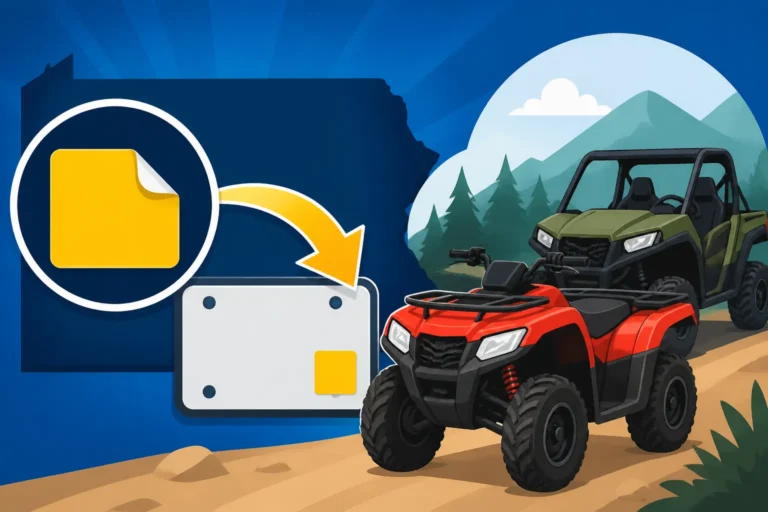
Once your application is approved, DCNR will mail you your official Pennsylvania ATV/UTV registration materials. This package typically includes three key items: your physical registration plate, the corresponding registration sticker, and a durable wallet card. Each piece serves an important purpose in proving your machine is legally registered in the Commonwealth.
The registration plate is a metal tag with a unique serial number that identifies your machine. It must be securely mounted on the rear of your ATV or UTV, typically on the grab bar or a designated mounting point. The key is visibility: it needs to be clearly readable from behind and kept free from mud or obstructions. The registration sticker is a small, colored decal that indicates the current validity period of your registration. This sticker must be affixed to a specific spot on your registration plate, usually in the upper right corner. It’s a quick visual cue for law enforcement or park rangers to confirm your registration is current. Finally, the wallet card is a compact, plasticized card that contains essential information about your machine and its registration. You are required to carry this card with you whenever you operate your ATV or UTV off your own private property. It's proof of registration that you can easily present if requested by an official. Make sure to keep it dry and safe. For specifics on placement, refer to [Where Pennsylvania Wants the Plate Mounted], [Where the Sticker Goes on the Plate], and [Why Both Pennsylvania Registrations Include a Wallet Card].
| Feature | Limited Registration (Private Land) | General Registration (Public/Designated Trails) |
|---|---|---|
| Primary Use | Private property, land you own or have permission to use. | State Forest/Park trails, DCNR-designated routes, public areas. |
| Cost (Registration) | Typically lower fees. | Slightly higher fees. |
| Plate Type | Specific plate design indicating Limited use. | Standard plate design. |
| Sticker Color | Distinct color to differentiate from General. | Standard color indicating General registration. |
| Trail Access | NOT permitted on DCNR trails or public riding areas. | PERMITTED on DCNR trails and most public riding areas. |
| Funding Contribution | Minimal contribution to state trail system. | Direct contribution to DCNR trail maintenance and development. |
| Validity Period | Two years. | Two years. |
You've made the move to Pennsylvania, and now your ATV or UTV is ready to join you in exploring all the natural beauty the state has to offer. By understanding Pennsylvania's unique DCNR registration process, gathering your documents, making the right registration choice, and completing the necessary forms, you’ve ensured your machine is fully compliant. Now, with your new Pennsylvania plate mounted and wallet card in hand, you’re all set to legally and safely enjoy the incredible riding opportunities that await you in your new home state!
Disclaimer
This article is for general informational purposes only and does not constitute professional advice. Laws, prices and regulations vary by location and change over time. Consult a qualified professional for guidance on your specific situation.