Does a Woodlot Quad Still Need a Plate?
It's a common scenario for folks here in Pennsylvania: you've got a quad, maybe an old reliable workhorse, and its primary job is helping out around your property, whether that's hauling firewood, checking fence lines, or just cruising your own little slice of heaven. You probably don't think much about things like registration and plates, especially if you never plan to hit a state trail. But the question of whether that "woodlot quad" needs a plate is actually more complex than you might think, and misunderstanding the rules can lead to some pretty hefty fines. This guide is going to clear up the confusion, explaining when and why your ATV might need to be registered, even if it rarely leaves your land.
Understanding Pennsylvania's ATV Registration Landscape
Pennsylvania has a very specific set of rules when it comes to ATVs and UTVs, and they're designed primarily for machines operating off of private property. It can feel a bit overwhelming, especially if you're just looking to enjoy your machine without a lot of bureaucratic hassle. The Pennsylvania Department of Conservation and Natural Resources (DCNR) is the agency that handles all this, not PennDOT, which often surprises people.
The Core Rules: When Registration is Required
At its heart, the DCNR requires ATVs and UTVs to be registered if they're going to be operated anywhere other than solely on your own private property. This is the absolute core principle. What does "solely on your own private property" truly mean? Well, that's where the nuances come in, and where many riders find themselves in a bind. If you plan to ride on state-designated trails, across private property with permission that isn't yours, or even just cross a public road, registration becomes a must.
The DCNR offers two main types of registration to cover these different scenarios: Limited Registration and General Registration. We'll dive into these specifics a bit later, but for now, just remember that the moment your wheels touch ground that isn't exclusively yours and not open to the public, you're likely entering registration territory. The state wants to know who's out there riding, not just for safety, but also to fund the very trails and programs that benefit riders. You can read more about [Why DCNR Registers Pennsylvania ATVs].
The Woodlot Scenario: Private Property vs. Public Access
Now, let's get right to the heart of the matter: your woodlot quad. You own a piece of land, maybe it's 10 acres, maybe it's 100, and you use your ATV to manage it. You figure, "It's my land, so I don't need a plate." This is a very common assumption, and often, it's correct. If your woodlot is truly self-contained, with no public roads, no shared access points, and you never leave its boundaries, then you generally don't need to register your ATV.
However, the definition of "solely on your own private property" is where people get tripped up. What if you have a deeded right-of-way that crosses a small, unpaved township road to get from one part of your woodlot to another? What if your woodlot borders state game lands or a state forest, and you occasionally need to access it via a public access point? These seemingly small situations can quickly pull your "woodlot quad" into the realm of requiring registration. The state distinguishes between your purely private, isolated land and any property that might be open for public use or require crossing public thoroughfares. It's about preventing unregistered machines from mixing with public areas, even briefly.
What "Private Land" Really Means for ATV Registration in Pennsylvania
The term "private land" sounds simple enough, doesn't it? But when it comes to Pennsylvania ATV registration, the DCNR has a very specific interpretation, and it's vital to understand the distinctions to avoid any legal headaches. Many riders mistakenly believe that as long as they're not on a state trail, they're in the clear. Unfortunately, the reality can be much more nuanced.
Your Own Property: The True Exemption
The clearest exemption from registration is when you operate your ATV solely on land that you own, lease, or have explicit, exclusive permission to use, and that land is not accessible or open to the public. Think of it as a completely closed system. If your woodlot is fully enclosed, perhaps bordered by other private properties, and you never need to touch a public road, shared driveway, or designated easement that leads to public access, then yes, your quad generally does not need to be registered. This applies whether it's a small backyard or a vast expanse of forest. The key is that it's exclusively yours and exclusively private in its use.
This is the scenario where the "woodlot quad" truly lives up to its unregistered potential. You use it for chores, for hunting access within your own boundaries, or simply for recreational riding on your private trails. No public interaction means no state requirement for registration. However, a lot of properties in Pennsylvania aren't quite so perfectly isolated.
Shared Access, Easements, and Neighboring Properties
Here's where it gets tricky. Many rural properties, including woodlots, might have shared driveways, utility easements, or even a public road frontage that's technically part of your deed but still considered public access. If your woodlot requires you to drive even a short distance on a shared access road that's also used by neighbors, or if there's a utility easement running through your property that the public (like utility workers) might use, the DCNR might view this as your machine operating in an area that isn't solely private.
Consider a situation where your woodlot is accessible via a long, gravel lane. If that lane is strictly private and only serves your property, you're likely fine. But if it's a shared lane with a few other landowners, or if it's also a public township road, even an unmaintained one, then suddenly your ATV's operation is no longer entirely on your exclusive private property. Even if you have permission to ride on a neighbor's property, if that neighbor's property isn't completely isolated from public access, or if you have to cross a public right-of-way to get there, you're no longer meeting the "solely on your own private property" clause for exemption. When dealing with complex land access, ensuring you have clear documentation, perhaps through legal forms from a service like LawDepot, can be helpful in defining permissions and boundaries.
The Slippery Slope: Brief Public Road Crossings
This is perhaps the most common trap for woodlot quad owners. You might have a large property, but to get from the lower section to the upper section, you need to quickly zip across a township road for 50 feet. "It's just 50 feet!" you might think. But that's 50 feet on a public thoroughfare, and in Pennsylvania, that's enough to trigger the need for registration. The moment your ATV's tires hit a public road, even if it's just to cross it at a ninety-degree angle to access another part of your property, you're technically required to be registered.
This can feel unfair, especially if you rarely leave your land, but the law is pretty clear on this point. The DCNR wants to ensure that any machine interacting with public infrastructure, no matter how briefly, is accounted for. This includes even small, unpaved township roads that feel more like private lanes. If you ride on a public road, even a little bit, you'll need at least a General Registration, and possibly insurance. You can learn more about [Crossing a Highway on an ATV in Pennsylvania] and [Pennsylvania's Designated ATV Roads] for designated routes.
Navigating Registration: Limited vs. General for Your Woodlot Quad
Understanding the specific scenarios that trigger registration is the first step. The next is knowing which type of registration applies to your "woodlot quad." Pennsylvania offers two distinct categories, each designed for different levels of public access. It’s crucial to pick the right one, because choosing incorrectly can still lead to fines, even if you thought you were compliant.
[Pennsylvania's Limited Registration for Your Own Land]
Limited Registration is designed for exactly what its name implies: limited use. This registration is absolutely free and is intended for ATVs and UTVs that are operated primarily on the owner’s private land but might occasionally need to cross a public road, or for those who ride on private land that is specifically authorized for limited public use. The critical point here is that a Limited Registration does not permit you to ride on state forest trails, state game lands, or any other public trail system designated for General Registration.
So, if your woodlot quad fits the bill of only needing to briefly cross a public road to get to another section of your property, or if you only ride on your own property and perhaps a neighbor's adjacent private land (with permission), then Limited Registration is probably what you need. It provides you with a special plate – [The Plate Pennsylvania Gives Limited Registrants] – which distinguishes your machine as being registered for these specific, limited scenarios. This plate signals to law enforcement that your machine is recognized by the state for these minimal public interactions, granting you that critical legal pass for road crossings.
[Pennsylvania's General Registration for Everywhere Else]
If your plans for your woodlot quad extend beyond your purely private land, then General Registration is what you'll need. This is the standard registration for any ATV or UTV that will be ridden on designated state forest trails, approved municipal trails, commercial parks like the AOAA or Rock Run Recreation Area, or even just regularly on private land that isn't yours (with permission) where public access points are involved. Unlike Limited Registration, General Registration comes with a fee, currently [Pennsylvania General Registration Cost] for a two-year period.
A woodlot quad might require General Registration if, for example, you decide to take it to a friend's hunting camp which requires you to drive a few miles on township roads, or if you occasionally want to venture out to nearby state forest trails. Even if 90% of your riding is on your woodlot, that other 10% on public or public-access lands will necessitate General Registration. This registration provides you with a different type of plate and a sticker to affix to it, signaling full compliance for broader access.
Making the Right Choice: Factors to Consider
Deciding between Limited and General Registration for your woodlot quad really boils down to your riding habits and future intentions. Here are some factors to weigh:
- Purely Private Use? If your machine genuinely never leaves your own land, and your land has no public roads, shared easements, or public access points, you might not need any registration at all.
- Occasional Public Road Crossings? If you need to cross a township road, even for a very short distance, to connect two parts of your property, Limited Registration is your likely answer. It provides the legal coverage for those essential, brief moments on public land.
- Venturing to Other Trails or Properties? If you plan to ride on state forest trails, municipal trails, or regularly on other private lands that require using public roads to get there, then General Registration is the only safe option.
- Future Plans? Even if you're only on your woodlot now, think about what you might want to do in the next year or two. If there's a chance you'll want to explore state trails or join friends on a group ride, it's often easier to just get General Registration from the start.
Ultimately, choosing the right registration is about understanding your exact usage patterns and making sure you're compliant. Don't assume. If you're buying a quad privately, make sure you get a proper bill of sale; LawDepot offers templates that can help ensure you have all the necessary documentation for your records, even if it's not directly for registration.
What Happens If You Don't Register Your Woodlot Quad Properly?
It's tempting to think that because you're mostly on your own land, the rules don't really apply, or that the chances of getting caught are slim. But playing fast and loose with Pennsylvania's ATV registration laws can lead to some genuinely unpleasant consequences, and they're often more expensive and inconvenient than simply getting the proper plate in the first place.
The Risk of Riding Unregistered
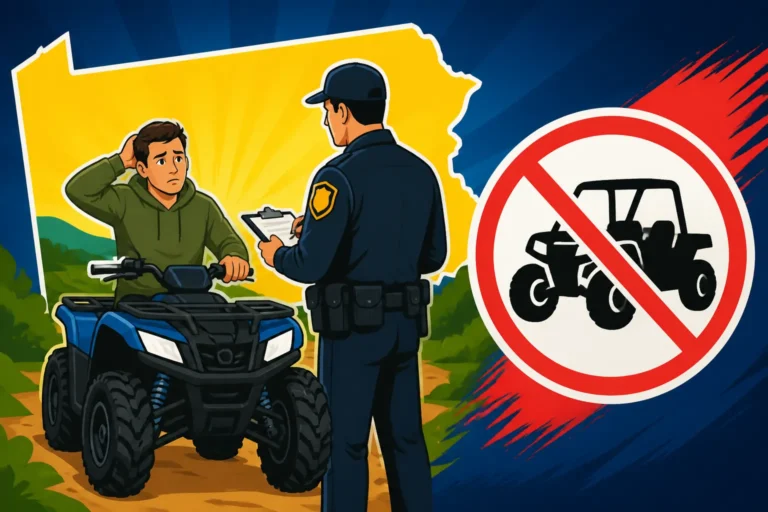
The most immediate and impactful consequence of riding an unregistered ATV off your own, truly private land is a hefty fine. Pennsylvania law is quite clear: operating an unregistered ATV on land where registration is required, even if it's just a quick hop across a public road, carries significant penalties. You're not just looking at a slap on the wrist. [Pennsylvania Fines for an Unregistered ATV] are serious.
Specifically, there's an automatic minimum fine of $300 for riding an unregistered ATV where one is required. This isn't a "maybe" fine; it's practically a certainty if you're caught. That $300 fine can quickly be compounded by additional costs, such as "cost of prosecution," which can add administrative fees and court costs on top of the initial penalty. Suddenly, that quick ride across the road to check your back forty becomes a very expensive lesson. This financial hit alone should be a strong motivator to ensure your woodlot quad is properly registered. You can read more about [Riding Unregistered Brings an Automatic $300 Fine].
Enforcement on Rural Roads and Trailheads
You might think that DCNR rangers or local law enforcement are only looking for unregistered machines on state trails. While those are certainly prime locations for enforcement, don't underestimate their presence or vigilance in more rural areas. Officers frequently patrol back roads, township roads, and areas bordering public lands. It's not uncommon for them to observe ATVs crossing roads, entering or exiting properties near public access points, or even being trailered down a rural highway.
If an officer observes you operating an unregistered ATV on any stretch of public road, even if it's just to cross, they are within their rights to stop you and issue a citation. They aren't going to differentiate between a joyride and someone genuinely trying to get from one part of their property to another. The law is about whether the machine is registered for that specific use on that specific piece of ground. Even if you're deep in your woodlot, but accessed it via a short public road crossing, you could still be cited if the machine isn't registered.
Best Practices for Peace of Mind
To truly have peace of mind with your woodlot quad, especially if it ever touches public ground, here are some best practices:
- Understand Your Property Lines: Be absolutely sure of where your property begins and ends, and identify any public roads, shared easements, or rights-of-way that might intersect or border it.
- Choose the Right Registration: If there's any doubt, or if you ever cross public land, opt for at least a Limited Registration. If you plan to expand your riding, get General Registration. It's a small investment for significant protection.
- Carry Documentation: Always have your registration card (the DCNR wallet card) with you when riding, even on your own land if it's registered. It proves you're legal. For private land use, having your deed or a clear land-use agreement can be helpful if questions arise. If you're selling or buying a quad privately, make sure you use a proper bill of sale. LawDepot can assist with generating professional and legally sound documents for such transactions, ensuring clear proof of ownership and purchase.
- Educate Yourself: Stay up-to-date on DCNR regulations, as they can occasionally change. The DCNR website is an excellent resource for current information.
Ignoring registration rules is a gamble that rarely pays off in the long run. The financial penalties and potential legal hassles far outweigh the convenience of not registering your ATV.
Registration Types for Pennsylvania ATVs
To help you decide which registration is right for your woodlot quad, or any ATV you own in Pennsylvania, here's a quick comparison of the two main types offered by the DCNR.
| Feature | Limited Registration | General Registration |
|---|---|---|
| Cost | Free | [Pennsylvania General Registration Cost] for two years |
| Purpose | Primarily private land use with limited public road crossings for access. | Public trails (state forests, municipal, private parks) and extensive road use. |
| Where You Can Ride | Your own private land (exclusively private), other private land with permission (if not open to the public), brief public road crossings for access. | All legal ATV trails in Pennsylvania (state, municipal, private parks), public roads designated for ATV use, private land with permission. |
| Plate Type | Special plate indicating "Limited Use." [The Plate Pennsylvania Gives Limited Registrants] | Standard ATV registration plate with a yearly sticker. |
| Insurance Required? | Not explicitly by DCNR for the registration itself, but always recommended for liability. | Mandatory if riding off your own land. |
| Who Needs It? | Woodlot owners who only cross public roads briefly, farmers using quads for agricultural work primarily on their land, those who never leave private property but cross a short public access point. | Anyone riding state trails, private parks, or frequently using public roads/access points. |
| Renewal Cycle | Two years, similar to General, but still free. | Two years, with associated fee. |
| Transferable? | Yes, can be transferred upon sale. | Yes, can be transferred upon sale. |
This comparison should give you a clearer picture of which registration best fits your needs, especially as a woodlot owner. The cost difference is significant, but the access and legal permissions associated with General Registration are often well worth it for anyone planning to venture beyond their own gates.
If you own a woodlot quad, you absolutely need to understand the nuances of Pennsylvania's ATV registration laws. While riding solely on your truly private, isolated property means you likely don't need a plate, any interaction with public roads—even just a quick hop across a township lane—or access points means you need at least a Limited Registration. If you have aspirations to hit state trails or frequently visit other private properties via public routes, General Registration is your ticket. Don't risk a hefty fine by assuming; take the time to figure out what's required for your specific situation. It’s far better to be safe, compliant, and enjoy your machine without worry than to face the penalties of an unregistered ride.
Disclaimer
This article is for general informational purposes only and does not constitute professional advice. Laws, prices and regulations vary by location and change over time. Consult a qualified professional for guidance on your specific situation.