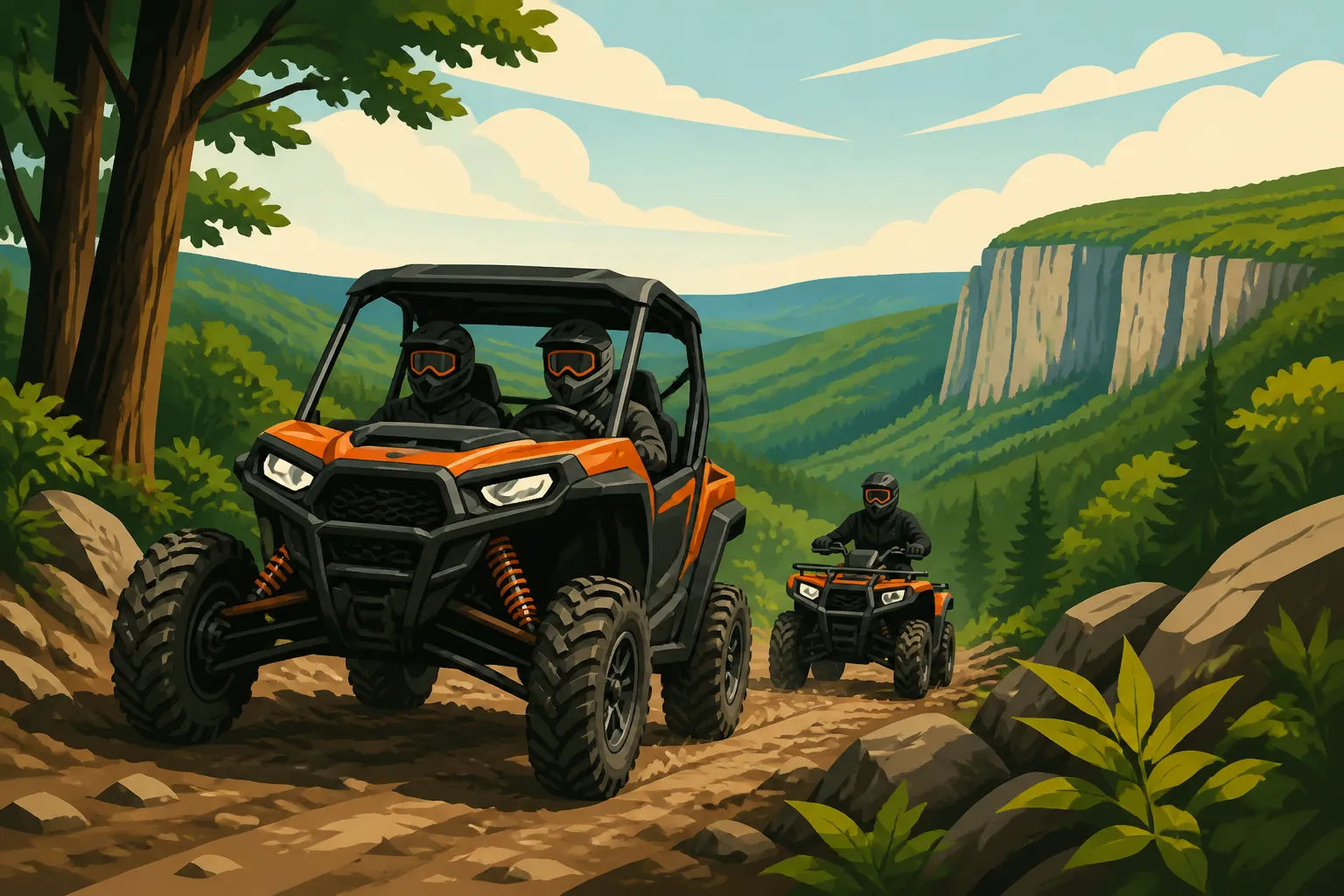
The Potter County Trail in Pennsylvania
The Potter County Trail offers a chance to ride a designated ATV route through Pennsylvania’s northcentral forest country, but a good day depends on more than finding the trailhead. Permit requirements, seasonal openings, machine width, weather, and navigation can all affect your plans. This guide explains how to prepare, what to expect, and where to verify details before you unload.
Understanding the Potter County Trail
Where the trail fits into Pennsylvania’s riding network
The Potter County Trail is a designated ATV route in the Susquehannock State Forest, a large forested area in northcentral Pennsylvania. The surrounding region is known for wooded ridges, remote roads, and small communities such as Coudersport and Galeton. That setting is part of the appeal, but it also means you should plan ahead: services and cell coverage may be limited once you leave town or reach a trailhead.
This is a specific state forest riding opportunity, not permission to ride any forest road or unmarked path you happen to see. Pennsylvania restricts motorized riding to routes and areas open to the vehicle and use in question. A forest road that looks inviting on a map may be closed to ATVs, reserved for other traffic, or subject to seasonal restrictions. Start with the official forest trail map and follow posted signs on the ground.
If you are comparing this route with other public riding options, remember that each area has its own layout, season, and access rules. [Where to Ride an ATV in Pennsylvania] provides broader context, while [Pennsylvania State Forest Trails] helps distinguish designated state forest routes from private riding parks and other trail systems.
What to expect from a forest-trail ride
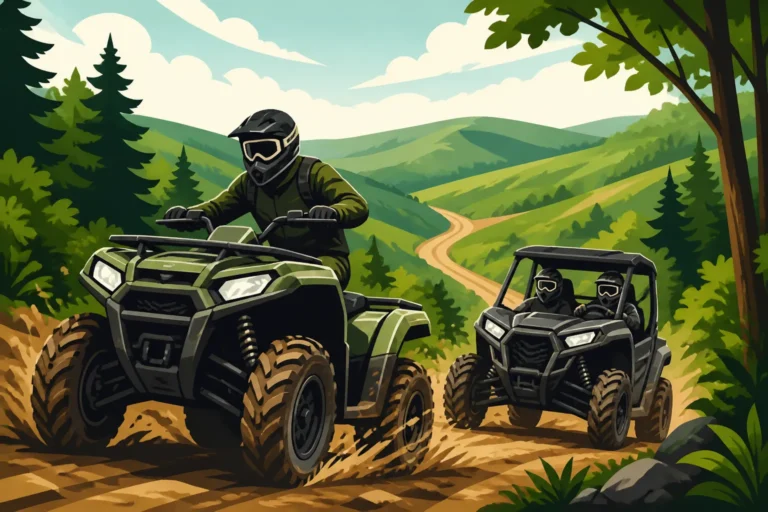
A ride here is best approached as a day outdoors in a working forest, rather than as a managed off-road park with a dense network of marked loops and facilities. Conditions can vary with rain, wind, maintenance work, and the time of year. A route that feels straightforward in dry weather may become slower or more demanding after a storm, especially where water, loose stone, or rough surfaces affect traction.
For that reason, set expectations around the kind of ride your group wants. A family looking for a relaxed outing may prefer to ride conservatively, take breaks, and turn around before fatigue sets in. Experienced riders may be comfortable with a more rugged surface, but should still stay on the designated route and avoid treating a difficult section as an invitation to bypass it through the woods.
A mapping app such as onX Offroad can be useful as a planning aid, particularly when you want to review the broader area before leaving home. Treat it as a supplement, not as proof that a road or trail is open to ATVs. Cross-check the route with official maps and signs; a digital line on a screen cannot tell you whether a closure has been posted or a trail condition has changed.
Permits, registration, and access
The difference between ATV registration and a trail permit
Pennsylvania ATV registration and a state forest trail permit are separate things. Registration concerns the machine and its eligibility to be operated under Pennsylvania’s ATV rules. A trail permit concerns access to particular designated state forest trails. Holding one does not automatically mean you have the other, and neither should be confused with permission to ride on private property.
The Potter County Trail is part of the northcentral state forest riding area. Riders planning to use designated trails in the relevant counties should review the requirements for the [Pennsylvania's Northcentral Regional Trail Permit] and confirm whether the permit covers the route they intend to ride. The permit system applies to specified trails, not every road or trail in Potter County.
Before leaving, check that your registration and permit are valid, that any required proof is with you, and that the permit is displayed as directed. Keep documents protected from mud and rain, but accessible if a ranger or officer asks to see them. A secure wallet or document holder can help prevent the familiar end-of-day problem of discovering that paperwork has soaked through a pocket.
Checking the route and permit before you unload
Do not assume that buying or carrying a permit guarantees every part of a planned ride is open. Forest routes can be subject to seasonal operating windows, maintenance closures, weather-related restrictions, or other posted limits. Confirm the current trail status and permitted access before driving a long distance with a trailer. If the route is closed, a nearby road is not necessarily an authorized substitute.
A useful pre-trip check is to identify the official trail name, locate its authorized access point, confirm that your permit applies, and read any notices about closures or operating dates. [Riding Potter County on the Permit] is a relevant starting point for understanding the permit’s relationship to this county’s riding. For map details, consult [Pennsylvania Trail Maps From DCNR] and compare the information with signs at the trailhead.
Mapping tools can help you orient yourself, but use them carefully. If you use onX Offroad, save the map information you need before traveling into an area where mobile data may be unreliable. Then compare your planned route with official information and posted trail markers. The best use of a digital map is to reduce confusion—not to override a gate, a closure notice, or a sign that says a route is not open to ATVs.
| Planning question | What to check | Why it matters |
|---|---|---|
| Is my machine registered? | Valid Pennsylvania registration or applicable documentation | Registration and trail access are separate requirements |
| Do I need a trail permit? | Permit rules for the designated state forest route | A permit may apply to specific trails rather than every forest road |
| Is the trail open? | Official notices, seasonal information, and posted signs | Closures and operating windows can affect your planned ride |
| Is my machine suitable? | Width, condition, and trail restrictions | A machine may be too wide or poorly suited to the route |
| Can I navigate without cell service? | Official maps and saved offline information | Remote areas may have limited or no reception |
Choosing a machine and preparing for trail conditions
Check width and vehicle suitability
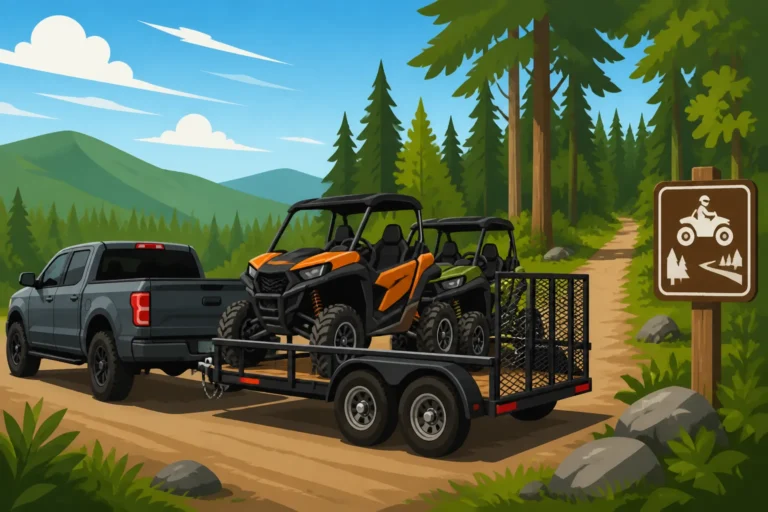
Before taking a quad or side-by-side to a state forest trail, verify the machine’s measurements against the applicable restrictions. A UTV can feel compact in a driveway and still be too wide for a trail system with a vehicle-width limit. Measure the actual machine at its widest point, including accessories that affect width, rather than relying only on the model name or a dealer’s general description.
Pennsylvania’s Class II trail rules include a width limit. Review [Pennsylvania's Class II Trail Width Limit] before you travel, and check the current trail information for any machine-specific restrictions. If you are still shopping for a side-by-side, make the trail’s limits part of the decision instead of assuming a larger rig will fit everywhere you want to ride. [Buying a Machine Too Wide for the Trail You Want] explores why that choice can create frustrating limitations later.
The right machine is not only one that fits. It should also be in sound mechanical condition and appropriate for the people riding it. Check tires, brakes, steering, lights, fluids, and any equipment required for your vehicle and route. For a side-by-side, inspect the restraints and ensure each occupant has suitable protective gear. A minor mechanical problem can become a much bigger issue when you are far from a road or repair shop.
Adjust your plans to weather and trail conditions
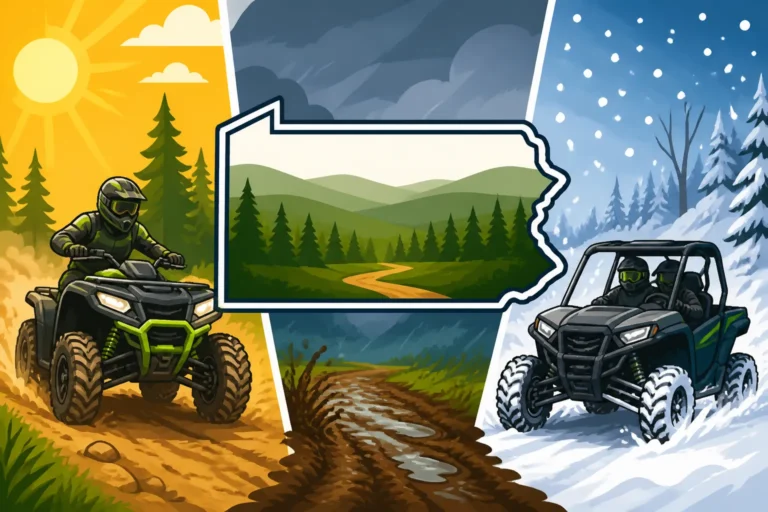
Rain changes more than the surface under your tires. It can make rocks slick, soften soil, reduce visibility, and increase the chance of rutting or trail damage. After heavy rain, a route may be slower or more challenging than it appeared during a dry-weather visit. If conditions look poor, postpone the ride rather than trying to force a full day into a narrow weather window.
Pay attention to how your group is coping as the ride progresses. A rider who is tired, cold, or uneasy may make poorer decisions, especially on uneven ground. Keep a comfortable pace, leave room between machines, and stop somewhere safe if visibility or traction becomes a concern. Turning back early can be the sensible choice, not a failure to finish.
Check [Pennsylvania Trail Conditions Before You Go] and [Pennsylvania Trails After Heavy Rain] when planning around unsettled weather. A mapping app such as onX Offroad can help you keep your bearings when you have prepared the map ahead of time, but it cannot replace local closure information or a careful look at conditions. If signs, gates, or forest staff indicate that a route is closed, follow that direction even if your map still shows a line.
Planning a safe and enjoyable ride
Build a practical day plan
A smooth trip begins before the trailer is hitched. Confirm the trail’s access point, expected riding window, and permit requirements. Decide how far your group is comfortable traveling, where you will stop, and what you will do if someone becomes tired or a machine develops a problem. Tell someone who is not riding where you plan to go and when you expect to return.
Pack for a remote outdoor outing, not just the time you expect to spend on the machine. Bring water, food, suitable clothing, basic first-aid supplies, and tools appropriate for your vehicle. Carry a charged phone, but do not assume it will work everywhere. A paper map or saved map information can be reassuring if service drops or a device battery runs down.
If this is your first visit, keep the first ride flexible. You may need extra time to find the correct access point, read signs, get your group organized, or sort out gear. Avoid scheduling the day so tightly that a small delay turns into pressure to ride faster or ignore a closure. A slower start is usually better than a rushed one on an unfamiliar trail.
Ride courteously and protect the route
Stay on the designated trail, obey posted signs, and avoid creating new tracks around wet or rough sections. Riding around an obstacle can widen the disturbed area and damage vegetation. If a section looks unsafe or impassable, stop and assess the situation rather than cutting through the woods or onto an unauthorized road.
On narrow trails, courteous spacing and predictable riding make a real difference. Leave room for the machine ahead, slow down where sightlines are limited, and be ready to encounter another rider, a maintenance vehicle, or other forest users. [Pennsylvania Trail Etiquette on Narrow Trails] offers useful habits for sharing a route without making a close encounter more stressful than it needs to be.
Take your rubbish with you, and leave gates, signs, and trail structures as you found them. A clean, undamaged trail is better for everyone and helps protect continued access. If you notice a hazard or damage, report it through an appropriate forest or trail contact rather than attempting an unauthorized repair yourself.
Frequently asked questions about the Potter County Trail
Is the Potter County Trail suitable for beginners?
It may be a reasonable outing for a beginner who is comfortable operating the machine and has prepared for a forest setting, but “beginner-friendly” depends on current trail conditions, the rider’s skills, and the vehicle. A new rider should not assume every section will be smooth or that help will be nearby. Review the route information, start conservatively, and ride with someone experienced if possible.
For a first trip, consider whether the group can stop, turn around, or shorten the day without pressure. A rider who is learning may benefit from practicing basic control in a safe, permitted area before tackling a longer forest outing. [Pennsylvania Trails for Beginners] can help you compare options and think through what makes a route manageable for newer riders.
Children and teens require extra planning. Follow Pennsylvania’s age-related rules, safety requirements, and supervision expectations for the setting. Choose a machine suited to the young rider and avoid assuming that an adult-sized quad is appropriate simply because the child can reach the controls. The goal is a ride that feels controlled and enjoyable, not one that asks a new rider to keep up with a faster group.
Can I rely on a phone map to find the trail?
A phone map is helpful, but it should not be your only navigation plan. Mobile coverage can be inconsistent in remote forest areas, batteries drain faster in cold weather, and digital maps may not show a newly posted closure. Download or save the information you expect to need before you leave service, and carry an official map or another backup where practical.
Use maps to confirm your general location and understand the approach, then follow the official markers and signs. If the app route conflicts with a posted sign, do not follow the app onto a closed or unauthorized road. This applies whether you use onX Offroad or another navigation tool. Digital mapping is most useful when it supports good judgment rather than replacing it.
If your group splits up, decide in advance where to regroup and what to do if someone loses contact. Avoid sending a rider ahead to “find the way” without a clear plan. In a forest setting, staying together and making decisions as a group is usually safer and less stressful than trying to reconnect after the route becomes confusing.
What should I confirm on the day of the ride?
Confirm that the trail is open, your permit is valid for the intended route, your machine meets the relevant restrictions, and you know where you are supposed to enter. Check weather and any closure notices before departure. At the trailhead, read posted information again, since signs can provide details that were not available when you planned the trip.
Also make a quick mechanical and gear check. Verify that tires are in good shape, brakes work properly, and any required protective equipment is ready. Keep registration and permit information accessible, and make sure everyone in your group knows the basic plan, including the expected return time and what to do if a machine has trouble.
Finally, be willing to change plans. If the access point is closed, weather has made the route unsuitable, or the group is not prepared for the conditions, choose another legal activity or come back another day. That can feel disappointing after a long drive, but it is better than turning a recreational ride into an avoidable safety or trail-access problem.
Disclaimer
This article is for general informational purposes only and does not constitute professional advice. Laws, prices and regulations vary by location and change over time. Consult a qualified professional for guidance on your specific situation.