Bloody Skillet’s 38 Miles
Bloody Skillet’s 38 miles can look like a straightforward day ride on a map, but the real experience depends on seasonal access, trail conditions, machine fit, and where you choose to start. This guide explains how to plan a safer, less stressful visit near Snow Shoe, Pennsylvania, from checking access and choosing a route to packing for a full day on the trails.
What to expect at Bloody Skillet
A trail network, not one continuous loop
Bloody Skillet is a seasonal ATV trail network in Moshannon State Forest in Centre County, near Snow Shoe. The commonly listed 38 miles describe the riding area, not necessarily one marked loop that every visitor can complete in a single outing. You may spend part of the day linking trails, backtracking, or returning to your starting point, depending on which sections are open and where you park.
That distinction matters when you’re planning around daylight, fuel, a child’s attention span, or a group with different riding speeds. A route that looks short on a phone screen can take longer than expected when the surface is rocky, the trail narrows, or you stop to let faster riders pass. Choose a conservative first route rather than assuming the mileage will translate neatly into a quick lap.
The name is familiar to many riders in central Pennsylvania, but don’t let familiarity replace a current map. Trail access, closures, and staging details can change. Start with [Pennsylvania Trail Maps From DCNR] and check the information available for the Bloody Skillet system before loading the machines.
Terrain and pace
Expect a forest riding experience rather than a groomed, predictable park loop. Trail surfaces can vary across a network: one section may feel smooth and flowing, while another may be rougher, rockier, or narrower. Rain and thaw can make conditions more challenging, and a trail that was comfortable on a dry day may be slower or slick after wet weather.
For newer riders, the key is to leave room for the terrain to dictate your pace. Don’t feel pressured to keep up with a group that knows the area or rides a more capable machine. Stop in a safe place to regroup, give each rider time to handle obstacles, and keep enough distance to react if someone brakes or takes a different line.
A practical first visit is about learning the system, not covering every mile. If the group finishes early, you can decide whether everyone has the energy and daylight for another section. If not, you’ve still had a good ride and learned which parts of the area you’d like to explore next time.
Plan access before you leave home
Confirm opening status and riding requirements
Bloody Skillet is not a year-round, ride-whenever-you-arrive destination. Pennsylvania’s state forest ATV trails can have seasonal operating windows and temporary closures. Spring thaw, trail work, weather damage, and other management needs can affect access, so a trail that appears on an old map may not be open on the day you visit.
Before heading out, confirm the current trail status and any posted requirements for Bloody Skillet. Check whether your machine needs Pennsylvania registration, whether proof of insurance is required for your riding situation, and whether a separate trail permit applies to the specific network. Requirements can differ among Pennsylvania trail systems, so don’t assume that a permit or registration used elsewhere automatically covers this ride.
It’s worth checking again close to departure, especially after heavy rain or during spring conditions. A quick look at [Pennsylvania Trail Conditions Before You Go] can help you build the habit of checking for closures rather than relying on a friend’s report from an earlier weekend.
Choose a suitable machine and confirm its width
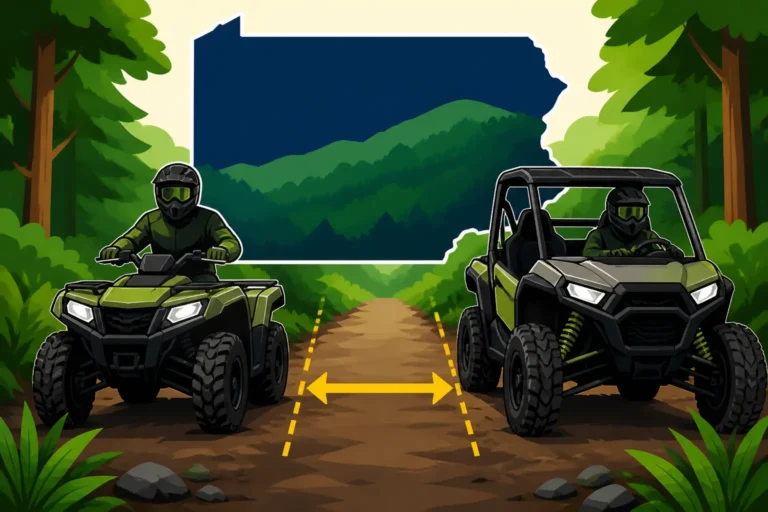
Before you tow to the trailhead, check the machine’s width and weight against the rules for the trail system. Pennsylvania state forest trails have size and equipment limits. In particular, the 64-inch width limit is important for many Class II machines. A side-by-side that works well on private land or at a pay-to-ride park may be too wide for a state forest trail.
Measure the widest point of the vehicle, including accessories that extend beyond the body. Mirrors, aftermarket wheels, or other add-ons can make a close measurement less reassuring than it first appears. Review [Pennsylvania's 64-Inch Width Limit] and verify the machine’s actual dimensions rather than relying only on a model name or brochure description.
A quick fit check can prevent an expensive and frustrating day. Imagine reaching the trailhead with a large UTV, only to discover that its width makes it ineligible for the route you planned. If you’re choosing a machine specifically for Pennsylvania trail riding, compare its dimensions with the rules before buying, not after the trailer is already packed.
| Planning question | What to check | Why it matters |
|---|---|---|
| Is the trail open? | Seasonal dates, temporary closures, and posted notices | An open-looking trail on an old map may be closed |
| Is the machine eligible? | Width, weight, and applicable vehicle class rules | Some machines may not fit the trail’s limits |
| Is the paperwork ready? | Registration, insurance proof, and any required permit | Requirements can differ between trail systems |
| Where will you stage? | Current trailhead directions and parking guidance | A suitable riding route is less useful if you cannot park safely |
| How long is the ride? | Route distance, daylight, fuel, and group pace | Listed network mileage is not the same as a single easy loop |
Build a route that suits your group
Start with a realistic first-day plan
If it’s your first visit, make the goal a comfortable orientation ride. Pick a starting point, identify a route that gives the group a clear return plan, and leave time to pause and check the map. A route that lets you turn around or retrace your path is often less stressful than trying to connect unfamiliar trails into a complicated circuit.
Agree on a few simple group rules before the first machine starts. Decide who leads, who rides at the back, and where you’ll stop if someone gets separated. Make sure everyone knows that the group will wait at safe junctions rather than continuing ahead because one rider has fallen behind.
Try to keep the plan flexible. If the trail is rougher than expected, the group is tired, or the weather changes, turn back while you still have enough daylight and fuel. Nobody needs to prove they can ride the entire network on their first trip.
Use maps without relying on a phone signal
A phone map can be useful for understanding the larger area, but don’t count on a strong signal or a fully charged battery throughout a forest ride. Save the map or route information you need before leaving service, bring a charging option, and carry a backup way to orient yourself. A paper map is useful even if you normally navigate digitally.
Some riders use apps such as onX Offroad to review mapped routes and keep track of their position. Treat any digital map as a planning and navigation aid, not as proof that a trail is open or legal to ride. Verify access with current trail information and follow posted signs on the ground, even if an app shows a route continuing.
For a group ride, make sure more than one person can navigate. If the only rider with a map loses battery or gets separated, the group may have to stop and work out where it is. A basic plan shared before the ride—starting point, intended route, and turnaround point—makes that situation easier to manage.
Pack and prepare for a full day
Carry the essentials within easy reach
A little preparation can make the difference between an inconvenient stop and a miserable day. Bring water, food, a basic first-aid kit, and clothing suited to the forecast. Weather in the woods can feel different from the parking area, and a cool morning can turn into a hot afternoon—or the reverse.
Keep registration and other required paperwork protected from rain and mud. Use a dry pouch or another secure holder rather than leaving documents loose in a storage box. If you’re unsure what paperwork to bring for your machine, [Pennsylvania ATV Registration and Insurance Proof] is a useful companion topic to review before the trip.
It’s also sensible to bring a small tool kit, a tire-repair option appropriate to your machine, and a way to contact help. These items won’t prevent every breakdown, but they can make minor problems easier to handle. Don’t pack so much that loose gear can fall off, interfere with controls, or become a hazard if the machine tips.
Plan for parking, trailers, and changing conditions
Check the trailhead and parking information before you tow to Bloody Skillet. Parking areas can feel tight when several groups arrive, especially if long trailers are trying to maneuver in limited space. Give yourself extra time to unload, secure the trailer, and get the group organized without blocking other visitors.
The parking situation is part of the ride plan, not an afterthought. Confirm that the staging location you intend to use is appropriate for your vehicle and trailer, and avoid assuming that an informal shoulder or a nearby pull-off is an acceptable substitute. [Parking a Trailer at a Forest Trailhead] covers practical considerations that are easy to overlook until you arrive with a loaded rig.
Conditions can shift during the day. If rain starts, a creek or low area looks different, or a trail appears damaged, slow down and reconsider the route rather than pushing through simply because you planned to ride it. Mud can hide rocks, ruts, and soft edges. For more on how weather affects riding plans, see [Pennsylvania Trails After Heavy Rain].
Ride courteously and handle problems calmly
Share narrow trails with care
On a narrow forest trail, courteous riding is more than good manners. It gives everyone room to react and helps reduce avoidable conflicts. Slow down when approaching another group, a blind corner, or a section where the trail narrows. Keep enough space between machines to avoid dust, rocks, or an abrupt stop catching the next rider off guard.
When you meet another rider, take the time to communicate clearly and pass only when there is room. Don’t assume the other person sees you, especially if the trail bends or the machines are noisy. If a rider needs to stop, choose a location where the group can pull out of the active line of travel rather than gathering at a tight junction.
Stay on the designated trail. Cutting a corner or riding around a muddy section can widen the route and damage forest ground. For more practical guidance, review [Pennsylvania Trail Etiquette on Narrow Trails]. The small decisions—slowing down, waiting your turn, and staying on the marked route—help keep the experience enjoyable for the next group, too.
Know what to do if plans change
A rider may get tired, a machine may develop a problem, or the group may discover that a route takes longer than expected. Agree in advance that anyone can call for a stop without being teased or pressured. It’s much easier to make a good decision when riders feel comfortable saying they need a break.
If a machine breaks down, move it out of the way if that can be done safely. Keep the rest of the group together, check the map, and decide whether the issue can be handled where you are or whether assistance is needed. Don’t leave someone alone on the trail while the rest of the group rides ahead to look for help.
If you ride in winter, don’t assume that the same access and conditions apply as during the main riding season. Weather, daylight, snow, and seasonal restrictions all affect planning. [Riding Bloody Skillet in Winter] can help you think through those additional considerations, but always confirm the current access rules before setting out.
Make the most of your Bloody Skillet visit
Treat the first ride as a scouting trip
There’s no need to turn your first visit into a mileage challenge. Pay attention to the pace your group can comfortably maintain, the kinds of trail sections everyone enjoys, and how much time it takes to return to the staging area. Those observations make it easier to plan a longer outing later.
After the ride, jot down practical details while they’re fresh: where you parked, which sections felt appropriate for your least experienced rider, how much fuel you used, and whether your map worked offline. A short note on your phone or in a riding log can save you from repeating the same planning questions before the next trip.
If you’re visiting with a group, ask each rider what they want from the next outing. One person may prefer a scenic, relaxed day; another may want to explore more trail. Agreeing on the goal in advance helps avoid the familiar frustration of discovering halfway through the ride that everyone had a different idea of what “a full day” meant.
Use dependable information for the next trip
Bloody Skillet rewards preparation more than guesswork. Use current trail information, obey signs and closures, and keep machine limits and paperwork in mind. When you find an access detail or route description online, check whether it applies to Bloody Skillet specifically rather than assuming that guidance for another Pennsylvania trail system carries over.
A few related resources can help fill in those details. [Registration Checks at Bloody Skillet] is useful for thinking about compliance at the trailhead, while [Pennsylvania's Northcentral Regional Trail Permit] can help explain why permit rules may differ by area. For a broader look at the nearby riding region, [Getting to Bloody Skillet From Snow Shoe] may help you plan the approach.
Use onX Offroad or another mapping tool to prepare your route, but pair it with current official trail information and signs at the site. That combination is more dependable than any one map alone. With a sensible route, a machine that fits, and a little flexibility, the 38-mile network becomes much easier to enjoy at your group’s pace.
Disclaimer
This article is for general informational purposes only and does not constitute professional advice. Laws, prices and regulations vary by location and change over time. Consult a qualified professional for guidance on your specific situation.