Pennsylvania Trails Closed in Spring
Spring can be a frustrating time to plan an ATV ride in Pennsylvania: the snow is gone, the machine is ready, and a trail that was open last season may still be closed. This guide explains why many trails shut during the spring thaw, which types of riding areas follow seasonal schedules, and how to confirm that a route is open before you tow there.
Why Pennsylvania ATV trails close in spring
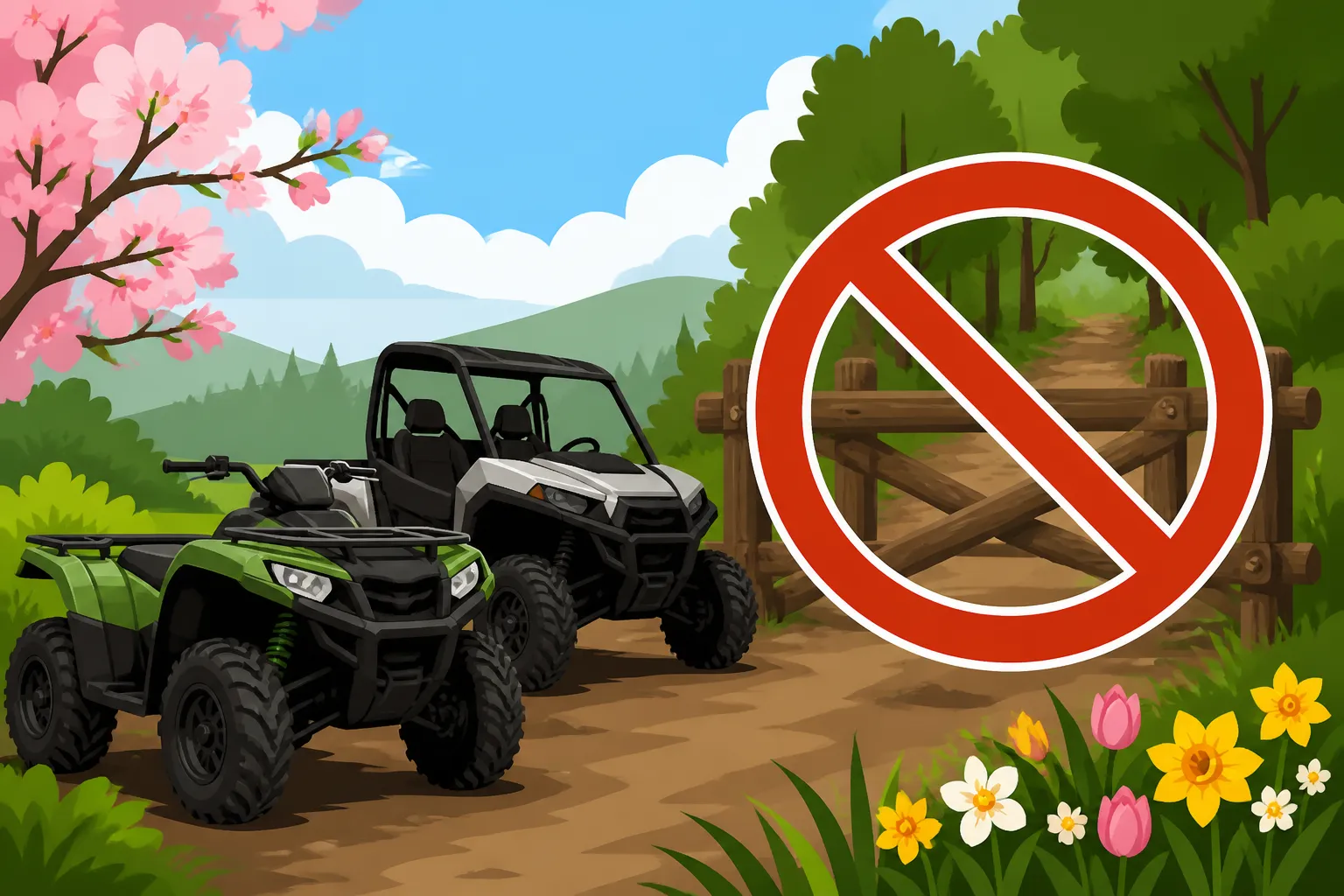
Spring trail closures are usually about protecting the ground while it is wet and vulnerable, not simply enforcing a calendar. Snowmelt, rain, and freeze-thaw cycles can leave trails soft even when nearby roads look dry. A quad or side-by-side can churn that surface into ruts that take a long time to repair.
Some Pennsylvania state forest ATV trails have a scheduled spring closure beginning April 1, with the summer season generally opening on the Friday before Memorial Day. That schedule is not a promise that every trail, park, or forest road in the state follows the same dates. Check the specific riding area before making plans. For more detail on the seasonal pattern, see [Why Pennsylvania Trails Close April 1](Why Pennsylvania Trails Close April 1) and [The Friday Before Memorial Day in Pennsylvania](The Friday Before Memorial Day in Pennsylvania).
Thaw and rain make trails easy to damage
A trail can appear firm on top while its lower layers are still saturated. When tires press into soft soil, they displace it and create ruts. Water then runs through those ruts, widening them and washing away gravel or soil. Repeated traffic can turn a temporary muddy patch into a longer-lasting erosion problem.
That’s why riding “just one quick loop” during a closure can do more damage than it seems. A machine may sink only a few inches, but the next rider can deepen the track, and rain can carry loose soil downhill. On rocky or steep terrain, damage can spread quickly beyond the muddy spot itself.
The same problem can occur after a heavy rain even when a trail is normally open. A trail system’s regular season dates do not necessarily mean every route is safe or available on a particular day. Check for weather-related restrictions and closures as well as the calendar. [Trails Damaged by Spring Thaw](Trails Damaged by Spring Thaw) explains why a closed trail can need time to dry before riding resumes.
Seasonal dates vary by riding area
Pennsylvania has several kinds of ATV riding areas, and they may have different owners, managers, permits, and opening schedules. A seasonal state forest trail is not the same as a private riding park, a club trail, or a road in a national forest. One area’s spring opening date does not automatically apply to another.
For example, riders may be looking at state forest routes in the Sproul, Tiadaghton, Susquehannock, or Bald Eagle forests, while other plans involve a managed riding area such as Rock Run or the Anthracite Outdoor Adventure Area. These places do not necessarily share one spring calendar. Check the operator or land manager for the exact area you intend to ride, including any trail-by-trail closures.
| Riding area type | What may affect spring access | What to check before traveling |
|---|---|---|
| Pennsylvania state forest ATV trails | Seasonal dates, wet conditions, maintenance, or local restrictions | The relevant DCNR forest district and trail notices |
| National forest routes | Forest-specific rules, permits, seasonal conditions, or closures | The current information for the particular forest route |
| Private riding parks | Park operating schedule, weather, maintenance, or event closures | The park’s own announcements and entry requirements |
| Club or leased trails | Club access dates, membership rules, landowner arrangements, and trail conditions | The club or organization that manages access |
| Township or connector roads | Whether the road is designated open to ATVs and any temporary restrictions | Township notices and posted signs |
For state forest routes, the broad seasonal schedule is a useful starting point, not a substitute for checking the district responsible for the trail. You can compare dates with [Pennsylvania's Summer Season Dates](Pennsylvania's Summer Season Dates), then verify any exceptions for your destination.
How to check whether a Pennsylvania trail is open
A map can show where a trail goes, but it may not tell you whether that trail is open today. This distinction matters in spring, when seasonal restrictions and temporary closures can overlap. Before you load the trailer, check both the official riding-area information and any recent closure notices.
Start with the land manager or trail operator
First identify who manages the trail. For a state forest trail, look for information from the responsible DCNR forest district. For a private park, check the park’s own notices. For a club trail, contact the club or review its access updates. If a route crosses more than one kind of land, check each manager; an open segment does not make the entire route open.
Pay attention to wording. A notice may apply to a specific trail, road, staging area, or entrance rather than the entire riding area. It may also distinguish between a seasonal closure and a temporary closure due to rain, maintenance, or a local issue. If the notice is unclear, ask the manager before you ride instead of relying on an old post or a friend’s recollection.
A route-planning app such as onX Offroad can help you orient yourself and compare a planned route with nearby roads and trail networks. Still, use it as a planning aid rather than proof that a trail is legally open. Maps and user-posted information can lag behind a closure notice. For official trail maps, see [Pennsylvania Trail Maps From DCNR](Pennsylvania Trail Maps From DCNR), and use [Pennsylvania Trail Closures to Check First](Pennsylvania Trail Closures to Check First) as a reminder to verify access before leaving.
Check the route, not just the destination
A popular destination may have several approaches, trail segments, or staging areas. One may be open while another is closed. This is especially important if your plan depends on a connector route, a forest road, or a short section that crosses land managed by someone else.
Before you go, write down the name of the trail, the access point, and the route you expect to take. Then check each segment against current information. If you are using onX Offroad to follow a route, compare what the app shows with the land manager’s notices and any posted signs at the trailhead. Don’t assume a line displayed on a map means the route is open to ATVs.
It also helps to have a backup plan. If the intended route is closed, choose another riding area whose operator has confirmed that it is open. Avoid improvising a detour onto an unmarked road or a closed trail. A detour that looks convenient on a screen may cross private property or land with a different access rule.
What to do when a trail is closed
A closure can spoil a carefully planned weekend, especially if you have already booked a campsite or driven several hours. It is still worth treating the closure as a firm boundary. Riding around a gate, bypassing a closure sign, or cutting a new path can damage the resource and create trouble for other riders who depend on continued access.
Don’t treat a dry-looking entrance as permission
The entrance may be dry while the shaded sections farther into the woods remain soft. Higher ground, exposed roads, and paved approaches can dry before low areas and wooded slopes. A trail that looks rideable from the staging area can become deeply rutted around a bend or near a stream crossing.
If a trail is officially closed, do not use your own judgment about whether it “looks good enough.” Even a careful rider can leave tracks that channel water or invite more traffic. [Why Mud Season Closes Trails](Why Mud Season Closes Trails) covers the reasons closures can remain in place after the snow has disappeared. If a trail is open but conditions are questionable, consider postponing your trip and check for rain-related updates in [Pennsylvania Trails After Heavy Rain](Pennsylvania Trails After Heavy Rain).
Find a legal alternative and make the drive worthwhile
When an area is closed, look for a different legal riding option rather than searching for an unofficial way in. A private park may have a separate operating schedule, while other trail systems may open on a different date. Confirm the rules, access conditions, and any permit requirements before you switch destinations.
If no suitable trail is open, you can still use the day to prepare for opening weekend. Check tire pressure, inspect belts and chains, tighten loose hardware, clean air filters, and confirm that registration and required riding documents are in order. If you use onX Offroad for trip planning, save an alternate route for a confirmed-open area instead of treating an unverified trail as a backup.
The opening week can also bring soft spots, lingering closures, or changing conditions. A posted season start is not a guarantee that every trail is passable or open in full. Read updates again before heading out, and pay attention to signs at the trailhead. [Riding a Trail the Week It Opens](Riding a Trail the Week It Opens) offers useful context for setting expectations around that first trip.
Planning a spring ride without a wasted trip
Spring riding takes a little more checking than a midsummer outing, but a simple routine can prevent a long drive to a locked gate. Confirm the schedule, look for temporary notices, and verify that your exact route and access point are available. If the trail manager lists a condition update or closure, follow it even if a map still shows the route.
Use this pre-trip checklist
Before you leave home, go through these steps:
- Identify the land manager. Determine whether the trail is managed by DCNR, a national forest, a private park, or a club.
- Check the seasonal dates. Confirm the opening schedule for that specific riding area rather than assuming statewide dates apply everywhere.
- Look for temporary closures. Check for rain damage, maintenance work, restricted access, or staging-area changes.
- Verify the whole route. Include connectors, access roads, and the return route—not only the trail you most want to ride.
- Confirm permits and riding rules. A trail being open does not automatically mean your machine or planned use meets the area’s requirements.
- Save a backup option. Choose another location only after confirming that it is open and that you meet its access rules.
- Check again on the day of the trip. Conditions and notices can change after you first made your plan.
A little preparation also helps if you are traveling with a group. Agree on the destination and route before anyone sets out, and make sure everyone knows that a closed connector is not an invitation to find an unofficial bypass. If the trip is canceled, contact a campground or other host directly about changing plans rather than assuming a trail closure changes its policies.
Keep seasonal rules separate from trail conditions
It is easy to mix up two different questions: “Is this trail in season?” and “Is this trail open today?” A trail can be outside its normal spring closure period but still temporarily closed after a storm. Conversely, a dry trail can remain closed because the seasonal opening date has not arrived.
That distinction is why current notices matter as much as maps and familiar dates. Use official trail information to establish access, then use route-planning tools to understand where you are going. onX Offroad can be useful for organizing a route, but the final decision should follow the rules and updates from the land manager.
For riders in Pennsylvania, spring patience helps protect the trails everyone wants to ride later. Waiting for a proper opening and checking the exact route may be less exciting than unloading the machine, but it can save a frustrating trip and help prevent damage that extends the closure.
Disclaimer
This article is for general informational purposes only and does not constitute professional advice. Laws, prices and regulations vary by location and change over time. Consult a qualified professional for guidance on your specific situation.