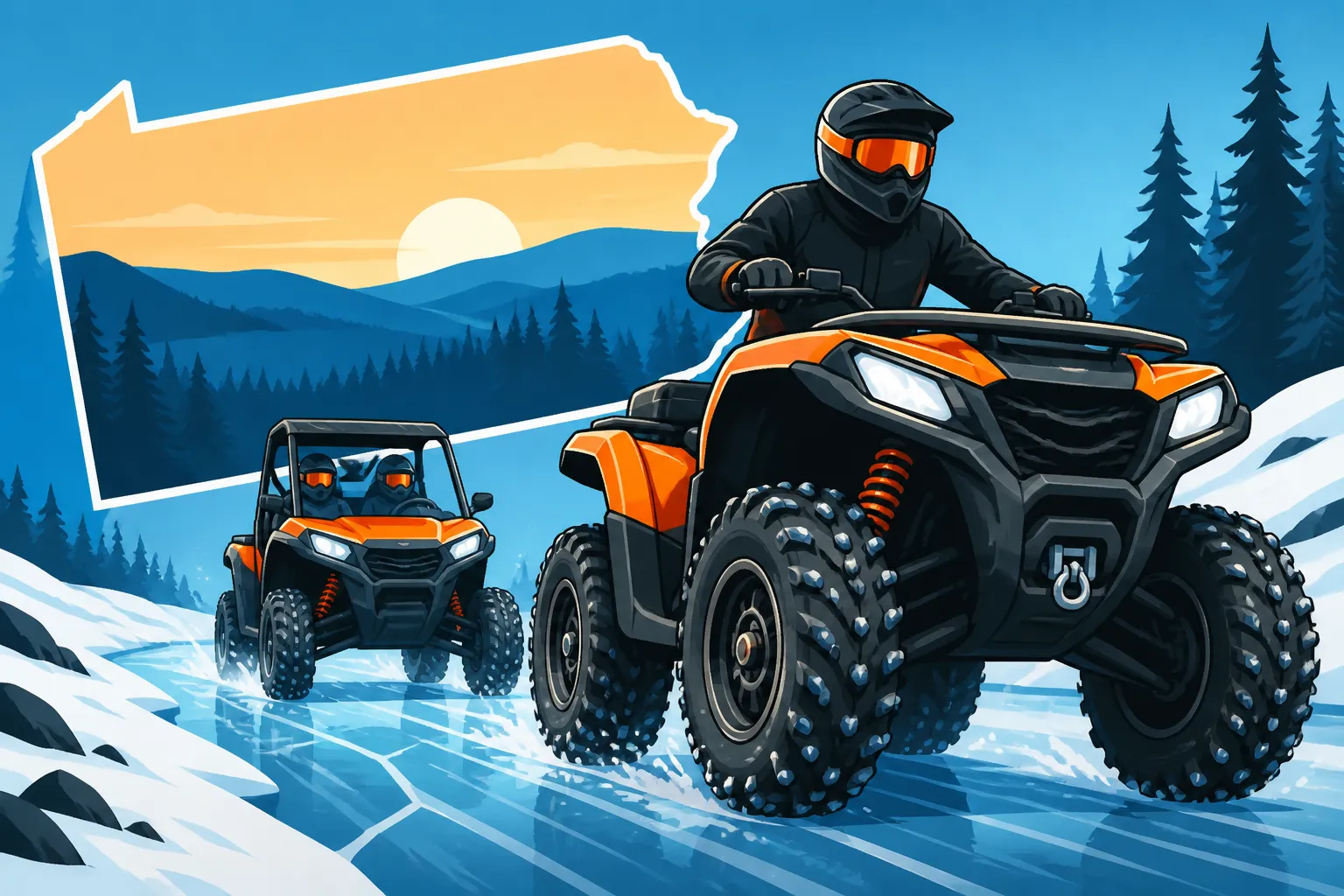
Studded Tires on a Frozen Trail
A trail that looks firm at the parking area can turn slick, rutted, or unexpectedly icy a short distance in. Studded tires may improve grip in some winter conditions, but they are not a substitute for checking access rules, trail conditions, and machine setup. This guide explains when studs can help on Pennsylvania ATV and UTV rides—and when they can cause trouble.
When studded tires help on a frozen trail
Studs are small metal inserts fitted into tire tread to add bite on hard, slippery surfaces. They can help when a route has a consistent layer of packed snow or ice, but winter trails rarely stay consistent for long. A shaded climb, sunny clearing, muddy hollow, and frozen crossing can all demand different handling within the same ride.
Packed snow and ice are different from frozen dirt
Studs are most useful when the tire can press into a hard, slick surface. On packed snow or ice, they may improve forward traction and braking grip. That extra bite can be welcome on a gentle, firm climb or a compacted approach where ordinary tread spins.
Frozen dirt is not automatically a good surface for studs. If the ground is hard but rough, rocky, or only lightly dusted with snow, studs may add little. They can also make a machine feel less predictable when the tires move between icy patches and bare ground. A trail that alternates between frozen dirt and exposed rocks may be harder on studs than a continuous snow-covered route.
Fresh, soft snow creates another challenge. Tires need tread to move snow and keep the machine advancing; studs alone do not provide that flotation or tread pattern. If snow is deep or loose, a studded tire can still spin, dig in, or push the machine sideways. Tire condition, tread design, machine weight, rider input, and the route itself all matter.
Conditions can change along a Pennsylvania route
Pennsylvania winter riding often means changing elevation, shade, and exposure. A section near a ridge may stay frozen while a lower, sunnier stretch softens into slush. A trail through dense woods may hold ice after an open area has thawed. Even on one loop, you may encounter packed snow, wet leaves, exposed stone, and bare ground.
That is why “frozen trail” is not a complete description of the riding conditions. Before heading toward places such as the Allegheny National Forest or Sproul State Forest, check the relevant access information and recent conditions. Trail access can depend on the specific route, land manager, and seasonal schedule. Pennsylvania Trails Open in Winter and Pennsylvania’s Winter Season Dates are useful starting points, but confirm details for the exact trail you plan to ride.
Do not assume a snowmobile route is open to ATVs or UTVs just because it is snowy. The two trail types can have different access rules, management, and intended use. Review Where a Snowmobile Trail and ATV Trail Differ before treating any winter route as an ATV trail.
A simple decision guide
Use the surface and the route—not the calendar alone—to decide whether studs make sense.
| Trail condition | How studs may perform | Practical consideration |
|---|---|---|
| Packed snow over a firm base | May provide added bite | Ride smoothly and leave room to brake |
| Continuous ice | Can improve traction, but cannot prevent every slide | Keep speeds low and avoid abrupt steering |
| Bare frozen dirt | May offer little benefit | Check for rocks and exposed hard ground |
| Mixed ice, gravel, and rock | Grip may change suddenly | Expect uneven handling and possible stud wear |
| Deep, loose snow | Studs alone may not solve poor traction | Tread design, clearance, and route conditions matter |
| Thawing mud or soft trail | Usually a poor match for winter studs | Avoid making ruts or damaging the trail |
For the larger question of studs on routes that include public roads, read Studded Tires on a Snow-Covered Road. Trail use and road use are not interchangeable: a tire that seems suitable for an icy trail may not be appropriate or permitted on every road.
Check access and trail conditions before fitting up
Tire choice only matters if the route is open to your machine. Winter access is often route-specific, and a trail can be closed even when the weather seems ideal. Plan around the land manager’s current information rather than relying on an old map, a social post, or tracks left by another rider.
Confirm the route is open to your machine
Start by identifying who manages the land and the exact trail or trail segment. A state forest route, private riding park, club trail, and township road may each have different rules. Check whether ATVs, UTVs, or both are allowed, and whether the trail is open during the dates you intend to ride. Width, weight, registration, permit, and seasonal requirements may also affect access.
Winter access can be especially easy to misunderstand. A route shown on an older map may be closed for the season, reserved for another type of vehicle, or temporarily shut because of weather or trail damage. Read Pennsylvania Trail Closures to Check First and Allegheny Forest Winter Riding Window when planning a ride in that region, then confirm the route details with the responsible land manager.
Mapping tools can help organize a trip, but do not treat a map display as permission to ride. onX Offroad can be useful for viewing routes and planning where a ride may connect, yet you should verify access restrictions and closures with the land manager. Save the route information you need before leaving home, since cell reception can be limited in forested or remote areas.
Read the surface, not just the forecast
A forecast tells you what may happen in the area, not what the trail surface is like under the trees. Look for recent reports from the relevant trail manager or riding area, and be alert to freeze-thaw changes. A route can start firm in the morning and become soft later, especially where sunlight reaches the ground.
When conditions are uncertain, choose a shorter, familiar route and leave yourself an easy way to turn around. Avoid assuming that an icy section will stay icy or that a soft section will support a heavy UTV. For more planning context, see Pennsylvania Trail Conditions Before You Go and Pennsylvania Trails After Heavy Rain. The latter is also relevant in winter thaws, when saturated ground can be vulnerable even if the surface was frozen earlier.
Use onX Offroad or another mapping tool to help with navigation, but keep a separate plan for closures, permitted routes, and safe turnaround points. If recent information conflicts, take the more restrictive interpretation and contact the trail manager rather than testing the route with your machine.
Know what the route requires beyond tires
Studs do not replace registration, permits, safety equipment, or any other applicable riding requirement. A legal, open route can still have requirements that differ from those of a nearby trail system. Confirm the rules for the location, especially if your ride crosses between public land, club property, and roads.
Also distinguish a trail permit from machine registration and trail access. These can be separate requirements. Pennsylvania ATV Trail Permits Explained can help clarify the difference, while Pennsylvania Rules for Riding a Snow-Covered Road is relevant if your planned route includes a road segment. Never assume that a road is open to ATV traffic because it is covered in snow or because other riders have used it.
Choose and install studs carefully
If the route is open and conditions make studs a reasonable choice, the next question is whether your tires and machine are suited to them. Stud installation is not a one-size-fits-all job. Tire construction, tread depth, vehicle weight, and the manufacturer’s guidance all affect what is safe and workable.
Match the stud to the tire and intended surface
Studs come in different styles and lengths. The right option depends on the tire’s tread and intended use, and a stud that protrudes too far may create problems on surfaces other than ice. A stud that is too short or poorly matched may provide little useful grip. Follow the tire and stud maker’s fitment guidance rather than selecting parts by appearance alone.
Inspect the tire before installation. Worn tread, damaged sidewalls, plugs, or cracking can make winter use a poor choice regardless of stud type. Do not install studs in a tire unless its construction and tread are intended to accept them. If you are unsure, ask a qualified tire or powersports shop to inspect the tire and explain the available options.
A UTV also puts different demands on tires than a lighter ATV. Added vehicle weight and passenger or cargo load can affect traction and handling. Check the tire’s load guidance and the machine manufacturer’s recommendations, and avoid assuming that a setup that worked on a small quad will behave the same on a heavier side-by-side.
Treat installation as a safety task
If the tire is designed for studs and you are installing them yourself, use the correct tool and follow the stud manufacturer’s instructions for placement and depth. Work carefully around the tread blocks, and inspect each tire after installation. Poorly seated studs can loosen, while uneven placement can contribute to an inconsistent feel.
After the first short ride, inspect the tires again. Look for missing, bent, loose, or damaged studs, as well as new cuts or bulges in the tire. Check again after riding on exposed rocks or bare ground. A stud that is secure in a tire is not immune to damage from rough surfaces.
If the tire needs professional installation, ask the shop what surfaces the setup is intended for and how often it should be inspected. Do not assume a shop’s recommendation answers whether the trail itself permits studded tires. That is a separate access question for the land manager.
Use a conservative pressure and handling approach
There is no universal tire pressure that works for every ATV or UTV in winter. Follow the vehicle and tire manufacturer’s guidance, account for the load, and avoid making pressure changes based on a guess or someone else’s setup. Cold temperatures can affect tire pressure, so check it with a gauge before the ride and recheck if conditions or altitude change substantially.
Once moving, use gentle throttle and braking. Sudden acceleration can spin the tires and disturb the trail surface; abrupt braking or steering can unsettle the machine, especially when one tire is on ice and another is on exposed dirt. Leave more space than usual between riders, and do not tailgate on a slope where the lead machine could slide or stop unexpectedly.
A cautious first pass is a useful test. Begin on a broad, low-risk section, assess how the machine turns and stops, and adjust your pace accordingly. If the tires feel unpredictable, or the trail surface is changing too quickly, turn around rather than trying to make the setup work.
Ride with control and protect the trail
The point of studs is improved traction in specific conditions—not permission to ride faster, climb steeper grades, or push through a closure. Winter traction can be deceptive: the machine may feel planted for several minutes and then lose grip on a polished corner or a patch of thawing mud.
Keep speed and spacing modest
On ice, stopping distance can change quickly. Slow down before turns, descents, and crossings instead of waiting until you are already on them. Avoid sharp steering inputs and high-speed cornering. If your machine begins to slide, aggressive corrections can make the situation worse; make small, controlled inputs and keep a safe escape path in mind.
Give other riders room to stop or change direction. On narrow trails, avoid meeting another machine on a steep or slick section if you can safely wait at a wider spot. Be courteous when yielding, and do not block the route while regrouping. Pennsylvania Trail Etiquette on Narrow Trails offers additional guidance for sharing tight trail sections.
If you are riding with a group, agree on a simple spacing and stopping plan before setting out. The lead rider should not disappear around a bend without checking that the group is still together, and the last rider should know where the group plans to turn around. UTVs and ATVs can behave differently on the same surface, so leave enough room for each rider to make independent decisions.
Avoid rutting and unnecessary trail damage
A frozen trail can still be vulnerable. If the surface begins to soften, spinning tires can cut ruts that remain after the thaw. Studs may increase the bite on hard surfaces, but aggressive throttle on soft ground can still dig into the trail. If you see the tires breaking through the firm surface, stop and reassess instead of repeatedly powering forward.
Do not ride around a closure sign, bypass a gate, or create a new line around a muddy or icy obstacle. Leaving the designated trail can damage vegetation and soil, and it may put you on land where riding is not allowed. If a section is unsafe, use an authorized alternate route or turn around. [Pennsylvania Rules for Riding a Closed Trail] and [Pennsylvania Rules for Riding Off the Trail] are worth reviewing before a winter outing.
In areas such as the Allegheny National Forest or near established riding destinations, conditions and access may differ from one route to the next. onX Offroad can help you keep track of a planned route, but it cannot replace posted signs or current instructions from the land manager. Do not follow another rider’s tracks as proof that a route is open.
Carry a winter-ready ride plan
Cold weather makes small problems harder to manage. Before leaving, tell someone where you expect to ride and when you plan to return. Carry a charged phone, but do not count on having service everywhere. Bring clothing layers, water, basic tools, and recovery equipment appropriate to your machine and route. A compact first-aid kit and a way to contact help are sensible additions.
Check the machine before departure. Look over tires and studs, brakes, lights, battery condition, fuel, and any belts or chains that apply to your model. Secure cargo so it cannot shift on a slope, and keep essential items accessible rather than buried under gear. If the machine has been stored for a while, do a short test ride close to home before towing it to a remote trailhead.
Finally, set a clear turnaround threshold. That might be worsening visibility, a softening trail, an unexpected closure, repeated loss of traction, or a machine problem you cannot address safely. The best winter ride is not the one that pushes through every obstacle; it is the one where everyone and every machine make it back without damaging the trail.
Disclaimer
This article is for general informational purposes only and does not constitute professional advice. Laws, prices and regulations vary by location and change over time. Consult a qualified professional for guidance on your specific situation.