Riding a Trail After Antlerless Season
Once antlerless deer season ends, it can feel like Pennsylvania’s ATV trails should reopen immediately. Some do follow a winter schedule, but the end of hunting season is not a statewide green light: trail dates, closures, land rules, and machine restrictions still matter. This guide explains what to check before riding and how to avoid arriving at a gate that is still closed.
What changes after antlerless deer season
The season may affect state forest trail access
Pennsylvania’s designated state forest ATV trails generally have seasonal riding periods. Some trails close during parts of fall and early winter, then reopen for a winter riding season after antlerless deer season. That timing helps reduce conflicts between trail users and hunters, but the precise opening date and rules depend on the trail system and the current season schedule.
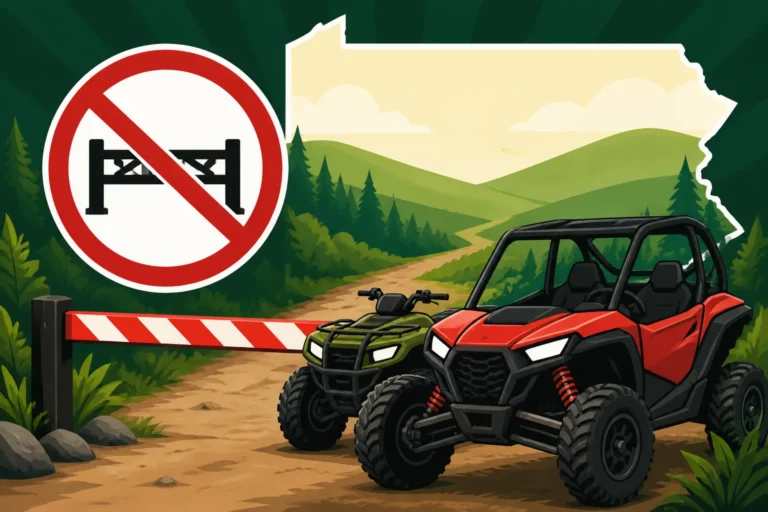
The key point is that hunting season’s end and trail reopening are related, but they are not interchangeable. A trail may have a posted reopening date, remain closed because of weather or maintenance, or operate under a schedule that differs from another forest district’s trails. Don’t assume that a trail is open just because you’ve heard that antlerless season has finished.
For a broader look at how seasonal access works, see Pennsylvania’s Antlerless Season and Winter Reopening and Pennsylvania Trails That Reopen for Winter. Those distinctions matter when you’re planning a ride in areas such as the Allegheny, Sproul, or Tiadaghton state forests, where a long drive to a trailhead can turn into a frustrating trip if the gate is still shut.
Not every riding area follows the same calendar
Pennsylvania has several kinds of ATV riding areas, and their schedules may not match. Designated state forest trails have specific access rules and seasons. Private off-road parks, club trails, and other managed properties set their own calendars and conditions. A trail that is open at one property does not mean nearby public land is open too.
The same caution applies to roads. A road that happens to appear on an off-road map is not automatically open to ATVs. Public-road use depends on designation and applicable rules, while private roads require permission. Check the rules for the exact place you plan to ride, not just the general region.
| Riding area | What to verify after antlerless season | Why it matters |
|---|---|---|
| Designated state forest trail | Published opening date, current closure notices, vehicle limits, and seasonal rules | State forest access is limited to designated trails and can change with conditions |
| Private riding park | Operating calendar, admission requirements, machine rules, and trail conditions | Each property controls its own access and may have separate restrictions |
| Club trail | Whether the trail is open to the public, membership requirements, and permission | A trail may be on leased or private ground rather than public land |
| Township or other public road | Whether ATVs are specifically permitted on that road | A road’s location on a map does not establish legal ATV access |
If you’re comparing nearby places, Pennsylvania’s ATV Trail Season can help you understand the seasonal pattern, while Pennsylvania Trail Closures to Check First is a useful reminder to look for current, location-specific notices.
A season opening does not cancel other restrictions
Even when a winter riding season has begun, you still need to follow machine-width, weight, registration, permit, and safety requirements that apply to that trail. Some state forest trails have vehicle limits that can rule out a wider side-by-side even when narrower ATVs are allowed. Conditions may also lead to temporary closures or restrictions after the scheduled opening.
Before you go, confirm that your machine fits the rules for the trail system, that required documents or permits are in order, and that the trail is open to your type of vehicle. The 64-Inch Width Limit in Pennsylvania explains why checking your machine’s dimensions matters before setting out for a state forest trail.
How to confirm a trail is actually open
Start with the agency or property that manages the trail
The most dependable first step is to identify who manages the exact trail you want to ride. For a state forest trail, check the relevant Pennsylvania DCNR information and contact the forest district office if an opening date or closure notice is unclear. For a private park or club system, check directly with the operator or club.
This sounds obvious, but it’s easy to skip when a trail name appears in a social media post or an older riding guide. A rider may report that a route was open last winter, while this season’s schedule or conditions are different. Treat older posts as background, not confirmation.
Also check whether the trail system has posted a temporary closure. A scheduled winter opening does not guarantee every segment is passable or available on a particular day. Maintenance, weather, erosion, or other land-management needs may affect access.
Use maps for planning, not as proof of permission
Mapping tools can make it easier to see trail networks, estimate travel time, and plan where to stage a trailer. onX Offroad may be useful for that kind of route planning, especially when you want to compare a trail area with nearby roads or identify where your group should meet. But a mapped line should not be treated as proof that a route is currently open or legally rideable.
Confirm access with the land manager before following any route whose status is uncertain. This is particularly important where public land, private parcels, club property, and roads are close together. A map may help you understand where you are; it does not replace posted signs, property permissions, or current closure information.
If you use onX Offroad to organize a ride, pair it with official information and a plan for checking the route on the ground. Download or save the information you’ll need before leaving home, since cell service can be unreliable in forested or mountainous areas. A group can also agree on a turnaround point in advance rather than improvising if a gate or closure blocks the planned route.
Check again close to ride day
A quick check several days ahead can help with planning, but it’s sensible to look once more just before leaving. Weather and land-management decisions can change access after you’ve made plans. If you’re traveling from Pittsburgh, Philadelphia, or another part of the state to ride near places such as Westport or Marienville, confirming access can save hours on the road.
Look for the date and location attached to any closure notice. A notice for one trail does not necessarily apply to every trail in the forest, and a report from another rider may describe a different access point or trail segment. When the wording is unclear, ask the managing office or property operator rather than guessing.
For trail-specific planning, Pennsylvania Trail Conditions Before You Go and Pennsylvania Trail Maps From DCNR are useful starting points. onX Offroad can complement that research by helping you plan where to navigate, but use the manager’s current notice to confirm whether riding is allowed.
A practical pre-ride check after hunting season
Work through the details before loading the machines
The most common mistake is checking only one thing, such as whether the hunting season has ended, and assuming the rest will sort itself out. A short checklist helps catch the details that can stop a ride before it starts.
- Name the exact trail system. “Riding in the Allegheny” is too broad to confirm access. Identify the particular trail, entrance, or managed property.
- Find the current seasonal schedule. Confirm the winter opening date for that specific system rather than relying on a general rule.
- Look for temporary closures. Check recent notices from the land manager or property operator.
- Verify vehicle eligibility. Check width, weight, and any other equipment restrictions that apply.
- Confirm permits and registration. Determine what paperwork or trail permit is required for that location and machine.
- Check weather and surface conditions. Snow, ice, thawing ground, and recent heavy rain can make a trail unsafe or vulnerable to damage.
- Prepare for limited service. Save directions and key contact information before you lose reception.
- Tell your group the plan. Agree on the meeting point, turnaround time, and what to do if the route is closed.
That last step can prevent a common group-ride headache: half the riders have already unloaded while the rest are trying to decide whether a nearby road is an acceptable substitute. It isn’t unless that road is specifically open to ATV use.
Think about winter surfaces and trail etiquette
A winter reopening does not mean every surface is easy or suitable for every rider. Frozen ground may feel firm in the morning and change as temperatures rise. Snow can conceal ruts, rocks, drainage channels, or branches. Ice can make a slope or bridge crossing much more difficult than it looked from the trailhead.
Ride at a pace that gives you time to react, leave room between machines, and avoid spinning tires when traction is poor. If a section is deteriorating or you’re unsure whether it can be ridden without damage, turn around rather than forcing a pass. That choice may disappoint the group in the moment, but it is better than damaging a trail or getting a machine stuck in a place where recovery is difficult.
For additional preparation, see Pennsylvania Trails After Heavy Rain and Pennsylvania Trail Etiquette on Narrow Trails. Those considerations apply in winter too: trail conditions and shared access call for patience, clear communication, and respect for other users.
Common questions about riding after antlerless season
Does the end of antlerless deer season mean all Pennsylvania ATV trails are open?
No. It may mark the start of a winter riding period for some designated state forest trails, but it does not automatically open every trail, road, club route, or private riding area. Each location may have its own calendar, access rules, and temporary closures. Confirm the status of the exact place you plan to ride.
Can I ride a nearby road if the trail is closed?
Not unless that road is legally open to ATV use and you meet the rules that apply there. A road shown on a map, or one that looks like a continuation of a trail, is not automatically a permitted ATV route. Check the road’s designation and posted signs, and do not use a road as a detour based only on another rider’s suggestion.
Is a trail open if a mapping app shows it?
Not necessarily. A mapping app can help with orientation and route planning, but map data may not reflect current seasonal access, temporary closures, or private-property boundaries. Use onX Offroad or another mapping tool as a planning aid, then verify the route with the property manager or official trail information.
What if the trail’s opening date is unclear?
Don’t assume. Contact the managing agency, forest district, club, or park and ask about the specific trail and date you have in mind. If you can’t confirm that riding is allowed, choose a location with clear, current access information instead.
Disclaimer
This article is for general informational purposes only and does not constitute professional advice. Laws, prices and regulations vary by location and change over time. Consult a qualified professional for guidance on your specific situation.