The 64-Inch Width Limit in Pennsylvania
A side-by-side can look trail-ready in the driveway and still be too wide for a Pennsylvania state forest ATV trail. That mismatch can mean a frustrating turnaround after a long tow, or a machine you cannot take where you planned. This guide explains what the 64-inch limit applies to, how to check your UTV, and what to verify before you ride.
What Pennsylvania’s 64-inch width limit means
The limit applies to designated state forest ATV trails
Pennsylvania’s 64-inch limit is associated with designated ATV trails on state forest land. These routes are intended for eligible machines that meet the trail’s rules, including a maximum width of 64 inches. A machine wider than that may not be allowed, even if it is registered, insured, and capable of handling the terrain.
That distinction matters because “a trail in Pennsylvania” is not one uniform category. A route in a state forest, a privately operated riding park, a club trail, and a public road can all have different access rules. A machine that is accepted at one destination is not automatically acceptable at another. Check the specific land manager’s rules rather than relying on the word “ATV trail” by itself.
The restriction is commonly discussed as the Class II trail width limit. Before planning a trip, read [Pennsylvania's Class II Trail Width Limit] and confirm the rules for the exact trail system you intend to ride. The trail name, land type, and permit requirements all matter—not just the machine’s advertised category.
The stated width is only one part of eligibility
Width is an important screening measurement, but it is not the only condition a rider may need to meet. Pennsylvania state forest trails can have additional limits and requirements, including rules about machine weight, registration, permits, seasonal access, and where a trail is open. Meeting the width rule does not make a machine eligible on every route.
For instance, a UTV might measure below the width limit but still be too heavy for a particular trail system’s requirements. Or the machine may fit the physical dimensions but lack the required registration or trail permit. Treat the 64-inch figure as one part of a checklist, not as a blanket pass.
It also helps to distinguish trail access from road use. A machine being narrow enough for a designated trail does not make it street legal, and permission to use a specific road does not necessarily grant access to a state forest trail. Keep each question separate: Is the machine eligible? Is the route open to it? Does the rider have the required paperwork?
How to measure your ATV or UTV accurately
Measure the machine in its riding configuration
A manufacturer’s published width is a useful starting point, but the number on a specification sheet may not match the machine you actually take to the trail. Width can change when accessories are added. Wider wheels, aftermarket tires, wheel spacers, fender extensions, or other modifications can push a machine beyond a limit that its stock configuration met.
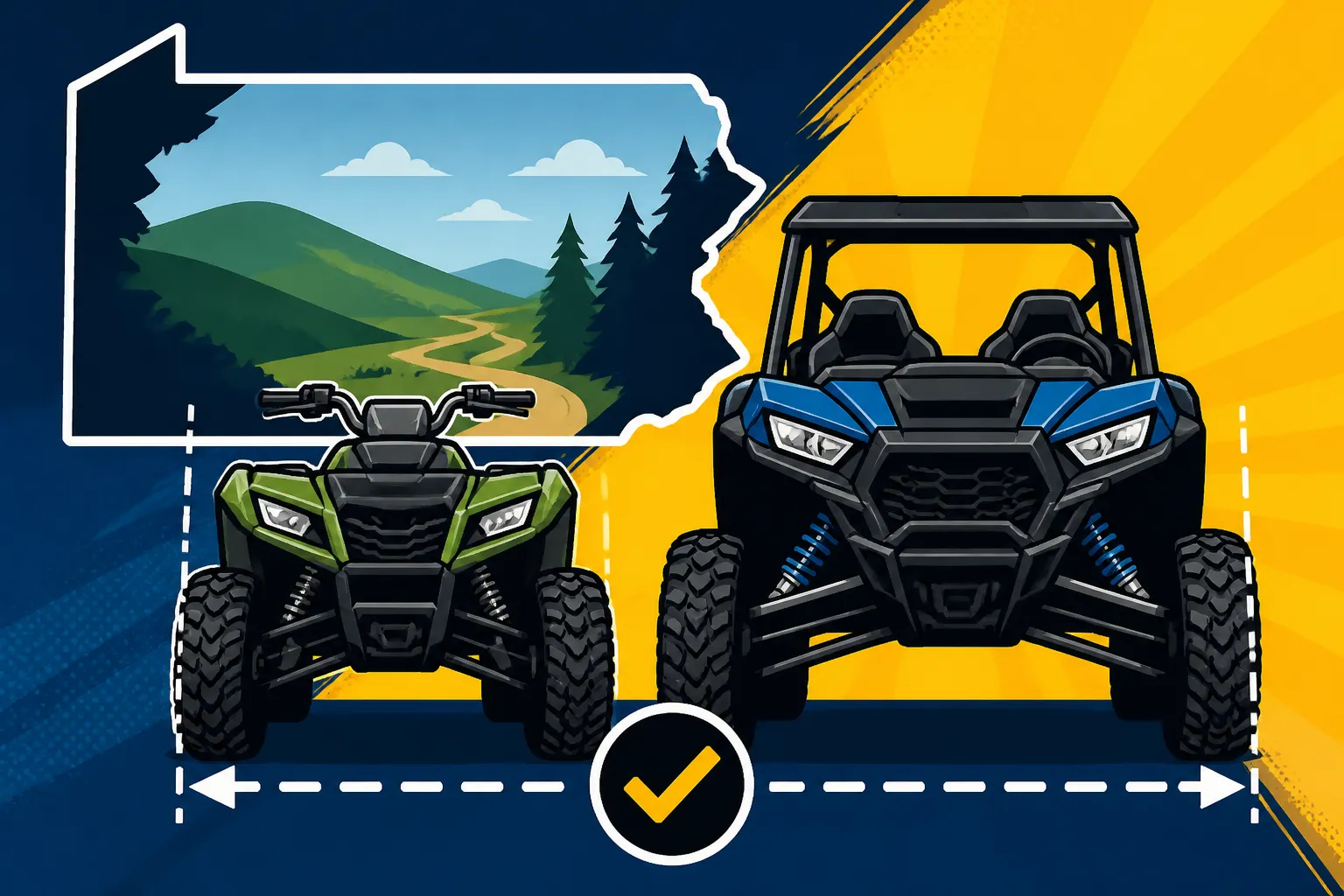
Measure the widest point from side to side, including components that extend beyond the body. Do not estimate based on the cab or fenders alone. If the tires stick out farther than the bodywork, they may determine the actual width. A practical approach is to place the machine on level ground and measure across its widest points with a tape measure, keeping the tape straight and perpendicular to the machine’s centerline.
Think about a rider who buys a UTV advertised at 64 inches wide, then installs wider tires for grip on rocky terrain. The original specification no longer tells the whole story. Before leaving home, check the machine as equipped and compare that measurement with the trail’s stated restriction. When a measurement is close to the limit, seek clarification from the land manager instead of assuming that a rounding difference will be overlooked.
Check the model details and keep a record
Look for the exact model year and trim when reviewing manufacturer specifications. Similar-looking versions can have different widths, and product listings may describe a base model rather than a machine with optional equipment. If you bought used, ask the seller whether the wheels, tires, suspension, or bodywork have been changed.
Keep a note of the measured width and the machine’s configuration. A photo of the measurement can help you remember which tire setup you checked, especially if you own more than one machine or swap wheels between seasons. This does not replace a trail authority’s determination, but it makes your own planning more reliable.
For a route-planning check, onX Offroad can help you review mapped riding areas and plan around your destination. Treat any app map as a planning aid, not the final authority on machine eligibility. Confirm access rules with the land manager, and compare the route information with [Pennsylvania Trail Conditions Before You Go] and [Pennsylvania Trail Closures to Check First] before loading up.
| What to check | Why it matters | Practical next step |
|---|---|---|
| Actual width at the widest point | Accessories or tires may extend beyond the body | Measure the machine as equipped |
| Manufacturer model and trim | Similar versions can have different dimensions | Find specifications for the exact model |
| Machine weight | Width may not be the only equipment limit | Check the trail system’s full machine rules |
| Trail ownership and designation | State forests, private parks, and roads may differ | Confirm the specific route’s rules |
| Registration and permit | A dimensionally eligible machine may still need documents | Review the registration and permit requirements |
| Seasonal access | A route may be closed even when the machine qualifies | Check official opening dates and closures |
Where the limit applies and where it may not
Different riding areas can have different rules
Pennsylvania’s riding opportunities include state forest routes, private riding parks, club properties, and roads designated for ATV use. Those places are not interchangeable. A private park may set its own admission and equipment rules, while a state forest route follows the rules for that land and trail system. A machine being welcomed at a private facility does not mean it can be taken onto a state forest trail.
This is especially important for owners of wider side-by-sides. A 64-inch restriction can rule out some state forest routes without ruling out every place to ride. You may need to look for a riding area that specifically permits your machine’s width and weight. Start with [Pennsylvania Trails for a Wide Machine] and check each destination directly before making plans.
The same caution applies to national forest riding. The Allegheny National Forest has its own route and permit information, which should be checked separately from state forest rules. If that is your destination, review [Pennsylvania Riding in the Allegheny National Forest] rather than assuming the state forest width rule applies in exactly the same way.
Roads and trail connectors are separate questions
A legal road connection is not a substitute for trail permission. Even if a machine can use a particular designated road, that does not necessarily authorize it to enter a nearby state forest trail. Conversely, a trail that admits a narrow machine does not mean the machine can travel on ordinary roads to reach it.
This can trip up riders planning a point-to-point route. A map may show two riding areas close together, but a connection between them may cross land with a different access rule or a road that is not open to ATVs. Check the status of every segment, not just the trailhead and destination. For road questions, [Pennsylvania's Designated ATV Roads] can help separate road access from off-road trail access.
An app such as onX Offroad can be useful for visualizing a route and noticing where a planned ride approaches roads, property boundaries, or other mapped features. Still, a line on a map is not proof that a route is open to your machine. Confirm the legal status and current access conditions through the relevant land manager before riding.
Choosing a UTV that fits the trails you want
Start with the destination, not the sales description
When shopping for a UTV, it is easy to focus on horsepower, seating, cargo space, or how comfortable it feels on a farm lane. Those features matter, but trail width can be the deciding factor if state forest riding is a priority. A machine that is too wide for the routes you want may spend more time parked than you expected.
Before buying, make a short list of the places you realistically plan to ride. Check the allowed width at each location and compare those rules with the exact machine’s dimensions. If you want to ride narrow state forest routes, a machine that fits their restrictions may give you more options. If you are choosing a wider model for work or family comfort, be honest about the trade-off: you may need to use different riding areas.
The guide [Best UTV Width for Pennsylvania Trails] can help frame the choice, but the right width depends on your preferred destinations. Also see [Buying a Machine That Fits Pennsylvania Trails] before making a purchase. Ask the dealer for the specification for the exact trim and confirm whether optional equipment changes its width.
Consider ownership changes after the purchase
A UTV’s dimensions can change as you personalize it. A lift, wheel spacers, wider tires, or other modifications may improve clearance or stability for some uses, but they can also affect whether the machine meets a trail limit. Before making a modification, consider the routes you want to keep available.
A used machine deserves the same careful check. Do not assume that the model’s stock width applies to the machine in front of you. Look for altered wheels, tires, fender flares, and suspension components. If the seller cannot confirm the setup, measure it yourself and ask for the original model specifications as a comparison.
This is where the phrase “fits on paper” can cause trouble. A spec sheet might show a compliant stock configuration, but the installed parts tell you what you are actually bringing. Keep any width measurement tied to that particular setup, and recheck it if you change tires or accessories later.
Planning a ride without a trailhead surprise
Confirm access and paperwork before you tow
Once you identify a trail that appears suitable, check its access rules and paperwork requirements. Pennsylvania ATV registration and trail permits are separate considerations, and specific destinations may have additional permit requirements. Review [Pennsylvania ATV Trail Permits Explained] and, if you are considering the northcentral state forest system, [Pennsylvania's Northcentral Regional Trail Permit].
Read the details for the exact riding area. Confirm the season, open days, trailhead access, permitted machine dimensions, and any weight limit. Trail availability can change because of maintenance, weather, or other closures. A route shown on a map may not be open on the day you plan to ride.
A smooth plan also accounts for the basics: registration documents, required permits, insurance where applicable, and a suitable trailer. Keep your paperwork accessible and make sure the plate or identifying information on the machine is visible as required. Sorting these details out at home is far easier than trying to resolve them at a trailhead.
Use maps as a planning layer, not permission
Digital mapping tools can make it easier to compare trailheads, estimate a route, and organize a day’s ride. onX Offroad may be part of that planning process, particularly when you want to review mapped riding areas before loading a machine. Use it alongside official land-manager information rather than in place of it.
A useful routine is to identify the trail system in the map, then verify its rules and status through the agency or property operator. Check that the route is open to the type and width of machine you have. Look for closures or access changes, and confirm that any route between the parking area and the riding area is legal for your vehicle.
If your machine is close to the 64-inch limit, do not build the plan around an assumption. Contact the responsible office or park operator and ask how the measurement is applied to your machine’s configuration. That small step can save a long drive, an awkward trailhead conversation, and the disappointment of turning around before the ride begins.
Disclaimer
This article is for general informational purposes only and does not constitute professional advice. Laws, prices and regulations vary by location and change over time. Consult a qualified professional for guidance on your specific situation.