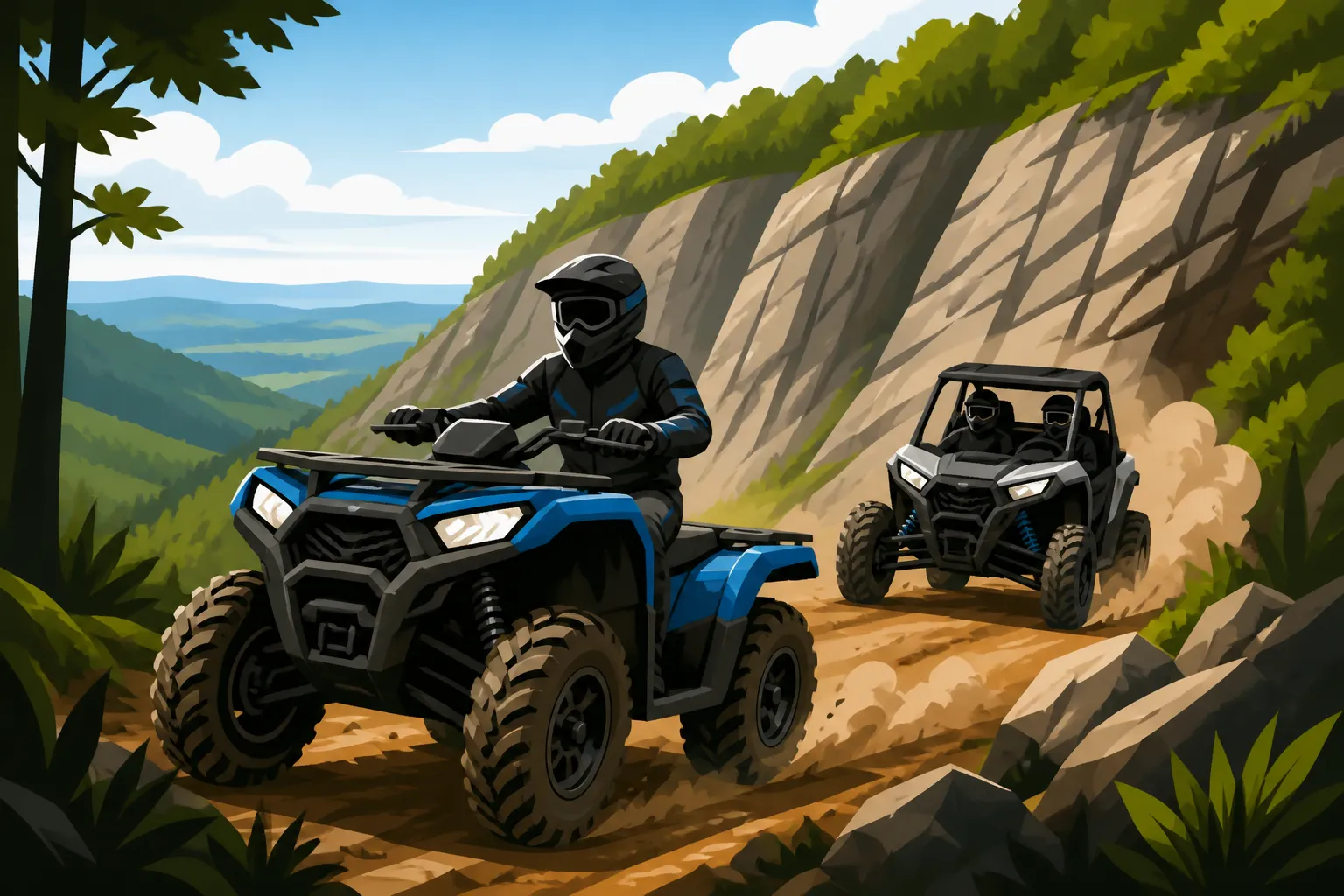
Sideling Hill’s 15 Miles
Sideling Hill’s 15 miles can sound like a quick spin on the map, but trail mileage doesn’t tell you how long a ride will take, what the surface is like, or whether your machine fits. This guide explains what to expect in Buchanan State Forest, how to plan a sensible ride, and what to check before you unload in Fulton County.
Understanding Sideling Hill’s 15 Miles
Trail mileage is not the same as a simple 15-mile loop
Sideling Hill is an ATV riding area in Buchanan State Forest in Fulton County, Pennsylvania. Its roughly 15 miles of trail give riders a defined destination, but that number alone doesn’t describe the experience. It may refer to the mileage of the trail system rather than one continuous loop that begins and ends at the same parking area. Check a current trail map before you plan your route so you understand how the available paths connect.
That distinction matters when you’re estimating the day. A rider who expects an easy, uninterrupted loop may be surprised by junctions, access roads, or stretches where a slower pace is appropriate. On a mountain trail, a short distance can take longer than it would on a smooth road. Rocks, ruts, turns, changing elevation, and stops to regroup all affect your progress.
It also helps to avoid treating 15 miles as a target you must complete. If you’re riding with children, a newer operator, or a group with different machines, plan around comfort and conditions rather than a number on a map. Start with a manageable section, then decide whether everyone is ready to continue. For additional context on the area, see [Sideling Hill in Fulton County](Sideling Hill in Fulton County).
Think of it as a forest-trail outing, not a road ride
A designated ATV trail in state forest is not an invitation to ride every nearby road or track. Stay on routes that are open and marked for your machine. Forest roads, access roads, private property, and trails that appear connected on a phone map may have different rules or restrictions. When a route is unclear, don’t assume it is open just because it looks passable.
This is especially important around trail junctions. A tempting side track may lead away from the designated system, enter a closed area, or end at a place where turning around is difficult. Pause at intersections and compare what you see with the official map or posted signs. If your group has more than one machine, make sure the last rider has time to read the junction too.
For riders who are used to large, purpose-built parks with obvious gates and marked loops, forest riding can feel less structured. It rewards a little preparation: know the trail system’s boundaries, keep the group together, and turn around when you’re unsure rather than hoping the route reconnects. A map can prevent a minor navigation question from becoming a long, tiring detour.
Planning Your Route and Finding the Trail
Check a current map before you leave home
Begin with official information about the trail system and its access points. Look for the current map, trail notices, seasonal closures, and any instructions about where to park or unload. Save an offline copy if your phone allows it. Cell service can be inconsistent in forested and hilly areas, and a route that loads perfectly at home may not be available once you’re riding.
A mapping app can help with orientation, but treat it as a planning aid rather than permission to ride. For example, onX Offroad can help you review nearby terrain and organize a route, but confirm that the paths you intend to use are designated and open through the appropriate official information. A track appearing on a digital map doesn’t necessarily mean ATVs are authorized to use it.
If you’re comparing maps, pay attention to the trailhead, parking area, and the route’s connection points—not just the highlighted line. Make sure everyone in the group knows where the ride starts and where you’ll regroup if someone needs to stop. For official map-planning help, see [Pennsylvania Trail Maps From DCNR] and [Pennsylvania Trail Conditions Before You Go].
Build a route around the group, not the most ambitious rider
Before unloading, agree on a simple plan: where you’ll start, how far you hope to ride, and what you’ll do if someone wants to turn back. Groups can move at very different speeds. An experienced rider on a nimble ATV may be comfortable covering rough ground faster than a new rider or someone in a wider side-by-side. Setting expectations before the engines start helps avoid pressure to keep up.
Choose a turnaround point that makes sense for the least experienced person in your party. That might mean exploring only part of the trail system, especially if the group is unfamiliar with the area. You can always make another visit after learning how the trail feels. A shorter ride with everyone relaxed is usually a better first outing than a full-day push that leaves someone anxious, exhausted, or separated from the group.
Keep a basic backup plan. Decide what the group should do if a machine develops a problem, a rider falls behind, or conditions change. Agree that nobody rides off alone without telling the others. If you use onX Offroad for route notes, share the intended plan with the group before you lose signal, and don’t rely on a phone battery as your only navigation backup.
Access, Seasons, and Riding Requirements
Confirm that the trail is open for your planned visit
Trail access can depend on the season, maintenance, weather, and management decisions. A trail shown on an older map may be temporarily closed, and a route that was open on your last visit may not be open on the day you return. Check for current notices before you travel, particularly if you’re arranging a group ride or towing machines a long distance.
Spring conditions deserve special attention. Thawing ground and wet trails can be easily damaged by tires, and a closure may protect the route until it can support traffic. Don’t use a closure notice as a suggestion to find a way around a gate or ride a nearby unmarked track. If the trail is closed, choose another legal riding option or reschedule. [Pennsylvania Trails Closed in Spring] explains why seasonal closures matter across the state.
Weather can change the character of a trail even when the route remains open. Recent rain may make a familiar section slick, muddy, or more difficult to negotiate. After storms, check for updates and be prepared to turn around if you encounter damage, standing water, downed branches, or unsafe conditions. If a posted notice conflicts with a route on your phone, follow the posted restriction and confirm details before continuing.
Check registration and permit rules for your ride
Before setting out, confirm the registration and permit requirements that apply to your machine and the specific place you plan to ride. Pennsylvania ATV registration and trail access permits are separate matters: having one does not automatically mean you have the other. The applicable requirements can depend on the trail, the land manager, and your circumstances as a Pennsylvania resident or visitor.
Don’t assume that a permit used for one Pennsylvania trail system covers Sideling Hill. Permit coverage can be specific to an area, and a permit intended for one set of forest trails may not apply elsewhere. Check the rules for the exact site you’re visiting, and carry the required proof with you. For a broader explanation of how the systems differ, read [Pennsylvania ATV Trail Permits Explained] and [Pennsylvania's Free State Forest Trails].
A practical pre-trip checklist is to confirm that your registration is valid, identify any permit required for this trail, and check whether your machine’s registration or out-of-state status affects access. Keep your paperwork somewhere protected but reachable. It’s much easier to resolve a documentation question at home than at a trailhead, after the machines are already unloaded.
| Planning question | What to check | Why it matters |
|---|---|---|
| Is the trail open? | Current official notices and posted signs | Closures may change with season, weather, or maintenance |
| Is my machine allowed? | Trail and land-manager rules | A route may have limits on vehicle type or size |
| Do I need a permit? | Requirements for Sideling Hill specifically | A permit for another trail system may not apply |
| Where do I unload? | Official access and parking information | Prevents unsafe or unauthorized roadside unloading |
| Can I navigate offline? | Saved map, route notes, and backup plan | Cell service and battery life may be unreliable |
Choosing a Machine and Riding Within Your Limits
Consider width, handling, and the trail surface
Before bringing a side-by-side, verify that its width is permitted on the trail you want to ride. Pennsylvania’s state forest ATV routes may have specific machine dimensions or class rules, and the standard applied to another riding area may not be the same. Measure your machine as equipped, including accessories that add width, and compare it with the current requirements. Don’t rely on a dealer’s general statement that a vehicle is “trail ready.”
A machine that fits the stated limit can still feel large on a narrow or uneven trail. Take turns slowly, watch for the outside edge of the track, and leave room for another rider to maneuver. A wide machine may be especially challenging where the route tightens, the ground is rutted, or there’s limited space to turn around. Read [Pennsylvania's 64-Inch Width Limit] and confirm how the relevant rule applies to your planned ride.
ATVs also need to be in sound mechanical condition. Check tires, brakes, steering, lights, and fluid levels before leaving home. Bring tools and basic supplies that match your machine, but don’t let a repair kit create a false sense of security. If a problem affects safe operation or could damage the trail, stop riding and arrange a safe way to get the machine out.
Match the difficulty to the least experienced rider
A trail can feel very different depending on recent weather, the machine you’re operating, and your experience. Riders who are new to off-road terrain should take their time and avoid following a faster rider through a section they haven’t assessed. Maintain enough space to stop safely, and make sure every operator can see the rider ahead without crowding them.
If a group includes children or teenagers, consider each rider’s actual ability—not just their confidence or how long they’ve ridden on private land. Review age, supervision, and safety requirements before the trip. Make sure young riders know how to stop, how to signal for help, and that they should wait for an adult rather than trying to catch up if the group spreads out.
A useful rule for any group is to stop before a difficult section and talk through the safest way to approach it. If a rider is uncomfortable, don’t shame them or insist they proceed. Turning back is a reasonable choice, especially when the surface is slick or visibility is poor. For trail-specific behavior that helps keep narrow routes safer, see [Pennsylvania ATV Trail Etiquette on Narrow Trails].
Making a Sideling Hill Ride Safer and More Enjoyable
Prepare for a day away from convenient services
Treat the ride as a forest outing, not as a trip where help or supplies will always be nearby. Bring drinking water, snacks, weather-appropriate layers, and any medication your group may need. Pack a first-aid kit and a charged phone, but remember that cell coverage can vary. Tell someone who isn’t riding where you’re going and when you expect to check in.
Think through your transportation plan before you reach the trailhead. Confirm that your trailer and tow vehicle are suitable for the machines you’re bringing, and check that tie-downs are secure. At the site, use the designated parking or unloading area and leave space for other visitors. Avoid blocking gates, signs, access roads, or places where emergency vehicles may need to pass. [Parking a Trailer at a Forest Trailhead] offers more planning considerations for trailhead parking.
Keep the day flexible. If the weather turns, someone gets tired, or a machine starts behaving differently, shorten the ride. A small issue can become a much bigger problem when a group presses on far from its starting point. Decide in advance who has the tools, who carries first aid, and how the group will communicate if it needs to stop.
Ride in a way that protects the trail and other visitors
Stay on the designated route and avoid widening it by riding around mud, rocks, or puddles. Going around a wet section can damage vegetation and create a broader, more eroded path. If the trail surface looks unsafe or unusually fragile, stop and reassess rather than trying to force a pass. Follow gates and signs, and never treat an unmarked spur as a convenient shortcut.
Control speed so you can stop within the distance you can see. Give other riders room, especially at blind corners, narrow sections, and places where the trail changes direction. If you meet hikers, maintenance workers, or other visitors, slow down and pass carefully where there is room. Keep noise and dust in mind, particularly near parking areas and shared access points.
Finally, leave the site as you found it. Pack out food wrappers, bottles, and broken parts; don’t leave trash at the trailhead or in the forest. A respectful ride helps protect access for the next group and makes the experience better for everyone using the area. If Sideling Hill is closed or unsuitable on your chosen day, use official information to find another legal destination rather than improvising on roads or trails that aren’t designated for ATVs.
Disclaimer
This article is for general informational purposes only and does not constitute professional advice. Laws, prices and regulations vary by location and change over time. Consult a qualified professional for guidance on your specific situation.