Why Pennsylvania Honors Only Mutual States
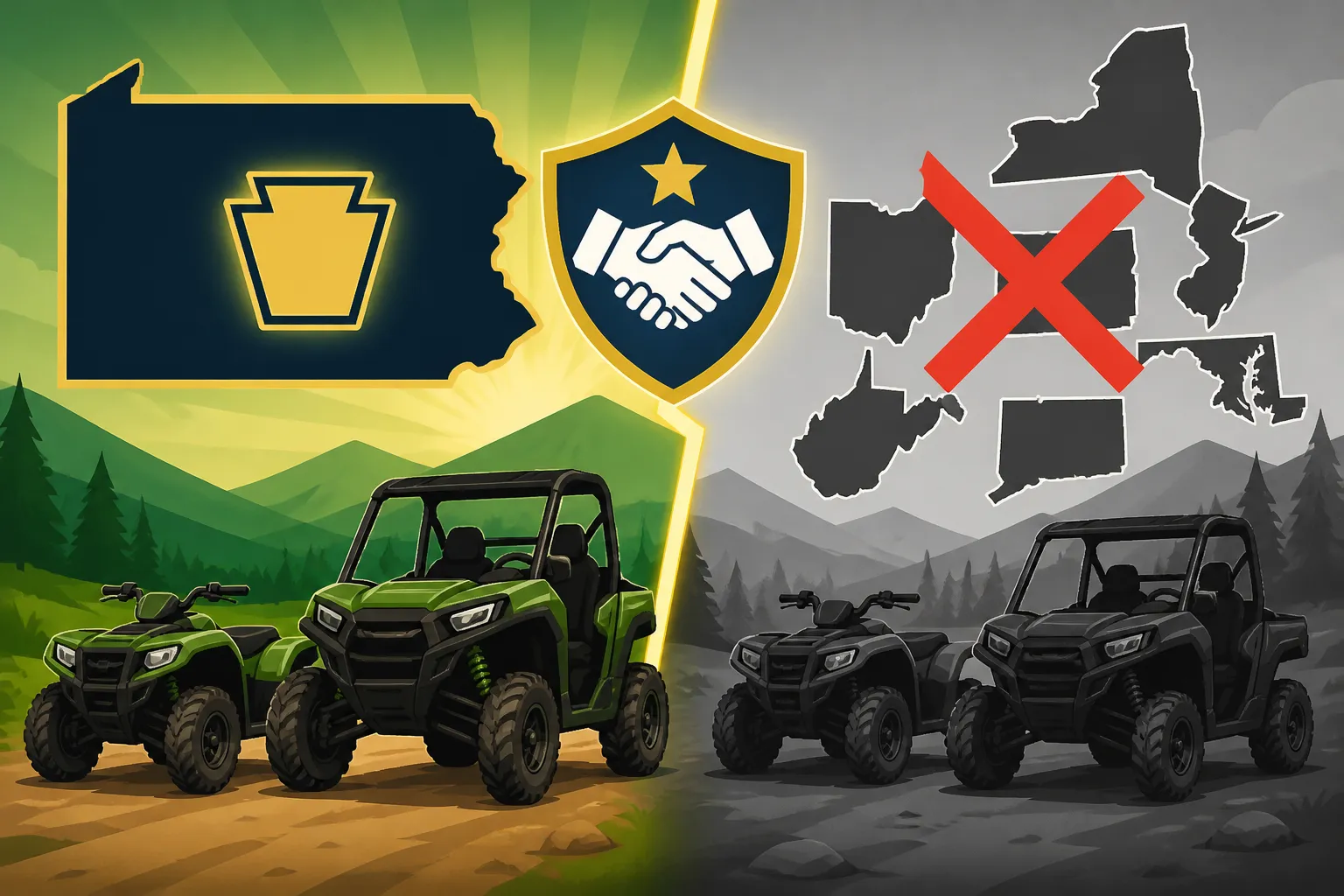
Pennsylvania does not automatically accept every out-of-state ATV or UTV registration. Recognition depends on whether the other state extends comparable privileges to Pennsylvania-registered machines. That mutuality can be confusing when you are planning a ride, especially because registration reciprocity does not automatically grant access to every trail. Here’s how to check what applies before you haul your machine across the state line.
What mutual reciprocity means
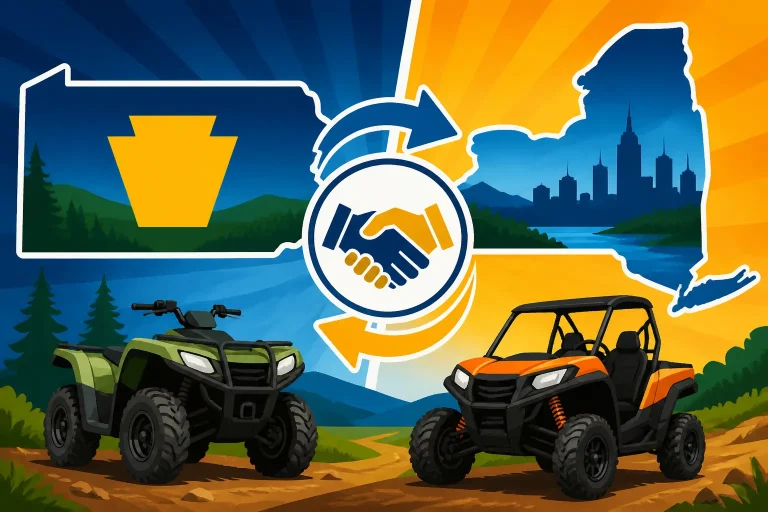
Reciprocity is an agreement to recognize another state’s registration under defined conditions. In Pennsylvania, the key idea is mutual treatment: Pennsylvania may recognize an out-of-state registration when the other state gives comparable recognition to Pennsylvania registrations.
That is more specific than simply having a registration card or plate from another state. A state may require ATVs to be registered, titled, permitted, or covered by a combination of documents. It may also treat residents and visitors differently. Pennsylvania’s reciprocity decision concerns whether the other state’s system provides a comparable privilege, not whether the two states use identical paperwork.
The arrangement is conditional rather than universal. A valid registration from one state does not necessarily qualify in Pennsylvania just because it is current at home. The status of reciprocal recognition can also change, so riders should confirm it for their particular trip rather than rely on an old list, a past visit, or another rider’s experience.
This is why the practical question is not only, “Is my machine registered?” It is also, “Does Pennsylvania recognize this type of registration from my home state, for this machine, and for the riding I plan to do?”
| Situation | What reciprocity may help with | What still needs checking |
|---|---|---|
| Visitor with a current registration from a mutually recognized state | Whether the home-state registration can be accepted while riding in Pennsylvania | Required display, proof to carry, trail permits, insurance, age and operating rules |
| Visitor with a permit or sticker instead of a registration | Whether Pennsylvania considers that document equivalent for the purpose involved | Whether the document qualifies under current Pennsylvania reciprocity rules |
| Pennsylvania resident using another state’s registration | Whether the other state’s registration receives recognition in Pennsylvania | Pennsylvania resident requirements and whether the out-of-state registration is actually valid for that resident |
| Machine used on a particular state forest or National Forest route | Registration recognition, if the reciprocity conditions apply | Separate land-manager permits, access rules, route openings, and machine restrictions |
| Rider with a registration from a state that is not mutually recognized | Little or no protection from Pennsylvania’s reciprocity policy | Whether Pennsylvania registration or another authorization is required before riding |
Reciprocity is best understood as a narrow recognition rule. It can prevent a visitor from having to obtain a separate Pennsylvania registration in qualifying circumstances, but it does not turn a home-state registration into a universal Pennsylvania riding pass.
For a broader overview of the visitor question, see Does Pennsylvania Honor an Out-of-State Registration? and Pennsylvania ATV Reciprocity With Other States. Those topics are related, but the decisive details are the current reciprocal status and the terms that apply to your machine.
Why Pennsylvania ties recognition to mutual treatment
Mutual recognition gives Pennsylvania a reason to accept another state’s registration: Pennsylvania riders receive comparable treatment when they travel there. Without that shared arrangement, Pennsylvania would be accepting an outside credential without assurance that its own registrations receive similar recognition elsewhere.
That distinction matters because states do not all regulate off-road machines in the same way. One state may issue a registration plate, another may use a decal or permit, and another may require different documents for different land types. Even when two systems look alike, their legal effect can differ. A sticker that permits riding on certain land in one state may not be the same as a registration that Pennsylvania recognizes.
Mutuality also helps explain why a list of “states that allow out-of-state ATVs” can be misleading. A state may let visitors ride on some roads or trails, but that alone does not prove that it gives Pennsylvania-registered machines the same registration treatment Pennsylvania gives its residents. Access, registration, and trail permits are separate questions.
Registration recognition is not a promise of identical rules
When Pennsylvania recognizes another state’s registration, that recognition does not mean the visitor is exempt from Pennsylvania rules. Riders generally still need to follow the requirements that apply where they are operating, including rules on where riding is allowed, passenger use, safety equipment, insurance, and road crossings.
The home-state registration may establish that the machine is registered for the purpose recognized by the reciprocity arrangement. It does not override Pennsylvania’s restrictions on a particular road or trail, and it does not change landowner rules. A machine can be properly registered and still be prohibited from a route.
Nor does a mutual agreement necessarily mean every machine type or every form of home-state document qualifies. A UTV, an ATV, a youth machine, and a machine registered for a limited use may be treated differently depending on the applicable rules. If the document is an off-road permit rather than a registration, do not assume the names are interchangeable.
That is the reason to verify the exact situation, not merely the state name. Describe the machine and the document you have when you contact the Pennsylvania registration authority. Ask whether the document qualifies for reciprocity in Pennsylvania and what proof must be carried or displayed.
Mutuality can matter to residents as well as visitors
Reciprocity is not only a convenience for tourists. It can also come up when a Pennsylvania resident buys or registers a machine in another state, stores it there, or travels across a border. But a Pennsylvania resident should not assume that obtaining an out-of-state registration removes Pennsylvania obligations.
A state’s rules may limit who can register a machine there, and Pennsylvania may apply different requirements to its own residents. The registration must be valid under the issuing state’s rules, and Pennsylvania’s recognition conditions still matter. A plate or sticker obtained elsewhere is not automatically a substitute for a Pennsylvania registration.
If you live in Pennsylvania and your machine is registered somewhere else, review When a Pennsylvania Resident’s Quad Is Plated Elsewhere. If you are a visitor with a valid home-state credential, Riding Pennsylvania With an Out-of-State Plate and Carrying Proof of an Out-of-State Registration can help you prepare for questions about what to show.
How to confirm whether your registration qualifies
Do not make a trip plan based on an informal state list or a memory of what was accepted on a previous ride. Reciprocity can depend on current agency policy and on the type of credential, so confirm the rule before using the machine in Pennsylvania.
Use this process:
- Identify the machine and document. Note whether it is an ATV or UTV, the state where it is registered, the registration’s expiration date, and whether the document is a plate, decal, card, permit, or a combination.
- Check Pennsylvania’s current reciprocity information. Use the Pennsylvania DCNR Snowmobile and ATV registration resources or contact the registration office. Ask whether your home state is currently treated as reciprocal and whether the recognition covers your machine and document.
- Check your home state’s rules. Confirm that the registration is valid for you and the machine, and that it is not limited to a use that would exclude your planned ride.
- Ask about display and proof. Find out what must be attached to the machine and what paperwork the operator should carry. A photograph of a document may not be accepted as a substitute for the required original.
- Check the land manager and route separately. Confirm whether the trail is open, whether a separate permit is needed, and whether the machine meets width, weight, or other route restrictions.
- Confirm the rules for the entire ride. A trip that includes a public road, private land, or more than one trail system may involve different requirements along the way.
Pennsylvania’s DCNR registration resources are the place to confirm registration questions; the relevant trail manager is the place to check access and permit rules. If the answer is unclear, ask the agency to distinguish between registration reciprocity and trail access. Those are often confused in casual discussions.
The state’s policy is covered in more detail in Pennsylvania’s Conditional Reciprocity Rule. That distinction is useful because reciprocity is conditional: a document may qualify for one purpose but not satisfy every requirement attached to a ride.
Keep the proof accessible
Carry the documents that demonstrate the machine’s registration and the rider’s permission to use any required trail system. Keep them where they can be reached without unpacking the machine or leaving them exposed to rain and mud. A waterproof wallet or document holder can help protect paper records, but riders should still check exactly what proof is accepted.
Before leaving, check that the machine’s plate or decal is attached as required and remains visible. Mud, cargo, a trailer hitch, or a machine accessory can block a registration identifier. A valid document is less useful if the required plate or decal cannot be read.
It is also sensible to save a record of the agency’s answer, including the date and the specific question asked. That does not replace the official rule, but it can help you recall what was confirmed and avoid relying on a vague phone conversation. If the trip is months away, check again before departing.
What reciprocity does not cover
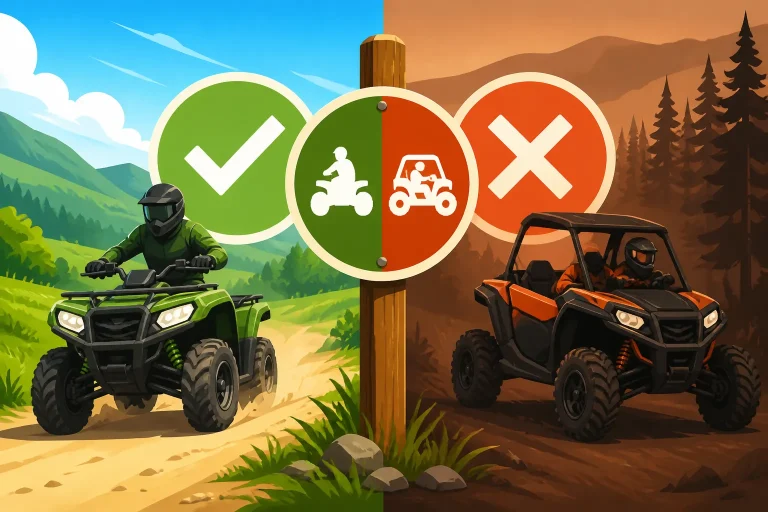
The most important limitation is that registration reciprocity does not equal permission to ride everywhere. Pennsylvania has distinct registration, trail-access, land-use, and operating rules. A visitor may satisfy one requirement and still need another authorization.
Trail permits are a separate requirement
Some places have their own access rules or permit systems. Mutual recognition of a home-state registration does not automatically waive those requirements. Check the specific trail or property before setting out, including whether a permit applies to each machine, whether the permit must be displayed, and whether the route is open during your travel dates.
For state forest riding, start with Do You Need a Permit for Pennsylvania State Forest Trails?. Some routes and land systems have rules that do not apply statewide. The Allegheny National Forest, for example, has its own access requirements; see Why the Allegheny Forest Sells Its Own Permit for the distinction between registration and forest access.
A trail permit is not necessarily a replacement for registration, either. Depending on the location and the machine, riders may need both. Confirm both requirements rather than treating a permit sticker as proof that registration reciprocity applies.
Pennsylvania operating rules still apply
A visitor riding in Pennsylvania must follow the rules that govern the location and type of operation. That may include restrictions on age, helmets, passengers, insurance, lights, road use, and machine dimensions. The fact that a machine is legal to operate in its home state does not make every Pennsylvania route legal for it.
Road use deserves particular care. Registration does not make an ATV or UTV street legal, and a route open to certain off-road machines is not necessarily open to every machine or rider. If your plan involves a road connection, verify that the specific road is designated or otherwise authorized for the intended use. Do not assume that local access follows from reciprocity.
Likewise, private property and club trails have their own access conditions. A registration does not grant permission to cross private land. Obtain the required permission or membership and follow any posted restrictions.
Insurance and other proof are not automatically waived
Reciprocity should not be treated as an exemption from Pennsylvania requirements that apply to the ride. Check whether insurance is required for your intended use and what documentation needs to be carried. Your home-state policy may or may not cover the activity or location you have planned; ask your insurer rather than assuming.
Safety-course credentials are another separate issue. Recognition of an out-of-state registration does not automatically mean Pennsylvania accepts an out-of-state safety certificate for every purpose. If a rider’s age or the type of riding makes a safety certificate relevant, check that question separately. Does Pennsylvania Accept an Out-of-State Safety Certificate? addresses that issue.
These distinctions can be summarized simply: registration answers whether the machine has the required registration status; a permit answers whether it can access a particular place; insurance and safety rules answer separate questions about operating it.
What to do if your state is not recognized
If your home-state registration is not covered by Pennsylvania’s current reciprocity policy, do not assume that you can ride anyway because the machine has a plate. First, ask Pennsylvania’s registration office what options apply to your circumstances. The answer may depend on whether you are a visitor or a Pennsylvania resident, how the machine is classified, and where you plan to ride.
Avoid applying for a Pennsylvania registration without first confirming that it is the correct solution. Registration systems have eligibility and paperwork requirements, and a duplicate registration may not solve a separate trail-access problem. The agency can clarify whether Pennsylvania registration is available or required for your case and what documents it expects.
If your trip includes several destinations, confirm requirements for each one. One trail system’s permit does not necessarily cover another, and registration recognition does not make a machine eligible for a route that excludes its size or type. Make a simple checklist for each ride day:
- Registration status and proof
- Required plate, decal, or other display
- Trail or land-access permit
- Insurance and any required proof
- Rider age and safety requirements
- Machine dimensions and route eligibility
- Road connections and local restrictions
- Current closures and seasonal access
For a visitor, the safest approach is to resolve any uncertainty before towing the machine to the trailhead. If the paperwork does not qualify, the problem is much easier to address at home than after arrival.
Frequently Asked Questions
Does Pennsylvania recognize every out-of-state ATV registration?
No. Recognition depends on Pennsylvania’s current reciprocity conditions and whether the other state provides comparable treatment to Pennsylvania registrations. Confirm the state, machine type, and document before riding.
Does a reciprocal registration let me ride Pennsylvania state forest trails?
Not by itself. Registration reciprocity and trail access are separate. Check whether the specific trail requires a permit and whether the machine is eligible for that route.
Can a Pennsylvania resident use an out-of-state registration instead?
Do not assume so. The registration must be valid under the issuing state’s rules, and Pennsylvania’s requirements for residents may still apply. Check with DCNR before relying on an out-of-state plate.
What should I carry when riding as a visitor?
Carry the registration proof required for your machine and any separate permit or insurance proof required for the ride. Confirm whether the document must be an original and whether a plate or decal must be displayed.
Disclaimer
This article is for general informational purposes only and does not constitute professional advice. Laws, prices and regulations vary by location and change over time. Consult a qualified professional for guidance on your specific situation.