Getting a Safety Certificate for an Eight-Year-Old
An eight-year-old in Pennsylvania needs more than a small ATV and an adult nearby to ride away from home. The safety-course rule depends on whose land the child is riding on, while age also limits engine size. Here’s how to understand the certificate requirement, what it does and does not allow, and what to check before a first ride.
When an Eight-Year-Old Needs a Safety Certificate
Pennsylvania requires children ages 8 through 15 to complete an ATV safety course and obtain a certificate to ride on land that does not belong to their parent or guardian, according to the Pennsylvania Department of Conservation and Natural Resources (DCNR). The rule applies to an eight-year-old riding away from a parent’s or guardian’s property, including when a landowner has given permission to ride.
That makes the land question important. A child riding on a parent’s or guardian’s own property is outside this particular certificate requirement. On other land, permission from the owner and the safety certificate are separate matters: permission may allow access, but it does not replace the course and certificate. For an overview of the age-based rule, see Pennsylvania Safety Certificates for Ages 8 to 15.
| Where the child rides | Certificate rule for an eight-year-old | Other point to check |
|---|---|---|
| Property belonging to the child’s parent or guardian | The certificate requirement described by DCNR applies to land outside the parent’s or guardian’s property. | Follow safe riding practices and any rules that apply to the property. |
| Another person’s private property | DCNR requires a course and certificate for riders ages 8 through 15. | The owner’s consent is also needed. |
| State-owned property | DCNR requires a certificate for a rider in this age group who rides away from a parent’s or guardian’s property. | ATVs may be operated on state-owned property only on clearly marked, designated trails. |
| A township road open to ATVs or another road | A safety certificate alone does not make every road available to an eight-year-old. | Road-use age rules are separate and can be more restrictive. |
A certificate is not a general pass to ride anywhere. It confirms that the child has met the safety-training requirement; it does not grant permission to use someone else’s land, open a closed trail, or override age and machine-size restrictions. DCNR says ATVs may be operated on private property with the owner’s consent, and on state-owned property only on clearly marked and designated trails.
Before making plans, work through these questions:
- Whose property is it? If it is not the child’s parent’s or guardian’s property, plan to meet the course and certificate requirement.
- Is the land open to ATV riding? Permission from a landowner does not mean a state trail or road is open.
- Is the machine appropriate for the child’s age? For an eight-year-old, the engine-size limit is a key part of the decision.
- Will the ride involve a road? Road rules are not the same as the general trail-training rule.
The certificate requirement is easy to miss when a ride is described as “just a short trip” or “only on a friend’s land.” The relevant distinction is whose land the child is riding on, not how long the ride lasts or whether an adult is present.
How to Get the Certificate
The confirmed steps are straightforward in principle: the child must complete an ATV safety course and receive a certificate before riding on land outside a parent’s or guardian’s property. DCNR’s rule establishes the required course and certificate, but course arrangements can involve details that should be checked directly with DCNR before enrolling.
Confirm the current course instructions
Start with DCNR’s instructions for youth ATV safety training. Check how to enroll, whether the course is offered in a format suitable for the child, what the child must complete, and how the certificate is issued. Don’t assume that watching an informal safety video, attending a dealer demonstration, or riding with an experienced adult counts as completing the required course.
The available facts establish that the course is required; they do not establish a particular provider, enrollment process, test format, or completion timeline. Confirm those details with DCNR rather than relying on an old form or someone else’s recollection. Where to Take a Pennsylvania ATV Safety Course and Pennsylvania ATV Course for Ages 8 to 15 are useful related topics when you are sorting out the training requirement.
Make sure the certificate is actually issued
Completing training and having the certificate in hand are not interchangeable for riding purposes. DCNR requires youth riders in the applicable age group to complete the course and obtain a certificate. Before the child rides away from a parent’s or guardian’s land, confirm that the certificate has been issued and find out how DCNR expects the rider to carry or show it. The related guidance on Carrying the Certificate on a Ride can help with that practical question.
Keep the certificate with the child’s riding paperwork, and make sure the child knows where it is. If the certificate is lost, damaged, or not yet received, check with DCNR about what to do instead of assuming that a course-completion confirmation will be accepted as a substitute.
Keep the rule separate from other riding requirements
A safety certificate does not take the place of vehicle registration, landowner permission, insurance, or trail access requirements. DCNR says ATVs in Pennsylvania must be registered and titled, except those used solely for business or agricultural purposes. The training certificate addresses the rider; registration and title address the machine. For an overview of the certificate rule alongside related youth requirements, see Pennsylvania ATV Safety Certificate Requirements.
Insurance is another separate issue. DCNR requires liability insurance when riding on property the rider does not own or lease, and riders must carry proof while riding. DCNR has not established minimum coverage standards for ATV liability insurance. Check the current requirements for the particular ride rather than treating a training certificate as proof that the vehicle paperwork is complete.
Age, Engine Size, and Where an Eight-Year-Old Can Ride
For an eight-year-old, course completion is only one part of the decision. Pennsylvania also limits the machine size for the youngest riders and restricts riding on state-owned property to designated ATV trails.
Choose a machine within the age limit
DCNR restricts riders who are 8 or 9 years old to ATVs with engines of 70cc or smaller. An eight-year-old’s course certificate does not remove that limit. Check the machine’s engine size before buying, borrowing, or taking it to a riding area. If the machine is above the limit, it is not an appropriate choice for an eight-year-old under this rule. See A 70cc Cap for the Youngest Riders for more on how the restriction applies.
A machine that fits the engine-size limit still needs to suit the child’s ability and physical size. DCNR advises that young or inexperienced riders should not operate ATVs without proper training and supervision. Training is a legal requirement for riding away from a parent’s or guardian’s property; careful supervision is a practical safety measure wherever the child rides.
Confirm the exact riding area
Private property, state-owned trails, and roads are not interchangeable settings. On private property, DCNR says the owner’s consent is required. On state-owned property, ATV riding is limited to clearly marked and designated trails. A certificate does not authorize riding off a marked trail or onto land where ATVs are not permitted.
State forest trails also have their own operating season. DCNR says designated ATV trails on state forest lands are open from the Friday before Memorial Day through the last full weekend in September. Trail access can depend on the specific place and current conditions, so check the destination before setting out. Why Eight Is the Floor on State Land provides additional context on youth riding restrictions.
An adult should verify that the route is truly open to ATVs, not simply a road or track that looks rideable. This matters especially where trail networks meet roads, private property, or other public land. If there is uncertainty about whether a specific route is designated, check with the managing agency before riding.
Treat road rules as a separate barrier
A child’s safety certificate does not automatically allow the child to operate an ATV on a road. DCNR says operators on joint-use roads open to ATVs and licensed motor vehicles must be at least 16 years old. DCNR also states that a driver crossing a street or highway must be at least 16 unless the driver holds a safety certificate and is supervised by someone at least 18. That crossing exception is not a general authorization for an eight-year-old to ride along a road. Confirm the precise crossing and route rules before planning any ride involving a street or highway.
For an eight-year-old, the simplest plan is usually to choose a permitted off-road area and avoid a route that depends on road travel. A certificate demonstrates training; it does not change the minimum age for joint-use roads.
A Pre-Ride Checklist for Parents and Guardians
Use this checklist before the child rides anywhere beyond a parent’s or guardian’s property. It keeps the certificate in context and helps catch problems that can be overlooked when the focus is only on the course.
- Course completed: The child has completed the required ATV safety course.
- Certificate issued: The child has obtained the certificate, and you know how it must be carried or presented.
- Land access confirmed: The ride is on property where ATV use is allowed, with the owner’s consent when riding on private property that is not yours.
- Trail status checked: If riding on state-owned property, the route is a clearly marked, designated ATV trail and is open for riding.
- Machine size checked: The ATV’s engine is 70cc or smaller, as DCNR requires for riders who are 8 or 9.
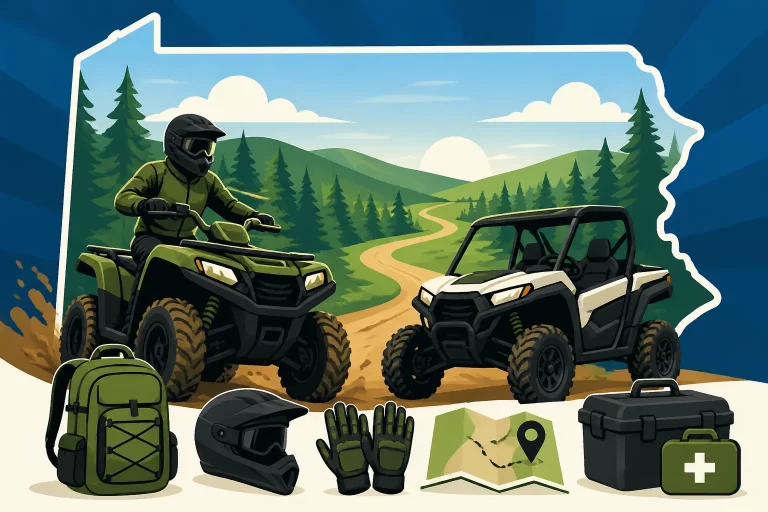
- Protective equipment ready: DCNR requires operators to wear a securely fastened helmet and eye protection. Operating without a securely fastened helmet is illegal.
- No passenger: DCNR prohibits carrying passengers on an ATV.
- Supervision arranged: The child is not riding without proper training and supervision.
- Other paperwork handled: Registration and any applicable insurance or trail requirements have been checked separately.
- Route kept off restricted roads: The ride does not rely on a certificate to get around a road-age restriction.
It is also worth explaining the rules to the child in plain language. They should know that a certificate does not mean they can ride on every trail, enter private land without permission, carry a passenger, or take an ATV onto a road. They should be able to identify the route they are allowed to use and understand that they must stop if the route becomes unclear.
A parent or guardian can make the first ride easier by keeping it simple: choose a familiar, permitted riding area, confirm access in advance, and avoid mixing trail riding with road crossings. The goal is not just to satisfy a paperwork requirement. It is to make sure the child understands the limits that apply to the machine, land, and route.
If any detail is unclear—especially the enrollment process, proof of course completion, or whether a trail is open—confirm it with DCNR or the land manager before riding. For broader youth age rules, see Pennsylvania Rules for a Nine-Year-Old Rider.
Sources
- Pennsylvania Department of Conservation and Natural Resources — Home Page – Snowmobile/ATV Registration (checked November 3, 2026)
- Department of Conservation and Natural Resources — Safety and Training | Department of Conservation and Natural Resources| Commonwealth of Pennsylvania (checked November 3, 2026)
- Pennsylvania Department of Conservation and Natural Resources — Request Youth ATV Rider Training | Commonwealth of Pennsylvania (checked November 3, 2026)
- Department of Conservation and Natural Resources — Riding Rules and Enforcement | Department of Conservation and Natural Resources| Commonwealth of Pennsylvania (checked November 3, 2026)
- Department of Conservation and Natural Resources — ATV Riding | Department of Conservation and Natural Resources| Commonwealth of Pennsylvania (checked November 3, 2026)
- Pennsylvania Department of Conservation and Natural Resources — Trail Conditions – Snowmobile/ATV Registration (checked November 3, 2026)
Disclaimer
This article is for general informational purposes only and does not constitute professional advice. Laws, prices and regulations vary by location and change over time. Consult a qualified professional for guidance on your specific situation.