Pennsylvania Reciprocity With Ohio
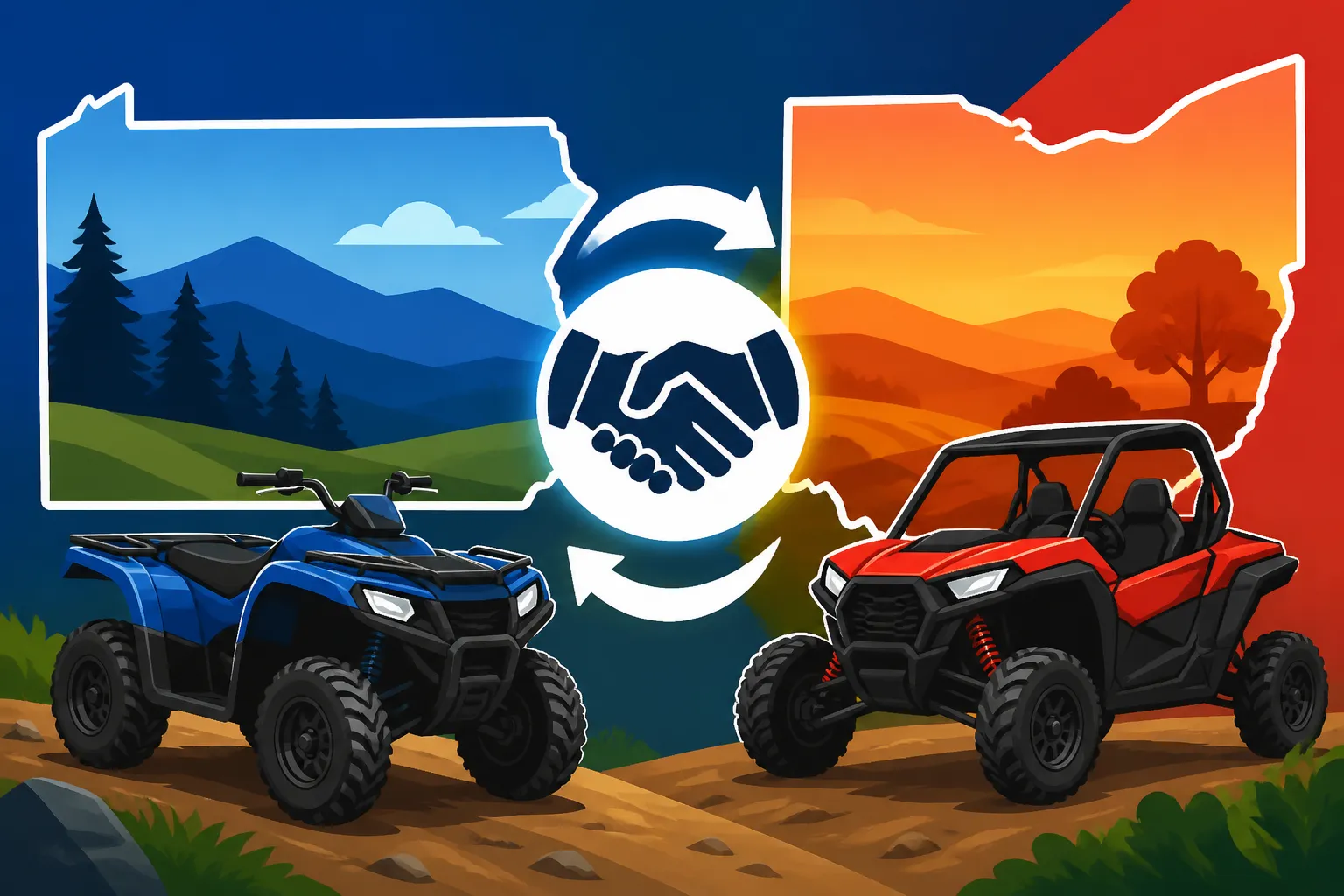
If your ATV or UTV is registered in Ohio, you may be able to ride it in Pennsylvania without obtaining a Pennsylvania registration. The key is understanding what reciprocity covers—and what it does not. A valid Ohio registration can address the machine’s registration status, but it does not automatically provide access to every Pennsylvania trail or waive the state’s riding rules.
What Pennsylvania reciprocity with Ohio means
Pennsylvania recognizes registration from certain other states under reciprocity arrangements. Ohio is included, so a visitor with a properly registered Ohio ATV or UTV can generally use that registration when riding in Pennsylvania. You normally do not need to register the same machine again with Pennsylvania’s Department of Conservation and Natural Resources solely because you have crossed the state line.
That recognition is about registration, not a blanket permission to ride anywhere. You still need to follow Pennsylvania rules for the type of land, road, or trail you are using. A machine’s Ohio registration does not turn it into a street-legal vehicle, authorize riding on a closed trail, or replace a separate permit required at a particular riding area.
| What you bring or plan to do | What reciprocity covers | What to check separately |
|---|---|---|
| A currently registered Ohio ATV or UTV | Whether the machine’s home-state registration can be recognized in Pennsylvania | Keep proof of the valid Ohio registration with you |
| Riding a Pennsylvania state forest trail | Registration status alone | Whether the trail requires a Pennsylvania permit and whether your machine fits its rules |
| Riding in the Allegheny National Forest | Ohio registration status | Any separate forest permit or local access requirements |
| Riding on a Pennsylvania road | Registration status only | Whether that specific road is open to ATVs and whether the machine and rider meet road-use requirements |
| Riding on private or club land | Registration status only | Landowner permission, club membership, or event requirements |
For a broader explanation of the state’s approach, see Pennsylvania ATV Reciprocity With Other States. For the visitor-focused requirements, Riding Pennsylvania With an Out-of-State Plate and Carrying Proof of an Out-of-State Registration are useful companion topics.
Your Ohio registration must be valid and belong to the machine
Reciprocity depends on having a legitimate, current registration—not merely an Ohio title, purchase receipt, bill of sale, or an application for registration. Bring the Ohio registration document or other official proof issued for the machine. Check that the identifying details match the ATV or UTV you are transporting, especially if you have recently bought it or transferred it to another owner.
If your Ohio registration has expired, is still being processed, or belongs to a previous owner, do not assume that a title or sales paperwork will work as a substitute. Resolve the registration issue before riding, or ask Pennsylvania’s registration office what documentation it will accept for your circumstances. The article [Does Pennsylvania Honor an Ohio ATV Registration?] addresses the recognition question directly.
Keep the proof somewhere you can reach it during a ride. A photo on a phone can be a useful backup, but it is safer not to rely on a phone alone: batteries fail, devices get damaged, and a remote trail may have limited service. Carry the official document in a protected wallet or storage pouch, and keep a separate copy with your travel paperwork.
Registration is not the same as a trail permit
Pennsylvania has different access rules for different public lands and privately managed riding areas. Ohio registration may satisfy the registration part of the trip, but a riding area can still require a trail permit, pass, membership, or other authorization. The permit may need to be purchased for each machine, so check the rules for every ATV or UTV you plan to bring.
The state’s permit system is explained in Pennsylvania ATV Trail Permits Explained. Some designated state forest trails require a Northcentral Regional Trail Permit, while other locations have their own arrangements. A permit for one trail system should not be treated as permission to ride elsewhere.
If your route includes a state forest, check Do You Need a Permit for Pennsylvania State Forest Trails? before loading the trailer. If the destination is in the Allegheny National Forest, review its separate requirements as well; the Ohio registration does not replace a forest-specific permit. Private parks and clubs can set their own access conditions, too.
What to check before riding in Pennsylvania
The safest planning approach is to separate the trip into three questions: Is the machine properly registered? Is the specific place open to this machine? Have you met the site’s access requirements? Answering each one helps avoid the common mistake of treating a valid Ohio plate as an all-purpose riding pass.
Confirm the destination and route
Start with the exact trail, park, forest, or road you intend to use. Do not rely on a general map showing a road or trail as rideable; closures, seasonal limits, machine-size restrictions, and permit rules may apply. Check current information from the land manager or riding area before leaving, especially if you are traveling during a seasonal opening or after heavy rain.
State forest trails can have limits on machine width and other vehicle characteristics. A full-size side-by-side may not be allowed on a trail that is open to narrower ATVs. Confirm the rules for your particular machine rather than assuming that all registered vehicles have the same access. The overview [Pennsylvania Rules for Riding a National Forest] can help you identify the separate considerations for national forest land.
Also check the route between your parking area and the trail. A road that connects two riding areas may not be open to ATVs just because the trails on either side are. Pennsylvania road use depends on whether the road has been officially opened for ATV use and on additional rider and vehicle requirements. For the separate issue of road legality, see Street Legal ATVs in Pennsylvania: The Short Answer.
Review rider, insurance, and equipment requirements
Pennsylvania’s riding rules apply to visitors as well as residents. Check age and supervision requirements for any young rider in your group, and do not assume that an Ohio registration changes those rules. If a rider’s eligibility depends on a safety certificate, verify that the rider has acceptable proof before the trip. Pennsylvania Safety Certificates for Ages 8 to 15 and Does Pennsylvania Accept an Out-of-State Safety Certificate? cover those questions.
Insurance is another separate issue. A policy written in Ohio may cover riding in Pennsylvania, but the registration itself does not prove that you have the insurance Pennsylvania requires for the kind of riding you plan to do. Read the policy or confirm coverage with your insurer, and carry proof. Make sure the policy applies to the machine, the rider, and off-road use in Pennsylvania rather than assuming that ordinary vehicle coverage or an Ohio registration card is enough.
Check the destination’s equipment rules as well. A riding area may require helmets or eye protection, limit passengers, or apply stricter rules than the general rules that affect your trip. For road use, additional requirements may apply to the operator, passenger, lighting, and insurance. Plan for the rules of the actual activity rather than using the machine’s Ohio registration as a guide to every requirement.
A practical pre-trip checklist
Use this checklist for each machine, including a borrowed ATV or UTV:
- Confirm that the Ohio registration is valid and issued for that machine.
- Carry the official registration proof and make sure the machine’s identifying information matches it.
- Identify the exact trail systems, roads, and properties you intend to use.
- Check whether each destination requires a separate permit, pass, club membership, or permission.
- Confirm machine-width, seasonal, age, passenger, and safety requirements for the destination.
- Verify that your insurance covers the planned riding in Pennsylvania, and carry proof of coverage.
- Check current closures and access notices before setting out.
This process matters most when one trip includes several types of land. A machine could be properly registered in Ohio and allowed at one destination, but still need a separate permit at another. A road segment between trailheads may have different rules from either trail system. Check each part of the route rather than assuming the first access decision applies to the whole day.
| Before you leave | Why it matters |
|---|---|
| Ohio registration document | Shows the machine has current home-state registration |
| Insurance proof | Helps show coverage for the planned Pennsylvania riding |
| Trail or forest permit, if required | Registration reciprocity does not replace local access authorization |
| Safety certificate or other rider documents, if applicable | Rider rules are separate from machine registration |
| Current trail and road information | Access can vary by location, season, machine, and temporary closure |
Common mistakes Ohio riders can avoid
Treating a title as registration
A title proves ownership; it is not the same thing as a current registration. If you recently purchased an ATV in Ohio, do not assume that the title or bill of sale alone establishes that the machine is registered for riding. Finish the registration process and carry the resulting proof. For a Pennsylvania purchase or registration issue, Pennsylvania Registration for a Machine Registered Elsewhere explains how out-of-state registration questions differ from ordinary title paperwork.
Assuming reciprocity provides access everywhere
A valid Ohio registration does not mean every Pennsylvania public trail is open to you. State forests, national forests, game lands, private property, and managed riding areas can have different access rules. Some locations prohibit ATV use, some open only designated routes, and some require an additional permit. Read the rules for the destination, not just the rules for registration.
It is particularly important not to confuse registration with a trail permit. The former identifies the machine as registered under a state’s system; the latter may grant access to a specific trail network or land unit. What Pennsylvania Charges Visitors to Ride summarizes why visitors may face access requirements beyond their Ohio registration.
Assuming a plated ATV can use public roads
A registration plate is not permission to ride on any public road. Pennsylvania permits ATV use only in situations allowed by its road rules, such as on routes specifically opened for that purpose or at authorized crossings. A road shown on a map may still be closed to ATVs. Before riding a connector, check that it is officially open and confirm that you meet the rules for that road.
Do not plan to ride from a trailhead into a nearby town unless you have confirmed that the complete route is legal for an ATV or UTV. A short distance on a closed road can still create a citation and may put riders and other road users at risk.
Forgetting that rules can change by location
A visitor may hear that Ohio registration is accepted and take that to mean every requirement is settled. In practice, a ride can involve state registration rules, land-manager rules, a separate permit, machine restrictions, and rider requirements at the same time. Check the relevant official information before travel, and recheck close to the ride if weather or seasonal conditions could affect access.
The simple takeaway is: a valid Ohio registration can generally satisfy Pennsylvania’s registration requirement through reciprocity, but it does not replace Pennsylvania’s riding rules or a permit required by a particular trail system. Bring proof, verify insurance and rider requirements, and confirm access for each place on your itinerary.
Disclaimer
This article is for general informational purposes only and does not constitute professional advice. Laws, prices and regulations vary by location and change over time. Consult a qualified professional for guidance on your specific situation.