What a Weekend Visitor Needs to Ride Pennsylvania
A weekend ride in Pennsylvania takes more than loading the ATV and picking a trail. Visitors need to sort out registration reciprocity, liability insurance, trail-specific permits, seasonal access, and age-related safety rules. The right combination depends on where you plan to ride and who is coming along. Use this checklist to prepare before you leave home.
Check your registration and insurance first
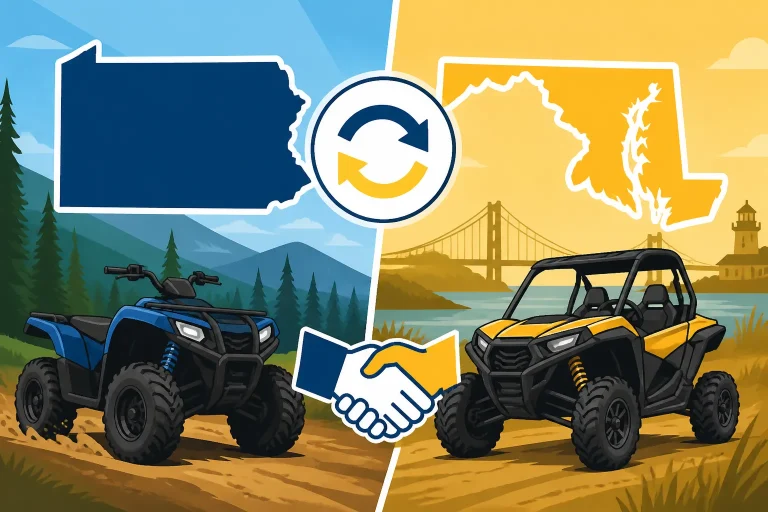
Pennsylvania generally requires ATVs to be registered and titled through the Department of Conservation and Natural Resources (DCNR), but visitors have an important exception. According to DCNR, a nonresident ATV with valid registration from another state does not need Pennsylvania registration. That exception is about registration; it does not automatically give you access to every trail or replace other requirements.
Carry proof of your home-state registration while riding. A registration card or other official document can help you show that the machine qualifies for the nonresident exception if you are asked. For more detail on the state-to-state rule, see Does Pennsylvania Honor an Out-of-State Registration? and Carrying Proof of an Out-of-State Registration.
Liability insurance is a separate requirement. According to DCNR, you must have liability insurance when riding on property you do not own or lease, and you must carry proof of insurance with you while riding. DCNR has not established minimum coverage amounts or other coverage standards for ATV liability insurance. That does not make the requirement optional: confirm with your insurer that your policy provides ATV liability coverage for the kind of riding you plan to do, then bring acceptable proof.
This distinction matters for a weekend visitor. A valid out-of-state registration may keep you from needing a Pennsylvania registration, but it does not exempt you from Pennsylvania’s insurance requirement when you ride away from your own or leased property. Trail permits are another separate issue, covered below. A home-state plate does not, by itself, authorize riding on a Pennsylvania trail system.
| Before the ride | What to check | Why it matters |
|---|---|---|
| Registration | Valid registration from your home state, if you are relying on the nonresident exception | DCNR says a valid out-of-state registration means a nonresident ATV does not need Pennsylvania registration |
| Insurance | Liability coverage and proof carried with you | DCNR requires liability insurance on property you do not own or lease |
| Destination | Whether that trail or property requires its own permit or permission | Registration and trail access are separate |
| Youth riders | Required training certificate and any age or machine-size limits | Requirements vary by rider age and where the ATV will be used |
| Season | Current opening dates, closures, and permitted trail types | A trail being on a map does not mean it is open for your weekend |
If your ATV does not have valid registration from another state, do not assume that a short visit makes registration rules disappear. According to DCNR, ATVs generally must be registered and titled, except machines used solely for business or agricultural purposes and certain other listed exemptions. A Pennsylvania General Registration allows use off private property; DCNR describes it as costing $20 for two years and providing a plate, expiration sticker, and wallet card. A Limited Registration is free and never expires, but it is for on-property use only. It does not serve as a substitute for trail access.
These Pennsylvania registration options are mainly relevant if you live in the state, are bringing an unregistered machine, or need to resolve a registration problem before riding. If you need to understand the visitor rules in more depth, see Pennsylvania Registration for a Machine Registered Elsewhere and Pennsylvania ATV Reciprocity With Other States.
Confirm the permit for the place you plan to ride
Pennsylvania has multiple kinds of riding areas, and one permit should not be assumed to cover them all. Before you set out, identify the actual trail system or property, then check its rules for permits, registration, season dates, machine eligibility, and access. The Pennsylvania ATV Trail Permits Explained overview can help you distinguish trail access from vehicle registration.
For example, the Northcentral Regional ATV Trail requires a yearly permit for all riders, according to DCNR. The trail covers parts of Clinton, Lycoming, Potter, and Tioga counties. DCNR lists the resident permit at $70 and the nonresident permit at $100 for the 2026 season. The 2026 season opened on Friday, May 22, and closed on Sunday, September 27, according to DCNR. Those dates have passed, so check DCNR’s current information before planning a future visit rather than assuming the trail is open.
The Allegheny National Forest has its own permit requirement. According to DCNR, riders need an annual $35 permit to use its ATV trail system, which has more than 100 miles of trails. DCNR gives the season as running from the Friday before Memorial Day through the last Sunday in September. Check the current forest rules and season before traveling; a Northcentral permit is not a substitute for an Allegheny National Forest permit.
State forest access has its own limits, too. According to DCNR, ATV riding in Pennsylvania state forests is restricted to designated trails, not state forest roads, state parks, or state game lands. Designated state forest trails are open from the Friday before Memorial Day through the last full weekend in September, according to DCNR. In practice, confirm the exact trail’s status and any posted restrictions before you ride.
The size and type of your machine can affect where it is allowed. According to DCNR, Class I ATVs are no more than 50 inches wide and have a dry weight of no more than 1,200 pounds. Class II ATVs exceed either limit and may be used on state forest land only where a trail is specifically posted open to them. If you ride a UTV or a wider machine, verify that the specific route allows it; do not rely on a trail map that does not identify vehicle restrictions.
Permit and access checks are worthwhile even if your weekend is already booked. A trail can be closed for the season or restricted to certain machines, and permission to ride private land is not the same as permission to ride public trails. DCNR says ATVs may be operated on private property with the owner’s consent, while state-owned property is limited to clearly marked and designated ATV trails. For system-specific details, see Pennsylvania’s Northcentral Regional Trail Permit and Pennsylvania’s Allegheny National Forest Permit.
Prepare youth riders and follow the riding rules
If children are joining the trip, check their age, training, and machine before you leave. According to DCNR, riders between 8 and 15 must complete an ATV safety course and receive a certificate to ride on land other than their parents’ or guardians’ property. They must carry the certificate when riding off that property. DCNR says children under 8 cannot operate an ATV on state-owned property, and riders who are 8 or 9 are restricted to machines with engines of 70cc or less.
DCNR states that children aged 16 or older must take its online ATV Safety Training course. It also encourages riders aged 16 or older to take the online course. Since training requirements depend on age and where the rider will be riding, confirm that each young rider has the required certificate before heading to a trail. See Pennsylvania ATV Safety Certificate Requirements and Does Pennsylvania Accept an Out-of-State Safety Certificate? if a rider trained outside Pennsylvania.
Safety rules apply to adults as well as young riders. According to DCNR, operators must wear a securely fastened helmet and eye protection, and it is illegal to operate an ATV without a securely fastened helmet. Passengers are prohibited on an ATV. Young or inexperienced riders should not operate without proper training and supervision, and operating under the influence of alcohol or other drugs is prohibited.
Stay on trails specifically designated for ATVs. On state-owned property, DCNR requires riders to use clearly marked and designated trails. If your route includes a road crossing, check the rule before you approach it: according to DCNR, a rider crossing a street or highway must be at least 16 unless the rider has a safety certificate and is supervised by someone who is at least 18. Joint-use roads open to ATVs and licensed motor vehicles have a separate minimum operator age of 16, according to DCNR. Do not assume that a road is open to ATVs just because it connects two parts of a route.
If you are relying on a township road, look for the green sign showing a white side-view silhouette of an ATV and rider; DCNR identifies that sign as the marker for township roads designated for ATV use. Confirm that the road is open and that your planned connection does not take you onto an unposted road. For more on road access, see Pennsylvania’s Designated ATV Roads.
Use a before-you-go checklist
Once the destination and riders are sorted out, take a moment to check the machine and pack the documents you may need. A compact checklist can prevent a long drive from turning into a canceled ride.
- Verify the destination. Check the trail system’s current permit, operating season, closures, and machine restrictions. If you are unsure which permit applies, ask the trail operator or land manager before traveling.
- Check registration and insurance. Bring your valid out-of-state registration if you are relying on the nonresident exception. Carry proof of liability insurance as required by DCNR when riding on property you do not own or lease.
- Confirm youth requirements. Make sure young riders have the required safety certificate and that the machine suits the rider’s age. Do not take a child under 8 onto state-owned property to operate an ATV, or take an 8- or 9-year-old on a machine above the stated engine limit.
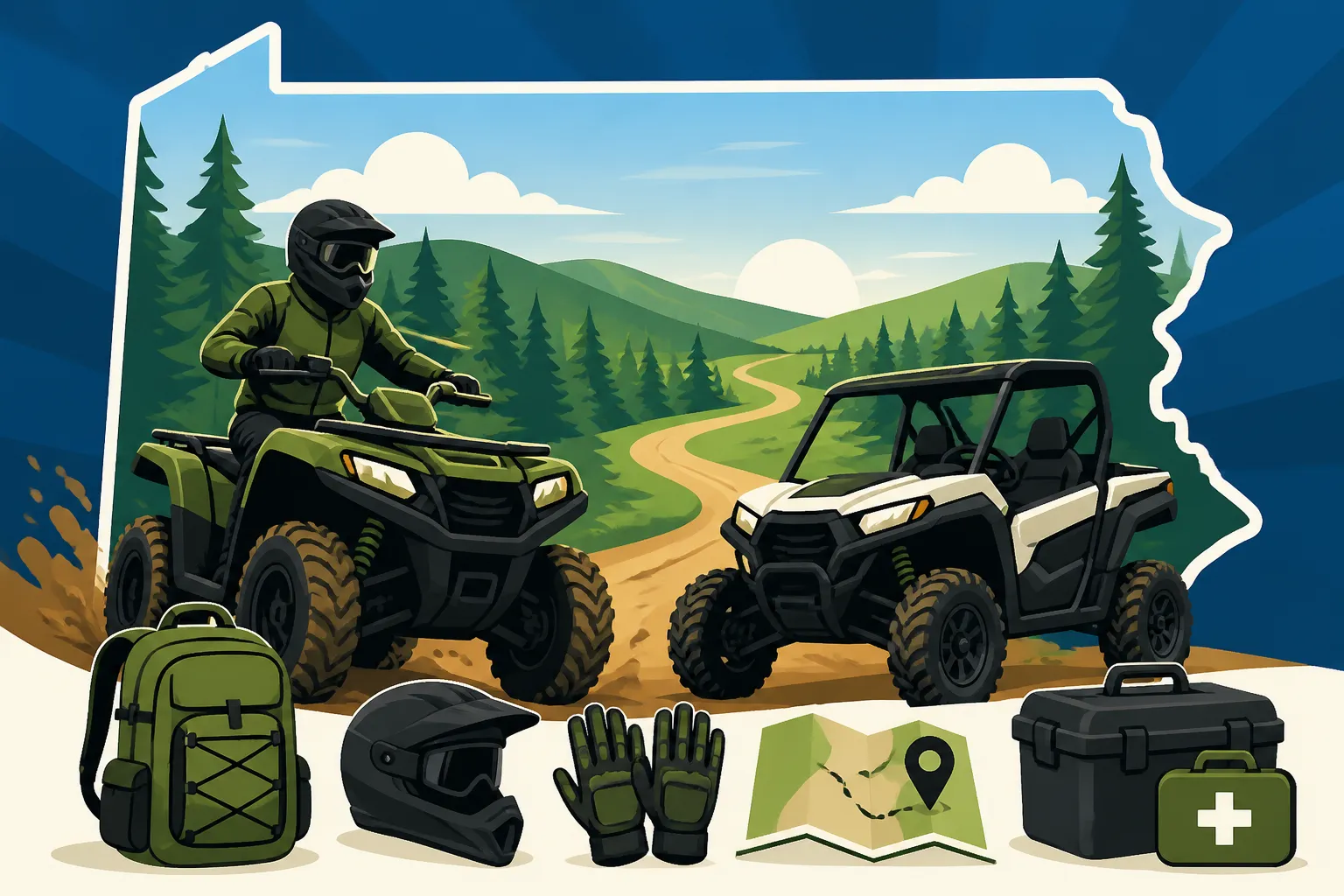
- Pack protective gear. DCNR requires a securely fastened helmet and eye protection. Bring gear for every rider, not just the person operating the machine.
- Inspect the ATV. Check that the machine is in safe working condition and that its lights and brakes work if your planned riding includes areas where they are required. DCNR specifies braking and lighting requirements, so review the rules that apply to your route.
- Mount the plate correctly. If your machine has a registration plate, DCNR says it must be on the upper rear, away from the tires, and visible from behind. The registration sticker belongs in the bottom corner of the plate area.
- Have a plan for an accident. DCNR requires drivers involved in an ATV accident to stop and exchange personal and vehicle information with the other parties or a police officer. Accidents involving injury, death, or more than $100 in property damage must be reported within seven days, according to DCNR.
A little preparation also helps avoid confusing a purchase or rental arrangement with permission to ride. A dealer’s temporary sticker, a rental agreement, a club membership, and a trail permit each serve different purposes. Ask the seller, rental provider, or trail operator exactly what documents and access permissions are included, and what you must arrange yourself. For a broader breakdown of visitor requirements, see What Pennsylvania Charges Visitors to Ride.
The practical takeaway is simple: carry valid registration from your home state, bring proof of liability insurance, and get the permit required by your specific destination. Then confirm the season, machine rules, and youth requirements before loading the trailer. Pennsylvania has 908 miles of designated ATV trails, according to DCNR, but access depends on following the rules for the particular place you choose.
Sources
- Pennsylvania Department of Conservation and Natural Resources — Home Page – Snowmobile/ATV Registration (checked November 3, 2026)
- Department of Conservation and Natural Resources — Register or Title Your ATV | Commonwealth of Pennsylvania (checked November 3, 2026)
- Department of Conservation and Natural Resources — DCNR-18.pdf (checked November 3, 2026)
- Department of Conservation and Natural Resources — Safety and Training | Department of Conservation and Natural Resources| Commonwealth of Pennsylvania (checked November 3, 2026)
- Pennsylvania Department of Conservation and Natural Resources — Request Youth ATV Rider Training | Commonwealth of Pennsylvania (checked November 3, 2026)
- Department of Conservation and Natural Resources — Riding Rules and Enforcement | Department of Conservation and Natural Resources| Commonwealth of Pennsylvania (checked November 3, 2026)
- Department of Conservation and Natural Resources — ATV Riding | Department of Conservation and Natural Resources| Commonwealth of Pennsylvania (checked November 3, 2026)
- Pennsylvania Department of Conservation and Natural Resources — Trail Conditions – Snowmobile/ATV Registration (checked November 3, 2026)
- Department of Conservation and Natural Resources — Northcentral Regional ATV Trail | Department of Conservation and Natural Resources| Commonwealth of Pennsylvania (checked November 3, 2026)
- DEPARTMENT OF CONSERVATION AND NATURAL RESOURCES — Report an ATV or Snowmobile Accident | Commonwealth of Pennsylvania (checked November 3, 2026)
Disclaimer
This article is for general informational purposes only and does not constitute professional advice. Laws, prices and regulations vary by location and change over time. Consult a qualified professional for guidance on your specific situation.