Pennsylvania Campgrounds Beside a Trailhead
A campground that looks close to a Pennsylvania ATV trailhead may still leave you with a long trailer haul, a complicated check-in, or no legal way to ride from your campsite to the trail. This guide explains how to choose a practical base near popular riding areas, what to confirm before booking, and how to plan for registration, permits, trail access, and towing.
How to Choose a Pennsylvania Campground Near ATV Trails
The best campground is not always the one closest to a trail on a map. What matters is whether you can legally and conveniently get your machine from the campsite to the trail system, whether the campground can accommodate your trailer, and whether its rules fit the way your group rides.
Start with the trail system, not the campground listing
First decide where you want to ride. Pennsylvania has several distinct kinds of riding destinations, including state forest trails, private off-road parks, and club-managed trail systems. They do not all have the same access rules, seasons, fees, or machine restrictions. A campground close to one kind of riding area may be a poor match if you have a wide side-by-side, a large trailer, or a group that needs facilities and space to unload.
Popular planning anchors include the Anthracite Outdoor Adventure Area near Shamokin, Rock Run Recreation Area in Cambria County, and trail systems around Westport and Snow Shoe. For a trip in the Allegheny National Forest, Marienville is a useful place to start your campground search. These place names help narrow your search area; they do not guarantee that a campground is beside a trailhead or that riding directly from the campground is allowed.
Before booking, identify the actual staging area you plan to use. Check its location, access road, parking situation, operating schedule, and machine requirements. Then compare the campground’s address with the trailhead—not just with the nearest town. A campground can be described as “near” a trail system while still requiring a substantial drive with your trailer.
You can use a map app or a tool such as onX Offroad to compare trail and access locations, but treat the map as a planning aid rather than permission to ride. Confirm access rules with the trail operator or managing agency. For more help choosing a destination, see [Pennsylvania Campgrounds Beside a Trailhead] and [Where to Ride an ATV in Pennsylvania].
Understand what “beside a trailhead” really means
Campground descriptions can use “near the trails” to mean several different things. The campground might share a boundary with a recreation area, sit a short drive from a staging lot, or simply be in the same region. Those options feel very different when you are pulling a loaded trailer or trying to get several machines ready for an early ride.
Ask whether the campground connects directly to an authorized riding route. Do not assume that a nearby forest road, township road, private lane, or utility road is open to ATVs. Pennsylvania road access depends on the specific road and its designation. A route that appears to connect two places on a map may be closed to ATV traffic or may not be a legal connector at all. Review [Pennsylvania Rules for Riding a Township Road] and [Pennsylvania's Designated ATV Roads] before planning to ride between your site and a trail.
For a practical comparison, think about the trip in two parts: getting your machine to the staging area and riding once you are there. A campground may be a comfortable base even if you need to tow to the trailhead each day. That can be a better choice than a closer campground where the access route is uncertain or the parking area cannot handle your rig.
| Campground setup | What it can offer | What to verify before booking |
|---|---|---|
| Beside a trailhead | Shorter drive to staging and an easier morning start | Whether the trailhead is accessible to your machine and whether overnight parking is allowed |
| A short tow from the trail | More campground choices while keeping the riding area within reach | Trailer parking, road conditions, and travel time with your loaded rig |
| In a nearby town | Supplies, restaurants, and other services may be easier to find | Whether the daily drive and trailhead parking work for your group |
| Near a state forest trail system | Access to public-land riding opportunities where permitted | Season dates, machine limits, required permits, and designated routes |
| Near a private riding park | A managed riding destination with its own entry and operating rules | Current rules for passes, unloading, camping, passengers, and machine dimensions |
Pennsylvania Riding Areas and Nearby Trip Bases
Pennsylvania’s riding destinations are spread across different regions, so it helps to choose a campground based on the exact trail system you plan to visit. The examples below are geographic starting points, not endorsements or guarantees of campsite availability.
Shamokin and the Anthracite Outdoor Adventure Area
If your group is riding at the Anthracite Outdoor Adventure Area, search for a campground or lodging base in the Shamokin area and surrounding communities. The important planning detail is that a nearby place to sleep is not necessarily a place to camp at the riding facility itself. Check the destination’s own rules and arrange an overnight stay separately if camping is not offered or does not fit your needs. The reference topic [Why the AOAA Has No Camping] is a useful reminder to confirm lodging before you set out.
For this kind of trip, ask the campground how it handles trailers and multiple machines. A site that fits a tent or small camper may not have enough room for a truck, enclosed trailer, and two or more ATVs. If your group arrives in separate vehicles, ask whether extra vehicles can park at the site or in a designated lot.
Also confirm the trail facility’s current entry and riding requirements. A state registration card does not automatically replace a private facility’s pass or other rules. Likewise, a campground’s proximity to the recreation area does not mean that its internal roads are open to ATV riding. Check [Pennsylvania ATV Trail Permits Explained] for context on how trail access requirements can differ by riding location.
Westport, Snow Shoe, and north-central riding
Westport and Snow Shoe are useful reference points when planning around trails such as Whiskey Springs and Bloody Skillet. Search by the specific trailhead you expect to use, then compare campground locations against the route you will drive with your trailer. A straight-line distance can be misleading in mountain terrain, where the practical route may take longer than it appears.
The same care applies to smaller roads near a trail system. Do not plan on riding from a campsite through a forest road or local road unless the route is expressly open to ATV use. Check route notices and signs when you arrive, and follow the posted access rules. [Pennsylvania Trails That Connect to Each Other] can help explain why a connection shown on a map should not be treated as automatic legal access.
For your map work, onX Offroad can help you keep candidate trailheads and nearby roads visible while you compare locations. Before relying on any route, verify it with the trail manager or the relevant public agency. Maps can help you prepare; current signs and access rules determine where you may ride.
Marienville and the Allegheny National Forest
Marienville is a practical search anchor for trips to riding areas in the Allegheny National Forest. Look for campgrounds and other overnight options in the surrounding area, then verify whether your intended trail system requires a separate permit or has seasonal operating rules. A campground reservation does not provide trail access, and a trail permit does not automatically give you permission to ride on every nearby forest road.
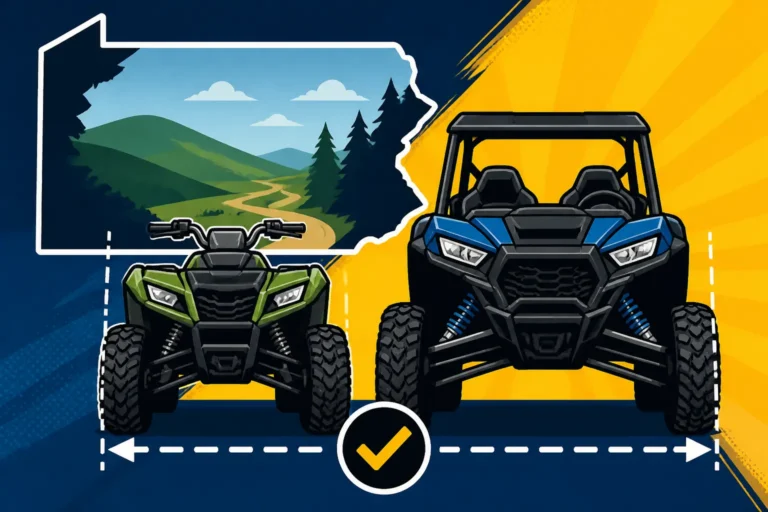
Check your machine’s dimensions before choosing a destination. Some Pennsylvania trails have restrictions that can make a route unsuitable for a wider side-by-side. Ask the managing office or trail operator about the specific route you intend to ride rather than relying on a general statement that a campground is “UTV friendly.” See [Pennsylvania's Class II Trail Width Limit] and [Pennsylvania Trails for a Wide Machine] when deciding whether your vehicle fits the riding area.
A forest-region trip also calls for a weather and road-condition plan. A campground entrance that is easy in dry weather may be more challenging after rain, and an access road may have conditions different from the trail itself. Ask about the road into the campground, the firmness of the parking area, and whether there is a suitable place to turn around with a trailer.
What to Confirm Before You Reserve
A quick call or message before booking can prevent a frustrating arrival. Campground websites may not spell out the details that matter to ATV and UTV riders, especially when a property serves a mix of tent campers, RV travelers, and riders towing machines.
Ask about trailers, unloading, and site layout
Be specific about your setup. Instead of asking whether the campground has “large sites,” explain what you are bringing: the tow vehicle, the trailer’s approximate length, the number of machines, and whether you need room to unload. A campground may have a large camping pad but limited space for a trailer, or it may require trailers to be parked in a separate area.
Ask these questions before you pay:
- Can a truck and loaded trailer park at the reserved site?
- Is there a separate trailer or overflow parking area?
- Is there a safe, level place to unload machines?
- Are there restrictions on washing, fueling, or repairing machines?
- Are ATV and UTV riders allowed to stay on the property?
- Are there quiet hours or limits on when engines may be started?
- Is the access road suitable for your tow vehicle and trailer?
A short phone call can reveal details that a booking page leaves out. For example, a site may be technically available but too tight for your trailer to turn around. You may also learn that the campground does not permit machine storage at the campsite, which changes how you need to plan each day.
Do not assume that “ATV friendly” means you can ride around the campground. It may only mean that the property welcomes riders who trailer their machines to a legal staging area. Ask what the phrase means at that particular campground, and get any important restrictions in writing.
Confirm registration, permits, and trail rules
Before the trip, check the requirements for both the machine and the trail system. Pennsylvania registration rules and trail access rules are separate issues. Depending on where you ride, you may need registration, a trail permit, proof of insurance, or facility-specific admission. Requirements can also differ between private recreation areas and public-land trails.
If you are bringing a machine from another state, confirm that its registration is recognized for the riding area you plan to visit and carry the required documents. Review [Does Pennsylvania Honor an Out-of-State Registration?] and [Carrying Proof of an Out-of-State Registration] if you are traveling in from elsewhere.
Put the necessary paperwork somewhere protected but easy to reach. A wet wallet card, missing proof of insurance, or paperwork left at home can turn a planned riding day into an avoidable hassle. It is also wise to check trail opening and closing information before departure, especially if your reservation is tied to a particular weekend. [Pennsylvania Trail Closures to Check First] is a useful planning topic.
A Practical Planning Checklist for Your Stay
Once you have chosen an area and a campground, work through the details in the same order you will encounter them: arrival, unloading, riding, and packing up. That helps catch small problems—such as nowhere to park a trailer—before they become stressful on the first morning.
Plan the drive and arrival
Save the campground address and the trailhead or staging-area address separately. Do not rely on a single pin for a whole trail system, since a large riding area may have more than one entrance or staging location. If cell service is unreliable where you are going, save directions and relevant maps ahead of time. onX Offroad can be one planning resource for reviewing routes and locations, but confirm important access details with the campground and trail manager.
Check the campground’s arrival process, gate hours, and after-hours instructions. If you expect to arrive late with a trailer, make sure you know where you can safely wait or turn around. Ask whether the route includes narrow roads, steep grades, low branches, or a tight entrance that could be difficult for a long trailer.
Build extra time into the first day. It often takes longer than expected to check in, position the trailer, unload machines, secure gear, and locate the right staging area. A rushed arrival increases the chance of leaving equipment behind or heading toward a trail entrance that does not allow your machine.
Pack for the campground as well as the trail
Riding gear is only part of the packing list. Bring secure tie-downs, a lock for the trailer or machines, basic tools, and a way to keep registration and insurance documents dry. If the campground has limited services, plan for fuel, food, drinking water, and any supplies you need before you arrive.
For a family or mixed-experience group, agree on the day’s plan before leaving the campground. Decide who is leading, where the group will regroup, and what to do if someone has a mechanical problem or loses the group. Use the trail system’s current map and follow posted signs rather than assuming that every visible side trail is open.
A good overnight base should make the trip easier, not add uncertainty. If a campground’s access policy is vague, the trailer parking is cramped, or the route to the trailhead depends on an unverified road connection, keep looking. A slightly longer tow can be worth it when the campground and trail access are clear, the site fits your equipment, and everyone knows the rules before the first ride.
Disclaimer
This article is for general informational purposes only and does not constitute professional advice. Laws, prices and regulations vary by location and change over time. Consult a qualified professional for guidance on your specific situation.