Pennsylvania Lighting Rules for Road Use
Navigating the rules for riding your ATV or UTV on designated roads in Pennsylvania can feel like trying to untangle a mess of Christmas lights in January – confusing, frustrating, and you're never quite sure if you have all the pieces. Many riders just want to get from one trail system to another, or perhaps run into town for a quick bite, but the fear of a citation because their machine isn't properly lit up is a very real concern. This guide will shine a light on exactly what Pennsylvania requires for your ATV or UTV's illumination when you're using those precious miles of shared roadway.
Why Proper Lighting is Non-Negotiable on Pennsylvania Roads
Let's face it, most of us who love ATVs and UTVs are drawn to the mud, the rocks, and the freedom of the trails. Roads? Not so much. But Pennsylvania has carved out some opportunities for us to use certain public roads to connect trails or access services. However, with that privilege comes a big responsibility: making sure your machine is visible and understood by other drivers. Unlike a dedicated trail where you might only encounter fellow off-roaders, a designated road means sharing space with cars, trucks, and even eighteen-wheelers.
The frustration often stems from the fact that a machine might be perfectly legal and safe for trail riding, but utterly inadequate for road use from a lighting perspective. Headlights designed for spotting deer at night on a remote logging road are different from those needed to be seen in broad daylight on a busy township road. Without proper lighting, you're not just risking a fine; you're risking a serious accident. It's about clearly signaling your presence, your direction, and your intentions to every other vehicle, pedestrian, and cyclist out there. Think about how quickly a driver in a car might miss a smaller, less visible ATV turning into a driveway if its lights aren't up to snuff.
The Safety Imperative for All Road Users
When you're out on a trail, the primary concern is often your own visibility to avoid obstacles. On a road, the paradigm shifts to mutual visibility. Other drivers need to see you, clearly and unambiguously, at all times of day and in all weather conditions. This isn't just about avoiding a ticket; it's about coming home safe. A poorly lit ATV or UTV can vanish into shadows, especially at dusk or dawn, or blend into background traffic in heavy sunlight. This is particularly true on rural Pennsylvania roads where unexpected turns and elevation changes are common.
Consider the driver of a pickup truck approaching you from behind on a winding road. If your taillights are dim, caked in mud, or simply not bright enough to cut through the sun, they might not register your presence until it's too late to react safely. The same goes for oncoming traffic trying to gauge your speed and position. These rules, while sometimes feeling cumbersome, are designed to protect everyone on the road. For example, if you're riding one of Pennsylvania's designated [Pennsylvania's Designated ATV Roads], you're no longer in the exclusive off-road domain; you're sharing the pavement.
Avoiding Citations and Keeping Your Riding Privileges
Pennsylvania takes its road safety seriously, and that includes the regulations for off-highway vehicles that venture onto public roadways. A Pennsylvania State Trooper, local police officer, or a DCNR Ranger performing checks at a trailhead or on a joint-use road is going to look at your lighting. If your lights don't meet the standards, you're looking at a citation. These fines aren't just a slap on the wrist; they can quickly add up, and repeat offenses can jeopardize your ability to ride legally on public lands or roads.
Imagine getting pulled over on a nice ride from, say, Coal Township to connect to a trail, only to find out your aftermarket LED bar isn't legal for road use or your turn signals aren't visible enough. It ruins the day, costs you money, and makes you second-guess future rides. Understanding and complying with the rules upfront saves you a lot of headache and expense down the road. It ensures that when you do ride on a designated route, you're doing so with confidence, knowing your machine is compliant. Getting caught riding illegally on a road without proper lighting could lead to [Pennsylvania Fines for Riding Illegally].
Headlights and Taillights: The Foundational Requirements
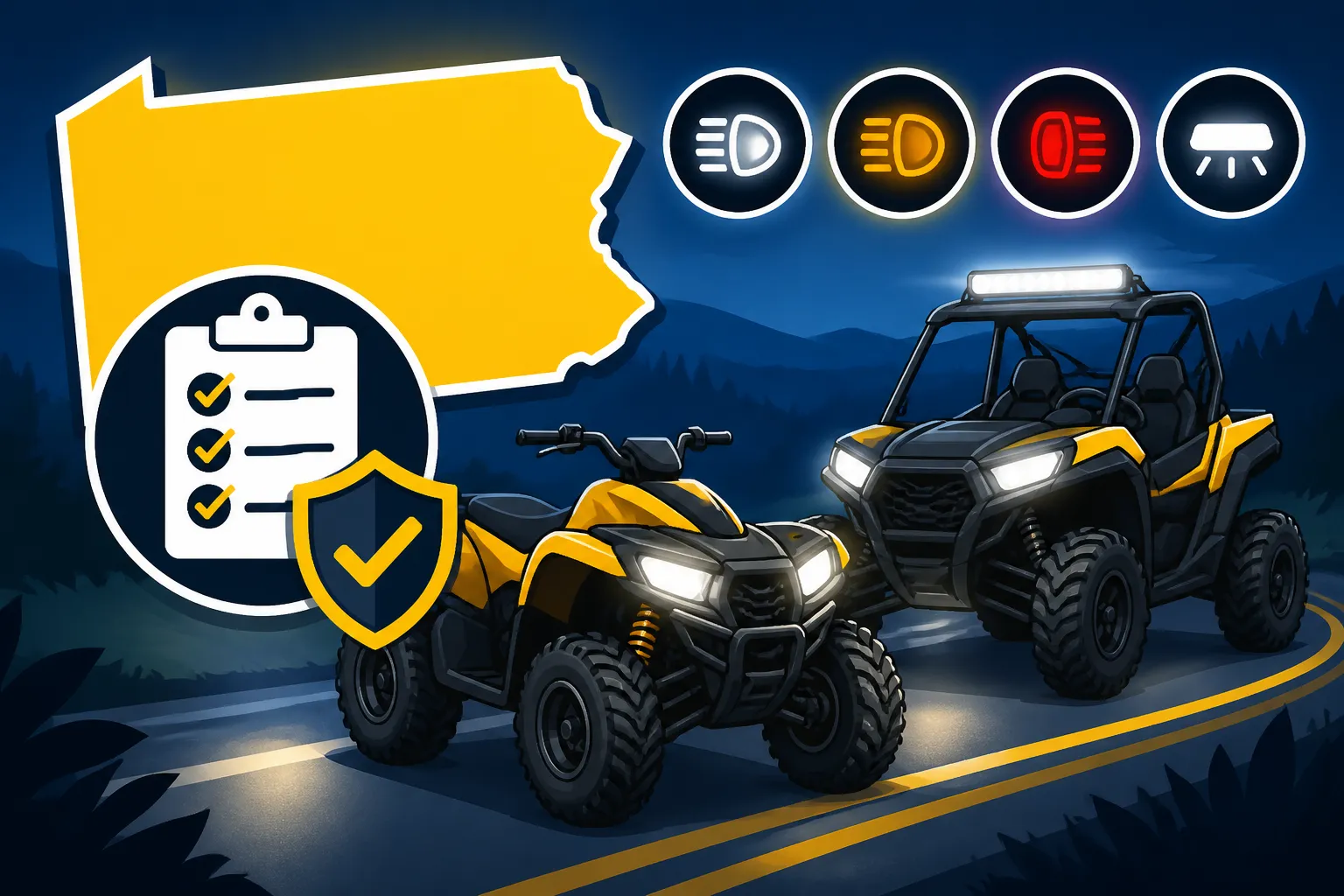
At the core of Pennsylvania's lighting regulations for ATVs and UTVs on designated roads are the fundamental requirements for headlights and taillights. These aren't just "nice-to-haves"; they are absolutely mandatory for any machine venturing off private property onto a shared roadway, even if you're just crossing a street. The goal is simple: to make sure you can see where you're going, and more importantly, that everyone else can see you, from both the front and the rear.
Headlights: Seeing and Being Seen
For road use, your ATV or UTV must be equipped with at least one headlight, and often two, that are capable of illuminating the road ahead and making your machine visible to oncoming traffic. The specific regulations generally require that headlights be white or amber in color, mounted at a certain height, and provide sufficient illumination. This isn't about having a blinding light bar for high-speed night runs on the trail; it's about a focused, appropriate beam that doesn't dazzle other drivers while still making your path clear.
Many stock ATVs and UTVs come with headlights, but are they truly adequate for road use? Sometimes, but not always. An off-road headlight might be too diffuse or too bright without a proper cut-off beam pattern to prevent blinding oncoming drivers. When you're riding on a joint-use road near, for example, Windber Borough, you're sharing that space with family cars. You need to be sure your headlights meet the legal requirements for intensity and aim. If you've been running with dim factory lights or have heavily tinted covers, it's definitely time for an upgrade, perhaps even looking at options from a reputable brand like SuperATV that offers road-legal lighting solutions designed for off-road machines.
Taillights: Your Rear-End Visibility
Just as crucial as headlights, if not more so from a defensive driving perspective, are your taillights. These lights are your primary means of communicating your presence to traffic approaching from behind. Pennsylvania law requires at least one red taillight, visible from a specific distance to the rear. This light must be illuminated whenever your ATV or UTV is being operated on a designated road. It's not enough for it to "sort of" work; it needs to be clearly visible, even in bright daylight or adverse weather.
Think about the conditions common in Pennsylvania: sudden fog rolling into a valley, heavy rain during a summer storm, or the low sun of winter. These conditions dramatically reduce visibility. A single, small, mud-caked taillight simply won't cut it. It needs to be bright, unobstructed, and positioned correctly. Many riders underestimate the importance of robust taillights until they realize how often they're navigating busy roads where rear-end collisions are a real threat. Ensuring your taillights are functional and visible is a fundamental step in road-legal compliance for any ATV or UTV.
Turn Signals and Brake Lights: Communicating Your Intent
Beyond simply being seen, effectively communicating your intentions to other road users is paramount when operating your ATV or UTV on designated roads. This is where turn signals and brake lights come into play. These are not optional accessories; they are critical safety features that allow you to signal turns, lane changes, and stops, preventing dangerous misunderstandings with other vehicles.
The Clear Signal of a Turn
Pennsylvania law explicitly requires ATVs and UTVs that are allowed on designated public roads to have functional turn signals. This means both front and rear signals, visible from a sufficient distance, that flash clearly to indicate your intention to turn right or left. This is often where stock off-road machines fall short. Many ATVs designed solely for trails do not come equipped with turn signals, or if they do, they might be small, dim, or easily obscured by mud or cargo.
Consider trying to make a left turn across traffic on a state route, like crossing SR 144 near Snow Shoe, without a clear, flashing signal. You'd be relying on hand signals (which are often hard to see on an ATV) or pure guesswork from other drivers, a recipe for disaster. The signals must be amber in the front and either amber or red in the rear, and they need to be bright enough to be seen in various lighting conditions, from the glare of high noon to the shadows of dusk. If your machine lacks proper turn signals, it's a critical upgrade you need to make before hitting any designated road. Brands like SuperATV offer conversion kits and individual components that can help you integrate compliant turn signals seamlessly into your ATV or UTV.
Brake Lights: Announcing Your Stop
Equally vital are brake lights, which must illuminate whenever you apply your brakes. This is how you tell the driver behind you that you are slowing down or stopping. Without functioning brake lights, any sudden deceleration could catch the following vehicle completely off guard, leading to a rear-end collision. Pennsylvania law requires at least one red brake light, visible from the rear, that lights up when the brakes are engaged.
Many ATVs and UTVs come with a taillight that also functions as a brake light, getting brighter when the brakes are applied. However, it's crucial to regularly check that this feature is working correctly on both your front and rear brake levers/pedals. Mud, water, or general wear and tear can compromise the switch or the bulbs, leaving you without this essential safety feature. A common mistake riders make is assuming their taillight is also a brake light without actually testing it. Before heading out on any designated road, especially when riding after dark, always do a quick check of your brake lights.
Reflectors and Auxiliary Lighting: Enhancing Visibility
While headlights, taillights, turn signals, and brake lights form the core of your ATV or UTV's road-legal lighting, Pennsylvania also emphasizes the importance of additional visibility aids, such as reflectors and auxiliary lighting. These elements play a crucial role in ensuring your machine is seen from all angles, particularly in low-light conditions or if your primary lights were to fail.
The Unsung Heroes: Reflectors
Reflectors are often overlooked but are incredibly important for passive visibility. Pennsylvania law typically requires ATVs and UTVs to be equipped with red reflectors on the rear and amber reflectors on the sides (front and rear). These small, inexpensive devices don't require power, but they dramatically enhance your machine's visibility by bouncing light back from other vehicles' headlights. If you're pulled over at night or in low visibility conditions by a DCNR Ranger, they'll be checking for these.
Think of a scenario where you're stopped on the side of a road after dark due to a mechanical issue, and your battery dies, rendering your active lights useless. Strategically placed reflectors can still make your machine stand out in the beam of an approaching car's headlights, potentially preventing a collision. It's a simple, low-tech solution that provides critical backup. Many aftermarket accessories, even basic fender flares or storage boxes, come with integrated reflectors, or you can easily add stick-on reflectors to key areas. Make sure they are clean and free of mud or grime to be most effective.
Auxiliary Lighting: For Trail, Not Necessarily for Road
Many ATV and UTV enthusiasts install auxiliary lighting, such as LED light bars, floodlights, or cube lights. These are fantastic for trail riding, illuminating wide areas for recovery operations, or spotting distant obstacles on a challenging trail. However, their use on Pennsylvania roads is highly restricted, and often illegal if not used correctly. The general rule of thumb is that any auxiliary light that projects an intense beam or is not specifically designed for on-road use (like a headlight with a proper beam pattern) must be covered or switched off when operating on a designated road.
Using a bright LED light bar on a public road is a surefire way to blind oncoming drivers and attract the attention of law enforcement, leading to a citation. While it might seem counterintuitive to cover up a light designed to make you more visible, the intensity and uncontrolled beam pattern of most auxiliary lights are a hazard to other road users. Save those powerful lights for the trails, especially when enjoying designated trail systems like those in Sproul State Forest or the Anthracite Outdoor Adventure Area. Ensure any auxiliary lights have separate switches from your primary headlights so you can easily comply with road-use regulations.
Common Mistakes and What to Check
It's easy to assume your ATV or UTV is properly equipped, especially if it came from a dealer, but misunderstandings and neglect can lead to serious issues on Pennsylvania's designated roads. Being proactive about checking your lighting system can save you from a fine or, more importantly, an accident. Many riders make simple, fixable errors that put them at risk.
Overlooking the "Small Stuff"
One of the biggest mistakes riders make is focusing only on the obvious lights (headlights, taillights) and neglecting the details. For example, turn signal visibility: are they bright enough to be seen in full sunlight? Are they obscured by a bag, a passenger, or a layer of mud? Sometimes, stock turn signals are simply too small or positioned awkwardly for effective road use. Also, many ATVs and UTVs have a single taillight/brake light combo. Is the increase in brightness for the brake function significant enough to be noticed by a driver behind you?
Another common oversight is the condition of the wiring and connections. Exposure to the elements – mud, water, dust, vibration – can wreak havoc on electrical systems. Corrosion in a bulb socket or a loose connection can cause lights to flicker, dim, or fail entirely. Before every road-use ride, take five minutes to do a walk-around inspection. Turn on your headlights, engage your turn signals, and have someone stand behind you to confirm your brake lights are working. This simple check can prevent a roadside chat with an officer about your non-compliant machine, or worse, a dangerous situation.
Forgetting About Maintenance and Cleanliness
Dust, dirt, and mud are constant companions for off-road enthusiasts. While a muddy machine might be a badge of honor on the trail, it's a hazard on the road. Caked-on mud can drastically reduce the effectiveness of your headlights, taillights, and especially reflectors. A dirty lens can cut light output by fifty percent or more. This isn't just about appearances; it's a safety issue.
Regular cleaning of your light lenses and reflectors is crucial. Use a soft cloth and appropriate cleaner to ensure maximum light transmission. Also, check your bulbs periodically. Even if a light is technically working, a dim or flickering bulb might not meet legal requirements for brightness. Consider replacing older incandescent bulbs with LED alternatives, which are often brighter, last longer, and draw less power. However, ensure any LED replacement bulbs still project the correct beam pattern for road use, especially for headlights.
The "Trail Only" Mentality on Roads
A significant hurdle for many riders is shifting from a "trail only" mindset to a "road-aware" one. What's perfectly acceptable for off-road adventure, like a very wide stance or certain types of tires, might not be for public roads. This extends to lighting. Some riders might think a powerful LED light bar pointed slightly downward is sufficient as a headlight, or that waving an arm is an adequate turn signal. Pennsylvania law says otherwise.
The intent of the law is to integrate ATVs and UTVs onto designated roads safely alongside other vehicles. This means adopting the same standards of visibility and communication that are expected of other motor vehicles. If you plan to ride your [Pennsylvania Rules for a UTV on a Road] or ATV on any public road, even a township road for a short connector, you must ensure your lighting package is fully compliant with all the requirements for on-road visibility and signaling. This includes proper headlight aim, visible turn signals, and bright brake lights, not just what's minimally functional for the trail.
Ensuring Your Machine Meets Pennsylvania Standards
Getting your ATV or UTV up to Pennsylvania's road-use lighting standards doesn't have to be an overwhelming task, but it does require careful attention to detail. It's about more than just slapping on some lights; it's about ensuring they are the right type, installed correctly, and fully functional. This is a crucial step for anyone wanting to take advantage of Pennsylvania's designated ATV roads without fear of legal repercussions.
Upgrading for Compliance: What to Look For
Many stock ATVs and UTVs, especially older models or those primarily designed for utility or racing, simply won't have the comprehensive lighting package required for legal road use in Pennsylvania. This means you'll likely need to invest in some upgrades. When choosing aftermarket parts, always prioritize quality and compliance. Look for lights that are clearly marked as DOT (Department of Transportation) compliant or explicitly designed for road legality.
Here’s a quick checklist of common upgrades and considerations:
| Lighting Component | Stock ATV/UTV Common Issue | Road-Use Requirement | Upgrade Consideration |
|---|---|---|---|
| Headlights | Single, dim, wide beam, no cut-off | At least one (preferably two) white/amber, focused beam, proper height, non-blinding | DOT-compliant headlights with proper low/high beam, adjustable aim. |
| Taillights | Single, small, often mud-obscured | At least one red, visible from specific distance, always on | Brighter LED taillights, dual taillight setup, higher mounting. |
| Brake Lights | Dim, slow to react, easily confused with taillight | Clearly brighter than taillight when engaged, instantaneous response | Brighter LED brake lights, check brake switches on both levers/pedals. |
| Turn Signals | Often absent or very small/dim | Front amber, rear amber/red, clearly visible, flashing | Dedicated front & rear LED turn signal kit, integrate into existing wiring. |
| Reflectors | Limited or missing entirely | Red rear, amber side (front/rear), clean and unobstructed | Add stick-on or bolt-on DOT-compliant reflectors to sides and rear. |
| Auxiliary Lights | Powerful LED light bars/cubes always on | Must be covered or switched off when on public roads | Separate switch for auxiliary lights, or quick-release covers. |
When purchasing parts, consider reputable aftermarket brands that specialize in UTV and ATV accessories. Companies like SuperATV offer a range of lighting solutions, from full turn signal kits to individual LED lights, designed to meet the demands of both off-road performance and on-road compliance. Always double-check the product specifications against Pennsylvania's specific vehicle code to ensure full legality.
Professional Installation Versus DIY
While many ATV and UTV owners are adept at wrenching on their machines, electrical systems can be tricky. If you're not comfortable with wiring diagrams, relays, and proper connections, consider having a professional shop or dealer install your lighting upgrades. Incorrect wiring can lead to blown fuses, battery drain, or even electrical fires. A professional installation ensures that all components are correctly integrated and function reliably.
If you opt for a DIY approach, take your time. Use appropriate tools, waterproof connections, and secure all wiring to prevent chafing or damage from vibration. Test each component thoroughly before considering the job done. Remember that a DCNR Ranger performing roadside checks at locations like Bloody Skillet or Whiskey Springs will be looking for proper functionality, not just the presence of lights. Every wire and connection matters to keep you legal and safe.
Carrying Proof and Staying Informed
Once your machine is properly equipped, make sure you carry proof of your ATV or UTV registration and, if required, proof of insurance. While lighting compliance is visual, having your paperwork in order is equally important for a smooth roadside encounter. Stay informed about any changes to Pennsylvania's ATV and UTV laws. Regulations can evolve, and what was legal last year might have new stipulations this year.
By proactively addressing your lighting needs, you're not just avoiding fines; you're contributing to a safer riding environment for everyone. It shows responsibility and respect for shared public spaces, ensuring that ATV and UTV riders continue to have access to designated roads for connecting trails and enjoying the vast beauty of Pennsylvania.
Disclaimer
This article is for general informational purposes only and does not constitute professional advice. Laws, prices and regulations vary by location and change over time. Consult a qualified professional for guidance on your specific situation.