Pennsylvania Rules for Crossing a State Route
The frustration of finding an amazing ATV trail system, only to discover a state route stands between you and the next section, is something every Pennsylvania rider knows. It’s not just an inconvenience; it’s a genuine safety concern and a legal tightrope walk. You’re left wondering, "Can I even cross that road? Or am I stuck turning back?" This guide is here to clarify the specific rules and best practices for crossing state routes in Pennsylvania, helping you connect your rides legally and safely without fear of hefty fines or dangerous encounters.
Understanding Pennsylvania's Stance on ATV Road Use
Why State Routes Are Different From Township Roads
Pennsylvania's approach to ATV use on public roads can feel like a patchwork quilt, and nowhere is that more apparent than when you look at state routes compared to local township roads. Most riders quickly learn that [Are ATVs Street Legal in Pennsylvania?] is a resounding "no" for good reason. State routes, managed by PennDOT, are primarily designed for conventional highway vehicles – cars, trucks, and motorcycles. Their high traffic volumes, higher speed limits, and often limited visibility make them inherently dangerous environments for off-highway vehicles (OHVs) like ATVs and UTVs. Unlike smaller township or borough roads, which sometimes have specific designations for ATV use through local ordinances or [Pennsylvania's Joint-Use Roads], state routes rarely, if ever, fall into this category for anything other than a direct crossing. The focus of the Pennsylvania Department of Conservation and Natural Resources (DCNR), which registers ATVs, is on promoting safe riding off public roads, primarily on designated trails. They aren't in the business of making state highways accessible for ATV travel.
Think about it: when you're barreling down a state highway in your truck, you're not expecting to see a quad cruising alongside you. This expectation gap is precisely why the regulations are so strict. The infrastructure – lane widths, shoulders, sight lines – isn't designed for the different performance characteristics of an ATV or UTV. While your SuperATV parts might make your machine a beast on the trail, they don't magically make it street legal for highway speeds and conditions. It's crucial to understand this fundamental difference: a state route is essentially a no-go zone for riding on, with very limited exceptions for simply traversing it.
The Legal Basis for Crossing, Not Riding
The critical distinction in Pennsylvania law isn't about whether you can ride on a state route (you generally can't, except in specific emergency or very rare utility situations, and even then with extreme caution), but how you can cross it. The law permits an ATV or UTV to cross a state highway, provided certain conditions are met, primarily to allow riders to access different sections of an approved trail system or private property. This isn't an invitation to take a shortcut down the shoulder for a quarter-mile; it's strictly for crossing the immediate expanse of the road. The intent is to facilitate trail connectivity, not road travel. If you're on a trail system, and a state route momentarily breaks that system, you might encounter a designated crossing point. These are typically marked and allow for the legal, brief traverse.
The legislation is pretty clear that ATVs are considered off-road vehicles. This means any interaction with paved public roads, particularly state-maintained ones, is heavily restricted. The ability to cross is a practical concession, acknowledging that some trail networks wouldn't be viable without it. Without this provision, many of Pennsylvania's fantastic trail systems would be fragmented and far less enjoyable. This crossing permission is a privilege, however, and it comes with stringent safety and operational requirements that must be followed to the letter. Violating these rules can lead to significant penalties, including [Pennsylvania Fines for an Unregistered ATV] and potentially more serious traffic citations if you're deemed to be operating unsafely.
Specific Rules for Crossing State Routes
The Ninety-Degree Rule and Stopping Requirements
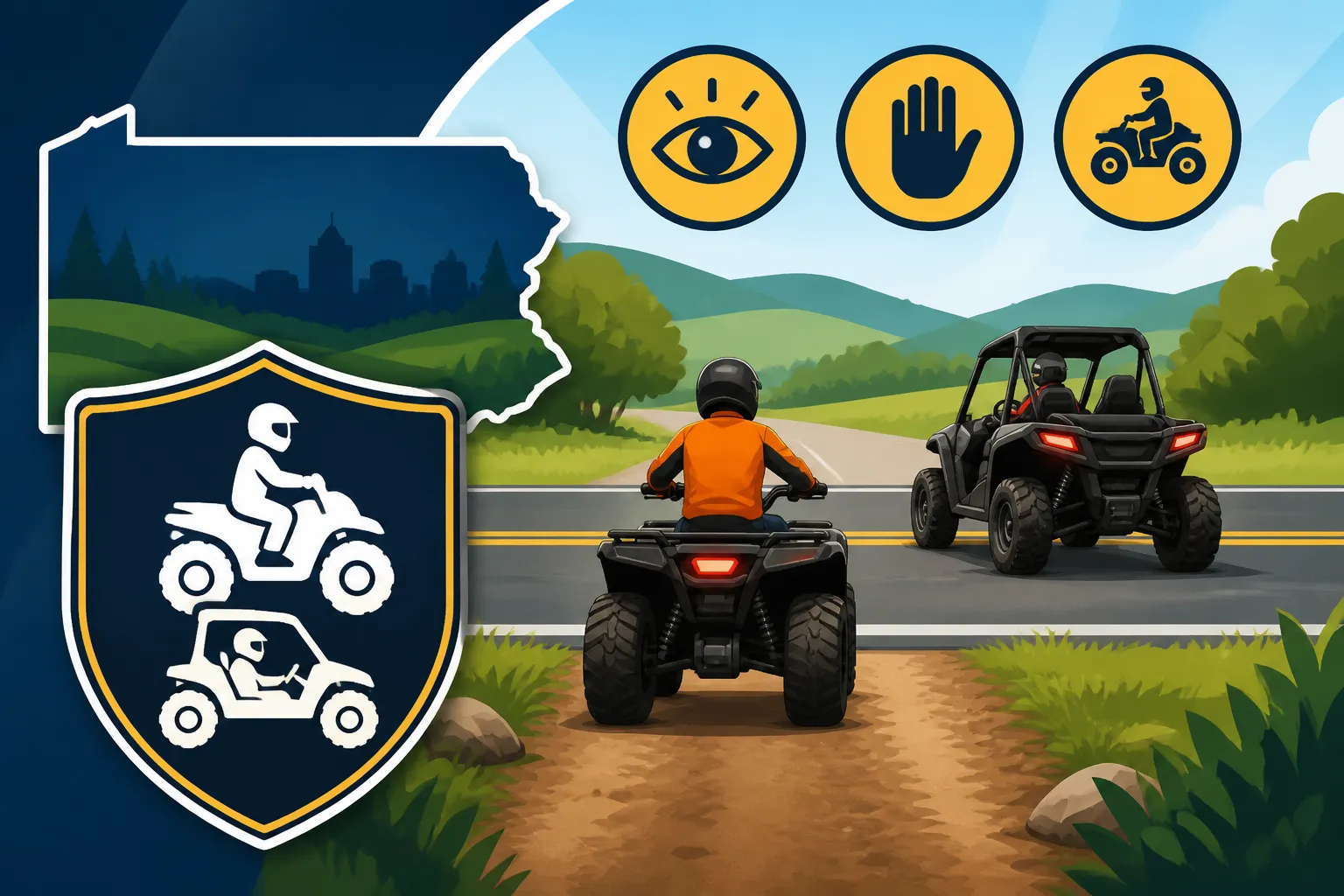
When it comes to crossing a state route in Pennsylvania, the "ninety-degree rule" is paramount. This means you must cross the road at as close to a right angle as possible – directly perpendicular to the flow of traffic. You cannot angle across the road, merge into traffic, or ride along the shoulder to find a "better" crossing spot down the road. The goal is to minimize your time in the roadway and your exposure to highway traffic. Before you even think about entering the travel lanes, the law requires you to come to a complete stop. This isn't just a rolling stop; it's a full, deliberate halt at the edge of the paved surface.
Imagine you're at the edge of a busy two-lane state road, ready to cross. You should pull up to the very edge of the road, stop, and look both ways, just like you would at a stop sign in a car. Critically, you must yield to all oncoming traffic. An ATV or UTV is small, less visible, and much slower to accelerate than highway vehicles. You need a significant gap in traffic to cross safely. If there's a hill or a bend in the road limiting visibility, you might need a spotter, or it might simply be too dangerous to cross there. Never assume a driver sees you or will slow down for you. The responsibility for a safe crossing falls entirely on the ATV operator.
Intersection Crossings and Divided Highways
Crossing a state route at a marked intersection, especially one with traffic signals, often feels safer and can indeed be less risky than trying to cross in the middle of a stretch of road. At intersections, you are expected to obey all traffic signals and signs, just like a regular vehicle. You'd wait for a green light, ensure the intersection is clear, and then proceed directly across. Even at an intersection, the ninety-degree rule still applies; you're crossing to the opposite side, not turning onto the state route. This is a common point of confusion, and one where many riders get into trouble. You cannot make a right or left turn onto a state route, even momentarily, unless that road is specifically designated as a [Pennsylvania Joint-Use Roads and Who Shares Them], which is exceedingly rare for state highways.
Divided highways, with their separate lanes of traffic and often a median, present an additional challenge. If you encounter a divided highway, you must treat each section of the highway as a separate crossing. This means you'll cross the first set of lanes, stop in the median (if it's wide and safe enough, and only if it's legally permissible to stop there without impeding traffic or becoming a hazard), then wait for another safe opportunity to cross the second set of lanes. The same rules apply: stop, look both ways, and yield to all traffic for each crossing. These types of crossings demand even greater vigilance and patience. You can't just power across four lanes of traffic without stopping; that's a recipe for disaster.
Equipment and Rider Requirements for Crossings
Beyond the operational rules, your machine and you as the rider also have requirements. While Pennsylvania doesn't demand your ATV be "street legal" with turn signals or full road lighting for a brief crossing, you absolutely need functional headlights, taillights, and working brakes. This is critical for visibility, especially if you're crossing at dusk or in low-light conditions, and for safety if you need to stop quickly. Many off-road machines, especially older ones, might have minimal lighting, so it's a good idea to ensure your lights are bright and fully operational before embarking on a ride that involves road crossings. Aftermarket lighting from a company like SuperATV can significantly improve your visibility to other drivers, even if it's not strictly mandated for a crossing.
Rider requirements are equally important. All riders and passengers on ATVs in Pennsylvania must wear a helmet, and this rule is particularly critical when interacting with public roads. Refer to [Pennsylvania Helmet Law for ATV Riders] for specifics. If you have a passenger, make sure they understand the unique risks involved. For details, check out [Pennsylvania Helmet Law for Passengers]. While there isn't a specific age restriction just for crossing a road versus riding on it, the general rule about [Pennsylvania's Minimum Age of Sixteen on Roads] for designated joint-use roads often informs how law enforcement might view a younger rider attempting a state route crossing. It's always best for an experienced and legally mature rider to handle these maneuvers. Additionally, carrying proof of [Pennsylvania ATV Insurance Requirement] is always wise, not just for trail riding but for any interaction with public roads. While the DCNR doesn't set minimum coverage for trail use, if you're involved in an incident on a state road, having proper liability insurance is crucial.
Common Misconceptions and Safety Considerations
The Difference Between State Routes and Joint-Use Roads
One of the biggest pitfalls for ATV riders in Pennsylvania is confusing a state route with a "joint-use" road. Many riders hear about roads being open to ATVs and mistakenly assume this applies to all roads, or at least state highways. This is a dangerous misconception. [Pennsylvania's Designated ATV Roads] are almost exclusively township, borough, or very specific state forest roads that have been explicitly opened to ATV traffic through local ordinances or DCNR designations. They are typically marked with specific green signs indicating ATV access. State routes, on the other hand, are the major arteries, often numbered routes like SR 144 near Snow Shoe or SR 120 at Westport, and they are generally not joint-use roads.
If a state route were a joint-use road, it would be extremely rare and prominently signed. The regulations for joint-use roads allow for limited travel on the road to connect trails, access services, or for specific purposes, but even then, there are rules about speed, riding on the shoulder, and following traffic laws. The permissions granted for a joint-use road are far more extensive than the narrow allowance to merely cross a state route at a ninety-degree angle. Always verify the specific designation of any road you plan to ride on or even cross. Local DCNR trail maps are your best friend here, as they will clearly indicate designated trail connectors and approved road segments. Never rely on hearsay or what "everyone else does."
Penalties for Illegal Road Use
Attempting to ride on a state route, even for a short distance, or crossing it improperly, can lead to significant and costly penalties. Law enforcement, including State Police and DCNR rangers, takes illegal ATV road use very seriously due to the inherent dangers it poses to both the rider and other motorists. The base fine for operating an unregistered ATV in Pennsylvania can be substantial, often starting around [Pennsylvania Fines for an Unregistered ATV]. Beyond that, riding on a prohibited road can incur additional fines for [Pennsylvania Fines for Riding Illegally], reckless endangerment, or even more severe charges depending on the specific circumstances and if an accident occurs. You could be facing [Pennsylvania's Automatic $300 Fine] in many instances.
Imagine you decide to ride a mile down a state route to connect to another trail. A state trooper spots you. Not only are you facing fines, but your ATV could be impounded, and you might have to appear in court. These incidents can quickly become very expensive, far outweighing the convenience of a "shortcut." Moreover, if you were to be involved in an accident, your ATV insurance might not cover you if you were operating illegally, leaving you personally liable for damages and medical costs. The risks are simply not worth it. The DCNR maintains a helpline ([Pennsylvania ATV Registration Help Line]) if you have questions about specific road segments, so there’s no excuse for guessing.
Planning Your Ride to Minimize State Route Crossings
The best strategy for dealing with state routes is to minimize your interaction with them as much as possible. This means meticulous ride planning. Before you even load your machine, study the trail maps for the area you plan to ride. Look for official trail connectors that avoid state routes entirely, or clearly marked crossing points. Many popular riding areas, such as the Whiskey Springs ATV Trail or parts of the Allegheny National Forest, have well-defined networks that minimize road interaction. Always carry a physical map or have a reliable GPS with pre-loaded trail data.
If a state route crossing is unavoidable, identify the safest possible point. Look for areas with excellent visibility in both directions, minimal traffic, and clear sight lines. Avoid blind corners, crests of hills, or areas where the shoulder is narrow or non-existent. Sometimes, it might mean trailering your machine a short distance to the next staging area rather than attempting a risky crossing. Local ATV clubs often have invaluable knowledge about safe crossing points or alternative routes. They are a great resource for understanding the nuances of local trails and connector roads. Remember, safety always triumphs convenience, especially when dealing with the speed and unpredictability of highway traffic. Companies like SuperATV focus on enhancing your machine for off-road performance, and that's where you should aim to spend the vast majority of your riding time.
Here's a handy summary of the key rules for crossing a state route:
| Rule Category | Requirement | Important Considerations |
|---|---|---|
| Crossing Angle | Must cross at a ninety-degree (perpendicular) angle to the road. | No angling, merging, or riding along the shoulder. Minimize time in traffic. |
| Stopping | Come to a complete stop at the edge of the paved surface before entering traffic. | Not a rolling stop. Stop, look thoroughly both ways, yield to all traffic. |
| Yielding | Yield to all oncoming traffic. | ATVs are less visible and slower to accelerate. Wait for a significant gap. Do not assume drivers see you. |
| Intersections | Obey all traffic signals and signs if crossing at an intersection. Cross at ninety degrees. | You cannot turn onto the state route, even momentarily, unless specifically designated as a joint-use road (rare for state routes). |
| Divided Highways | Treat each side of the highway as a separate crossing. Stop in the median if safe. | Requires double the vigilance. Cross one direction, stop, then cross the other. |
| Machine Equipment | Functional headlights, taillights, and brakes are mandatory. | Good visibility is crucial, especially in low light. Ensure all safety equipment is in working order. |
| Rider Requirements | Operator and passenger must wear an approved helmet. Experienced rider recommended. | [Pennsylvania Helmet Law for ATV Riders] applies. Be aware of [Pennsylvania's Minimum Age of Sixteen on Roads] for general road use, and exercise mature judgment for crossings. |
| Insurance | Carry proof of [Pennsylvania ATV Insurance Requirement]. | Essential for any public road interaction, even brief crossings, in case of an incident. |
| Prohibited Actions | No riding on the state route, no turning onto it, no riding along the shoulder. | State routes are not joint-use roads. Violation can lead to severe fines and potential impoundment. |
| Planning | Study maps, identify safe crossing points, or plan routes to avoid state routes entirely. | Use official DCNR maps. Consider trailering if a crossing seems too risky. Local clubs are a great resource for finding safe routes and designated crossings. |
Disclaimer
This article is for general informational purposes only and does not constitute professional advice. Laws, prices and regulations vary by location and change over time. Consult a qualified professional for guidance on your specific situation.