Pennsylvania Rules for Riding a School Property Road
Riding your ATV or UTV in Pennsylvania offers incredible freedom and access to some truly breathtaking trails and landscapes. However, it's easy to get confused about where you can and cannot legally operate these machines, especially when it comes to areas that seem like public access but aren't, such as school property roads. This guide aims to clear up that confusion, explaining why riding your quad on school grounds is almost universally prohibited and what the serious consequences of ignoring these rules can be.
Understanding What Constitutes "School Property" in Pennsylvania
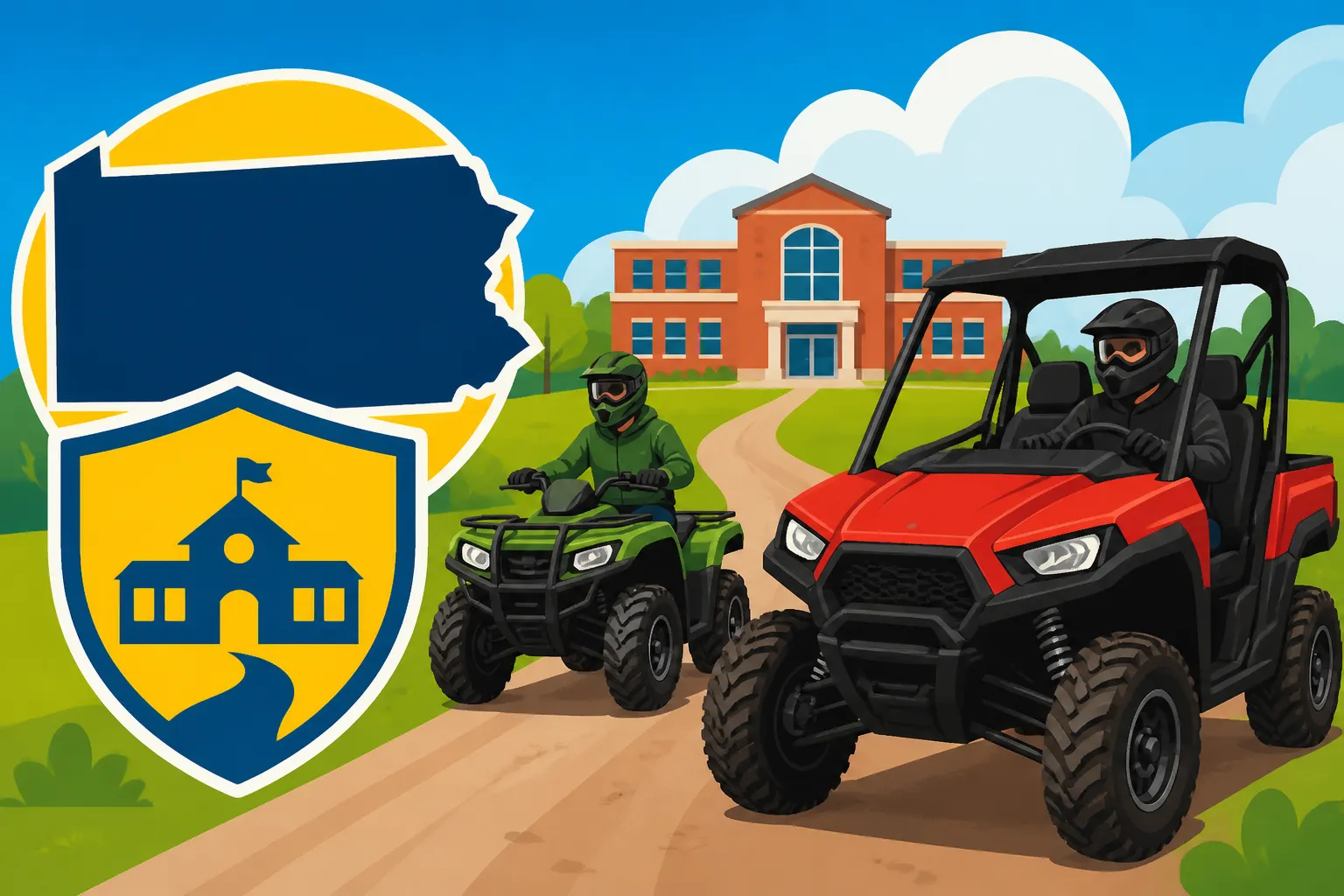
When we talk about "school property" in Pennsylvania, it's not just the school building itself. This term encompasses the entire parcel of land owned or leased by a school district or private educational institution. This typically includes the school buildings, of course, but also extends to all surrounding grounds: parking lots, athletic fields, playgrounds, bus loops, staff parking areas, and any access roads, driveways, or paths that lead to or are contained within these areas. Essentially, if a plot of land is designated for educational purposes, it falls under the umbrella of school property.
Even if an access road on school property seems like a shortcut, or looks like a quiet, unused stretch of pavement, its designation as part of the school's domain means it's governed by rules specifically designed to protect students, faculty, and the educational environment. These aren't public roads in the traditional sense, even if they're paved and connect to a public street. They are private-public lands, managed with a very specific set of priorities in mind.
It’s crucial to understand this distinction because the rules for operating an ATV or UTV on school property are very different from those governing [Pennsylvania's Designated ATV Roads] or even private land where you have explicit permission. The intended use of these school roads is solely for school-related traffic, student transportation, and authorized personnel. They are not intended for general recreational vehicle use.
The Blanket Prohibition: Why ATVs Are Generally Banned on School Grounds
When it comes to operating ATVs and UTVs, Pennsylvania law is pretty clear: unless a road is specifically designated as open to these machines, or it's your own private property, you generally can't ride there. School property, with its inherent focus on child safety and liability, falls squarely into the "not allowed" category for recreational ATV use. This isn't just about common sense; it's about deeply rooted legal and safety considerations.
Safety Concerns for Students and Staff
Imagine a child unexpectedly darting out from between parked cars during drop-off or pickup, or crossing a bus lane to get to the playground. School grounds are bustling with pedestrians, especially children, who often move unpredictably. The presence of ATVs or UTVs, even driven slowly, introduces a significant and unnecessary risk. These machines are often quieter than cars at low speeds, can accelerate rapidly, and are not designed for the confined, pedestrian-heavy environments of a school campus. School districts have a paramount responsibility to ensure the safety of their students and employees, and allowing off-road vehicles like ATVs on school property would directly undermine this commitment.
Beyond the immediate danger of collision, there's also the noise and disruption factor. The sound of an ATV, especially one with a modified exhaust, can be startling and disruptive to the learning environment. This isn't just a minor annoyance; it's a distraction that school administrations are keen to prevent.
School District Liability and Insurance Implications
This is a huge one. School districts face immense liability risks if an accident occurs on their property. If an ATV rider were to get injured, or worse, injure a student, staff member, or damage school property, the school district could face significant legal challenges. This is why you'll see strict rules about all sorts of activities on school grounds. Allowing ATVs, which are generally meant for off-road, rugged terrain (and sometimes require specialized components like those from SuperATV for extreme conditions), into an environment with vulnerable pedestrians is an unacceptable risk for any school.
Furthermore, a school's insurance policies are typically not structured to cover accidents involving recreational ATVs on their property. Any incident could lead to massive claims, increased insurance premiums, or even the cancellation of coverage for the district. For this reason alone, most schools have a very firm stance against unauthorized vehicle use of any kind on their grounds, particularly off-road vehicles. Understanding [Pennsylvania ATV Insurance Requirements] is key for riders, but even with your own robust policy, it doesn't grant you permission to ride where prohibited.
Maintaining Order and Preventing Unauthorized Access
School property is also about maintaining a controlled and secure environment. Allowing ATVs to traverse school roads makes it harder for security personnel and staff to monitor who is on the property and why. It opens the door to potential vandalism, trespassing, and other unauthorized activities. By maintaining a strict "no recreational vehicles" policy, schools can better regulate access and ensure that everyone on their grounds has a legitimate reason to be there.
This clear boundary helps prevent situations where riders might attempt to use school parking lots as staging areas, or cut through school grounds to access other areas. It reinforces the idea that school property is a specific-use area, not a shortcut or a recreational zone. You'll find similar restrictions, though often for different reasons, on places like [Pennsylvania State Game Lands and ATVs].
What If There's an Event? Special Permissions and Exceptions
So, are there ever any circumstances where an ATV might be allowed on school property? The short answer is: extremely rarely, and under very specific, controlled conditions. This isn't something you can assume, nor is it ever for recreational riding.
Authorized School Events or Maintenance
The most likely (though still uncommon) scenario for an ATV to be on school property would be for a specific, authorized school event, or for essential maintenance work. For example, a groundskeeping crew might use a utility-focused UTV to move heavy equipment or supplies across athletic fields after hours, or during a weekend when students are not present. Similarly, a local community fair held on school grounds might have an authorized participant using a quad as part of an emergency response team or for moving equipment, but only with explicit, written permission from the school district and usually under direct supervision.
These are not situations where someone just decides to ride their recreational quad to an event. These are pre-approved, highly controlled uses with a clear operational purpose. The machine would likely be used in a very limited capacity, at low speeds, and with extensive safety precautions in place. It's a world away from recreational trail riding, which could involve higher speeds, maneuvers, and certainly isn't appropriate for navigating an area intended for children.
The Strict Requirements for Any Exception
If, by some extraordinary chance, a school district were to consider allowing an ATV or UTV on their property for an event or specific task, the requirements would be incredibly stringent. You would need:
- Explicit, Written Permission: A casual verbal "yes" is not enough. You'd need a formal letter or permit from the school district, signed by authorized personnel, outlining the specific dates, times, areas, and purposes for which the ATV is allowed.
- Proof of Insurance: The school district would undoubtedly require proof of robust liability insurance coverage, ensuring that any potential damages or injuries are covered. This might even need to be a specific policy naming the school district as an additional insured party. [Pennsylvania ATV Insurance Minimum Coverage] requirements would likely be the bare minimum, with schools often demanding far more.
- Safety Plan: A detailed safety plan would likely be required, outlining speed limits, designated routes, and safety personnel on site.
- No Recreational Riding: Even with permission for a specific task, this permission would never extend to recreational riding. The moment the task is complete, or the event concludes, the machine would need to be removed.
It's important not to confuse a temporary, sanctioned operational use with permission for casual riding. There's a huge difference between using a powerful UTV from a brand like SuperATV to pull a heavy trailer during a school clean-up day and riding your recreational quad through the parking lot. Assume all school property is off-limits unless you hold explicit, specific, and written permission for a defined, non-recreational purpose.
The Broader Implications: Fines, Liability, and Community Relations
Ignoring the rules about where you can ride your ATV or UTV, especially on sensitive areas like school property, carries a significant risk. It's not just about a stern talking-to; there are serious legal and financial consequences that can impact you personally and the broader ATV community.
Legal Penalties: Fines, Trespassing, and Impoundment
Riding an ATV on school property without explicit permission is a form of trespassing. In Pennsylvania, trespassing can lead to significant fines. Furthermore, if your ATV is not properly registered or insured, which is a requirement for riding off your own private land, you could face additional citations. For instance, [Pennsylvania Fines for an Unregistered ATV] or [Pennsylvania Fines for Riding Illegally] can be substantial, often starting at $300 for a first offense, plus court costs. These are not minor penalties.
In some cases, law enforcement might also have the authority to impound your ATV, especially if you're cited for multiple violations or if there's a perceived danger. Getting your machine back from impoundment can be a costly and time-consuming process, involving storage fees, administrative charges, and proof of ownership and registration. It's a hassle you absolutely want to avoid.
Personal Liability: Financial and Legal Risks
Beyond fines, you open yourself up to immense personal liability if you cause damage or injury while riding on school property. If you hit a car in the parking lot, damage a fence, or, tragically, injure a child or staff member, you could be sued. Personal injury lawsuits can result in judgments for hundreds of thousands or even millions of dollars, which could financially devastate you for years to come. Even if you have personal ATV insurance, your policy might not cover incidents that occur while you are trespassing or riding in a prohibited area, leaving you fully exposed.
The ripple effects can be far-reaching. A civil lawsuit means your assets could be at risk, your wages could be garnished, and your credit rating could be severely impacted. It’s a gamble that simply isn't worth taking for a quick ride.
Damage to the ATV Community's Reputation
Every time an ATV rider behaves irresponsibly or illegally, it casts a negative shadow on the entire ATV community. When school property is violated, it creates local headlines, raises public outcry, and solidifies negative stereotypes about ATV riders as reckless and disrespectful. This makes it harder for responsible riders and organizations to advocate for more legal riding areas, [Pennsylvania ATV Trail Permits], or even to maintain access to existing trails. Local communities and landowners become less trusting, and the sentiment often turns against all riders, not just the individual offender.
We work hard to promote responsible riding, and incidents like these set us back significantly. If we want to enjoy the freedom of riding our machines, we must be good stewards of the sport and respect the rules and boundaries set by landowners, whether private or public.
Here's a quick summary of places where recreational ATV riding is generally not permitted versus where it might be:
| Area Type | Recreational ATV Riding Status in PA | Key Considerations |
|---|---|---|
| School Property Roads | Generally PROHIBITED | Child safety, school liability, trespassing fines. |
| Public Roads (Unposted) | Generally PROHIBITED (unless specifically designated) | Most public roads are not street legal for ATVs. |
| Private Property | PERMITTED with explicit landowner permission | Must have written permission, respect boundaries. |
| Designated ATV Trails | PERMITTED with proper registration & permits | Requires [Pennsylvania ATV Registration Cost], specific trail permits, safety gear. |
| State Game Lands | Generally PROHIBITED (exceptions for disabled hunters with permit) | Strict regulations, not for recreational riding. |
| State Forest Roads | Generally PROHIBITED (unless specifically designated and signed) | Limited joint-use roads exist, but specific rules apply. |
The bottom line is simple: assume you cannot ride on school property. If you have any doubt, always seek clear, written permission from the property owner or governing authority before you even think about putting a tire on the ground. Staying informed and riding responsibly protects both you and the future of ATV and UTV recreation in Pennsylvania.
Disclaimer
This article is for general informational purposes only and does not constitute professional advice. Laws, prices and regulations vary by location and change over time. Consult a qualified professional for guidance on your specific situation.